
An Olympia day trip from Nafplio crosses the Peloponnese from the Argolic Gulf to the sanctuary of Zeus, where the ancient Olympic Games were held, and returns the same evening. Tours across the rest of the country are listed on Greece Tours.
The sections below cover the tours you can book, the route, timing, the stops in Arcadia, the Altis, the temples, the stadium, the workshops and training grounds, the museums, the Games, the village, the season, packing and booking for an Olympia day trip from Nafplio, with links into the Olympia pages. The tours shown are checked on GetYourGuide and Viator.
What is an Olympia day trip from Nafplio?
An Olympia day trip from Nafplio is a long return drive across the Peloponnese to the sanctuary where the ancient Olympic Games were held. It covers about 200 km each way, with three to four hours at the site and museums.
Nafplio is the capital of Argolis, on the Argolic Gulf. It served as the first capital of the modern Greek state in the 19th century. Its old town, Palamidi fortress and Bourtzi castle make it a common base for travellers in the eastern Peloponnese.
Ancient Olympia lies in Elis, the Ilia regional unit, in the western Peloponnese. The sanctuary sits in the valley of the Alfeios river, at the foot of the hill of Kronos. An Olympia day trip from Nafplio therefore crosses the whole peninsula from east to west. The sanctuary, the training grounds and three museums all lie within walking distance of the village.
The day suits travellers who stay in the Argolid and want Olympia without moving hotels. It also fits those who have already seen Mycenae and Epidaurus near Nafplio and want the sanctuary of Zeus to complete the set of great Peloponnese sites.
Which Olympia day trips from Nafplio can you book?
No GetYourGuide tour starts in Nafplio, so an Olympia day trip from Nafplio runs by private driver or self-drive. Guided tours, audio tours and tasting tours then start at Olympia itself. Viator also sells a two-day Peloponnese tour that includes both places.
The site-based GetYourGuide tours suit travellers who arrive by car. Each one starts in or near the village of Ancient Olympia:
- Private Guided Tour of Ancient Olympia
- Olympia: The VR Glasses Tour, with an audio guide
- Olympia: Museum Skip-the-Line Entry Ticket and Audio Guide
- Ancient Olympia: Agrotourism Guided Tour with honey, wine and olive oil tasting
The VR tour shows the buildings as they once stood through virtual reality glasses. The agrotourism tour adds a farm visit and a tasting of local honey, wine and oil after the ruins. Both fit the afternoon of an Olympia day trip from Nafplio.
Viator lists “2 Days Peloponnese Tour: Ancient Olympia – Corinth, Mycenae, Nafplio, Epidaurus”. It splits the same distance over two days with a night on the road. Travellers who want a shorter drive compare the Olympia day trip from Kalamata, which starts closer to the site.

Which route links Nafplio and Olympia across Arcadia?
The route of an Olympia day trip from Nafplio runs west through Argos to the A7 Moreas motorway and Tripoli. The A7 then heads south-west towards Megalopoli, and national roads cross Arcadia and Elis to Olympia.
The first leg leaves the Argolid plain at Argos and climbs into the mountains of Arcadia on the A7. Tripoli, the capital of Arcadia, sits on a high plateau in the middle of the peninsula. The motorway makes this part of the drive quick and steady.
From Tripoli, the A7 runs south-west towards Megalopoli. The last stretch leaves the motorway for national roads that follow the hills and valleys west into Elis. The road reaches the Alfeios valley and runs down it to the village of Ancient Olympia.
- Nafplio to Argos: the Argolid plain
- Argos to Tripoli: the A7 Moreas motorway
- Tripoli to Megalopoli: the A7 motorway
- Megalopoli to Olympia: national roads through Arcadia and Elis
An Olympia day trip from Nafplio with a private driver leaves the navigation to the driver. Self-drivers fill the tank before the mountain section, since villages thin out west of Megalopoli.
How long does an Olympia day trip from Nafplio take?
An Olympia day trip from Nafplio takes 10 to 11 hours door to door. The drive takes about 3 hours each way, so 6 hours go to the road. The site and the museums need another 3 to 4 hours.
An early start leaves time for both the open site and the main museum before closing time. A departure from Nafplio at breakfast brings travellers to Olympia before the midday heat on the open ruins.
The return leg runs in the late afternoon and evening. On an Olympia day trip from Nafplio, a short stop on the way back breaks the 3-hour drive and keeps the driver fresh.
- Drive out: about 3 hours
- Archaeological site: about 2 hours
- Archaeological Museum: about 1 to 1.5 hours
- Lunch in the village: about 1 hour
- Drive back: about 3 hours
Travellers who want a slower pace split the trip with a night in Ancient Olympia. That turns the Olympia day trip from Nafplio into two easier days, with the site visited early the next morning.
Where can you stop on the drive through Arcadia?
An Olympia day trip from Nafplio passes Tripoli, the capital of Arcadia, and Megalopoli with its ancient theatre. Karytaina, a village above the Alfeios valley with a Frankish castle of the 13th century, lies close to the route.
Tripoli makes a practical coffee stop on the plateau, with cafes around its central squares. It lies roughly a third of the way from Nafplio to Olympia.
Megalopoli was founded in the 4th century BC under the Theban general Epaminondas. Its ancient theatre was one of the largest in ancient Greece. The ruins lie just outside the modern town and fit a short leg-stretch on an Olympia day trip from Nafplio.
Karytaina sits on a rock above the Alfeios. Its castle dates from the Frankish period of the 13th century and overlooks the river valley. More stops between the Argolid sites appear among the day trips from Nafplio.
What was the Altis, the sacred grove of Zeus?
The Altis was the walled sacred grove of Zeus at Olympia. It held the temples, the great altar of Zeus, the treasuries of Greek cities and hundreds of statues of victors. An Olympia day trip from Nafplio walks through its heart.
A wall marked the boundary of the sacred ground. Inside stood the buildings of worship, while the training grounds, guest houses and workshops stood outside. This plan still shapes the walk through the ruins today.
The altar of Zeus stood in the open, built up from the ash of sacrifices over the centuries. Statues of Olympic victors and offerings from cities filled the spaces between the temples. Only their bases survive in place.
On an Olympia day trip from Nafplio, the path from the entrance passes the training buildings first and then enters the Altis. Shade from pine and olive trees covers parts of the site, which helps on hot days.
How big were the Temple of Zeus and its gold-and-ivory statue?
The Temple of Zeus was a Doric temple of the 5th century BC, about 64 metres long and 28 metres wide. Inside sat Phidias’s gold-and-ivory statue of Zeus, about 12 metres tall. On an Olympia day trip from Nafplio, its fallen columns dominate the site.
The architect Libon of Elis designed the temple. Its columns stood about 10.5 metres high. The seated statue of Zeus inside counted among the seven great marvels on ancient lists of sights.
Earthquakes in the 6th century AD threw the columns down. The drums still lie on the ground in rows where they fell. One column has been set back upright, which shows the height of the building. More detail sits on the Temple of Zeus at Olympia page.
The sculptures from the two pediments and the metopes now stand in the Archaeological Museum. An Olympia day trip from Nafplio links the two: the empty platform outside and the figures that once crowned it inside.
Why is the Olympic flame lit at the Temple of Hera?
The Olympic flame is lit at the Temple of Hera because it is one of the oldest Doric temples in Greece, from the 7th to 6th century BC. A curved mirror and the sun’s rays light the flame there for each modern Games.
The Heraion first had wooden columns. Builders replaced them with stone one at a time, so the surviving columns differ in thickness and style. Fallen capitals lie beside the platform today.
The lighting ceremony takes place in front of the temple, a tradition of the modern Olympic movement since the 20th century. Priestesses in ancient-style dress focus the sun’s rays with the mirror to light a torch.
On an Olympia day trip from Nafplio, the Heraion stands at the foot of the hill of Kronos, near the north edge of the Altis. The altar in front of it is the spot where the flame begins its journey to the host city.
What happened in the ancient stadium of Olympia?
The ancient stadium hosted the foot races of the Olympic Games. Athletes entered through a vaulted tunnel, the Krypte, onto a track of about 192 metres. On an Olympia day trip from Nafplio, visitors walk the same tunnel and track.
The track measures one stade, 600 Olympic feet. Stone starting lines survive at both ends, with grooves for the runners’ toes. The oldest event of the Games was the stadion, a single sprint of one length.
Earth embankments around the track held about 45,000 spectators. The judges sat on a stone platform on the south side. No stone seats ever ringed the track, so the crowd sat or stood on the grass slopes. Ordinary visitors camped in tents around the sanctuary during the festival.
- Entrance: the vaulted Krypte tunnel
- Track: about 192 metres, one stade
- Starting lines: stone, at both ends
- Capacity: about 45,000 on earth banks
Visitors on an Olympia day trip from Nafplio race the track themselves for a photo. The stadium lies at the eastern edge of the site, so it makes a natural end point for the walk.
What do the Zanes statues at the stadium entrance tell?
The Zanes were bronze statues of Zeus on stone bases beside the stadium entrance. Fines paid by athletes who cheated or bribed rivals funded them. An Olympia day trip from Nafplio passes their 16 surviving bases on the way to the track.
Each base carried the name of the cheater and the offence. Every athlete walking to the Krypte passed this row of warnings before a race.
The bronze figures have gone, but the bases still stand in a line below the terrace of the treasuries. Their inscriptions recorded bribery as well as rule-breaking during events.
On an Olympia day trip from Nafplio, a guide or the audio tour explains the stories behind the names. The row gives a rare look at how the Games punished foul play.
What was made in the workshop of Phidias?
The sculptor Phidias built the gold-and-ivory statue of Zeus in this workshop west of the Altis in the 5th century BC. Its main room matched the inner room of the Temple of Zeus. An Olympia day trip from Nafplio passes its brick ruins.
The matching size let the sculptor test the statue in the same space it was to fill. Excavators found tools, clay moulds for the gold drapery and a small cup inscribed “I belong to Phidias”.
In the 5th century AD, a Christian church rose over the workshop. Its walls survive, which is why the building still stands higher than the ruins around it.
The cup and the moulds now sit in the Archaeological Museum. Travellers on an Olympia day trip from Nafplio see the workshop first and the finds later, so the story joins up across the visit.
Who built the round Philippeion?
Philip II of Macedon began the round Philippeion after the battle of Chaeronea in the 4th century BC. Alexander the Great completed it. On an Olympia day trip from Nafplio, its re-erected Ionic columns stand inside the Altis near the Temple of Hera.
The building held statues of the Macedonian royal family by the sculptor Leochares. It stood as a statement of Macedonian power inside the sacred grove of the Greeks.
Ionic columns ran around the outside of the circular building. Restorers have set part of the ring back upright, so the curve of the ring is clear from the path.
The Philippeion lies a short walk from the Heraion. On an Olympia day trip from Nafplio, the two buildings together show the span of the sanctuary, from early Doric worship to Macedonian kings.
Where did athletes train at Olympia?
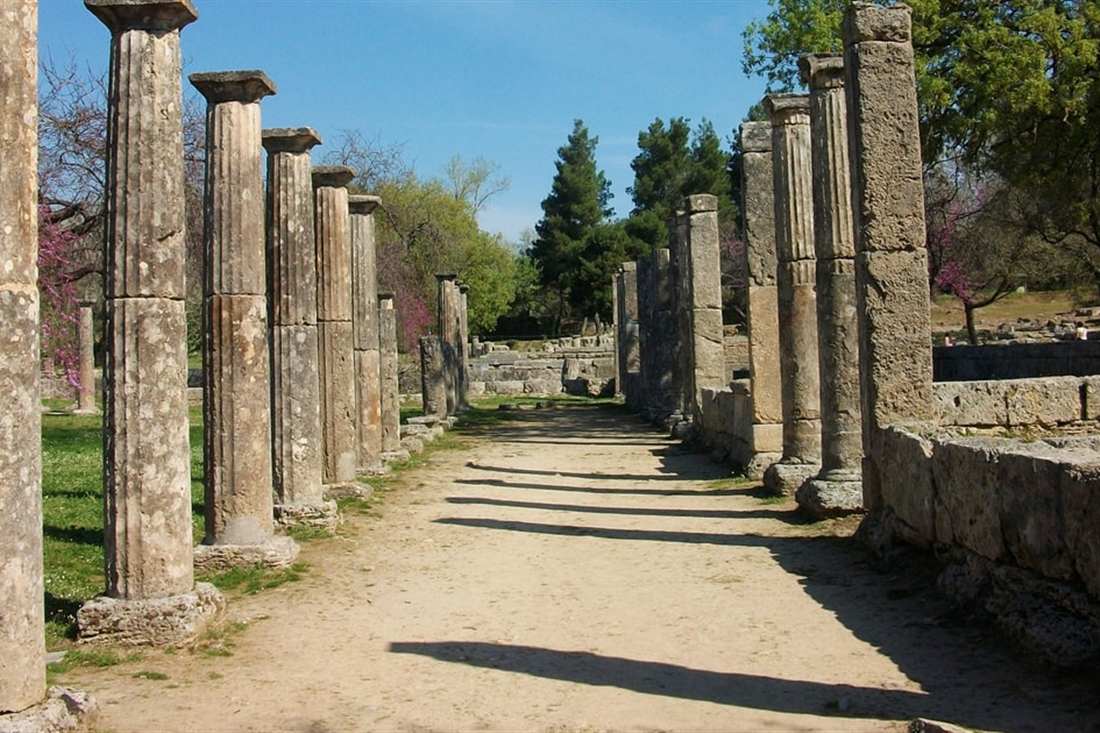
Athletes trained in the Palaestra and the Gymnasium, just outside the Altis. Wrestlers, boxers and jumpers used the Palaestra of the 3rd century BC. An Olympia day trip from Nafplio starts among these colonnades at the site entrance.
The Palaestra is a square courtyard ringed by colonnades, with rooms behind them for bathing, oiling and lessons. Rows of its columns have been re-erected, which makes it a favourite spot for photos.
The Gymnasium dates from the 2nd century BC. Its long colonnades gave runners a track under cover, and the open ground served javelin and discus practice.
- Palaestra: wrestling, boxing and jumping
- Gymnasium: running, javelin and discus
- Both: outside the walls of the Altis
On an Olympia day trip from Nafplio, the training grounds come first after the ticket gate. They set the scene before the temples and the stadium.
What stood on the terrace of the treasuries?
Small temple-like treasuries of Greek cities lined a terrace below the hill of Kronos. Cities such as Sikyon, Gela and Megara stored their offerings to Zeus there. An Olympia day trip from Nafplio sees the terrace above the Zanes.
Each treasury showed off the wealth of its home city to every visitor of the Games. Their foundations sit in a row on the slope, with steps leading up from the Altis.
Nearby stands the Nymphaeum of Herodes Atticus, a monumental fountain of the 2nd century AD. It brought fresh water into the sanctuary and fed the crowds at the Games.
The terrace gives a good view over the Altis. On an Olympia day trip from Nafplio, it makes a short climb with a clear look across the fallen columns of the Temple of Zeus.
Where did athletes swear their oath and guests stay?
Athletes swore to obey the rules in the Bouleuterion, before the statue of Zeus Horkios. Victors dined in the Prytaneion, beside the sacred hearth. On an Olympia day trip from Nafplio, the large Leonidaion guest house lies at the south-west corner.
The oath bound athletes, their fathers and their trainers alike. Breaking it led to fines, and the fines paid for the Zanes at the stadium entrance.
The Prytaneion kept the sacred flame of the sanctuary burning. Winners of the Games were honoured with a feast there.
Leonidas of Naxos built the Leonidaion in the 4th century BC. It housed official visitors around a central courtyard. On an Olympia day trip from Nafplio, it is the first large ruin on the left after the Phidias workshop.
Which treasures fill the Archaeological Museum of Olympia?
The museum holds the pediment sculptures and metopes of the Temple of Zeus, the Hermes of Praxiteles and the Nike of Paionios. An Olympia day trip from Nafplio sets aside at least an hour for these rooms after the site.
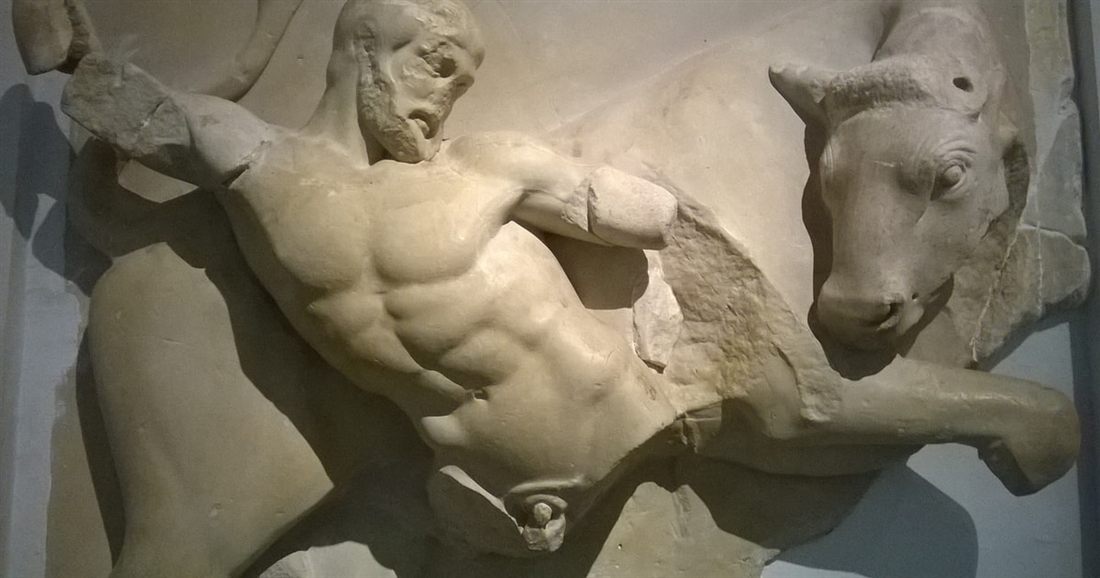
The east pediment shows the chariot race of Pelops and Oinomaos. The west pediment shows the battle of the Lapiths and Centaurs, with Apollo standing at the centre. The metopes tell the Labours of Heracles.
The Hermes of Praxiteles holds the infant Dionysus in one arm. The Nike of Paionios once stood on a tall pillar in front of the Temple of Zeus.
- Pediments of the Temple of Zeus
- Metopes of the Labours of Heracles
- Hermes of Praxiteles
- Nike of Paionios
- Bronze armour and offerings, with a helmet inscribed for Miltiades
On an Olympia day trip from Nafplio, the museum gives shade and cool air after the open ruins. It stands a short walk from the site entrance.
What does the Hermes of Praxiteles show?
The Hermes of Praxiteles is a marble statue of the god Hermes holding the infant Dionysus. Excavators found it in the ruins of the Temple of Hera in the 19th century. An Olympia day trip from Nafplio sees it in its own room of the museum.
Ancient writers recorded a Hermes by Praxiteles standing in the Heraion, and the statue matches that account. Praxiteles worked in the 4th century BC and was known for soft, relaxed figures in marble. The statue stands about 2.1 metres tall and is carved from Parian marble.
Hermes leans on a tree trunk and once held out a bunch of grapes to the child, according to the usual reading of the lost right arm. The smooth finish of the marble stands out against the battered pediment figures in the next rooms.
On an Olympia day trip from Nafplio, the Hermes room makes a quiet stop near the end of the museum route. Benches let visitors sit and look at the statue from all sides.
Why did the Nike of Paionios stand on a tall pillar?
The Nike of Paionios is a marble statue of the winged goddess of victory. The Messenians and the Naupaktians set it on a tall triangular pillar in front of the Temple of Zeus in the 5th century BC. An Olympia day trip from Nafplio sees it in the museum.
The sculptor Paionios of Mende carved the figure. The dedication marked a victory over the Spartans, and the inscription on the base names the donors and the artist.
Raised high on the pillar, the goddess seemed to land from the sky in front of the temple. Her wind-blown dress shows the movement of the descent.
The triangular base and part of the pillar still stand at the site, in front of the Temple of Zeus. On an Olympia day trip from Nafplio, the base outside and the statue inside tell the same story at two stops.
Which events made up the pentathlon and the pankration?
The pentathlon combined five events: the stadion race, the long jump, the discus, the javelin and wrestling. The pankration mixed boxing and wrestling with almost no rules. An Olympia day trip from Nafplio passes the grounds where athletes trained for both.
Long jumpers carried stone or metal weights, the halteres, and swung them to add distance. The discus and javelin were thrown on open ground, and the Gymnasium gave space for practice.
Wrestling ended when one man threw his opponent to the ground three times. The pankration allowed punches, kicks and holds, and a fight lasted until one man gave up.
- Stadion: a sprint of one stade
- Long jump: with hand weights
- Discus and javelin: throwing events
- Wrestling: three falls to win
The Palaestra served wrestlers and pankratiasts. On an Olympia day trip from Nafplio, its courtyard shows where these fighters prepared before the Games.
Where did the chariot races of Olympia take place?
The chariot and horse races ran in the hippodrome, south-east of the stadium. Floods of the Alfeios river later washed it away, and no trace survives above ground. An Olympia day trip from Nafplio sees only the open ground where it lay.
The four-horse chariot race was the costliest event of the Games. The prize went to the owner of the horses, not to the driver.
That rule let Kyniska of Sparta, a princess, win the four-horse race in the 4th century BC. She became the first woman named as an Olympic victor, though she never drove the chariot herself.
A statue base with her inscription once stood in the sanctuary. On an Olympia day trip from Nafplio, guides point out the low ground towards the river where the hippodrome ran.
How did the sacred truce and the judges run the Games?
Heralds from Elis travelled across Greece to announce the sacred truce before each festival. Judges called Hellanodikai, chosen from Elis, ran the events in purple robes. An Olympia day trip from Nafplio visits the sanctuary they controlled.
The truce protected athletes and visitors on their way to and from Olympia. Cities that broke it faced fines and faced a ban from the Games.
The Hellanodikai checked that athletes were freeborn Greeks and that they had trained for the required period. They also judged the contests and handed out the fines that paid for the Zanes.
Elis, a city to the north-west of Olympia, organised the festival through these judges. On an Olympia day trip from Nafplio, the Bouleuterion and the Zanes show the rules they enforced.
What ties the modern Olympic Games to Olympia?
The modern Olympic Games began in Athens in the 19th century, inspired by Olympia. Every Games flame starts at the Temple of Hera, and the heart of Pierre de Coubertin, founder of the modern Games, rests at Olympia. An Olympia day trip from Nafplio passes these links.
Coubertin led the revival of the Games and asked for his heart to be buried at Olympia. It lies in a memorial stele near the International Olympic Academy, a short distance from the archaeological site.
The International Olympic Academy opened in the 20th century beside the sanctuary. It runs sessions on the history and ideals of the Games for students and officials from around the world.
The torch relay that carries the flame from Olympia to the host city began in the 20th century. Each relay starts with the lighting ceremony at the Heraion and a run through the ancient stadium.
- Revival of the Games: Athens, 19th century
- Flame lighting: at the Temple of Hera
- Coubertin’s heart: in a memorial stele at Olympia
- International Olympic Academy: beside the site
On an Olympia day trip from Nafplio, these modern traces sit next to the ancient ruins. They show how the sanctuary still shapes the Games today.
What do the two smaller museums at Olympia show?
The Museum of the History of the Olympic Games in Antiquity and the Museum of the History of Excavations complete the visit. One ticket covers the site and the museums. An Olympia day trip from Nafplio fits both in when time allows.
The Games museum sits in the old museum building. It covers the events, the athletes and the other Panhellenic contests at Delphi, Isthmia and Nemea.
The excavations museum tells how archaeologists found and recorded the site. It suits travellers who want the story behind the ruins they have just walked.
Ticket details and opening hours sit on the Olympia tickets page. On an Olympia day trip from Nafplio, the main museum comes first, and the smaller two follow if the return drive allows.
How did the ancient Olympic Games begin and end?
Tradition dates the first Olympic Games to the 8th century BC. They were held every four years in honour of Zeus and ended in the late 4th century AD under the emperor Theodosius I. An Olympia day trip from Nafplio visits their home.
A sacred truce let athletes and visitors travel to Olympia in safety during the festival. The early Games had only the stadion race. Wrestling, boxing, the pentathlon and chariot races joined the programme over time.
Olympia was one of four Panhellenic sanctuaries with games, beside Delphi, Isthmia and Nemea. The Olympic festival ranked first among them.
The ban under Theodosius I ended more than a thousand years of Games. On an Olympia day trip from Nafplio, the site shows the scale the festival reached before it closed.
Who took part, and what did winners receive?
Only freeborn Greek men took part, and married women were barred from watching. Winners received a wreath cut from the sacred wild olive tree near the Temple of Zeus. On an Olympia day trip from Nafplio, the training grounds show where they prepared.
The olive wreath carried no money value. The real reward came at home, where cities honoured victors with statues and privileges.
Athletes arrived weeks before the festival to train under the eyes of the judges. Their oath in the Bouleuterion bound them to the rules of the Games.
Victors’ statues once filled the Altis. On an Olympia day trip from Nafplio, their empty bases still line the paths between the temples.
How did the site come back from under the mud?
Earthquakes and floods of the Kladeos and Alfeios rivers buried Olympia under metres of silt after the sanctuary closed. French and German excavations in the 19th century brought it back to light. An Olympia day trip from Nafplio walks the cleared ground.
A French expedition dug at the Temple of Zeus in the 19th century. Systematic German excavations began later in the same century under Ernst Curtius.
The German Archaeological Institute still works at Olympia today. UNESCO added the site to its World Heritage List in the 20th century.
The silt that buried the sanctuary also protected it. On an Olympia day trip from Nafplio, the Kladeos river still runs along the western edge of the site.
What does the modern village of Ancient Olympia offer?
The village of Ancient Olympia lies next to the archaeological site, with tavernas, cafes and shops along its main street. An Olympia day trip from Nafplio uses it for lunch. Pyrgos, the capital of Ilia, lies about 20 km west.
The main street runs a short walk from the site entrance. Lunch there splits the visit between the ruins in the morning and the museum after the meal.
Pyrgos serves as the regional capital. The cruise port of Katakolo lies on the coast west of Pyrgos, which is why cruise passengers also arrive by tour bus.
On an Olympia day trip from Nafplio, the village also has fuel stations and supermarkets for the drive back. Shops sell olive oil and honey from the farms of Ilia. The region is farming country of olive groves and vineyards, and local farms run tours with tastings of honey, wine and olive oil, such as the agrotourism tour on GetYourGuide.
Which months suit an Olympia day trip from Nafplio?
Spring and autumn suit an Olympia day trip from Nafplio, with milder heat for walking. Summer brings strong sun on the open site and little shade in the stadium. Winter brings shorter opening hours and short daylight for 6 hours of driving.
Late spring adds green hills along the drive through Arcadia. Autumn keeps warm days with softer light on the stone. March and November bring cooler days and smaller crowds at the site. Spring wildflowers cover the slopes of the hill of Kronos above the Altis, and the olive harvest runs through late autumn in the groves of Ilia.
In July and August, the stadium turns hot by late morning. An early departure from Nafplio puts the walk before the midday sun.
In winter, the mountain roads of Arcadia turn cold. An Olympia day trip from Nafplio in those months needs a check of the opening hours and the road weather the day before.
What do you wear and bring on an Olympia day trip from Nafplio?
Wear walking shoes and bring water, a hat and sun protection on an Olympia day trip from Nafplio. A light layer helps on the mountain roads of Arcadia. The site paths are gravel and uneven stone.
- Walking shoes with grip
- Water bottle
- Hat and sun protection
- Light layer for the drive
- Snacks for the road
Sandals slip on the gravel and the worn stone of the stadium tunnel. Closed shoes keep dust and grit out on the walk.
The car serves as a base on an Olympia day trip from Nafplio. Leave spare water and a change of shirt in it for the drive back.
How do you book and cancel an Olympia day trip from Nafplio?
Book a private driver or plan a self-drive day, then add a site tour on GetYourGuide. Free cancellation runs up to 24 hours before the start on listings that offer it. An Olympia day trip from Nafplio then runs on one clear plan.
The site tours on GetYourGuide include the private guided tour, the VR glasses tour, the skip-the-line museum ticket with audio guide and the agrotourism tour with tastings. Match the tour start time to the arrival time from Nafplio.
Viator’s two-day Peloponnese tour suits travellers who prefer a night on the road. Other days from the same base include the Mycenae day trip from Nafplio and the Corinth day trip from Nafplio.
Read the cancellation line on each listing before paying. A booking made early for an Olympia day trip from Nafplio stays flexible until the free window closes.
Frequently Asked Questions
Is an Olympia day trip from Nafplio possible in one day?
Yes. The drive takes about 3 hours each way, and the site and museum need 3 to 4 hours. A full day of 10 to 11 hours covers it with an early start.
Can you make an Olympia day trip from Nafplio by bus?
Buses link Nafplio and Olympia only with changes, so the timetable leaves too little time at the site for a day trip. A car or a private driver suits the day better.
How long do you need at the site on an Olympia day trip from Nafplio?
Plan about 2 hours for the archaeological site and 1 to 1.5 hours for the main museum. Add time for the two smaller museums if the return drive allows.
Can an Olympia day trip from Nafplio add another stop on the way?
Yes. Tripoli and Megalopoli lie on the route, and the ancient theatre of Megalopolis makes a short stop. Each stop adds time to an already long day.
How far ahead do you book?
Book the driver and the site tour once the date is fixed. Free cancellation up to 24 hours before the start keeps an early booking flexible on listings that offer it.