
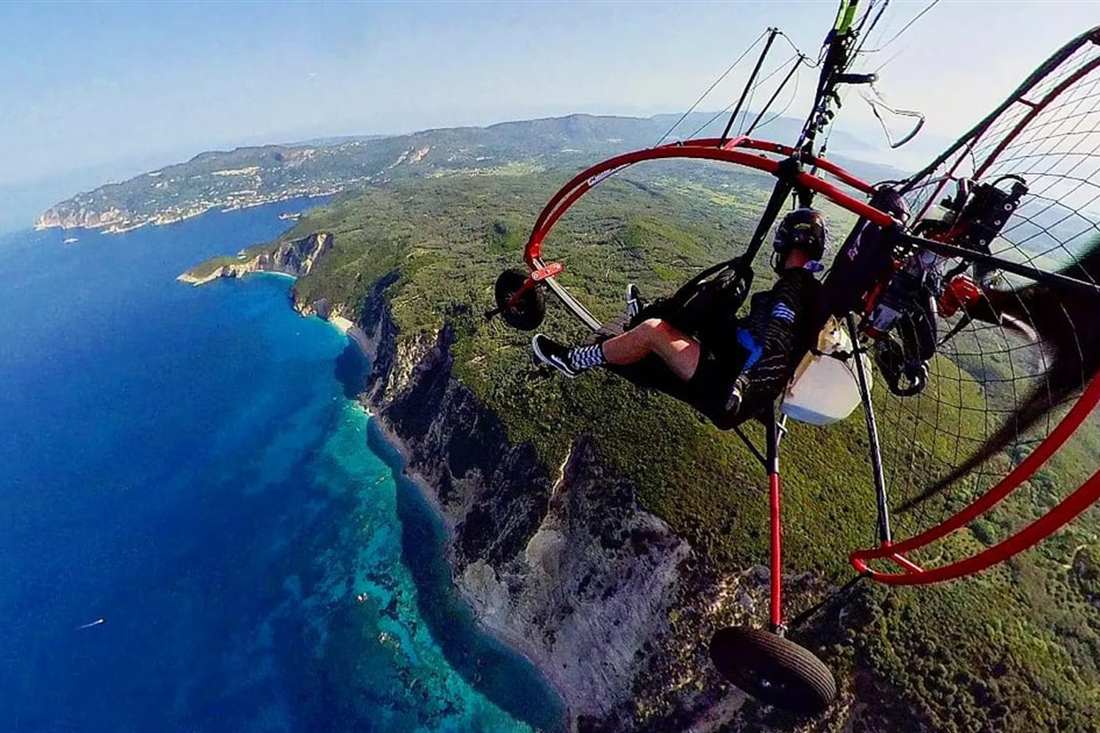
Corfu paratriking is a tandem flight in a two-seat motorised trike under a paraglider wing, flown by a certified pilot for 15 to 50 minutes over the west coast beaches near Pelekas and Glyfada or the south coast near Lefkimmi. Tours across the rest of the country are listed on Greece Tours.
The sections below cover the flights you can book, how a flight works, the take-off sites, the views, flight times, the sunset flight, the pilots, who can fly, what to bring and booking, with links into the Corfu pages. The flights shown are checked on GetYourGuide.
What is Corfu paratriking?
Corfu paratriking is a tandem flight in a two-seat motorised trike hung under a paraglider wing. A certified pilot flies, and the passenger sits and watches. Regular flights last 15 to 20 minutes over the west or south coast of Corfu.
A paratrike is a paraglider on wheels with an engine at the back. The engine drives a propeller, and the wing above carries the trike once it gathers speed.
The wheels make take-off and landing easy. The passenger does not run, steer or hold anything during Corfu paratriking. The pilot handles the wing lines and the engine.
Flights cross the beaches, hills and villages of the island. Three of the four routes follow the west coast. There the land drops to long sandy bays on the Ionian Sea.
Which Corfu paratriking flights can you book?
Four Corfu paratriking flights are listed on GetYourGuide. Three fly for 20 minutes over the west or south coast. A fourth lists a 30-minute session near Lefkimmi, with the footage on an SD card.
- Corfu: Tandem Paratriking Flight over Corfu, a 20-minute flight
- Paratrike Flight over Corfu’s West Coast, 20 minutes from Vatos in the Ropa Valley
- Corfu: 20-Minute Paramotor Paragliding Flight, in a two-seat trike near Lefkimmi
- Corfu: Paramotor Flight over the South Coast, 20 minutes from Alikes Lefkimmi
The tandem paratriking listing promises scenic views of the island during the 20 minutes in the air. The west coast listing names the beaches of the western shoreline below the route.
Two local operators run Corfu paratriking from the west coast. Corfu Paragliding works from Pelekas, and Corfu Extreme Sports flies from near Ermones and Vatos.
How does a Corfu paratriking flight work?
A Corfu paratriking flight starts with a weather update and a meeting point two days before. On the day, the pilot gives a briefing and fits the helmet and harness. The trike rolls forward, the wing fills and the pair lift off.
- Receive the weather update and meeting point two days ahead
- Meet the pilot near Pelekas or Vatos
- Hear the briefing and put on the helmet and harness
- Wait for suitable wind at the take-off site
- Fly for 15 to 20 minutes, or longer on a VIP flight
- Land on the wheels and return by transfer
The passenger sits in the rear seat behind the pilot. Both look out over an open frame, with no cabin between them and the view.
Corfu Extreme Sports adds optional acrobatic moves for guests who want them. A standard Corfu paratriking flight keeps a smooth, steady line along the coast.
Where does Corfu paratriking take off?
Corfu paratriking takes off on the west coast near Ermones and Vatos, and from the Pelekas area. A south coast flight leaves from Alikes, near Lefkimmi. Meeting points sit near Pelekas or Vatos for the west coast flights.
Vatos lies in the Ropa Valley, the flat green plain in the centre of the island. Ermones sits on a small bay just west of it, on the coast.
The Corfu Paragliding base at Pelekas lies 11.4 km from Corfu Airport and 12.6 km from Corfu Town. Pelekas village sits on a hill above the west coast beaches.
The south coast flight starts at Alikes, near Lefkimmi, at the southern end of Corfu. That route covers a quieter part of the island, away from the west coast resorts.
What do you see on a Corfu paratriking flight?
Corfu paratriking shows the west coast from the air. Riders see the Ionian Sea, the beaches of Glyfada and Kontogialos, green mountains and hill villages. The south coast flight looks down on the beaches near Lefkimmi.
- The long sandy bay of Glyfada beach
- Kontogialos beach, south of Glyfada
- The cliffs above Myrtiotissa beach
- Pelekas village on its hill
- The green Ropa Valley inland
- The open Ionian Sea to the west
From the air, the yellow sand of the west coast stands out against the deep blue water. Olive groves and cypress trees cover the hills behind the beaches.
Clear days stretch the view along the coast in both directions. The pilot points out the landmarks over the intercom during Corfu paratriking.
How long is a Corfu paratriking flight?
A regular Corfu paratriking flight lasts 15 to 20 minutes in the air. A VIP flight lasts 40 to 50 minutes, about double a normal flight. With transfers and the briefing, the whole outing takes 2 to 3 hours.
The GetYourGuide listings give 20 minutes of flying for each paratrike route. The Lefkimmi listing gives 30 minutes in total, with 20 minutes in the air.
The VIP flight covers more of the coast at a slower pace. It suits guests who want to see the whole west shore in one Corfu paratriking session. Guests booking it plan a longer slot in their day.
Tandem paragliding without an engine lasts about 15 minutes. The engine on the trike keeps the flight going longer and lets the pilot choose the route.
What is the sunset Corfu paratriking flight?
The sunset Corfu paratriking flight runs in the calm air of early evening. It follows the west coast for 20 minutes and climbs up to 800 metres. The sun sets over the Ionian Sea, straight ahead of the trike.
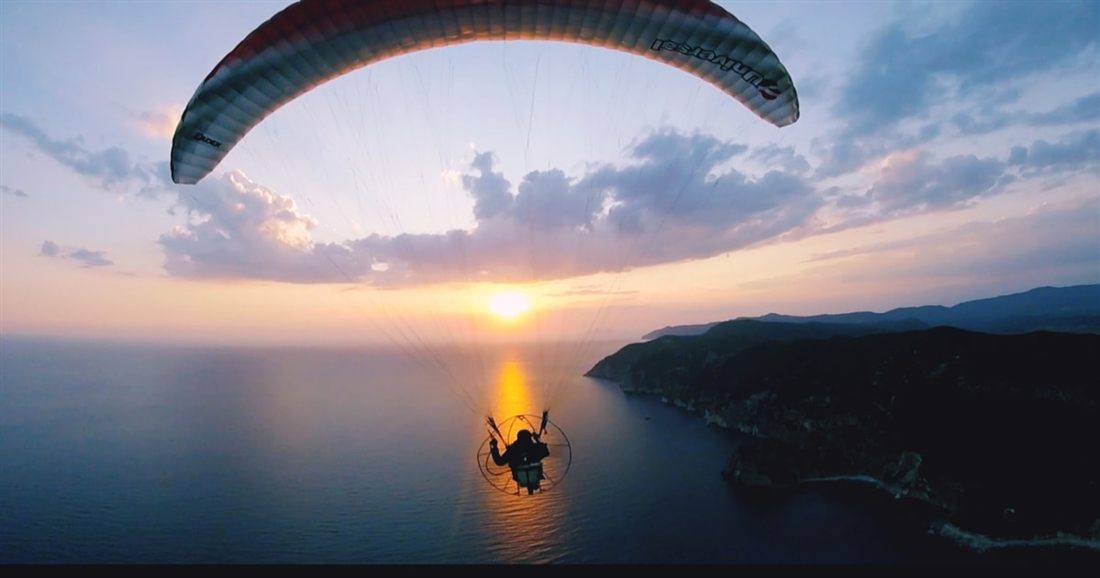
Corfu Paragliding offers sunset flights because the weather is calm at that time of day. Light wind makes the ride smooth for the passenger.
The west coast faces the sunset, so the light falls across the beaches and hills below. The sea turns gold as the sun drops to the horizon.
Guests who want it pick the evening time when they book their Corfu paratriking flight.
Who flies the paratrike, and is Corfu paratriking safe?
Certified pilots fly every Corfu paratriking flight. Corfu Extreme Sports states that its pilots are approved by the Greek Air Sports Federation. Each flight uses a helmet, a harness and the trike’s safety gear, and it waits for suitable wind.
Corfu Paragliding calls itself the pioneer of paragliding on Corfu. Its team describes its pilots as fully certified and highly experienced, with hundreds of flights behind them.
Weather decides each flight. The operator sends a weather update two days before. On the day, the pilot waits for the right wind. A poor forecast moves the flight to another slot.
- Certified pilots at the controls
- A helmet and harness for the passenger
- A briefing before take-off
- Flights only in suitable wind
Who can do Corfu paratriking?
Corfu paratriking takes passengers from age 12, with parental consent for anyone under 18. The weight limit is 120 kg. Guests need good physical and mental health, and no flying experience is required.
The rolling take-off on wheels means the passenger never runs. That opens Corfu paratriking to guests who cannot run off a slope for a foot-launched flight. Guests recovering from illness or surgery wait for a later trip.
Teenagers fly with a parent’s consent, and the pilot sets the pace of the flight. Family days on the island are covered on the Corfu with kids page.
Which Corfu paratriking route suits you, west or south?
The west coast routes of Corfu paratriking fly from Vatos, Ermones or Pelekas over Glyfada and the beaches below the hills. The south coast route flies from Alikes near Lefkimmi. West suits big views; south suits a quieter shore.
The west coast routes take in the sandy bays, the cliffs and the green hills of central Corfu. Sunset flights run on this side, since it faces the evening sun.
The south coast route starts near the old salt pans of Alikes, a flat wetland by the sea. The land there is lower and the resorts are fewer.
- West coast: Glyfada, Kontogialos, Pelekas and the Ropa Valley
- West coast: the sunset and VIP flights
- South coast: Alikes and the beaches near Lefkimmi
- South coast: a shorter drive for guests based in the south
How do you get to a Corfu paratriking take-off site?
Corfu paratriking meets near Pelekas or Vatos, both in central Corfu. Pelekas lies 12.6 km from Corfu Town and 11.4 km from the airport. The Lefkimmi flight starts in the far south of the island.
Green KTEL buses run from Corfu Town to Pelekas and Glyfada on the west coast. A hire car or taxi reaches Vatos and Ermones in the Ropa Valley.
Guests staying in the north of the island face a longer drive to the take-off sites. A rental car covers the drive at any hour, as the Corfu car rental page explains.
What is included in Corfu paratriking?
Corfu paratriking includes the flight, the safety gear, a certified pilot and transfers between the take-off and landing sites. GoPro video is an optional add-on. The Lefkimmi flight hands over the footage on an SD card.
- The paratrike flight of 15 to 50 minutes, by plan
- Paratrike, harness and helmet
- An expert certified pilot
- Local transfers between take-off and landing
- Optional GoPro video, including a 360 camera
Corfu Paragliding also films flights with a GoPro. Guests take the video home as a record of the route. The briefing and the wait for wind are part of the outing.
What do you wear and bring for Corfu paratriking?
Wear trekking or sports shoes and bring a light jacket for Corfu paratriking. Sunglasses help in the bright light over the sea. A bottle of water suits the wait at the take-off site.
- Trekking or sports shoes
- A light jacket for the cooler air aloft
- Sunglasses
- A bottle of water
Loose items stay on the ground, since the open trike has no storage. The pilot’s camera records the flight for guests who book the video.
Which months and conditions suit Corfu paratriking?
Corfu paratriking needs light wind, so the pilot waits for suitable conditions before each take-off. Calm early evenings suit the sunset flight. The operator confirms the weather two days ahead and moves the flight if the forecast turns.
Corfu has a greener climate than the Aegean islands, with more rain in winter. Summer brings long dry days and warm evenings for flights along the coast.
Guests with a flexible day in their plans keep a second date free. A moved Corfu paratriking flight then fits another evening of the stay.
What does a paratrike look like?
A paratrike is a light three-wheeled frame with two seats, one behind the other, and a propeller engine at the back. A large paraglider wing flies above it on lines. On Corfu paratriking, the passenger sits in the rear seat.
The frame stays open, with no cabin or windscreen. A cage around the propeller keeps hands and feet clear of the blades.
The tandem wing is larger than a solo paraglider, so it carries two people and the engine. On the ground, it lies spread out behind the trike before take-off.
How does Corfu paratriking compare with paragliding and parasailing?
Corfu paratriking uses an engine and wheels, so it flies longer and needs no hill. Tandem paragliding glides without power for about 15 minutes. Parasailing hangs from a rope behind a boat over a beach.
- Corfu paragliding covers the foot-launched tandem flights from the hills
- Corfu parasailing covers the boat-towed rides off the beaches
- Chania paratriking covers the same flight type on Crete
The tandem paraglider is nearly twice the size of a solo wing. Its passenger hangs in a harness in front of the pilot, with no seat or wheels.
How do you book Corfu paratriking?
Book Corfu paratriking on GetYourGuide or directly with the operators. Corfu Paragliding takes bookings by WhatsApp. Corfu Extreme Sports confirms the meeting point and weather two days before the flight. Pick a regular, VIP or sunset flight at checkout.
The VIP flight needs a longer slot, since it doubles the time in the air.
The booking confirmation lists the meeting point near Pelekas or Vatos. Guests without a car arrange the drive to that point. The transfers cover only the take-off and landing sites.
Frequently Asked Questions
Is Corfu paratriking the same as paramotoring?
Not quite. In foot-launched paramotoring, the pilot wears the engine on the back and runs to take off. A paratrike carries the engine on a wheeled frame with two seats. Listings on Corfu use both names for the trike flights.
How high does Corfu paratriking fly?
The sunset flight along the west coast climbs up to 800 metres, as Corfu Paragliding states. Regular flights vary in height with the route and the wind. The pilot sets the height with the engine during the flight.
Can you film your own Corfu paratriking flight?
Corfu Paragliding films its flights with a GoPro, and Corfu Extreme Sports sells GoPro video as an add-on. The Lefkimmi flight gives the footage on an SD card. Ask the pilot before take-off about carrying a personal camera.
What happens if the wind is too strong?
The flight waits or moves to another slot. The pilot only takes off in suitable wind. The weather update two days before gives the first warning. The final call comes on the day at the take-off site.
Does Corfu paratriking run from Corfu Town?
No. The take-off sites sit on the west coast near Pelekas, Ermones and Vatos, and in the south at Alikes. Corfu Town lies about 12 km from Pelekas. Guests staying in town drive or take the bus to the meeting point.
How much time does the whole outing take?
Plan 2 to 3 hours for a Corfu paratriking outing with transfers. That covers the meeting, the briefing, the wait for the right wind, the flight itself and the transfer back from the landing site to the start.
Can two friends fly together?
No. The paratrike seats one pilot and one passenger. Friends and couples book back-to-back flights from the same take-off site. The first flyer watches the second from the ground.