
Philippi tickets give entry to the archaeological site of Philippi near Kavala, a UNESCO World Heritage Site with a Greek theatre, a Roman forum and early Christian basilicas, and to the Archaeological Museum of Philippi at the site. Tours across the rest of the country are listed on Greece Tours.
The sections below cover what the tickets open, the theatre and forum, the basilicas and the Octagon, the museum, where to buy, e-tickets, reduced and free entry, the tours that include entry, the summer festival’s own tickets, getting there, the time a visit needs and combining Kavala and Amphipolis, with links into the Philippi tours pages. The tours shown are checked on GetYourGuide and Viator.
What are Philippi tickets?
Philippi tickets are the official entry tickets for the remains of ancient Philippi, the walled city that UNESCO inscribed as a World Heritage Site in 2016, beside Krinides in north-eastern Greece, near Kavala, and for the Archaeological Museum of Philippi inside the site.
Hellenic Heritage, the ticket platform of the state organisation ODAP, issues Philippi tickets, and the Ephorate of Antiquities of Kavala, a regional service of the Ministry of Culture and Sports, runs the site they open. Hellenic Heritage presents Philippi as the leading archaeological site of Eastern Macedonia, with remains of Classical, Roman and Byzantine date.
Philippi tickets open three layers of one city. Philip II of Macedon refounded it in 356 BC on a Thasian colony, Rome resettled it with army veterans after the battle fought outside its walls in 42 BC, and after the apostle Paul’s visit in AD 49/50 the city grew into a seat of Christian pilgrimage.
Which parts of Philippi do Philippi tickets open?
Philippi tickets are two separate tickets on the Hellenic Heritage listings: the site ticket opens the walled city with its theatre, forum, basilicas and Octagon, and the museum ticket opens the Archaeological Museum of Philippi, a building of its own by the west entrance.
According to the Ministry of Culture, the key monuments of the site are the Octagon, the two basilicas known as A and B, the forum, the theatre, the acropolis and the city walls. The 3.5 km circuit of walls climbs from the plain to the fortified acropolis, and Philippi tickets admit visitors to the city inside it.
Until a change in entrance fees, one ticket covered both the site and the museum. Hellenic Heritage, the official platform, now lists them as two venues, each with an admission of its own, so a visit to both calls for two Philippi tickets.
What do Philippi tickets show at the theatre and the forum?
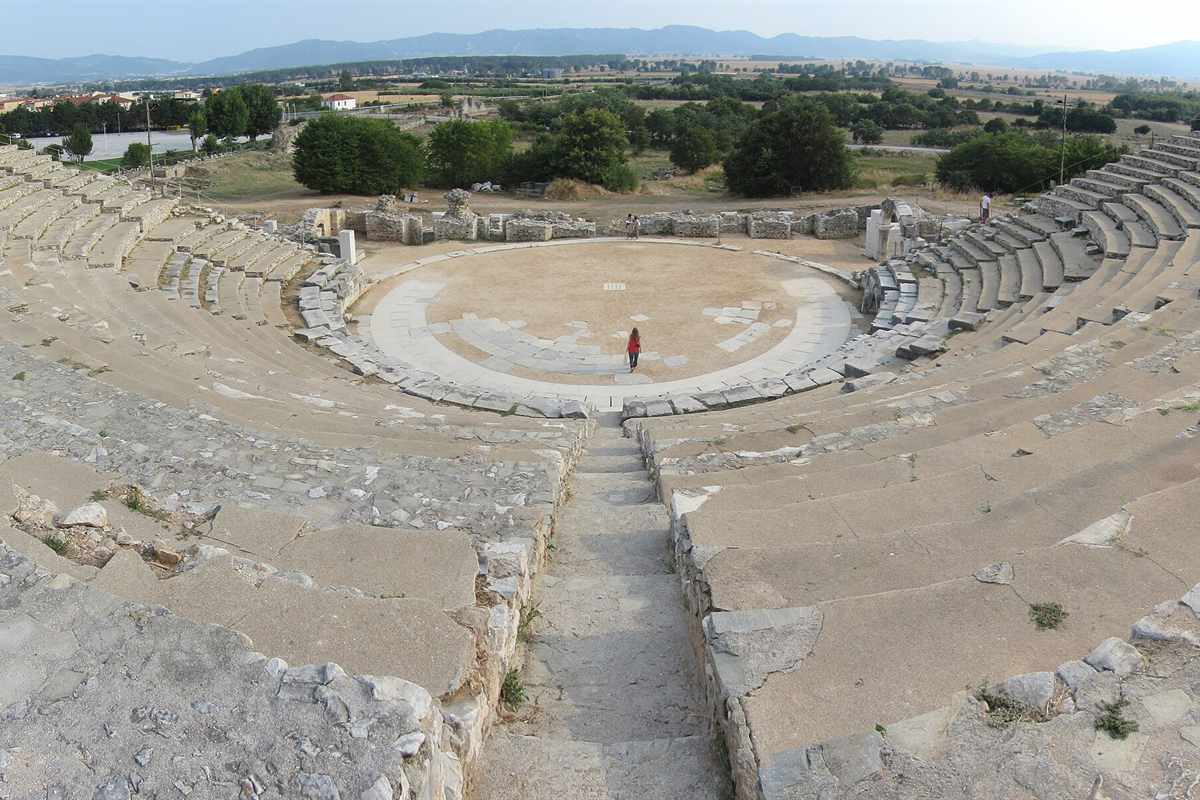
Philippi tickets show a theatre built under Philip II around the middle of the 4th century BC and rebuilt by the Romans for arena games, and the forum, the administrative core of the Roman colony, set beside the paved Via Egnatia.
Hellenic Heritage picks out the theatre as the clearest sign of how Philippi changed. Remodelled in the 2nd and 3rd centuries AD for Roman shows, it became an arena for gladiator fights, then housed workshops in the Early Byzantine period, so Philippi tickets lead to one building with three lives.
Inside the forum, public buildings framed an open square, with a pair of monumental temples at its north-east and north-west corners. With Philippi tickets, visitors also see the paved road along its north side, taken to be the Via Egnatia, the old route between Europe and Asia, and a terrace of temples further north.
South of the forum, across a commercial street 9 m wide, Philippi tickets take in the macellum, a market of the 2nd century AD with shops on either side of a colonnaded court. The palaestra now lies largely beneath Basilica B, though its latrines in the south-east corner, the best-kept part, remain.
What do Philippi tickets show at the basilicas and the Octagon?
Philippi tickets show the ruins of the city’s Early Christian churches: Basilica A of the late 5th century, Basilica B of around 550 AD and the Octagon, the episcopal church dedicated to Saint Paul, with its baptistery, bathhouse and bishop’s residence.
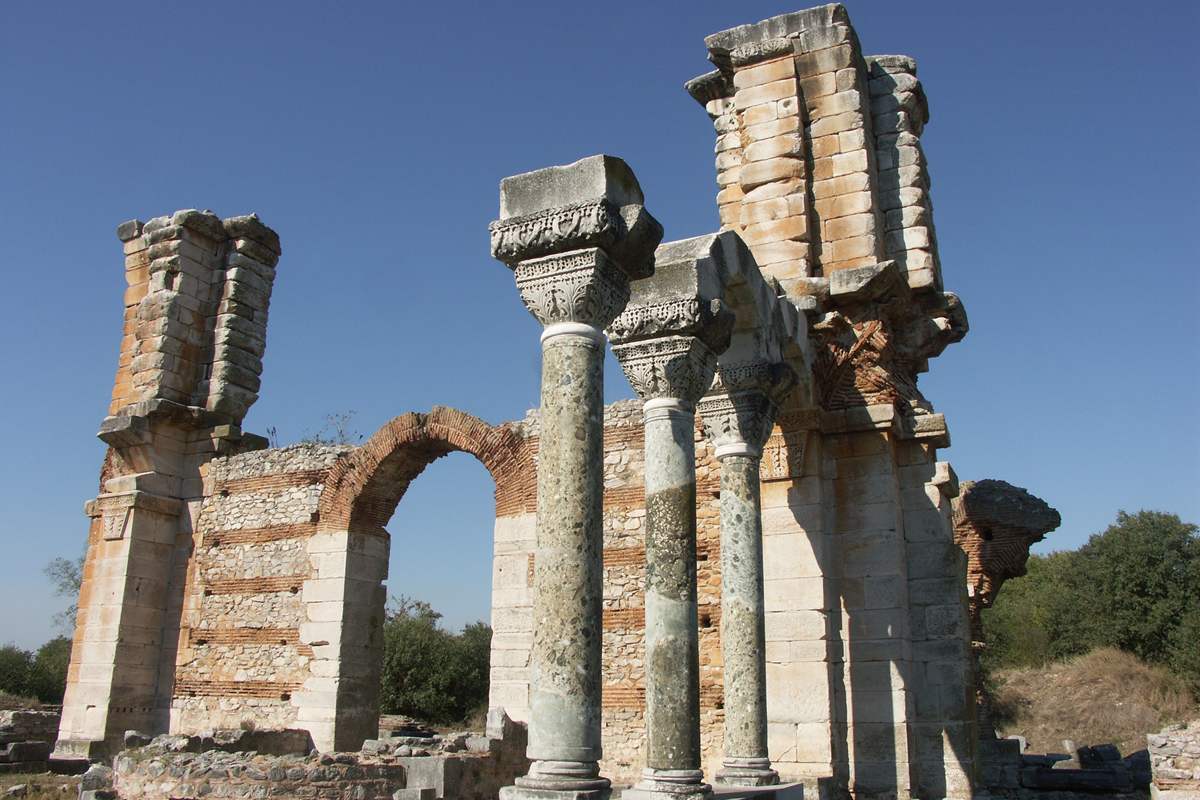
Basilica A, a three-aisled church 130 m long and 50 m wide, has a square atrium, a transept and an unusual phiale. Philippi tickets show pieces of its rich floor, part of the ambo and painted walls that imitate cut marble, and, to the south, the Roman cistern revered as the prison of Paul.
Basilica B, the second large church on Philippi tickets, rose around 550 AD over the old market. A dome on large pillars covered its almost square nave, the sanctuary was vaulted, and the carving follows the art of Constantinople. Its builders kept the market’s six-column colonnade as a grand entrance to the north aisle.
The Octagon that Philippi tickets reveal was built and rebuilt in three phases between the late 4th or early 5th century and the mid-6th. It replaced a smaller church of Saint Paul of the early 4th century, which rose over a Late Hellenistic tomb-heroon, and a monumental gateway faced the Via Egnatia.
What do Philippi tickets show in the Archaeological Museum of Philippi?
Philippi tickets for the museum show the finds from the digs on two floors: prehistory to Roman times on the ground floor, and Christian Philippi, from its Early Christian peak to its abandonment in the late 14th century, on the first floor.
Ioannis Triantafyllidis and Dimitrios Fatouros, two architects, designed the building. On its ground floor, Philippi tickets lead to figurines in a naturalistic style from the Neolithic settlement of Dikili Tash, grave stelae of the Hellenistic period and marble sculpture found at the Roman forum and the theatre, the buildings the site ticket opens outside.
The first floor turns to the Christian city, from the age of its basilicas to the Turkish conquest that left it empty. Here Philippi tickets show inscriptions worked into mosaics, with carved architectural pieces from the Early Christian churches. The building also has a café and a shop.
Where can you buy Philippi tickets?
Philippi tickets are sold at the ticket office of the archaeological site in Krinides and online through tickets.hh.gr, the Hellenic Heritage store; licensed travel agencies buy them through partner accounts, and tickets from any other reseller are invalid at the gate.
On the Hellenic Heritage page for the ruins, the Buy tickets link opens a dedicated Philippi venue in the ODAP store, so Philippi tickets for the site can be booked before the trip. The museum’s Hellenic Heritage page carries no such link, which leaves its ticket to be bought on arrival in Krinides.
Partner accounts are open to travel agencies trading legally in Greece or elsewhere in the EU, and the Philippi tickets they issue stay valid until 31 December of their year of issue. ODAP bans resale and trading and strikes an offending partner off its system for two years, while anyone who presents a ticket from an unofficial source faces criminal and civil penalties.
How do Philippi tickets work as e-tickets?
Philippi tickets bought online land in your inbox as a PDF once the card payment clears, and staff scan the code on it at the entrance, while holders of reduced or free tickets also show an original ID card, passport or certificate.
Buyers must be at least 18, pay mainly by debit or credit card and choose the ticket type and quantity themselves, since ODAP issues Philippi tickets exactly as entered. A reduced or free status proven by an ID card or passport also arrives as a PDF, while one that ODAP checks through a national digital portal earns a QR code instead.
If a category needs further documents, the e-mail holds only a purchase receipt with a transaction code, which the site’s ticket office exchanges for Philippi tickets once it sees the originals. Codes and ticket numbers are personal: the first person to present a ticket counts as its holder, so any later print of the same PDF is refused at the gate.
Who gets reduced or free Philippi tickets?
Philippi tickets are free for children up to 18 from any country, EU nationals up to 25 and Ministry-listed groups, reduced for EU seniors over 65 from 1 October to the end of spring, and free for everyone on dates the Ministry fixes.
The Ministry of Culture also grants free Philippi tickets to disabled visitors of every nationality, plus one escort where the disability is rated at 67%, and to Greek unemployed citizens, refugees, Greek conscripts, journalists, tourist guides licensed in Greece, and ICOM and ICOMOS members, each on the matching card or certificate.
The reduced rate also covers parents escorting primary-school visits from EU and EEA countries and teachers leading school or college groups from outside the EU. A visitor who cannot prove the status at the gate is turned away without a refund, and on the dates below, Philippi tickets for everyone are free and come only from the ticket offices:
- 6 March, the Melina Mercouri memorial day
- International Monuments Day, 18 April, and International Museums Day
- the European Heritage Days weekend, the last one in September
- 28 October, a national holiday
- every first and third Sunday from 1 November to 31 March
Which tours include Philippi tickets?
Philippi tickets are not listed as included by any of the five GetYourGuide tours checked: the listings sell routes from Thessaloniki or Kavala, three with pickup and two with a skip-the-line label, so buyers confirm whether admission is covered before paying.
Three private tours start in Thessaloniki with pickup: an 8-hour trip on the Apostle Paul’s trail at Philippi plus Kavala’s Ottoman sights and harbour, offered in English or Greek; a 9-hour excursion in a premium Mercedes, booked per group; and a small-group route that joins Philippi and Kavala with Lydia’s baptistery and the Lion of Amphipolis.
From Kavala, one tour leaves the port for a guided visit to ancient Philippi and its museum, with a private option and a child category for ages 7 to 17, and another spends 4 hours on the Lydia baptismal site, Philippi, the medieval aqueduct and a panoramic tour of Kavala. All five offer free cancellation and stop taking bookings 8 to 10 hours ahead.
Viator lists four more tours naming Philippi, among them a 7-hour private outing themed on St Paul. For the full-day plan by road, see our Philippi day trip from Thessaloniki, and carry Philippi tickets unless the booking says admission is covered.
Are Philippi tickets the same as Philippi Festival tickets?
No, Philippi tickets admit you to the archaeological site by day through Hellenic Heritage, while seats for Philippi Festival performances in the ancient theatre are sold by the Municipal and Regional Theatre of Kavala at its own sales points and through online partners.
Unlike Philippi tickets, festival seats sell at the Visitor Information Centre, the former EOT office on Kavala’s Central Square, at the Proskinio café beside the theatre in Krinides, and at the theatre’s own box office, which opens only on performance days. Online pre-sales run through more.com and ticketservices.gr.
The theatre hosts the festival every summer, with performances listed from July into September; the price list sets seat prices show by show, and two events were free. For two performances of The Persians by Aeschylus, the festival charged only the entrance fee to the ancient theatre; beyond that case, Philippi tickets and festival seats stay separate purchases.


How do you reach Philippi to use your Philippi tickets?
Philippi tickets are used at a site about 15 km from Kavala on the road to Drama, reached by car, by taxi or by a Drama-bound KTEL bus to Krinides; from Thessaloniki, Kavala lies 153 km away by car or KTEL coach.
Drivers with Philippi tickets follow the provincial road from Kavala towards Drama; the ruins lie just west of Krinides. A signposted turn-off ends at a large car park around a small park, with room for campers and a restaurant under the trees. Taxis cover the same road, so agree the fare first.
Without a car, Philippi tickets mean a KTEL ride from the station on Mitropolitou Chrysostomou Street in central Kavala, where a Drama service reaches central Krinides in about half an hour, a short walk from the gate. From Thessaloniki’s Macedonia terminal, express KTEL coaches need between two and two and a half hours to Kavala.
Cruise passengers with Philippi tickets come ashore at Apostolos Pavlos, the central passenger port, within walking distance of the town centre, with a new terminal and coach parking. From the quay, Kavala’s fleet of about 130 orange or white taxis covers the road, and a guided port excursion to the site lasts 4 to 4.5 hours.
How much time do Philippi tickets need, and in which order?
Allow half a day from Kavala for Philippi tickets: a guided round trip from the port covering the site and museum lasts 4 to 4.5 hours. See the upper part from the theatre to the museum, then cross the Via Egnatia to the forum.
Inside the gate, the path brings holders of Philippi tickets straight to the theatre. Basilica A stands about 150 m further on, and keeping above the Via Egnatia for another 150 m leads to Basilica C and the museum, which lies within the site, so one walk covers ruins and collection.
The acropolis path, an optional climb on Philippi tickets, starts in front of the museum entrance and rises to a Late Byzantine tower, steep and shadeless in summer. Back beside Basilica A, the route passes the prison of Paul and crosses the Via Egnatia to the forum and Basilica B.
Each of the Philippi tickets allows one entry, and the stub stays with you in case guards ask for it; once you leave, it expires. Finish both halves before walking out, and add time for Lydia’s baptistery: a private tour from Kavala covering the ruins and the baptistery takes 3.5 hours.

Can you combine Philippi tickets with Kavala and Amphipolis?
Yes, Philippi tickets fit one day with Kavala and Amphipolis, which also lie on the old Via Egnatia, but they admit you only at Philippi: the Archaeological Museum of Kavala and the museum on the Amphipolis site each sell their own tickets.
Kavala pairs naturally with Philippi tickets: as ancient Neapolis it was the harbour of Philippi, and Paul landed there on his first voyage to Europe. Its Archaeological Museum, open since 1964, follows the town from Neapolis to Byzantine Christoupolis. Our Kavala day trip from Thessaloniki maps the rest.
Amphipolis lies in the Serres regional unit by the River Strymon, close to the highway from Thessaloniki to Kavala, so drivers heading east pass it before using Philippi tickets. Its museum sits inside the ancient walls, with parking, a ramp and a lift, and a day trip to Amphipolis from Thessaloniki adds its Lion.
On the ancient royal road, Philippi controlled the stretch between Amphipolis and Neapolis, so a day out of Thessaloniki takes Amphipolis, Philippi and Kavala in that order, from west to east. A private tour linking Philippi tickets with Lydia’s baptistery, Kavala and the Lion of Amphipolis lasts 8 hours.
Frequently Asked Questions
Do Philippi tickets cover Lydia’s baptistery?
No, Philippi tickets are valid only for the site named on them. The Baptistery of Saint Lydia is a separate church shrine about 1 km away, by the Zygaktis river west of the ancient city, where Paul is said to have baptised Lydia; adult baptisms still take place there on her feast day.
Can wheelchair users make full use of Philippi tickets?
Partly. The museum on Philippi tickets has a ramp, a lift and a toilet for disabled visitors, and the site has its own car park, but the footpath up to the acropolis is steep with little shade. Kavala also keeps taxis adapted for disabled passengers, booked in advance.
Are Philippi tickets refundable if plans change?
Only the entry slot can change. Under the Hellenic Heritage terms, Philippi tickets bought online are final once paid, with no cancellation, refund or edit, but a chosen time slot can move twice for free up to 120 minutes ahead. If force majeure shuts the site that day, the ticket is extended or refunded.
Which season suits Philippi tickets best?
Philippi tickets are easiest to use away from midsummer. The ruins give hardly any shade, summers around Kavala run hot, and the acropolis climb grows hard in the heat, so a spring or autumn date eases the walk; summer visitors need a hat against the sun.