
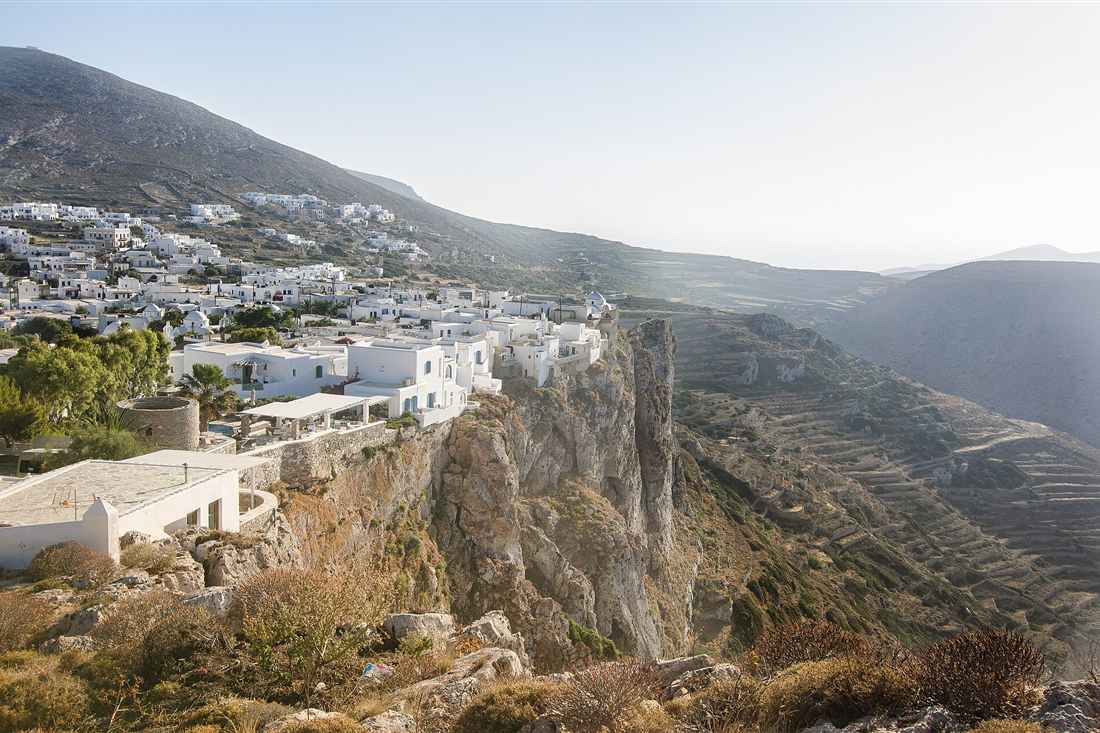
A Folegandros wine tasting takes you to Domaine Paliomilos on the dry-stone terraces between Chora and Ano Meria, through the vineyard and the cellar and on to a seated flight of four to six wines poured with the island’s cheese, capers and rusks. Plan the rest of the island with Greece Tours.
This page covers the visit: where the estate sits and how to reach it, the grapes grown on the terraces, what is poured and what comes with it, the price bands, the eight-course food and wine pairing dinner, the harvest, who the visit suits, and how to book a Folegandros wine tasting.
What is a Folegandros wine tasting and what happens during it?
A Folegandros wine tasting is a guided visit to Domaine Paliomilos on the schist terraces between Chora and Ano Meria, combining a vineyard walk, a cellar tour and four to six poured wines served with island cheese, capers and barley rusks over 90 minutes to three hours.
The visit opens outdoors. A member of the estate team leads guests along the dry-stone terraces, points out the bush-trained Assyrtiko heads sitting low against the meltemi, and explains why the vines carry no trellis. The walk covers 300 to 600 metres of stony ground and lasts 20 to 30 minutes. Elevation on the plots sits between 200 and 300 metres, with the Aegean visible on three sides. The Folegandros wine tasting hosts state this at booking. A Folegandros wine tasting is planned around it.
The cellar follows. Stainless tanks, a small barrel store and the bottling line occupy one building, and the guide walks through destemming, fermentation temperatures and the short ageing the whites receive. Guests then sit at long wooden tables under shade cloth. Glasses arrive in sequence, white first, rosé second, red last, each poured at 60 to 80 millilitres with tasting notes given aloud. It decides when to take a Folegandros wine tasting.
Food arrives alongside rather than afterwards. Plates hold local cheese, capers preserved from the estate’s own bushes, tomato-topped rusks and olive oil pressed on the island. This structure separates a Folegandros wine tasting from a bar pour: the wines are read against the food they were grown for. Groups run from two people to sixteen, and the pace stretches when the table stays talking. Every Folegandros wine tasting works to that rule.
The estate produces small volumes, so bottles sold at the end travel directly from the cellar door. Guests reaching the island by the Folegandros to Paros ferry frequently schedule the visit for their first full afternoon, before the walking days begin. The Folegandros wine tasting price reflects it.
Where is Domaine Paliomilos and how do you reach the estate?
Domaine Paliomilos sits on terraced land above the main island road between Chora and Ano Meria, 10 to 15 minutes by car or scooter from Chora, 20 minutes from Karavostasi port, and reachable by the Ano Meria bus plus a short signed walk.
The single asphalt road running the spine of the island connects all three points. From Chora the distance measures roughly 4 kilometres northwest; from Karavostasi it measures roughly 8 kilometres. Scooter rental in Chora runs 20 to 30 euros per day, ATV rental 35 to 50 euros, and small car hire 45 to 70 euros in high season. Parking sits on packed gravel beside the entrance gate. Every Folegandros wine tasting works to that rule. This is what a Folegandros wine tasting delivers at the table.
The public bus toward Ano Meria departs Chora at intervals through the day in July and August, with fares of 2 euros. The relevant stop lies on the main road, and the estate track climbs 300 to 400 metres from there. Walkers arriving on foot from Chora follow the old footpath, a 45 to 60 minute route across terraces and past chapels, and reach the gate with dusty boots. The Folegandros wine tasting price reflects it.
Opening hours in season run from late morning to sunset, with the final seated Folegandros wine tasting starting around 19:00 so the light over the Aegean carries the last pour. Arrival by taxi from Karavostasi costs 15 to 20 euros one way, and drivers wait if arranged in advance. A Folegandros wine tasting is planned around it.
Travellers combining Milos and Folegandros on one itinerary place the estate visit on the Folegandros leg, since the Milos ferry docks at Karavostasi and the road north passes the turning within the first quarter hour of driving. A Folegandros wine tasting fills first on that count in August.
What grapes grow on Folegandros and how do the wines taste?
Folegandros vineyards carry Assyrtiko, Aidani, Monemvasia and Mavrotragano on dry-stone terraces between 200 and 300 metres. Bush-trained vines, constant north wind and salt spray produce dry whites with citrus, stone and saline length, plus firm, dark-fruited reds with grippy tannin.
Assyrtiko dominates the white plantings. On this schist and volcanic-influenced soil it delivers lemon peel, green apple and a chalky finish, with total acidity high enough to hold structure through a warm September. Aidani softens the blend with white flowers and peach skin. Monemvasia adds body and a herbal edge that reads as thyme, the same thyme growing wild across the terraces around the vines. A Folegandros wine tasting is planned around it.
Mavrotragano carries the red side. Berries stay small, skins stay thick, and the resulting wine shows black cherry, dried fig and iron, with tannins that need food. Alcohol lands between 13 and 14.5 percent. Ageing in used oak for 8 to 12 months rounds the edges without covering the fruit, and bottles hold well for five to eight years in a cool cellar. A Folegandros wine tasting fills first on that count in August.
The growing conditions explain the style. Rainfall stays under 400 millimetres per year, irrigation is absent, and yields fall to a fraction of mainland levels. Vines sit low to the ground because the meltemi blows hard from June through September. Salt deposits on leaves and skins, and tasters at a Folegandros wine tasting notice the resulting mineral bite in the first white poured. This is what a Folegandros wine tasting delivers at the table.
Bottle prices at the cellar door sit between 15 and 32 euros. Production is measured in a few thousand bottles per label, so most of it stays on the island. The Folegandros wine tasting season turns on this.
What is poured at a Folegandros wine tasting and what food comes with it?
The standard flight covers four to six wines, moving from dry Assyrtiko-based white through a rosé to Mavrotragano red. Accompanying plates hold estate olive oil, preserved capers, island cheeses, barley rusks with grated tomato, thyme honey, and a closing shot of raki.
Pours run 60 to 80 millilitres each, totalling roughly half a bottle across a six-wine flight. The order follows weight: an unoaked Assyrtiko first, an Aidani-Monemvasia blend second, a dry rosé third, then one or two reds. When a barrel sample is available during the harvest weeks, the guide draws it directly from the cellar and pours it unfiltered beside the finished bottling. This is what a Folegandros wine tasting delivers at the table.
The capers come from bushes growing between the terrace walls, picked in June and salted rather than pickled. The cheeses rotate with the season and include soft fresh white cheese and a harder aged version from Ano Meria producers. Barley rusks arrive topped with tomato, oregano and oil, the standard island plate, and they cut the acidity of the young Assyrtiko cleanly. The Folegandros wine tasting season turns on this.
Thyme honey closes the food service and pairs with the aged red or with a sweeter late-harvest bottling when one exists that year. Raki finishes the table, poured cold in small glasses, and the estate offers water throughout. Guests avoiding alcohol are served grape juice from the same fruit at reduced cost. The Folegandros wine tasting room is set up for it.
Every element on the plate is grown, pressed, salted or aged within a few kilometres of the tasting bench, which is the argument the estate makes for the format. The island of Folegandros supports this pairing structure because its farming and its viticulture occupy the same terraces. Guests at a Folegandros wine tasting meet it in the first half hour.
What does a Folegandros wine tasting cost across its different formats?
The estate tasting with a food plate runs 25 to 45 euros per person. The eight-course food and wine pairing dinner costs 70 to 120 euros. A private boat afternoon finishing with wine on board runs 150 to 250 euros per person depending on group size.
At the 25 to 30 euro tier, guests receive four wines and a shared plate of cheese, rusks, capers and oil, with the vineyard walk included and the cellar visit shortened. The 35 to 45 euro tier adds two further pours, frequently a reserve Assyrtiko and an aged Mavrotragano, a fuller plate with honey and cured items, and the raki service. Both tiers last 90 minutes to two hours. The Folegandros wine tasting room is set up for it.
The pairing dinner price covers eight plated courses, matched glasses across the estate range, service, and a seat that holds for three hours. Wine volume across the dinner reaches roughly a full bottle per guest. Groups stay small, and the price reflects kitchen labour rather than bottle cost alone. Guests at a Folegandros wine tasting meet it in the first half hour.
The boat format charters a small vessel from Karavostasi for four to six hours, covering Katergo beach, the Chrysospilia sea cave entrance and the south coast cliffs, with swimming stops and a final anchorage where the estate wines are poured with cold plates. Fuel, skipper, snorkel gear and the wine are included in the quoted figure. A Folegandros wine tasting starts with this settled.
A Folegandros wine tasting bought as an add-on to a restaurant meal in Chora sits lower, around 18 to 25 euros for three glasses. Bottle purchases at the cellar are separate and settled in cash. The Folegandros wine tasting flight is set by it.
What is the eight-course food and wine pairing dinner at the estate?
The pairing dinner seats six to fourteen guests for three hours across eight small courses, each matched to one estate wine. The seasonal menu draws on Aegean fish, island goat, capers, tomato and handmade matsata pasta, and it requires booking two to seven days ahead.
Service starts at sunset, around 19:30 in July and 19:00 in late September. Guests sit at one long table, which fixes the format as communal rather than private. The kitchen sends courses at 15 to 20 minute intervals, and the winemaker or estate host introduces each glass before the plate lands, explaining vineyard block, vintage conditions and the reason for the match. A Folegandros wine tasting starts with this settled.
Early courses lean light: raw or lightly cured fish with lemon and oil against young Assyrtiko, then caper leaves and fresh cheese against the Aidani blend. Matsata, the island’s hand-rolled pasta, arrives mid-meal with either rooster or goat sauce, and the red enters at that point. Slow-cooked goat with thyme follows. Dessert pairs thyme honey and almond with a sweet or aged pour. The Folegandros wine tasting flight is set by it.
Total wine served reaches eight glasses of 70 to 90 millilitres. The estate arranges taxi transfers back to Chora on request at 15 euros per car, because the road north is unlit and the walk back covers 4 kilometres of dark asphalt. The Folegandros wine tasting timetable is built on it.
Dietary adjustments are handled with 48 hours notice, and vegetarian menus substitute chickpeas, aubergine and cheese across the meat courses. Guests treating the evening as the culmination of a Folegandros wine tasting itinerary schedule it for their final night, after the daytime cellar visit has already covered the vineyard ground. A Folegandros wine tasting keeps the glasses for it.
When is the Folegandros harvest and when do tastings operate?
Picking runs through the second half of August, finishing in the first days of September for the late red parcels. Tastings operate from May to early October, peak daily in July and August, reduce to fewer sessions in May and October, and stop entirely for winter.
Harvest dates shift with the year, and dry Augusts pull the Assyrtiko pick forward to 12 or 15 August. Fruit comes in at dawn in plastic crates of 15 to 20 kilograms, carried down terrace steps by hand because tractors reach only the lower plots. Pressing begins the same morning while temperatures stay under 25 degrees. The Folegandros wine tasting timetable is built on it.
Visitors arriving during those two or three weeks see destemming, tank filling and the first fermentations working. The cellar smells of crushed fruit and carbon dioxide, and the guide draws juice and half-fermented must directly for tasting. This is the densest version of a Folegandros wine tasting, though the estate limits group sizes during harvest because the working floor stays busy. A Folegandros wine tasting keeps the glasses for it.
May and early June deliver a different picture: flowering vines, cool evenings around 18 degrees, thin crowds and unhurried table service. Sessions in those weeks run on two or three fixed times per day rather than continuously. October brings pruning preparation and the last of the season’s bottles, with the final visits landing around 5 to 10 October. That detail shapes a Folegandros wine tasting from the first pour.
From November through April the estate closes to visitors. Ferry frequency drops to two or three sailings per week, restaurants in Chora shut, and vineyard work turns to pruning and wall repair. Planning a Folegandros wine tasting outside the May to October window does not work. The estate confirms it by message when a Folegandros wine tasting is booked.
Who suits a Folegandros wine tasting and how is it booked?
The format suits couples, groups of two to eight, walkers finishing the Chora to Ano Meria path, and travellers holding an evening before a morning ferry. Booking runs two to five days ahead in July and August, by phone, email or the estate website.
Walkers make natural guests. The old stone path from Chora climbs past Ano Meria chapels and passes within reach of the terraces, so a 60 minute walk ends at the gate with the vineyard already read on foot. Closed shoes matter on that ground: the terraces are loose schist, and sandals slip on the descent between rows. That detail shapes a Folegandros wine tasting from the first pour.
Families are accepted, and children are served juice and food while adults taste. Groups above ten need advance arrangement because the seated area holds a fixed number of benches. Solo travellers join scheduled sessions rather than paying private rates, which keeps the cost at the lower 25 to 30 euro band. The estate confirms it by message when a Folegandros wine tasting is booked.
Confirmation comes by message with the meeting point, the session time and a note on parking. Cancellation windows run 24 to 48 hours. Card payment covers the tasting fee at most sessions, while bottle purchases at the cellar door are settled in cash, so carrying 50 to 100 euros in notes is practical since the island has limited ATM coverage in Chora only. It decides when to take a Folegandros wine tasting.
Timing against ferries matters. Karavostasi lies 8 kilometres south, and morning departures to Santorini, Milos and Piraeus leave early. An evening Folegandros wine tasting followed by a 07:00 sailing works when transport is arranged the night before rather than at dawn. The Folegandros wine tasting hosts state this at booking.
Frequently Asked Questions
What does a Folegandros wine tasting cost?
From 25 to 45 euros per person for the estate tasting with a plate of cheese, capers and rusks, 70 to 120 euros for the eight-course food and wine pairing dinner, and 150 to 250 euros for a private boat afternoon that ends with wine on board.
Where is the winery on Folegandros?
Domaine Paliomilos sits on the schist terraces above the Chora road towards Ano Meria, 10 to 15 minutes by car or scooter from Chora and about 20 minutes from the port at Karavostasi.
What grapes grow on Folegandros?
Assyrtiko, Aidani and Monemvasia for the whites and Mavrotragano for the reds, grown on bush-trained vines at 200 to 300 metres on dry-stone terraces, giving dry wines with citrus, stone and a salt edge.