
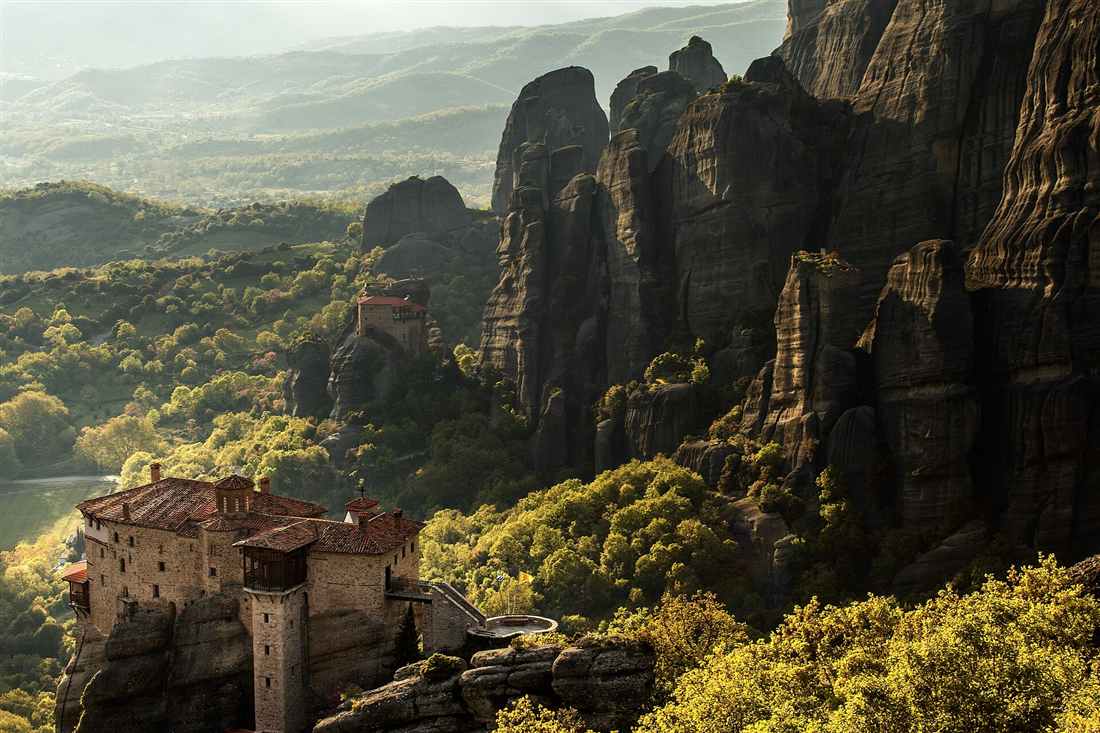
A Meteora e-bike tour is a guided ride of two and a half to four hours from Kalambaka or Kastraki on a pedal-assist mountain bike, covering 15 to 25 km and 300 to 500 metres of climbing past the monastery viewpoints to the Psaropetra platform. Plan the rest of the trip with Greece Tours.
This page covers the whole ride: where the route goes, the bikes and batteries, how hard it is and who it suits, the price bands, which departure time to take, the monastery stops, the self-guided rentals, the road rules, the season, and how to book a Meteora e-bike tour.
What is a meteora e-bike tour and how long does it last?
A meteora e-bike tour is a guided pedal-assist ride of two and a half to four hours from Kalambaka or Kastraki, covering 15 to 25 km with 300 to 500 metres of climbing, monastery viewpoints and one drink stop.
The motor is a 250-watt mid-drive unit capped at 25 km/h under European rules. It multiplies pedal input instead of replacing it, so the rider still turns the cranks on the ramp out of Kastraki towards the ring road. Groups run from two to ten riders behind one guide, who holds 10 to 14 km/h on the gradients and halts every 15 minutes at a viewpoint for photographs and water. The Meteora e-bike tour operators state this at booking.
Meeting points sit at the bike depots on Trikalon Street in Kalambaka and at the central square of Kastraki, both within 900 metres of the first climb. The briefing lasts 15 minutes: saddle height, brake feel, the four assist levels, battery readout and hand signals. Riders test the bike on a flat 300-metre stretch before the group turns uphill. A Meteora e-bike tour is planned around that.
The season runs from late March to early November, with daily departures in June, July, August and September and reduced schedules in April and October. Rain closes the schist descents, so operators shift bookings rather than ride wet rock. Winter rides operate on request when the temperature holds above 5 degrees and the tarmac stays dry. This is what a Meteora e-bike tour delivers on the ring road.
Distance separates the two formats. The short circuit covers 15 km with one long climb; the extended loop adds the Agios Nikolaos Anapafsas side road and the Kastraki back lanes for a total near 25 km and roughly four hours door to door.
Where does the standard route run between Kastraki and the Psaropetra platform?
The route climbs from Kastraki past the Doupiani rock and the hermit caves, joins the ring road below Great Meteoron and Varlaam, reaches the Holy Trinity and Saint Stephen viewpoints, pauses at Psaropetra, then descends back through Kastraki.
The first 2.5 km rise from 240 metres at the village square to about 400 metres beside the chapel of Doupiani, the oldest surviving structure of the rock community. From the saddle behind it the guide points out the wooden platforms and ladder scars on the pillar faces, where hermits lived in the caves of Badovas before the large houses were built. Every Meteora e-bike tour is timed against it.
From that point the asphalt ring road carries the group anticlockwise. Great Meteoron sits at 613 metres on the tallest pillar; Varlaam faces it across a 200-metre gap. The road then swings east towards Roussanou, drops 60 metres, and climbs again to the fork where Holy Trinity stands on its isolated tower above the Pinios valley and the roofs of Kalambaka. The Meteora e-bike tour fleet is equipped for it.
Psaropetra is the marked balcony between Holy Trinity and Saint Stephen, at kilometre 11 of the loop. It faces west across the whole rock field, which is why evening departures build a 25-minute halt there. The return leg drops 350 metres in 4 km on a closed gradient back into Kastraki, finishing at the square. A Meteora e-bike tour rolls out with this settled.
Guides adjust the sequence when coach traffic fills the Great Meteoron car park between 10:30 and 13:00, riding the Saint Stephen half first.
What bikes, batteries and safety equipment do the operators supply?
Operators supply hardtail and full-suspension pedal-assist mountain bikes with 250-watt motors and 500 to 700 watt-hour batteries, plus a certified helmet, gloves, a filled water bottle, a handlebar phone mount and frame sizing for riders from 155 to 200 cm.
The fleets in Kalambaka run Bosch Performance Line and Shimano EP8 drive units on aluminium frames with 27.5 or 29-inch wheels and hydraulic disc brakes. A 500 watt-hour pack covers the 15 km circuit twice over; the 625 and 700 watt-hour packs exist for the extended loop and for heavier riders who hold the bike in Turbo on the ramps. A Meteora e-bike tour is planned around that.
Sizing runs from small to extra-large, matching leg lengths across the 155 to 200 cm band. Children’s frames with 24-inch wheels and step-through models sit in reserve at the larger depots. Saddle height is set at the depot and rechecked after the first kilometre, since a low saddle burns battery and knees together on a 10 percent grade. This is what a Meteora e-bike tour delivers on the ring road.
The guide carries a repair roll with two spare tubes, tyre levers, a mini pump, a chain tool, quick links, a multi-tool, brake pads and cable ties. A phone with the operator number reaches the support van, which reaches any point on the ring road within 12 minutes. The Meteora e-bike tour timetable is built on it.
Helmets are compulsory on every departure. Gloves, sunglasses and a reflective vest travel in the bar bag for the descent, and a spare battery rides in the van on the four-hour itinerary.
How demanding is the ride and which riders does it suit?
The motor flattens the 8 to 12 percent ramps of the ring road, so the ride suits anyone who rides an ordinary bicycle. Minimum age is 12 or 14 by operator, and morning or evening slots avoid the 40-degree July afternoons.
Total climbing across the short loop reaches 350 metres, spread over three pitches of 1.5 to 2.5 km. In Tour or Sport mode a rider of average fitness holds a conversation the whole way up. Eco mode doubles the effort and is chosen by cyclists who want the workout; Turbo drains a 500 watt-hour battery in about 70 minutes of continuous climbing. The Meteora e-bike tour fleet is equipped for it.
Handling matters more than fitness. An e-bike weighs 22 to 25 kg, so the descent from Psaropetra into Kastraki rewards steady braking with two fingers and a low centre of gravity. Guides stop the group twice on that descent, at the hairpin below Roussanou and again at the village entrance, where traffic joins from the Kalambaka road. A Meteora e-bike tour rolls out with this settled.
Heat governs the calendar. Thessaly records 38 to 42 degrees in the shade during the second half of July and through August, and the pillars radiate stored heat until 20:00. Departures move to 08:30 and 18:30 for those weeks, cutting exposure to under three hours. Guides brief it before a Meteora e-bike tour leaves.
Riders with a hip replacement, recent knee surgery or a balance disorder are placed on step-through frames or steered towards the private format with a shorter loop.
What does a meteora e-bike tour cost and what does the price include?
A shared meteora e-bike tour of two and a half to three hours costs 45 to 75 euros per rider. A private guide costs 80 to 120 euros. Self-guided rental with a loaded GPS route runs 30 to 45 euros for a full day.
The shared fare covers the bike, battery, helmet, gloves, guide, insurance and one bottle of water. Photographs taken by the guide arrive by shared album afterwards at no charge with the main Kalambaka operators. Groups of six or more secure a 10 percent reduction, and families booking two adults plus two children pay a fixed package near 180 euros. This is what a Meteora e-bike tour delivers on the ring road.
Monastery admission stays outside the fare at 5 euros per adult, paid in cash at each gate. Food is separate too: the coffee stop at the Kastraki taverna terrace adds 3 to 6 euros, and transfers from Trikala, 22 km away, or from the Kalambaka railway station are arranged for 10 to 25 euros. The Meteora e-bike tour timetable is built on it.
Private departures buy timing control. A private meteora e-bike tour starts at any hour, halts wherever the group asks, and extends to four hours for an added 25 euros. Photographers book this format for the pre-dawn slot at Holy Trinity. It decides which Meteora e-bike tour to take.
Self-guided rental hands over the bike, a charged battery, a helmet and a GPX file for the 15 km ring loop. Deposit is 100 euros or a passport held at the desk, and the return deadline is 19:00 in summer.
Which departure time works best, the 09:00 start or the evening slot?
The 09:00 start delivers cool air and open monastery gates. The evening slot leaves between 17:00 and 19:00 depending on the month and ends on the Psaropetra platform, where the west light strikes the sandstone pillars head-on.
Morning riders reach Great Meteoron near 10:00, before the coach fleet from Thessaloniki fills the 60-space car park. Air temperature in June sits at 21 degrees at 09:00 and 34 degrees by 14:00, a difference that decides how the climb feels. Monastery gates open at 09:00 or 09:30 and close at 16:00 from April to October, and at 15:00 in winter. A Meteora e-bike tour rolls out with this settled.
Evening departures trade access for light. Gates shut before the group arrives, so the ride becomes a viewpoint circuit. Sunset falls at 20:50 in late June, 19:45 in early September and 17:30 in November, which is why the meeting time slides across the season. Details of the timing and the best platforms are set out under Meteora sunset. Guides brief it before a Meteora e-bike tour leaves.
The rock is grey conglomerate shot with quartz pebbles, and it turns copper for the last 30 minutes before the sun drops behind the Chasia range. Psaropetra holds about 40 people comfortably; the guide positions the group on the north edge, away from the coach passengers dropped at the road. The Meteora e-bike tour price reflects it.
Riders with a single day in Kalambaka take the morning slot and walk to a second viewpoint at dusk on foot.
Can riders enter the monasteries during the ride?
Yes. Six working monasteries admit visitors for 5 euros each, every one closed on a different weekday. Tours build a 20-minute stop into one of them, with bikes locked at the steps because the entrances involve 140 to 300 carved stairs.
Great Meteoron closes on Tuesday, Varlaam on Friday, Roussanou on Wednesday, Saint Nicholas Anapafsas on Friday, Holy Trinity on Thursday and Saint Stephen on Monday. Guides read that calendar before choosing the stop. Saint Stephen has the shortest approach, a level footbridge instead of a staircase, which makes it the standard choice on the evening loop when time runs short. The Meteora e-bike tour timetable is built on it.
The dress code applies at every gate: covered shoulders for everyone, trousers or a skirt below the knee. Cycling shorts fail the check, so the gatekeepers hand out wrap skirts at the entrance and collect them on the way out. Riders who plan an interior visit carry a light wrap or long trousers in the bar bag. It decides which Meteora e-bike tour to take.
Inside, the catholicon frescoes date from the 16th century, painted by the Cretan school under Theophanes Strelitzas at Great Meteoron and Saint Nicholas. Photography stays banned in the churches and permitted in the courtyards. The refectory museums at Varlaam and Great Meteoron hold manuscripts, barrel cisterns and the original rope-and-net hoists. Fuller background on each house appears in the guide to the Meteora monasteries. A Meteora e-bike tour books out on that count in August.
Bikes stay at the base because no monastery permits wheels beyond the gate.
What does a meteora e-bike tour reveal that a coach itinerary skips?
The bike reaches the Doupiani hermitage, the back road above Kastraki, the Adrachti pinnacle and the old monk paths, and it stands still between the pillars after 18:00 when the coaches have left the ring road empty.
Coaches follow a fixed sequence: Great Meteoron, Varlaam, one photo halt, then Kalambaka. Their length blocks the narrow lanes above Kastraki, so the Doupiani chapel, the Badovas cave cluster and the north terraces stay off their route entirely. A meteora e-bike tour turns onto those lanes within ten minutes of leaving the square. Guides brief it before a Meteora e-bike tour leaves.
Adrachti is the 25-metre needle standing alone behind the village, visible from a gravel spur that a 50-seat vehicle never enters. Below it run the monk paths cut into the conglomerate in the 14th century, still marked by rock-hewn steps and iron rings that anchored the rope ladders before the road was built in 1961. The Meteora e-bike tour price reflects it.
Silence is the second difference. Between 18:30 and sunset the ring road carries fewer than ten vehicles an hour, and the sound reduces to wind through the pinnacles and choughs circling Varlaam. A meteora e-bike tour uses that window deliberately, stopping on the verge wherever the light or the view justifies it. The Meteora e-bike tour season turns on this.
Stopping freedom compounds the advantage. Twenty photo halts across 15 km cost nothing in time on a bike; each one costs a coach a parking manoeuvre. The guide also points out geology the commentary skips, including the Pinios delta pebbles cemented into the rock 25 million years ago.
What clothing and gear does the ride require?
Closed shoes, a light jacket for the 8-degree temperature drop after sunset, sun cream, 1.5 litres of water, sunglasses for the descent and a camera cover the whole ride. The guide carries tubes, a pump, a multi-tool and a first-aid kit.
Trainers or approach shoes grip the flat pedals; sandals and flip-flops are refused at the depot. Shorts or leggings work for the ride, though anyone planning a monastery entry brings a wrap or long trousers. Cotton holds sweat on the climb, so a synthetic shirt performs better between June and September, when the ambient temperature exceeds 32 degrees. It decides which Meteora e-bike tour to take.
Water is the item riders underestimate. The operator supplies one 500-millilitre bottle; a further litre in a small backpack covers the loop, since the only fountain sits at the Kastraki square and the taverna stop lands at kilometre nine. Electrolyte tablets help on the August departures. A Meteora e-bike tour books out on that count in August.
Evening groups descend 350 metres in the last 4 km with the sun already down. Air at the Psaropetra platform reads 8 degrees cooler than the village at 20:00 in September, and the wind chill on a 30 km/h descent adds to that, which makes a packable windproof layer the single most useful item in the bar bag. Riders on a Meteora e-bike tour meet it in the first kilometre.
Sunglasses guard against grit and low sun on the west-facing descent. Sun cream at factor 30 goes on before the start, because shade on the ring road is limited to short oak stands near Roussanou. Cash in 5-euro notes covers gate admission.
How does a meteora e-bike tour compare with a minibus tour or a hike?
An e-bike covers about 25 km of the Meteora ring road in three hours at 15 km/h, stopping wherever the rider chooses. A minibus runs six fixed stops in 45-seat or 18-seat groups. Hiking the monk paths moves at 4 km/h.
The coach itinerary locks in Great Meteoron, Varlaam, Roussanou, Agia Triada, Agios Stefanos and the Psaropetra platform, with 10 to 20 minutes at each pull-in. A cycling group of 4 to 10 riders halts at the Adrachti rock pillar above Kastraki, the Ypapanti hermitage turn-off, the Doupiani chapel and quiet gravel spurs no 12-metre vehicle enters. The Meteora e-bike tour price reflects it.
Walking reaches what wheels never do: the stone staircase from Kastraki to Agios Nikolaos Anapafsas, the Sourloti trail, the cave hermitages of Badovas. That comes at 4 km/h across 8 to 12 km, five hours of effort, with 400 metres of ascent. Riders on 250-watt motors climb the same 400 metres in 40 minutes with a heart rate near walking pace. The Meteora e-bike tour season turns on this.
Cost per hour separates the three clearly. A coach seat runs 25 to 30 euros for four hours, near 7 euros an hour, with no equipment. A guided meteora e-bike tour costs 50 to 75 euros for three to four hours, near 18 euros an hour, and includes the bike, helmet, guide and water. Self-guided walking costs nothing beyond boots and a map. That is the Meteora e-bike tour difference.
Combining beats choosing. Morning on two wheels around the full 25 km loop, afternoon on foot up the 143 steps into Varlaam, delivers both the geography and the interiors inside one day based in Kalambaka.
What self-guided meteora e-bike tour options run around Kalambaka?
Kalambaka shops rent e-bikes for 30 to 45 euros per day with a GPX route file, a multilingual audio guide loaded to the rider’s phone, helmet, lock and repair kit. Collection runs from 09:00, return by 19:00 or 20:00 in summer.
The audio guide holds 12 to 18 geolocated points in English, German, French, Italian and Spanish. Each triggers within 80 metres of a landmark: the Kastraki war memorial, the Doupiani rock, the Great Meteoron gate, the Psaropetra terrace. Playback runs offline, so the patchy signal in the gorge below Agia Triada does not interrupt commentary. Headphones stay out of both ears by road law. A Meteora e-bike tour books out on that count in August.
The GPX file loads to Komoot, Garmin or Wahoo. The standard route measures 22 to 26 km with 550 to 700 metres of climbing, starting at the Kalambaka central square, rising through Kastraki, running the full ring clockwise past all six monasteries, then descending the asphalt back to town in 15 minutes. Riders on a Meteora e-bike tour meet it in the first kilometre.
Battery packs of 500 to 700 watt-hours cover 60 to 90 km in eco and tour modes, three loops of the ring before recharge. Deposits sit at 100 to 200 euros or a passport held at the counter. A self-guided meteora e-bike tour suits riders comfortable reading a route; the roads carry coach traffic between 09:30 and 13:00, so an 08:30 departure clears the worst of it. A Meteora e-bike tour carries the kit for it.
Half-day rental, four hours, drops the price to 20 to 30 euros.
How far does the battery go and what happens if it runs out?
A 500 to 700 watt-hour pack covers 40 to 70 km on the Meteora ring, depending on assist level, rider weight and wind. Four modes — eco, tour, sport, turbo — draw from 30 to 120 watts per hour of riding.
The ring itself demands 550 to 700 metres of ascent across 25 km. In eco, a 75 kg rider finishes with 55 to 65 percent charge remaining. In turbo, the same loop drains 60 to 75 percent. Guides set eco or tour for the flat stretch out of Kalambaka and switch riders to sport for the two steep ramps: the wall above Kastraki and the pitch to Agia Triada. The Meteora e-bike tour season turns on this.
An empty battery does not strand anyone. These are pedelecs, not throttle scooters, so the drivetrain works as an ordinary bicycle with a 22 to 24 kg frame. The descent from Psaropetra to Kalambaka drops 300 metres over 5 km and needs no motor at all, just brakes. That is the Meteora e-bike tour difference.
Guided operators run a support vehicle, a van or pickup carrying a spare battery, two spare bikes, a floor pump, tubes and a cooler. Radio contact keeps the driver 5 to 10 minutes from any point on the loop. On a self-guided meteora e-bike tour the shop answers the phone until closing and collects riders from the ring road for 20 to 30 euros. The Meteora e-bike tour route is set by it.
Chargers refill an empty pack in 3.5 to 5 hours, so mid-ride swaps beat mid-ride charging.
What is the sunset ride at Psaropetra actually like?
The sunset departure climbs 300 metres from Kalambaka to the Psaropetra platform in 50 minutes, arriving 40 minutes before the sun drops behind the Pindus foothills — between 18:00 in November and 20:30 in June.
Psaropetra sits on the eastern arm of the ring road, a railed terrace facing Roussanou and the Thessalian plain. Between 40 and 90 minutes before sunset the sandstone conglomerate shifts from grey-brown to orange, then deep red on the west faces of the pillars carrying Varlaam and Great Meteoron. Photographers set up on the stone wall; riders lean bikes against the railing behind them. Riders on a Meteora e-bike tour meet it in the first kilometre.
Coach traffic peaks 45 minutes before the drop, then empties fast. Drivers leave to reach Trikala or Ioannina before dark, and by 15 minutes after sunset the platform holds 20 people instead of 200. That gap is why the guide holds the group back rather than turning immediately for town. A Meteora e-bike tour carries the kit for it.
The descent runs under lights. Front units push 800 to 1,200 lumens, rear lights flash red, and reflective vests come out of the guide’s pannier. The guide leads, a second staff member closes, and speed stays near 20 km/h on the switchbacks above Kastraki. The 5 km back to Kalambaka takes 15 to 18 minutes. The Meteora e-bike tour operators state this at booking.
An evening meteora e-bike tour runs 2.5 to 3 hours and prices at 55 to 70 euros. Temperatures fall 8 to 12°C after dark in October, so a windproof layer belongs in the bag.
When is the season and what is the weather like on the Meteora ring?
Rides operate March through November. July afternoons reach 35 to 40°C on the exposed asphalt, against 20 to 24°C at 09:00. October brings oak and plane colour on the lower slopes. December to February closes the ring to ice and rain.
Kalambaka sits at 240 metres, the high point of the ring near 600 metres. That 360-metre difference produces a 2 to 3°C drop between town and Psaropetra. July and August departures run at 08:00 or 18:00 for that reason; the 13:00 to 17:00 window on bare sandstone offers no shade between Great Meteoron and Agia Triada. That is the Meteora e-bike tour difference.
May and June hold 24 to 29°C afternoons with the plain still green from spring rain. Wildflowers cover the verges through mid-May. September repeats those numbers with warmer stone and thinner crowds after the first week. The Meteora e-bike tour route is set by it.
October is the strongest month for a meteora e-bike tour: 18 to 24°C, low sun angles that model the rock all day, and the Pinios valley turning yellow. Rainfall climbs through November to 90 mm for the month, and operators cancel on wet mornings because painted road markings and the polished conglomerate dust turn slick. Every Meteora e-bike tour is timed against it.
Winter brings snow on the pillar tops five to ten days a year, and the ring road ices in shaded curves above Kastraki. Shops in Kalambaka shut the rental fleet from mid-December, reopening for Orthodox Easter traffic in March or April.
Can children and families join the ride?
Riders aged 12 to 14 handle their own e-bike, depending on operator policy and height above 150 cm. Younger children ride in rear child seats rated to 22 kg or on tag-along trailers. A 90-minute family loop replaces the full ring.
The family route leaves Kalambaka, runs the flat 2.5 km to Kastraki through the village lanes, climbs gently to the Doupiani chapel at the base of the pillars, and returns. Total distance sits at 8 to 10 km with 120 metres of ascent. That keeps the group off the busiest coach section between Varlaam and Agia Triada entirely. A Meteora e-bike tour carries the kit for it.
Fleets carry three to six frames in small and extra-small, with 26-inch wheels and step-through geometry for riders under 165 cm. Child seats mount to two or three bikes in a typical fleet of 12, so families state ages and heights at booking rather than at the counter. The Meteora e-bike tour operators state this at booking.
Traffic management follows a fixed pattern. The guide rides at the front and sets a 12 to 15 km/h ceiling for mixed-age groups. A second guide closes the line. Children ride in the middle. At blind curves the closing guide moves out to claim road space while the line passes. Coaches on the ring travel at 30 to 40 km/h and drivers know the cycling groups by sight. A Meteora e-bike tour is planned around that.
A family meteora e-bike tour prices at 35 to 45 euros for adults and 20 to 25 euros for children.
What are the road rules and safety standards on the Meteora ring road?
Greek law caps pedelec assistance at 25 km/h and 250 watts, requires front and rear lights after dark, and treats e-bikes as bicycles on the shared ring road. Operators enforce helmets for the full ride and carry public liability insurance.
The ring is a two-lane asphalt road with no shoulder for long stretches and stone parapets on the drop side. Coaches, rental cars, monastery service vehicles and taxis share it from 08:00 to 18:00. Guides ride single file through the four blind hairpins between Roussanou and Agia Triada and regroup at the pull-ins where coaches park. The Meteora e-bike tour route is set by it.
The briefing before departure runs 10 to 15 minutes. It covers the motor cut-off when braking, the difference between the right lever and the left, and the instruction to feather both brakes on the 12 percent descent below Psaropetra rather than dragging the rear. Hydraulic disc brakes on 180 mm rotors handle the heat; rim brakes on a 24 kg bike do not. Every Meteora e-bike tour is timed against it.
Helmets meet EN 1078 and stay on from the shop door to the shop door. High-visibility vests come out for evening departures and cloudy afternoons. Every bike leaves with a bell, working lights and a charged battery checked at the counter. The Meteora e-bike tour fleet is equipped for it.
Operators running a licensed meteora e-bike tour hold civil liability cover of 500,000 to 1,000,000 euros per incident, plus a guide certified in first aid. Personal travel insurance covers the rider’s own medical costs.
How do you book a meteora e-bike tour and what is the cancellation policy?
Book 2 to 5 days ahead in July and August, 24 to 48 hours in April, May, September and October. Minimum group size runs 2 to 4 riders. Free cancellation stands until 24 hours before departure, with full refunds for weather calls.
Reservations go through the operator’s own site, Viator, GetYourGuide or the hotel desk in Kalambaka. The booking form asks for height, age and riding experience so the shop assigns frame sizes before arrival. Payment splits between a 20 to 30 percent deposit online and the balance in cash or card at the shop. The Meteora e-bike tour operators state this at booking.
The meeting point sits in central Kalambaka, near the Dimarcheio square or on Trikalon street, five minutes on foot from the train station. Hotel pickup covers Kalambaka and Kastraki properties at no extra charge, with a 15-minute window before the stated departure. Guests staying in Trikala, 21 km away, arrange their own transfer. A Meteora e-bike tour is planned around that.
Weather cancellation follows a morning call. Rain above light drizzle, wind over 45 km/h or ice on the upper ring cancels the departure. Operators offer a slot the following day, an evening reschedule or a full refund within five working days.
Under-minimum departures merge into the next available slot. When a booked pair finds no third rider in November, shops run the meteora e-bike tour as a private ride at a 15 to 25 euro supplement per person rather than cancelling.
How does the ride fit into one or two days at Meteora?
A 09:00 ride ends by 12:30, leaving the afternoon for monastery interiors before the 15:00 to 17:00 closing times. An 18:00 evening loop suits arrivals from Athens or Thessaloniki who spent the day travelling.
Trains shape the one-day plan. The service from Athens leaves at 08:20 and reaches Kalambaka near 13:00; the return departs at 17:20. That window fits a 13:30 ride of three hours with a shop 300 metres from the platform, or a monastery visit with no cycling at all. From Thessaloniki, the connection through Palaiofarsalos takes 3 to 3.5 hours. Every Meteora e-bike tour is timed against it.
Two days open the full picture of Meteora. Day one takes the ring by bike, covering all six monastery exteriors, Psaropetra, Adrachti and the Kastraki lanes. Day two goes on foot up the old stone paths the monks cut, reaching Ypapanti and the Badovas hermitages that the asphalt never approaches. The Meteora e-bike tour fleet is equipped for it.
Pairing the wheels with Meteora hiking works because the two use different muscles and different hours. Walkers start at 07:30 to beat the heat; a meteora e-bike tour runs comfortably at 18:00 when the trails hold no shade.
Monastery closing days rotate: Agios Stefanos shuts Monday, Varlaam Friday, Roussanou Wednesday in winter. Checking that calendar before setting the riding slot avoids a locked gate at the top of a 300-metre climb.
Frequently Asked Questions
What does a Meteora e-bike tour cost?
From 45 to 75 euros for the shared ride of two and a half to three hours with a guide and a drink stop, 80 to 120 euros for a private guide, and 30 to 45 euros a day for a self-guided rental with a GPS route and audio guide.
How hard is a Meteora e-bike tour?
The pedal-assist motor levels the 8 to 12 percent ramps on the ring road, so anyone who rides a bicycle manages it. Riders start at age 12 to 14 by operator, and the morning and evening slots avoid the summer heat.
Can you visit the monasteries on an e-bike tour?
Yes. The tours build in a 20-minute stop at one monastery, entry costs 5 euros, the bikes wait at the steps, and the dress code of covered shoulders and a skirt wrap is supplied at the gate.