
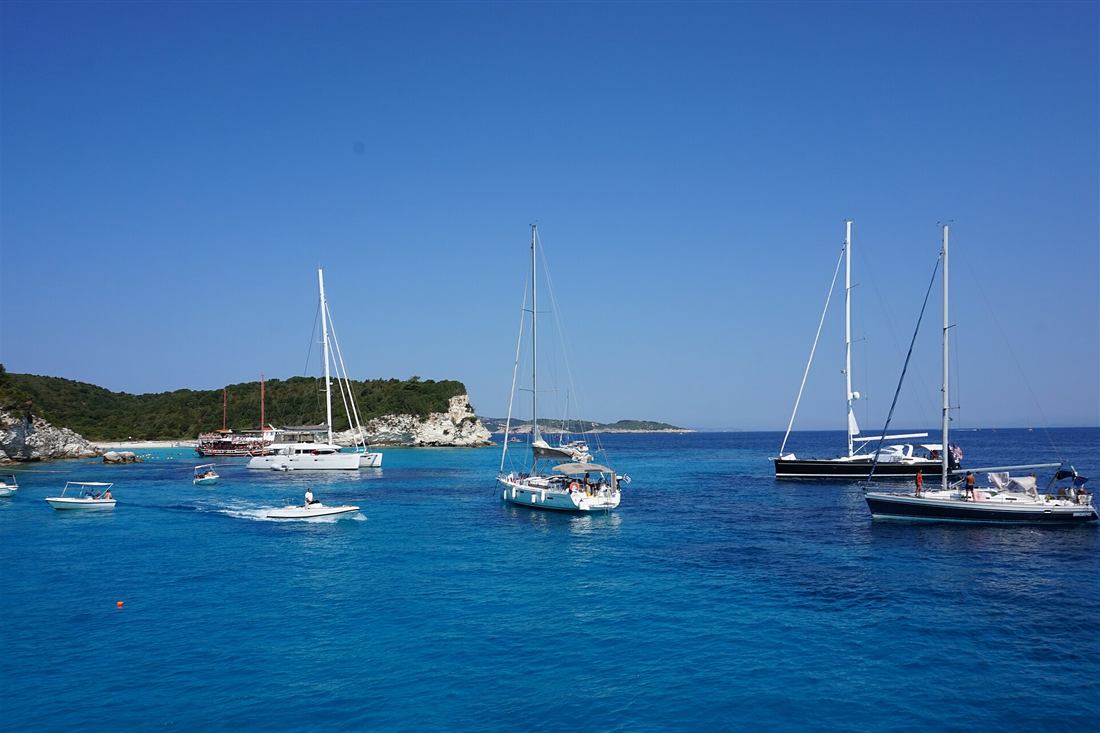
A Parga to Paxos boat trip leaves the quay below the castle in the morning, crosses the open channel to the Ionian island, calls at Gaios or Lakka, rounds the blue caves on the west coast and anchors off Antipaxos for a swim before the run home. Plan the rest of the trip with Greece Tours.
This guide covers the day in full: the crossing and the sea state, the harbours at Gaios and Lakka, Voutoumi and Vrika on Antipaxos, the caves and sea arches, the swim stops, the boats and what they carry, what the ticket includes and what to bring, the timings, the season and the prices.
What is the Parga to Paxos boat trip and where does the boat leave from?
The parga to paxos boat trip is a full-day cruise that leaves from the town quay in Parga, directly below the Venetian castle. One boat covers the blue caves of western Paxos, the beaches of Antipaxos and the harbour of Gaios, then returns the same evening.
The season for a Parga to Paxos boat trip opens in spring and closes in autumn. Boarding starts thirty minutes before departure on the paved waterfront in front of the tavernas, where the crew check names against a printed passenger list. The town car parks sit above Parga, so passengers walk down through the lanes to the water.
Antipaxos and its beaches are the swimming stop of a Parga to Paxos boat trip. Four cruises sell this day from the same quay: From Parga: Antipaxos, Paxos, Blue Caves and Gaios Cruise; Parga: Paxos and Antipaxos Boat Tour with Swim Stops; Parga: Blue Caves, Paxos and Antipaxos Cruise and Swim; and the longer Lakka and Gaios itinerary.
Gaios is the harbour where a Parga to Paxos boat trip puts passengers ashore. Visitors staying across the strait join the same morning sailing after a Parga day trip from Corfu, arriving by road from the Igoumenitsa ferry port with time to spare before the lines are cast off.
How long is the crossing to Paxos and what is the sea like on the way?
The crossing covers twenty nautical miles of open Ionian water. Standard day-cruise boats run it in ninety minutes, and the faster catamarans cut it to seventy. Morning water is glassy; the northwest wind builds after midday and makes the return leg the rough half.
Private charter turns a Parga to Paxos boat trip into a boat for one party. The maistros, the summer northwesterly, rises from late morning and pushes a short steep chop across the channel between the Epirus headlands and the north cape of Paxos. Crews time the outbound leg early for exactly that reason.
Voutoumi and Vrika hold the clearest water a Parga to Paxos boat trip anchors in. Passengers prone to seasickness take a tablet an hour before boarding, sit low and midships over the keel line, and keep their eyes on the horizon rather than on a phone screen.
Lakka in the north is the alternative call on a Parga to Paxos boat trip. The homeward run heads into the wind and the swell, and the deck at the bow takes spray. The stern seats under the awning stay dry from the first mile to the last.
What happens in Gaios, the main harbour of Paxos?
Gaios is the capital and main harbour of Paxos, reached through a narrow green channel behind the wooded islet of Agios Nikolaos. Cruise boats berth on the town quay and release passengers for ninety minutes to two hours ashore.
The price of a Parga to Paxos boat trip is set by the vessel and the group size. The channel run is the photograph of the day: cypress and olive on both banks, a ruined Venetian fort on the islet above the water, and a bottom shallow enough to read from the rail.
The season for a Parga to Paxos boat trip opens in spring and closes in autumn. Ashore, a Venetian square opens behind the waterfront with tavernas, bakeries and shops selling olive-wood bowls and Paxos olive oil. Walking the harbour front end to end takes ten minutes.
Antipaxos and its beaches are the swimming stop of a Parga to Paxos boat trip. Two cash machines serve the harbour and both build queues while the cruise fleet is in, so the practical move is to carry euros over from Parga in the morning.
Which cruises call at Lakka and Loggos on northern Paxos?
Lakka fills a horseshoe bay at the northern tip of Paxos, and Loggos is the small fishing harbour halfway down the east coast. The Lakka and Gaios itinerary calls at both anchorages, while the three shorter cruises pass them from the water.
Booking a Parga to Paxos boat trip ahead secures the deck space in August. Lakka holds the palest water on the island, a turquoise shelf over white sand where the boats anchor and passengers swim ashore or ride the tender to the village quay.
Private charter turns a Parga to Paxos boat trip into a boat for one party. Loggos keeps four tavernas along a working quay under an old soap factory, and the village stays quiet through the middle of the day until the evening trade starts.
Voutoumi and Vrika hold the clearest water a Parga to Paxos boat trip anchors in. Guests already based on the island pick up shorter boat trips around Paxos from these same two harbours instead of crossing the channel from the mainland.
Why are Vrika and Voutoumi on Antipaxos the highlight of the day?
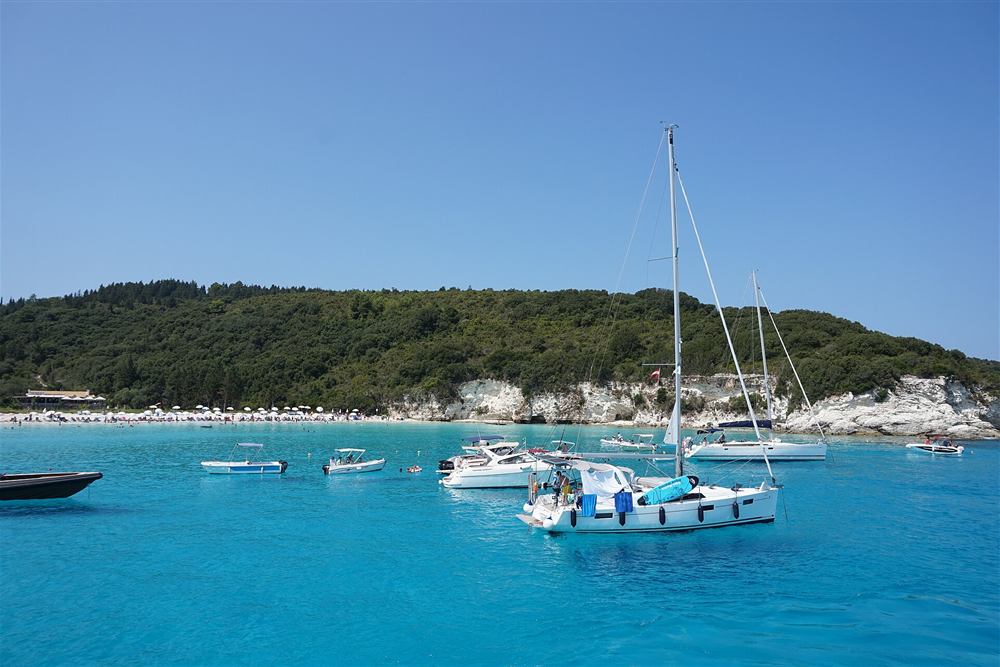
Antipaxos lies three kilometres south of Paxos, a vineyard island of two hundred residents with two celebrated beaches, Vrika and Voutoumi. White limestone under clear water throws back a turquoise that reads as tropical, and all four cruises anchor here.
Loggos is the third harbour on the island, called at by the longer itineraries. Antipaxos and its beaches are the swimming stop of a Parga to Paxos boat trip. Vrika is fine pale sand in a sheltered cove with two tavernas at the back. The cruise boats drop anchor offshore and run a tender in for passengers who want lunch on the beach.
The price of a Parga to Paxos boat trip is set by the vessel and the group size. Voutoumi is steeper, pebbled and wider, with a footpath climbing over the ridge to Vrika in fifteen minutes and a taverna terrace looking straight down into the bay.
The blue caves on the west coast are the scenic leg of a Parga to Paxos boat trip. Visibility reaches ten metres over the pale seabed, which is why the main swim stop is scheduled here rather than off the darker cliffs of the west coast.
What are the blue caves and how close do the boats go in?
The blue caves cut the cliffed west coast of Paxos between Erimitis and Ortholithos. Light refracts through the submerged entrances and lifts the water to electric blue. Small boats enter the wide caverns, and the large day-cruise vessels hold at the mouth and turn.
The channel behind Agios Nikolaos island shelters the approach to Gaios. Voutoumi and Vrika hold the clearest water a Parga to Paxos boat trip anchors in. The named features run in sequence along the coast: the red-brown cliffs of Erimitis, the Ipapanti sea cave, the Tripitos arch cut clean through a headland, and the Ortholithos stack standing off the shore.
Booking a Parga to Paxos boat trip ahead secures the deck space in August. Entry depends on sea state. Flat water lets a captain bring the bow inside the cavern; a westerly swell closes the caves and the route switches to the sheltered east coast instead.
Sea arches and cliffs line the route a Parga to Paxos boat trip follows. Photographs work best shot against the light from inside a cave mouth, with the exposure locked on the lit water rather than on the dark rock overhead.
How are the swim stops organised and how long does each one last?
Each cruise schedules two swim stops of thirty to forty-five minutes, one off Antipaxos and one in a bay on the Paxos coast. The Boat Tour with Swim Stops adds a third anchorage, which stretches total water time past two hours.
Families take a Parga to Paxos boat trip for the swimming and the short crossings. Swimmers enter from a boarding ladder at the stern into open water fifteen metres deep, so confidence out of the depth counts for more than fitness or speed.
Loggos is the third harbour on the island, called at by the longer itineraries. Crew stay on deck and watch the water, and a ring buoy hangs off the transom throughout. Children swim in a buoyancy jacket, which the boats carry in child sizes.
Two swim stops break the day on a Parga to Paxos boat trip. A mask and snorkel turn the Antipaxos stop into the best hour of the day. The larger boats rent gear on board, and passengers bring their own for a better fit.
What are the boats like and what is the passenger capacity on board?
The day-cruise vessels are motor boats of eighteen to twenty-five metres. Capacity runs from eighty to a hundred and fifty passengers. Each carries a shaded lower saloon, an open sun deck with bench seating, a bar and toilets on board.
The olive groves of Paxos rise behind the harbours the boats tie up in. Sea arches and cliffs line the route a Parga to Paxos boat trip follows. Seating is unallocated, so early boarders take the stern shade and the forward rail. The sun deck bakes from midday onwards while the saloon below stays far cooler.
The channel behind Agios Nikolaos island shelters the approach to Gaios. A guide gives commentary over the public address system in English as the boat passes each landmark, and the bar sells water, coffee, beer and toasted sandwiches.
Day-cruise vessels with shade and toilets run the Parga to Paxos boat trip. Smaller operators run rigid inflatables and eight-passenger speedboats over the same route, and those craft enter the narrow caves that the big vessels decline.
What does the ticket include and what do you bring on board?
The ticket covers the return crossing, the cave tour, the swim stops and the harbour calls with a guide on board. Food, drinks, the Antipaxos tender and taverna lunches sit outside it. Bring water, sunscreen, a towel, a hat and cash.
A Parga to Paxos boat trip leaves the quay below the castle in the morning. Two litres of water per person is the working figure, because the deck temperature runs above the shade reading and the on-board bar charges resort prices for a bottle.
Families take a Parga to Paxos boat trip for the swimming and the short crossings. Cash matters in Gaios and on Antipaxos, where the beach tavernas and the tender operators take euros first and treat a card payment as a fallback.
A Parga to Paxos boat trip runs eight to nine hours from the quay and back. A dry bag protects a phone on the wet bow, and water shoes handle both the pebble at Voutoumi and the metal ladder rungs at the swim stop.
What is the total day length and what are the departure and return times?
The day runs nine to ten hours door to door. Boarding opens at 08:30, departure falls between 09:00 and 09:30, and the boat ties up again on the Parga quay between 17:30 and 18:30. Hotel transfers are not part of it.
The crossing on a Parga to Paxos boat trip covers open water in about ninety minutes. The shape of the day is fixed: ninety minutes out, the caves and the west coast, the Antipaxos swim, lunch and free time in Gaios, then the crossing back to Epirus.
The olive groves of Paxos rise behind the harbours the boats tie up in. Passengers walk to the quay under their own steam, since the four cruises sell as a pier-to-pier product with no pickup from accommodation anywhere in the resort.
Cash for Gaios is worth carrying on a Parga to Paxos boat trip. The return lands in time for a shower and dinner in the Parga lanes, and the sunset over Valtos beach follows about an hour after that.
When does the season run and what cancels a sailing?
The cruises run from spring through to the middle of autumn, with daily departures across the peak weeks of July and August. Wind cancels a sailing: when the northwesterly pushes past force six, the port authority holds the whole fleet in harbour.
Gaios is the harbour where a Parga to Paxos boat trip puts passengers ashore. Operators confirm the next morning’s sailing the evening before, and a cancellation converts into a full refund or a transfer to the following day at no extra charge.
A Parga to Paxos boat trip leaves the quay below the castle in the morning. Shoulder-season departures drop to four or five a week, and the boats fill on the calm days rather than on any fixed pattern in the calendar.
Water, sunscreen and a hat are the kit for a Parga to Paxos boat trip. An inland alternative fills a blown-out day: rafting and kayaking on the Acheron river sits forty minutes from Parga and runs whatever the sea is doing.
What do the cruises cost and when do you book?
The shared cruise sits in a thirty-five to fifty-five euro band per adult, with children under twelve at reduced fares and infants free. A private charter out of Parga starts near six hundred euros for the boat and climbs with size and crew.
Lakka in the north is the alternative call on a Parga to Paxos boat trip. The longer Lakka and Gaios itinerary prices above the three shorter cruises, because the day adds an anchorage in the north and an extra hour on the water.
The crossing on a Parga to Paxos boat trip covers open water in about ninety minutes. High-summer sailings sell out two to four days ahead, the front-row seats go to the earliest bookings, and free cancellation runs to twenty-four hours before departure.
A strong north-westerly cancels a Parga to Paxos boat trip rather than risking the channel. Groups of six and up compare well against per-head tickets on a private yacht charter from Parga, which sets its own route, its own pace and its own swim stops.
Frequently Asked Questions
How long is a Parga to Paxos boat trip?
Eight to nine hours from the quay and back, with about ninety minutes of open water each way, two to three hours ashore at Gaios or Lakka, and two swim stops on the Antipaxos coast.
What does a Parga to Paxos boat trip cost?
The shared day cruise costs from about 35 to 55 euros per adult. A private charter for the boat runs from about 600 euros for the day, set by the vessel and the group size.
What runs on a rough day?
The captain cancels rather than crossing the channel in a strong north-westerly, and the operator moves the booking to the next sailing or refunds it. The morning forecast decides the day.