
The Church of Panagia Evangelistria Tinos is the holiest Marian shrine in Greece, built around a miraculous icon of the Annunciation and host to the largest Orthodox pilgrimage in the country each August 15. The marble basilica rises above Tinos Town and gives the island its identity as a sacred destination. This guide covers the icon, the pilgrimage, the architecture and how to visit. Plan the whole trip with Greece Tours.
The shrine of Panagia Evangelistria Tinos draws hundreds of thousands of pilgrims a year, many seeking healing before its silver-clad icon. The shrine sits at the top of Tinos Town, a short walk from the ferry port, and anchors the religious life of the whole Cyclades. The sections below explain the history, the miracle, the great feast and the practical details of a visit to this defining landmark of Tinos.
What is the Church of Panagia Evangelistria?
The Church of Panagia Evangelistria is a Greek Orthodox basilica that houses a miraculous icon of the Annunciation. Built of Tinian and Parian marble above Tinos Town, it is the most important Marian pilgrimage site in Greece.
Panagia Evangelistria, also called Panagia Megalochari, stands as the spiritual heart of the island. The white marble church crowns a hill at the top of the main avenue, reached by a wide ceremonial street from the harbour. Pilgrims come year-round to venerate the icon, light candles and seek the Virgin’s intercession, while the complex also holds chapels, museums and a holy spring. The shrine functions as both a working church and a national religious landmark. Its fame rests on a discovery in the early 19th century.
Why is Panagia Evangelistria so important?
Panagia Evangelistria is important because its icon is believed to work miracles, especially healing, which makes it the foremost Marian shrine in Greece. The August 15 pilgrimage draws crowds from across the Orthodox world to the church.
The church holds a status in Greek Orthodoxy comparable to Lourdes in Catholicism. Believers credit the icon with countless healings and answered prayers, and the shrine receives offerings, vows and pilgrimages from across Greece and the diaspora. The discovery of the icon, soon after Greek independence, gave the young nation a powerful symbol of divine favour, which deepened its national significance. The church became a focus of both faith and patriotism. Every year the Greek president, government ministers and military honour guards attend the August 15 service, underlining the shrine’s national weight. Pilgrims arrive not only from Greece but from Orthodox communities worldwide, and the offerings they leave fund hospitals and welfare projects across the country. The sheer scale of devotion sets Panagia Evangelistria Tinos apart from any other church in the Cyclades. Travellers exploring the wider things to do in Tinos find the shrine the island’s defining sight. The story behind it begins with a nun’s vision.
What is the story of the miraculous icon?
The icon of Panagia Evangelistria was found buried in a field in the early 19th century, after a nun named Pelagia saw repeated visions of the Virgin revealing its location. The icon depicts the Annunciation and is attributed by tradition to the Apostle Luke.
The discovery story shapes the entire shrine. Sister Pelagia, a nun at the nearby Kechrovouni Monastery, reported visions in which the Virgin Mary directed her to a buried icon. After digging in an indicated field, workers uncovered the icon of the Annunciation amid the ruins of an older Byzantine church. The find, soon after the Greek War of Independence, was hailed as a miracle and a national blessing. The church rose on the spot to enshrine it. The icon, now covered in silver, gold and jewels left as offerings, remains the focus of every pilgrimage to the shrine. Tradition holds that the painting is one of those made by the Apostle Luke, which adds to its sanctity in the eyes of believers. The original colours are now hidden beneath the precious metal casing, so pilgrims venerate the framed and jewelled icon rather than the bare panel. Its discovery amid the ruins of an earlier church convinced the faithful that the site had always been holy ground. The greatest of these falls in midsummer.
When is the Tinos pilgrimage?
The main Tinos pilgrimage falls on August 15, the feast of the Dormition of the Virgin, the most important Marian holiday in Greece. A second great pilgrimage marks the Annunciation on March 25, the date the church celebrates its icon.
Two feast days define the calendar of Panagia Evangelistria. August 15, the Dormition of the Theotokos, is a national holiday and the peak pilgrimage, when tens of thousands fill the island. March 25 marks both the Annunciation, the icon’s subject, and Greek Independence Day, joining faith and nation in a single celebration. The week around August 15 sees the island at its busiest, with every bed booked months ahead, a pattern the guide to the best time to visit Tinos explains. The August feast carries the most striking scenes.
What happens during the August 15 pilgrimage?
During the August 15 pilgrimage, thousands of believers walk from the harbour to the church, many crawling on their knees up a carpeted lane to fulfil a vow. The icon is carried in procession, and the streets fill with prayer, candles and crowds.
The Dormition pilgrimage produces some of the most moving scenes in Greece. Pilgrims disembark at the port and make their way up the main avenue to the shrine, some on their knees along a padded strip laid for the purpose, in fulfilment of a tahma, or sacred vow. Inside, worshippers queue to venerate the icon and leave offerings. On the feast day itself, the icon is carried in a solemn procession through the streets, accompanied by clergy, navy honour guards and vast crowds. The atmosphere blends deep devotion with national ceremony. Warships of the Hellenic Navy anchor in the bay, flags line the route, and the streets fill from dawn with families who have travelled overnight by ferry. Many pilgrims sleep on the church grounds or in the squares to keep their place near the icon. Stalls sell candles, incense and religious keepsakes along the avenue, and the air carries chanting and the scent of beeswax. The scale of the August gathering at Panagia Evangelistria Tinos has no equal in the Greek religious calendar. This intensity contrasts with the calm of the marble building itself.
What is the architecture of the church?
The architecture of Panagia Evangelistria centres on a white basilica of Tinian and Parian marble, set within a courtyard of mosaic pebbles. Carved fanlights, columns and a grand marble staircase reflect the island’s renowned sculpture tradition.
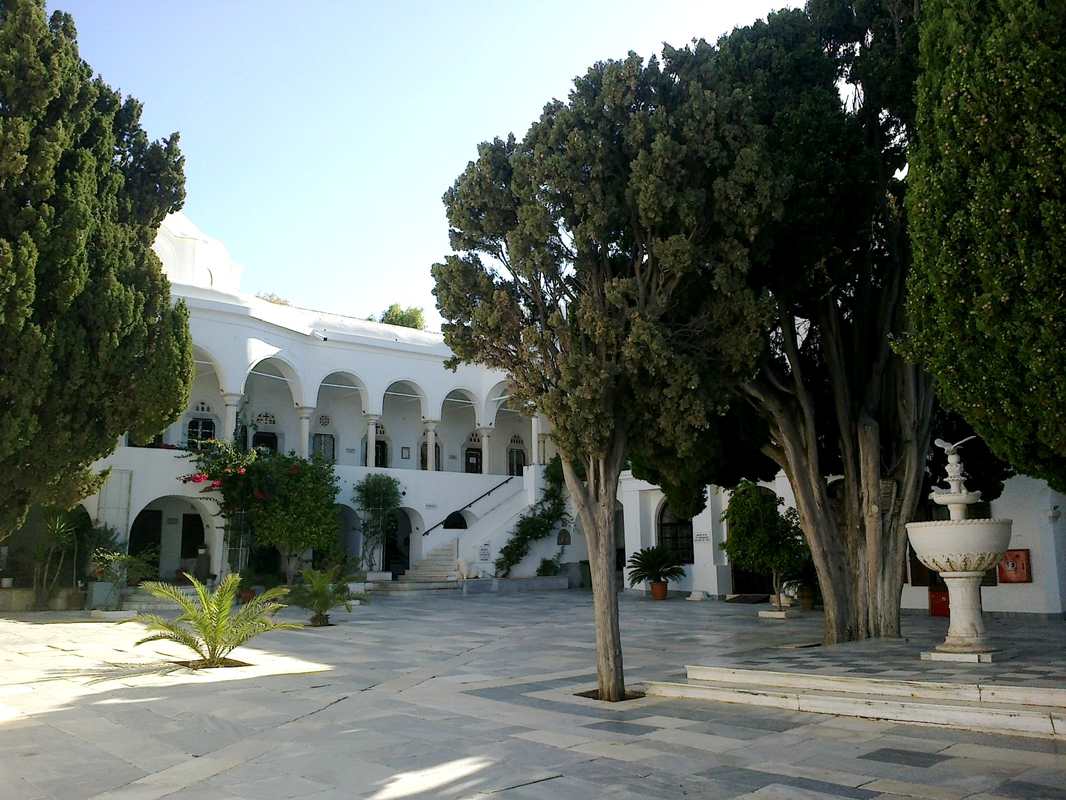
The church showcases the marble craft for which Tinos is famous. Local sculptors built and decorated the basilica with carved columns, reliefs and an ornate iconostasis, all in gleaming island marble. A broad marble staircase climbs to the main church, and the courtyard below is paved with the black-and-white pebble mosaics typical of the Cyclades. Bell towers, arcades and chapels surround the central nave. The whole complex functions as a showcase of Tinian sculpture, a craft detailed in the guide to the marble craft of Tinos. The dazzling white of the marble against the blue Aegean sky makes the church visible from the harbour and from arriving ferries. Inside, the iconostasis and the canopy over the icon represent some of the finest carving on the island. The pebble-mosaic courtyard, worked in black and white stones, depicts religious and maritime motifs underfoot. Every surface reflects the skill of the Pyrgos-trained sculptors who gave the shrine its grandeur. Inside, the shrine holds far more than the icon.
What can you see inside the church complex?
Inside the Panagia Evangelistria complex you can see the miraculous icon, the crypt with its holy spring, museums of offerings and art, and chapels. The walls hang heavy with silver and gold ex-votos, including model ships left in thanks.
The complex rewards an unhurried hour beyond the main icon. The upper church holds the silver-clad icon and an interior thick with hanging lamps and votive offerings. Below, the crypt marks where the icon was found and shelters a holy spring. Several museums display ecclesiastical art, sculpture and the offerings of grateful pilgrims, from jewels to silver ship models given by sailors saved at sea. Galleries show religious paintings and island artefacts. The sheer weight of ex-votos testifies to the faith invested in Panagia Evangelistria Tinos. Sailors and ship-owners have long left silver and gold models of vessels in thanks for rescue at sea, and these crowd the walls beside crutches, jewellery and inscribed plaques. The museums hold Byzantine and post-Byzantine icons, vestments and sculpture, while a gallery displays works donated by Greek artists. A picture gallery and a collection of the island’s marble art round out the holdings. Allow time to climb between the levels, since each holds a distinct part of the shrine’s story. The crypt holds a particular significance.
What is the holy spring and crypt?
The crypt of Panagia Evangelistria marks the spot where the icon was unearthed and contains a holy spring, or agiasma. Pilgrims collect the blessed water, believed to carry healing properties, in bottles to take home.
The crypt connects every visitor to the founding miracle. Set beneath the main church, it preserves the site of the icon’s discovery and the spring that emerged there. Pilgrims descend to fill small bottles with the agiasma, the blessed water, which they keep for healing and blessing. The crypt also holds a chapel and, by tradition, commemorates victims lost at sea, including those of the cruiser Elli, sunk in the harbour during the Second World War on the very feast day. The space carries a quiet, solemn and deeply moving weight. Pilgrims often queue patiently to enter the small chamber, lighting candles and praying at the site of the find. The spring is channelled to taps where the faithful fill their bottles, and many believe the water aids recovery from illness. The contrast between the bright, crowded upper church and the cool, dim crypt below gives the visit an emotional arc. For many pilgrims, the crypt is the most moving part of the whole shrine. The nun behind the discovery is herself venerated.
Who was Saint Pelagia of Tinos?
Saint Pelagia of Tinos was the nun whose visions led to the discovery of the icon at Panagia Evangelistria. She lived at the Kechrovouni Monastery, where her cell is preserved, and the Orthodox Church later canonised her.
Pelagia’s role makes her inseparable from the shrine. A nun at the fortified Kechrovouni Monastery in the hills above Tinos Town, she reported the visions of the Virgin that pinpointed the buried icon. Her account, tested and accepted by the church, set the discovery in motion. The Orthodox Church later recognised her as a saint, and her preserved cell at Kechrovouni draws pilgrims tracing the story to its source. The monastery, one of the largest in Greece, sits among the villages explored in the guide to the villages of Tinos. Visitors can trace the whole story by pairing the shrine with Kechrovouni, walking from the place of veneration to the cell where the visions occurred. The monastery preserves Pelagia’s room, her relics and a small museum, set within a fortified village of whitewashed lanes high above the coast. The drive up rewards pilgrims with sweeping views and a quieter, more contemplative counterpart to the busy church below. The shrine’s reputation rests on its miracles.
Is Panagia Evangelistria the Lourdes of Greece?
Panagia Evangelistria is often called the Lourdes of Greece, because pilgrims credit its icon with miraculous healings. Like the French shrine, it draws the sick and the faithful who come to pray, venerate the icon and seek the Virgin’s help.
The comparison captures the shrine’s role in Greek faith. As Lourdes does for Catholics, Panagia Evangelistria offers Orthodox believers a focus for hope and healing, and the walls of offerings record the cures and rescues attributed to the Virgin. Pilgrims arrive throughout the year, not only on the great feasts, often having travelled far to fulfil a vow. The shrine’s charitable foundation channels offerings into hospitals, schools and relief work across Greece. This blend of devotion and good works sustains its standing. Stories of the cured and the saved pass by word of mouth and fill the offerings that line the walls, each a private testimony made public. The sick are often carried to the icon, and parents bring children to be blessed. For believers, the shrine offers not a guarantee but a focus for hope, prayer and gratitude. That role, more than any single miracle, explains why the church draws such enormous and constant devotion. A second feast complements the August pilgrimage.
How do you visit the Church of Panagia Evangelistria?
You visit the Church of Panagia Evangelistria free of charge, a short walk up the main avenue from the ferry port in Tinos Town. The church opens daily, and a modest dress code applies to all visitors.
A visit is simple and central. The church stands at the top of Megalocharis Avenue, the wide ceremonial street that climbs directly from the harbour, a walk of about five minutes. Entry is free, and the shrine welcomes visitors of all faiths daily from morning into the evening, with longer hours around the feasts. Inside, visitors light candles, venerate the icon and explore the museums and crypt. The central position means most travellers reach it on foot, as the guide to how to get to Tinos describes. The walk up the avenue passes shops selling candles, incense and votive offerings, which pilgrims buy before entering. Wheelchair access is possible via ramps, though the marble steps form the traditional route. The church stays open through the middle of the day, unlike many smaller Greek churches that close for the afternoon. Arriving early or late avoids both the heat and the tour-group crowds at Panagia Evangelistria Tinos. A few customs guide behaviour inside.
What is the dress code and etiquette at the church?
The dress code at Panagia Evangelistria is modest: covered shoulders and knees for both men and women. Visitors keep quiet, avoid flash photography during services, and follow the queue to venerate the icon respectfully.
Respectful behaviour matters at an active shrine. Visitors cover shoulders and knees, with a light scarf or wrap sufficing for those in beachwear. Inside, the tone stays hushed, especially during the frequent services, and photography is limited or discouraged near the icon and the altar. Pilgrims light a candle on entering and join the queue to kiss the icon. Modesty and quiet apply year-round, and the crowds of August 15 call for extra patience. Observing these customs honours the faith of the pilgrims around you. Lighting a thin beeswax candle at the entrance is the customary first act, and visitors may leave a small offering in the boxes provided. Mobile phones should be silenced, and conversation kept to a whisper near the icon. Those who wish may join the queue to venerate the icon with a kiss, though no one is obliged to. Simple awareness of the worship in progress is enough to visit respectfully, whatever one’s own beliefs. The timing of a visit shapes the experience.
When is the best time to visit Panagia Evangelistria?
The best time to visit Panagia Evangelistria for calm reflection is outside the August 15 and March 25 feasts, when crowds are smaller. To witness the great pilgrimage, visit on August 15, but expect dense crowds and booked-out accommodation.
Timing depends on what a visitor seeks. For a quiet, contemplative visit, the late spring and early autumn months bring mild weather and modest crowds, ideal for exploring the church and museums at leisure. To experience the full intensity of Greek Orthodox devotion, the August 15 pilgrimage is unmatched, though it demands months-ahead booking and tolerance for crowds. The week around the feast transforms the whole island. Pairing the shrine with a guided cultural tour adds context, as the guide to Tinos tours and guided experiences shows. Morning visits before the cruise groups arrive offer the calmest experience, with soft light filling the marble courtyard. The week around August 15 is best avoided by travellers seeking quiet, as the island fills and ferries sell out. Those drawn precisely by the spectacle, however, should arrive several days early and book months ahead. Whatever the season, a short visit reveals why the shrine defines the island’s identity. The questions below cover the points travellers ask most.
What is the history of the church?
The history of Panagia Evangelistria Tinos began soon after Greek independence, when the icon was discovered in the early 19th century. The state and the faithful funded a grand marble church on the site, which grew into a national shrine.
The church rose at a defining moment for modern Greece. The icon came to light just as the new nation emerged from its war of independence, and the discovery was read as a sign of divine favour on the young state. Donations poured in from across the Greek world, and the island’s own sculptors built the marble basilica that stands today. A charitable foundation, the Panhellenic Holy Foundation of Evangelistria, was established to manage the shrine and its offerings, directing funds to hospitals, schools and relief work. Over the following generations the complex expanded with museums, galleries and guesthouses for pilgrims. The marble for the church came from the island’s own quarries, worked by the same families who carved its villages, which tied the building to local craft as well as national faith. Successive additions raised the bell towers, laid the courtyards and built the grand staircase that pilgrims climb today. The shrine became woven into the national story as much as the religious one. One wartime tragedy bound it even closer to the nation.
What is the cruiser Elli connection to the church?
The cruiser Elli was a Greek warship torpedoed in Tinos harbour during the August 15 pilgrimage in the Second World War, while honouring the feast at Panagia Evangelistria Tinos. The attack, before Greece entered the war, is commemorated at the shrine.
The sinking of the Elli marks one of the most poignant episodes tied to the church. The light cruiser had anchored off Tinos to take part in the Dormition festivities when it was struck by torpedoes from a submarine, before Greece had entered the conflict. The attack on a holy day shocked the nation and is remembered as a symbol of unprovoked aggression. The shrine and the island commemorate the victims each year, and relics of the event are preserved within the complex. The tragedy deepened the bond between the church, the navy and the Greek people. The shrine’s life, however, runs on a steady annual cycle.
What services and feast days take place at the church?
Daily liturgies, vespers and the veneration of the icon take place at Panagia Evangelistria Tinos year-round. The great feasts of the Annunciation on March 25 and the Dormition on August 15 bring the largest services and processions.
The church functions as a living place of worship, not only a monument. Priests celebrate the Divine Liturgy each morning and vespers in the evening, and a steady stream of pilgrims venerates the icon throughout the day. Beyond the two great Marian feasts, the calendar includes the memory of Saint Pelagia, weekly services and the blessing of pilgrims who arrive to fulfil vows. Choirs, candles and incense fill the marble interior during the major celebrations. The rhythm of services gives the shrine a constant devotional pulse between the headline pilgrimages. Sunday liturgies draw the island’s own congregation alongside visitors, and name-day celebrations bring families to baptise children or give thanks. The chanting of the cantors, the gilded lamps and the clouds of incense create an atmosphere unchanged for generations. Even on an ordinary weekday, a steady trickle of pilgrims keeps candles burning before the icon. This unbroken devotion, not only the great feasts, defines the living church. Visitors of every background are welcome to observe.
Can non-Orthodox visitors and families visit the church?
Non-Orthodox visitors and families are welcome at Panagia Evangelistria Tinos, free of charge, provided they dress modestly and stay quiet during services. The museums, crypt and courtyard interest children and travellers of all faiths.
The shrine opens its doors to everyone. Visitors of any faith, or none, may enter to admire the marble architecture, the icon and the museums, as long as they respect the dress code and the worship in progress. Families find the courtyard, the holy spring and the silver ship offerings engaging for children, who respond to the stories of the discovery and the sea rescues. The free entry and central location make the church an easy stop on any island itinerary. Quiet curiosity is welcomed, while photography near the icon is restrained. A respectful visit leaves a strong impression of Greek devotion. The questions below cover the points travellers ask most.
Frequently Asked Questions
Why is Tinos famous for its church?
Tinos is famous for the Church of Panagia Evangelistria, which houses a miraculous icon of the Annunciation found in the early 19th century. The shrine is the holiest Marian pilgrimage site in Greece and hosts the country’s largest pilgrimage each August 15.
Is entry to Panagia Evangelistria free?
Entry to Panagia Evangelistria is free for all visitors. The church, crypt and museums welcome pilgrims and travellers daily, with a modest dress code of covered shoulders and knees, and donations support the shrine’s charitable foundation, which funds hospitals, schools and welfare work across Greece from the offerings it receives.
What is the August 15 pilgrimage in Tinos?
The August 15 pilgrimage in Tinos marks the Dormition of the Virgin, the most important Marian feast in Greece. Thousands of pilgrims walk and crawl from the port to the church, and the miraculous icon is carried in a solemn procession. The Greek state, navy and church all take part, and the island fills to capacity, so accommodation and ferries must be booked months in advance for those wishing to attend.
Why do pilgrims crawl to the church in Tinos?
Pilgrims crawl on their knees up the carpeted avenue to the church in Tinos to fulfil a tahma, a sacred vow made in exchange for healing or help. The act of penance and gratitude is most visible during the August 15 pilgrimage, when a padded strip is laid along the route and many complete the climb in the heat as a deeply personal expression of faith.
How do you get to the church from the Tinos port?
You get to the church from the Tinos port by walking about five minutes up Megalocharis Avenue, the wide street climbing directly from the harbour. The Church of Panagia Evangelistria stands at the top, visible from the waterfront below and from arriving ferries, its white marble facade marking the highest point of the town.
What dress code applies at Panagia Evangelistria?
A modest dress code applies at Panagia Evangelistria, with covered shoulders and knees for men and women. Visitors arriving from the beach use a scarf or wrap, keep quiet inside, and limit photography near the icon and during the frequent daily services.