
Where to eat in Chania ranges from the Venetian harbour tavernas to the value backstreets of Splantzia, the mezedopoleia pouring raki, the fish tavernas of Nea Chora and the stalls of the covered market, serving Cretan dishes from dakos and boureki to gamopilafo across western Crete. Plan the whole trip with Greece Tours.
This guide covers where to eat in Chania in full: the harbour versus the backstreets, the Cretan dishes to seek out, the Splantzia squares, the fish tavernas, the covered market, the raki and meze ritual, the vegetarian and vegan food, the sweets and breakfast, the cooking classes and food tours near the old town, the prices, and the late Greek dinner hours.
Where do you eat in Chania?
You eat across four distinct zones: the Venetian old harbour for waterfront dining, the Splantzia backstreets for shaded tavernas, the covered market for produce and cheese, and the Cretan mezedopoleia and rakadika scattered through the lanes behind the port.
Chania divides its food geography by mood and price. The curved Venetian harbour puts tables at the water’s edge beneath the lighthouse, and the tariff there reflects the view. Step one lane back, into the maze of Topanas and Splantzia, and the same Cretan dishes arrive at family-run tables for less money, cooked by owners who source from the hills of the Chania regional unit. The town rewards the diner who walks inland.
The covered market anchors the daytime eating, stacked with graviera wheels, barrels of olives, wild greens, thyme honey and tomatoes grown in the Messara plain. Around it, the mezedopoleia and rakadika serve small plates with tsikoudia, the Cretan grape-pomace spirit poured after every meal. For a full orientation to the destination and its neighbourhoods, the Chania hub maps how the eating quarters connect to the beaches, the museums and the day trips.
Nea Chora, the fishing suburb a ten-minute walk west of the harbour, keeps the fish tavernas where boats land the catch each morning. Splantzia, the old Turkish quarter around the plane-tree square of Plateia 1821, holds the intimate raki bars. The result is a compact food capital where a diner crosses from a seafront lobster grill to a two-euro plate of dakos inside a single evening on foot.
Season and time of day redraw the map. Mornings belong to the bougatsa counters and the kafeneia; midday to the market stalls and the mezedopoleia; the evening to the harbour terraces and the rakadika of Splantzia. The town eats outdoors from spring through autumn, tables spilling into the lanes under vine canopies and awnings. A first-time diner walks the harbour once for the view, then spends the rest of the trip inland where the cooking runs deeper and the prices fall.
What Cretan dishes do you eat in Chania?
You eat dakos, boureki, kalitsounia, gamopilafo, apaki, staka, chochlioi boubouristi and antikristo \u2014 a canon built on barley rusk, wild greens, courgette, mizithra cheese, smoked pork, snails and spit-roasted lamb, dressed in Chania olive oil.
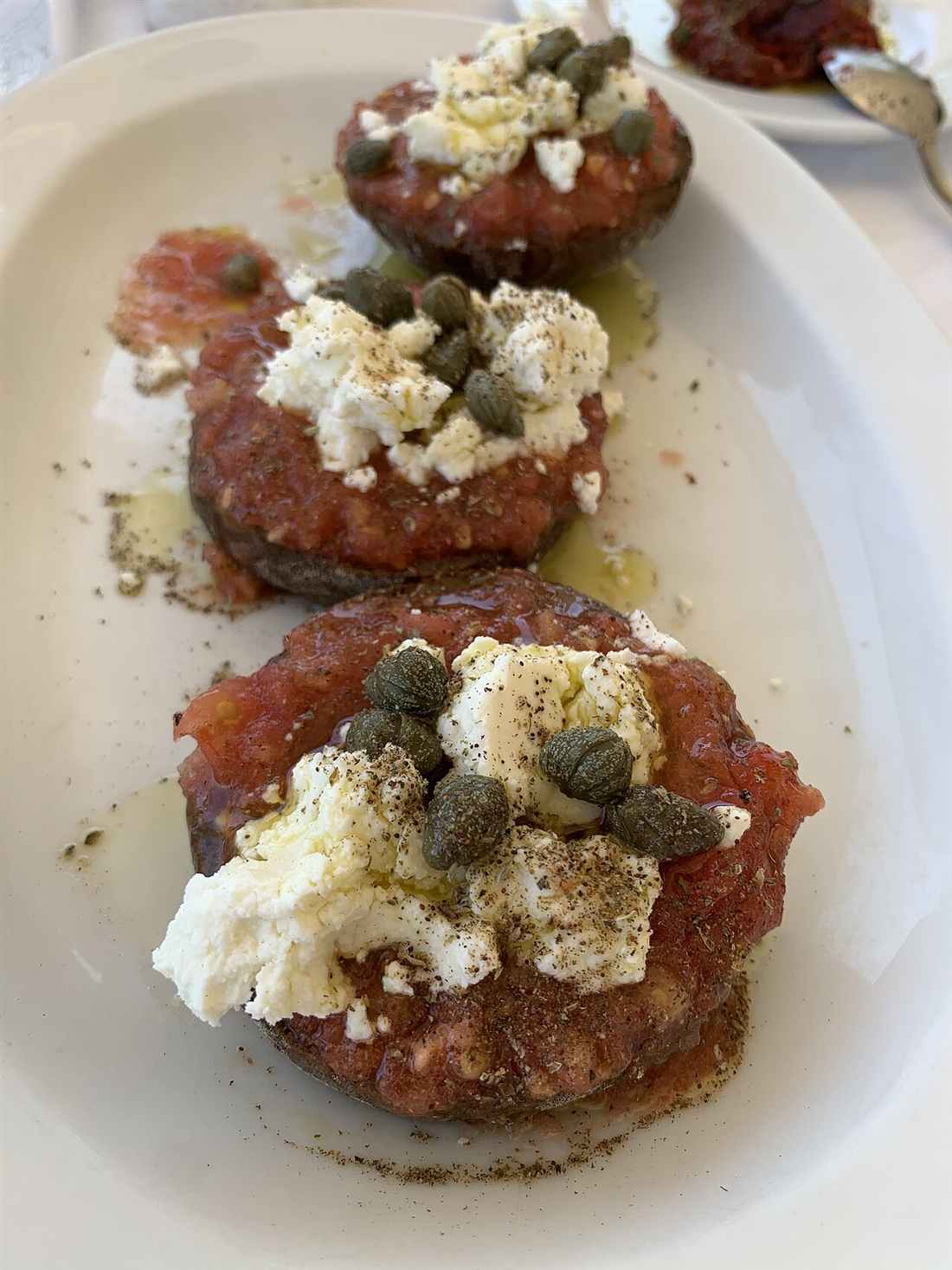
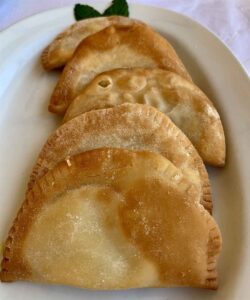
Dakos leads the table: a round barley rusk soaked to soften, piled with grated ripe tomato, crumbled mizithra or feta, oregano and a flood of oil. Boureki is the Chania signature, a baked layering of thin-sliced courgette and potato with mizithra and mint, and it belongs to this town more than any other on the island. Kalitsounia are the small cheese or herb pies, folded or coiled, brushed with honey when sweet.
Gamopilafo, the wedding rice, is cooked in goat and chicken stock until creamy and finished with staka butter \u2014 a dish reserved for feasts and served year-round in the tavernas that keep the tradition. Apaki is pork marinated in vinegar and smoked over aromatic herbs, then sliced thin. Staka, the rich cream skimmed from sheep’s milk and cooked with flour, arrives with fried eggs or stirred through pilaf.
Chochlioi boubouristi are snails fried face-down in a hot pan, splashed with vinegar and rosemary, and eaten straight from the shell \u2014 a plate that defines a proper raki session. Antikristo is lamb staked in a ring around an open fire and cooked “facing” the flame, a shepherds’ method from the mountains. Every one of these dishes rests on the region’s oil; the Crete olive oil pressed around Chania carries the flavour that binds the whole cuisine together.
Beyond the headline plates sit the everyday supports of the Cretan table: pilafi cooked in meat stock, sfakianes pites folded thin, gemista stuffed with rice, ofto lamb baked slow, and hondros \u2014 cracked wheat simmered with meat into a thick porridge. Cheese threads through all of it, from the firm graviera to the fresh mizithra and the sharp aged xinomizithra. The barley rusk, the paximadi, sits on the table beside the bread as the base for dakos and the shepherd’s field lunch. Together these dishes trace a cuisine of the mountains and the sea meeting on one plate.
Where do you eat in Chania old town and the harbour?
You eat along the Venetian waterfront for the lighthouse view and a premium, and in the value backstreets of Topanas and Splantzia one lane inland for the same Cretan cooking at family prices. The trade-off is scenery against thrift.
The harbour arc, from the Firka fortress round to the mosque of the Janissaries, lines its edge with tables that face the water and the illuminated Egyptian lighthouse after dark. Diners pay for that frontage, and the menus lean toward grilled fish, seafood platters and the crowd-pleasing staples. The setting earns the visit at least once, and the sunset over the mole is the reason the seats fill early in high summer.
Turn inland and the arithmetic changes. The stepped lanes of Topanas, the old Christian and Venetian quarter west of the port, hide courtyards roofed with vine leaves where the boureki costs a third less and the tomato in the dakos tastes of the field it grew in. These kitchens cook for locals as much as visitors, and the owner who greets you pressed the oil or knows the shepherd who cured the apaki.
The old town is a walking labyrinth of Venetian and Ottoman stonework, and the food scene rewards getting lost in it. A guide to the quarter’s lanes, monuments and eating spots sits at Chania old town, which threads the tavernas to the harbour walls and the hidden squares. The rule holds across the peninsula: the closer the table to the water, the higher the bill; the deeper into the stone maze, the truer the plate.
Where do you eat in the Splantzia quarter?
You eat in Splantzia at the mezedopoleia ringing Plateia 1821 and along Daliani and Kanevaro streets, where shaded tables under the giant plane tree serve small plates with carafes of raki in the old Ottoman heart of the town.
Splantzia is the eastern quarter of the old town, built around the square that carries the date of the Cretan revolt against Ottoman rule. A vast plane tree throws shade over the tables, and the church of Agios Nikolaos with its twin minaret-and-bell-tower marks the corner. The mood is unhurried, the lanes free of harbour crowds, and the eating leans toward the mezedopoleio format: a spread of small dishes shared across a long, slow table.
The plates that land here run to fava with capers, fried kalitsounia, grilled sausage laced with orange, marinated anchovies, gigantes beans baked in tomato, and boards of graviera and apaki. Owners bring the food in waves and refill the raki carafe without asking. Daliani street, once the heart of the old Jewish and Ottoman market, threads north from the square lined with tiny courtyards.
Raki culture governs the rhythm. The tsikoudia arrives cold in a small carafe, poured into shot glasses, and the meal proceeds one meze and one toast at a time. “Yamas” precedes each round. This is the quarter for a long evening rather than a quick plate, and the price stays gentle because Splantzia cooks for its own neighbourhood first. The square fills after dark when the day’s heat lifts and the families come out.
Splantzia holds the town’s layered history in its stonework, and the eating carries that memory. The quarter passed through Byzantine, Venetian and Ottoman hands, and the food records each: the coffee ritual, the honey pastries, the fried snails, the herb pies. Musicians play the lyra and laouto in the squares on warm nights, and the taverna owners know their regulars by name. A diner who settles in here at nine and rises past midnight has eaten the way the town has eaten for generations, unhurried and shared across the table.
Where do you eat seafood and fish in Chania?
You eat seafood at the fish tavernas of Nea Chora, the fishing suburb west of the old town, and along the harbour, where the daily catch is sold by the kilo \u2014 red mullet, sea bream, sardines, calamari, prawns, sea urchin and grilled octopus.
Nea Chora is the address for fish. A ten-minute walk west of the Venetian port brings you to a small beach and a strip of tavernas where the boats tie up and the catch reaches the ice display within hours of landing. You choose the whole fish from the counter, it is weighed in front of you, and the price is quoted by the kilo before it hits the charcoal. Barbounia (red mullet), tsipoura (sea bream) and fresh sardines head the board.
The harbour tavernas serve the same repertoire with the lighthouse backdrop and a higher tariff. Octopus is hung to dry on lines by the water, then grilled and dressed with oil and vinegar. Kalamari comes fried in light batter or stuffed with cheese and herbs. Garides saganaki sets prawns in a tomato-and-feta sauce, and achinosalata spreads raw sea-urchin roe on bread for those who chase the sharpest flavours of the Cretan sea.
The honest way to order fish in Chania is to ask what came in that morning and to accept the kilo price before cooking. Small oily fish \u2014 gavros, sardeles, marides \u2014 cost little, arrive crisp from the fryer, and pair with a squeeze of lemon and a carafe of white. Larger prized fish command the premium of any Mediterranean port. The waterfront ouzeri format pairs a plate of grilled fish with ouzo or tsikoudia and a slow view of the moored boats.
The catch shifts with the season and the weather. Calm summer seas bring the small fish and the octopus; the cooler months land the larger bream and bass. Fish soup \u2014 kakavia, built from the day’s mixed small fry, potato and oil \u2014 turns the humblest catch into a meal. Diners who want the freshest plate arrive at Nea Chora in the evening, when the boats have unloaded and the ice counters carry the day’s landing. The suburb keeps its working-port character, and the tavernas cook the fish plainly, on charcoal with oil, lemon and oregano, letting the sea do the work.
What is the Chania covered market for food?
The Agora, Chania’s cross-shaped covered market, is the town’s food hall: stalls of Cretan graviera and mizithra, barrels of olives and oil, thyme honey, dried herbs, mountain tea, charcuterie, fresh fish and produce, plus small counters cooking the market’s own raw ingredients to order.
The Municipal Market sits at the edge of the old town in a grand cross-plan hall of iron and stone. Its four arms each hold a trade: butchers and charcuterie down one, fishmongers on ice down another, and the long runs of cheese, honey, herbs, spices, olives, rusks and bottled oil filling the rest. This is where a self-catering visitor stocks a picnic and where a cook buys the graviera, the barley dakos rusk and the wild oregano that build a Cretan table.
The Chania cheeses lead the shopping. Graviera Chanion is the firm, nutty sheep’s-milk cheese that carries a protected designation from the region, aged in mountain cellars. Mizithra, soft and fresh, goes into the dakos and the boureki. Anthotyros and the sharp, aged xinomizithra fill out the boards. Alongside sit the herb stalls \u2014 dried thyme, sage, dittany (diktamo), and the mountain tea (malotira) brewed against colds.
Small tavern counters inside the arms cook the market’s ingredients on the spot: a grilled fish bought two metres away, a plate of snails, a bowl of bean soup. The market cafes pour Greek coffee and raki through the day. Thyme honey from the Akrotiri and Apokoronas hills, sea salt, dried figs, carob and bottled Chania oil round out the stalls that make the Agora the single densest food address in the town.
The market runs on a morning rhythm. Traders open early, the fish stalls sell down as the ice melts through the heat, and the produce turns over with the day’s supply from the surrounding plains. A visitor arrives before noon for the fullest counters and the freshest catch. The stallholders cut samples of graviera and offer spoons of honey, and the shopping doubles as a tasting of the whole regional larder \u2014 the cheeses of the mountains, the oil of the groves and the herbs of the hillsides gathered under one iron roof.
Where do you eat Cretan meze and drink raki?
You eat meze and drink raki at the rakadika \u2014 the small raki houses of Splantzia and the backstreets \u2014 where a spread of hot and cold plates arrives with carafes of tsikoudia, the pomace spirit distilled across the Chania hills each autumn.
The rakadiko is the Cretan institution built around tsikoudia. You order the drink and the food follows in small plates: fried kalitsounia, chochlioi boubouristi, gavros marinato, staka with eggs, grilled graviera (saganaki), horta boiled and dressed in oil and lemon, and slices of apaki. The plates keep coming through the evening, and the bill stays modest because the format runs on volume of small dishes rather than a single main.
Tsikoudia, also called raki on Crete, is distilled from the grape pomace left after the wine pressing \u2014 the skins, pips and stems \u2014 in copper stills across the villages. The autumn distillation, the kazani, is a social festival in its own right, with fires, meat on the grill and communal tasting. In the town, the spirit is served cold and clear, and refusing the complimentary end-of-meal carafe misses the point of the meal.
The ritual matters as much as the plates. The host pours, the glasses are raised with “yamas”, and the pace is deliberately slow \u2014 hours across a table, not a rushed course. Xerotigana, the honey-drenched fried pastry ribbons, close a festive spread. The rakadika of Splantzia and the lanes behind the harbour hold this culture best, where locals settle in for the long evening and the visitor is folded into the round.
Where do you find vegetarian and vegan food in Chania?
You find plant-based eating everywhere in Chania because Cretan cooking is vegetable-led by tradition: horta, gigantes, fava, briam, dolmades, boiled and stuffed vegetables, and the fasting dishes of the Orthodox calendar fill every taverna menu, with dedicated vegetarian kitchens in the old town.
The Cretan diet rests on wild greens and pulses long before any modern label. Horta \u2014 boiled mountain greens dressed in oil and lemon \u2014 appears on every table, gathered from stamnagathi (spiny chicory), vlita (amaranth), radikia and dandelion. Fava, the yellow split-pea pur\u00e9e topped with onion and capers, is naturally vegan. Gigantes are giant beans baked in tomato and herbs, and briam roasts courgette, potato, aubergine and pepper in oil.
The Orthodox fasting periods \u2014 the weeks of Lent and the Advent before Christmas \u2014 built a deep repertoire of nistisima, dishes free of meat, dairy and eggs. Dolmades (vine leaves stuffed with rice and herbs), gemista (tomatoes and peppers stuffed with rice), black-eyed bean salad, artichokes braised with dill, and the herb-filled kalitsounia all belong to this lineage and stay on the menu year-round. The wild-greens pies of Chania rank among the finest vegetable dishes in Greece.
Dedicated vegetarian and vegan kitchens cluster in the old town and around Splantzia, building tasting plates from the same tradition with fresh takes on the classics. The market supplies them: seasonal greens, pulses, tomatoes, olives and the oil that carries the whole cuisine. A vegan diner orders fava, horta, gigantes, briam, dolmades, olives, bread and a tomato salad and eats a full Cretan meal without a single substitution.
Season sets the greens. Spring brings the tender wild shoots \u2014 stamnagathi, wild fennel, artichokes braised with lemon and dill; summer turns to the sun vegetables in gemista and briam; autumn and winter lean on the pulses and the hearty bean soups. The horta pies shift their filling with what the hillsides give. A plant-based traveller in Chania eats by the calendar and finds the table richer for it, since the cuisine treats vegetables as the centre of the plate rather than a garnish beside the meat.
What sweets and breakfast do you eat in Chania?
You eat bougatsa with soft mizithra, sfakiani pita drizzled with thyme honey, loukoumades in honey and sesame, Greek yoghurt with honey and walnuts, and kalitsounia \u2014 taken with Greek coffee at the kafeneio or a fresh orange juice through the morning.
Bougatsa Chaniotiki is the town’s breakfast landmark: a pan of crisp filo filled with fresh, faintly sour mizithra, cut into squares and dusted to taste \u2014 a savoury-sweet start eaten warm from the counter. The sfakiani pita, from the Sfakia region to the south, is a thin pan-fried cheese pie folded round mizithra and finished with a run of thyme honey, the sweet-and-savoury balance that defines Cretan baking.
Loukoumades are the honey doughnuts \u2014 yeasted dough fried to golden puffs, soaked in honey syrup and scattered with cinnamon and sesame or crushed walnut. Greek yoghurt, thick and strained, arrives with honey and nuts as a lighter morning plate. The sweet kalitsounia, coiled and brushed with honey, cross the line between breakfast and dessert, and xerotigana appear at any celebration.
The kafeneio governs the morning rhythm. Greek coffee is brewed in the briki and served with a glass of water, sketos, metrios or glykos by sweetness, and the cup is nursed slowly. Freddo espresso and freddo cappuccino, the cold coffees Greece drinks through the heat, fill the market cafes and the harbour terraces. A slice of bougatsa and a strong coffee, taken standing at a counter or seated under an awning, is the standard Chania start to a day.
Honey ties the sweet table together. The thyme honey of the Cretan hills, dark and aromatic, drizzles over the sfakiani pita, the loukoumades and the yoghurt, and it appears at the market in jars beside the herbs. Sesame-and-honey pasteli, walnut-stuffed baklava and the syrup-soaked xerotigana carry the same thread through the pastry shops. The Cretan sweet tooth runs to honey and nuts over sugar and cream, and the balance of savoury cheese against sweet honey \u2014 the sfakiani pita’s whole identity \u2014 defines the island’s baking more than any single cake.
How much does eating out in Chania cost?
A taverna meal with wine runs from a light backstreet spread to a harbour-front dinner at three or four times the price. Meze plates cost a few euros each, a carafe of house wine or raki is inexpensive, and fresh fish is priced by the kilo before cooking.
The value tier sits in the backstreets and in Splantzia, where a plate of dakos, a horta, a boureki and a carafe of wine feed one diner for the price of a single harbour main. A shared table of five or six meze with raki spreads the cost further and fills everyone. Bread and the tsikoudia at the end arrive without charge in the traditional houses, and the couvert for bread is small where it applies.
The harbour tariff reflects the lighthouse frontage. Grilled meats, seafood platters and the full-menu tavernas along the water charge the premium of any European waterfront, and the cost climbs in the peak summer weeks. The scenery justifies one such meal; the everyday eating happens inland where the same kitchens charge local prices.
Fish is the variable line on any bill. Prized whole fish \u2014 sea bream, sea bass, red mullet \u2014 are quoted by the kilo, and a large fish for two runs well above a plate of small fried gavros or sardines, which cost little and taste of the sea just as truly. The honest practice is to ask the kilo price and confirm the weight before the fish is cooked, so the bill holds no surprise. Raki and house wine remain the cheapest way to drink through a Chania evening.
What food experiences and cooking classes are in Chania?
Chania runs hands-on Cretan cooking classes in old-town kitchens and hillside farms, guided food tours of the market and tavernas, and tastings at the wineries and olive mills of the surrounding countryside, where visitors press oil, taste graviera and distil an understanding of the diet.
The cooking classes put visitors at the bench making boureki, kalitsounia, dolmades and dakos from market ingredients, then sitting to eat the result with wine and raki. Farm-based classes in the villages of Apokoronas and Akrotiri add the harvest \u2014 picking greens and vegetables, gathering herbs, meeting the animals whose milk becomes the cheese \u2014 and turn a lesson into a half-day in the Cretan landscape.
Guided food tours walk the covered market and the old-town lanes, stopping at the cheese stalls, the bakeries, the rakadika and the tavernas to taste graviera, honey, olives, charcuterie and street bougatsa across a morning. The guide explains the protected cheeses, the wild greens and the distilling of tsikoudia, threading the tastings into the history of the quarters.
The countryside adds the two pillars of Cretan flavour: wine and oil. Winery visits in the hills sample the indigenous grapes \u2014 the white Vidiano and Vilana, the red Kotsifali and Liatiko \u2014 with cellar tours and vineyard lunches. Olive-mill and grove tastings walk visitors through the harvest and the cold-press, pouring the fresh, peppery early-harvest oil that defines the local kitchen. The oil is the thread through every dish, and understanding the Crete olive oil tradition unlocks the whole cuisine.
These experiences run to a rhythm of the land. The olive harvest fills the late-autumn and winter weeks, when the mills press the new oil and the groves fill with pickers; the grape harvest and the tsikoudia distillation belong to the early autumn. A visitor who times a trip to the harvest joins the working countryside at its busiest, tasting oil straight from the press and spirit warm from the still. Combined food-and-landscape days pair a village cooking class with a mill tour and a winery lunch, turning a single outing into a full account of how the Chania table is grown, pressed, distilled and cooked.
When do people eat in Chania and do you need to book?
People in Chania eat late by northern standards \u2014 lunch from two, dinner from nine and running past midnight in summer. Booking is essential for the harbour-front tavernas in the peak weeks and for large groups, while the backstreet and Splantzia tables absorb walk-ins.
The Greek clock runs late. Lunch settles in through the early afternoon, and the long midday break folds into a slow meal rather than a quick bite. Dinner starts when the heat drops \u2014 nine o’clock is normal, and families with children fill the squares from that hour. The evening stretches, because the meal is the event, not a prelude to it, and the raki keeps the table occupied long after the plates clear.
Reservations divide by location. The waterfront tavernas with the lighthouse view fill their prime sunset and post-sunset seatings in the summer peak, and a table there without a booking is uncertain on a warm evening. Ring ahead, name the hour, and confirm the number in the party. The tavernas of Splantzia and the backstreets keep a more relaxed door and seat walk-ins through the night, turning tables as diners linger.
Season shapes the whole picture. The high summer weeks pack the town and stretch the kitchens; the shoulder months of spring and autumn open the same tables with room to spare and cooler evenings for the harbour terraces. Sunday lunch draws local families to the tavernas for the long midday meal, and the feast days bring gamopilafo and antikristo to the fore. The constant across the calendar is the late hour and the unhurried pace of the Cretan table.
The practical plan for a visitor is simple. Book the harbour tables ahead for one memorable seafront dinner, keep the other evenings free for the backstreets and Splantzia where a walk-in table waits, and shift the main meal later into the night to match the local clock. Arrive at a taverna hungry and unhurried, order a spread of meze to share, accept the closing carafe of raki, and let the evening run its length. That pace, more than any single dish, is how Chania eats.
Frequently Asked Questions
Where do you eat in Chania old town?
Chania old town splits between the Venetian harbour tavernas with the view and the higher prices, and the backstreets of Splantzia and the Topanas lanes with the mezedopoleia, the raki and the better value. Both serve Cretan dishes a short walk apart.
What Cretan dishes do you eat in Chania?
Chania serves dakos with rusk, tomato and mizithra, boureki of courgette and cheese, kalitsounia cheese pies, gamopilafo wedding rice, apaki smoked pork, staka, snails and the fire-roasted antikristo, washed down with raki.
How much does eating out in Chania cost?
A taverna meal in Chania runs a modest sum per person for meze and a main, with the harbour front charging more for the view. Fish is priced by the kilo, and a round of raki with a sweet arrives free at the end of the meal.