
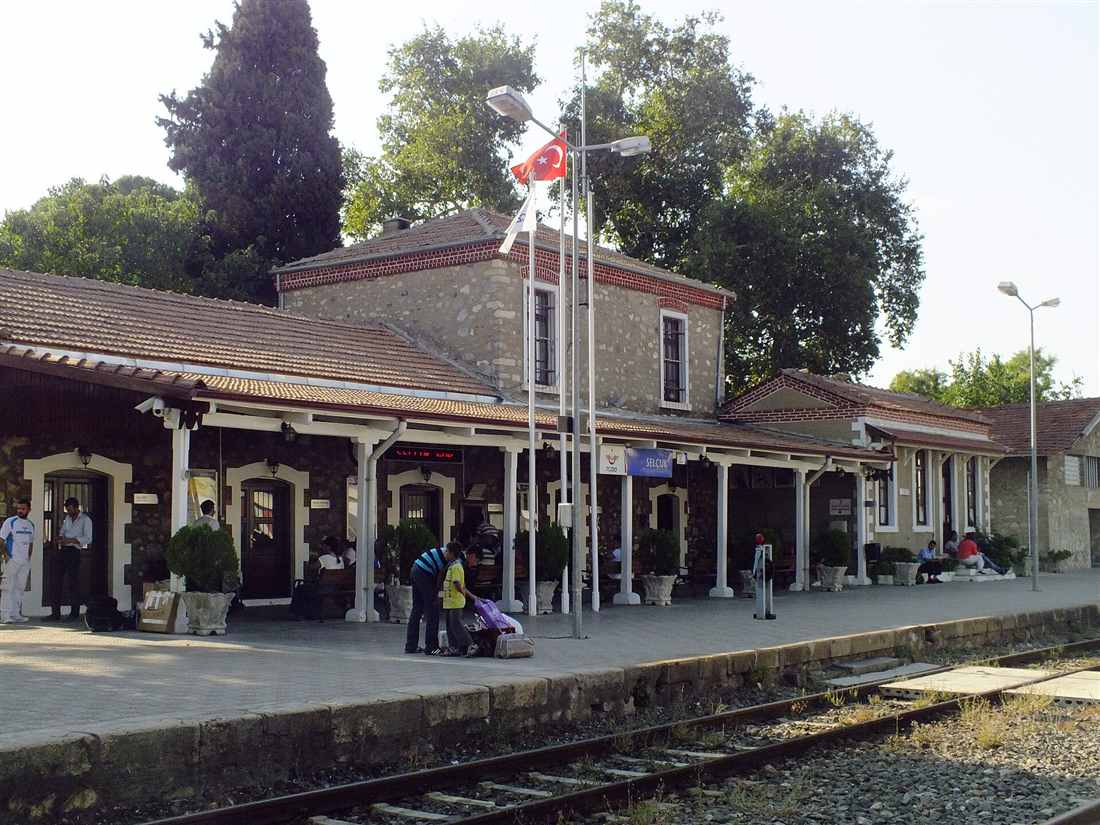
To get to Ephesus you head for Selcuk, the town 3 kilometres from the site: reach Selcuk by train or bus from Izmir, 80 kilometres north, by taxi or tour from the Kusadasi cruise port 18 kilometres south, or by air into Izmir Adnan Menderes Airport. Plan the whole trip with Greece Tours.
This guide covers how to get to Ephesus in full: where the site sits and its nearest town, the routes from Izmir airport, by train, by bus and dolmus, from the Kusadasi cruise port, from Istanbul and from the Greek island of Samos, which gate to enter, and how to move between Ephesus and the sites around it.
Where is Ephesus and what is the nearest town?
Ephesus sits on Turkey’s Aegean coast in İzmir Province, 3 km southwest of Selçuk, the nearest town. Kuşadası lies 18 km to the south, and İzmir, the regional capital, stands 80 km to the north.
Selçuk is the gateway settlement for the ancient city. The town holds Selçuk railway station, the intercity bus terminal (otogar), the Ephesus Archaeological Museum, the Basilica of Saint John and the Isa Bey Mosque. A dolmuş (shared minibus) and taxis run the short 3 km stretch from the town centre to the Lower Gate of the ruins, and the walk along Dr Sabri Yayla Bulvarı takes 35 to 40 minutes.
Kuşadası, 18 km south, is the coastal resort and cruise port that feeds most day visitors to the site. İzmir, 80 km north, holds Adnan Menderes Airport (ADB), the largest air gateway to the Aegean, and İzmir Basmane and Alsancak stations for onward rail. The ancient harbour of Ephesus once opened to the Aegean, but the Küçük Menderes River (the ancient Cayster) silted the bay, so the ruins now lie 6 km inland from the modern shoreline at Pamucak Beach.
How do you get to Ephesus from İzmir Adnan Menderes Airport?
İzmir Adnan Menderes Airport (ADB) sits 60 km north of Ephesus. Take the İZBAN suburban train from the airport station to Tepeköy, change to a TCDD regional train to Selçuk, then a dolmuş or taxi to the Lower Gate. Driving covers the distance in one hour.
The İZBAN commuter line has a station directly beneath the airport terminal. Ride it two stops south to Tepeköy, where the TCDD regional service (the İzmir Basmane–Söke and İzmir–Denizli lines) stops at Selçuk. The combined rail journey runs 75 to 90 minutes. Buy the İZBAN leg with an İzmirim Kart travel card and the regional leg from the TCDD counter or conductor.
Driving is the fastest door-to-door option. From the airport, follow the D550/E87 dual carriageway south through Torbalı and Belevi to Selçuk, a 60 km run of about one hour. Car hire desks operate inside the arrivals hall from the major rental firms. A private transfer or airport taxi covers the same route without a change. Havaş and municipal shuttle buses connect ADB with İzmir city centre, from where the Basmane rail service reaches Selçuk directly.
For travellers landing without a hire car, the rail combination is the cheapest onward route and runs through the day. The İZBAN card is bought and topped up at machines in the airport station concourse, and the same card covers the return leg. Passengers with heavy luggage take a fixed-price airport taxi or a pre-booked minibus transfer, both of which wait at the arrivals kerb and reach Selçuk hotels in 60 to 70 minutes. Flight arrivals into ADB spread across the day from domestic and European origins, so a morning landing leaves a full afternoon at the ruins before the site closes.
How do you get to Ephesus by train?
Board a TCDD regional train at İzmir Basmane station bound for Söke or Denizli and alight at Selçuk station, a 90-minute journey of 74 km. From Selçuk station, the Lower Gate lies 3 km away by dolmuş, taxi or a 40-minute walk.
The Turkish State Railways (TCDD) run six daily regional services down the Aegean corridor from İzmir Basmane, the central terminus in the İzmir bazaar district. Trains stop at Tepeköy, Torbalı, Belevi and Selçuk before continuing to Aydın, Söke or Denizli. Tickets cost a few Turkish lira, and seats are open on the regional class. Check the TCDD timetable for departure times, as services are spaced through the day rather than hourly.
Selçuk station sits in the town centre, a five-minute walk from the otogar and the museum. From the station forecourt, a Selçuk–Ephesus dolmuş runs to the site turnoff, or a metered taxi covers the 3 km to the Lower Gate in five minutes. Walkers follow the tree-lined avenue past the Temple of Artemis and reach the entrance in about 40 minutes. The train is the cheapest scheduled route from İzmir and avoids the traffic of the coastal road.
Rail travellers heading further south link Ephesus with Aydın, Nazilli and Denizli on the same TCDD corridor, so a stop at Selçuk pairs with an onward run to Pamukkale. Northbound, the regional train returns to İzmir Basmane through the evening, and the last service back leaves Selçuk in the late afternoon. Bicycles and folded prams travel in the open regional carriages without a supplement. The platform at Selçuk stands at street level with no barrier, so alighting passengers walk straight into the town toward the otogar, the museum and the site road.
How do you get to Ephesus by bus or dolmuş?
Intercity coaches run from İzmir Otogar to Selçuk otogar in about 70 minutes. From Selçuk, the Selçuk–Ephesus dolmuş drops passengers at the Lower Gate turnoff. From Kuşadası, a direct minibus reaches Selçuk in 30 minutes.
İzmir’s main bus terminal (İzmir Şehirlerarası Otobüs Terminali) dispatches coaches and minibuses south to Selçuk throughout the day. Operators such as the regional Aydın and Söke lines pass through Selçuk on the D550. The fare is modest and the ride covers 80 km in a little over an hour. Selçuk otogar sits beside the railway station, so onward connections are immediate.
The Selçuk–Ephesus dolmuş departs from the Selçuk otogar and follows the road toward the Lower (North) Gate, setting passengers down at the site access lane a short walk from the ticket office. Confirm the return timing with the driver, as the last minibus back to town leaves in the late afternoon. From Kuşadası, frequent dolmuş minibuses run the 18 km to Selçuk in 30 minutes, and from there the Ephesus dolmuş or a taxi completes the trip. A taxi direct from Kuşadası to the site entrance takes 25 minutes.
How do you get to Ephesus by car and where do you park?
Drive south from İzmir on the D550/E87 for 80 km to Selçuk, then follow the brown Efes signs 3 km to the gates. Free car parks sit at both the Lower (North) Gate and the Upper (South) Gate, staffed through opening hours.
The self-drive route from İzmir runs down the four-lane D550 through Torbalı, Belevi and the Selçuk junction, a straightforward 80 km that takes 70 minutes without traffic. From Kuşadası the coastal D515 climbs inland 18 km to the same junction in 25 minutes. Brown heritage signs marked “Efes” direct drivers off the main road toward the two gates, and the lanes to each entrance are surfaced and signed.
Two car parks serve the site. The northern car park at the Lower Gate lies nearest Selçuk town and the Temple of Artemis, and the southern car park at the Upper Gate sits on the Magnesia road above the ruins. Parking attendants collect a flat daily fee at each. Drivers who park at the Upper Gate and walk downhill face a return to fetch the car, so a group splits by dropping walkers at the top and meeting the driver at the Lower Gate. Hire cars from İzmir ADB reach Selçuk in one hour, and the town holds fuel stations, a covered market and hotels with private parking for an overnight stay.
How do you get to Ephesus from Kuşadası cruise port?
Ephesus lies 18 km northeast of Kuşadası cruise port. A taxi reaches the Lower Gate in 25 minutes, a shore excursion coach in the same time, and a dolmuş via Selçuk otogar in about 45 minutes with one change.
Cruise ships dock at the Ege Ports terminal in central Kuşadası, and the ruins are the headline excursion for every ship on the Aegean itinerary. Taxis wait at the port gate and quote a fixed fare for the round trip with waiting time. Organised shore excursions leave the terminal by air-conditioned coach, entering at the Upper (South) Gate so passengers walk downhill to the Lower Gate where the bus meets them.
Independent travellers take a Kuşadası–Selçuk dolmuş from the town minibus stand, ride 18 km to Selçuk otogar, then transfer to the Ephesus dolmuş or a taxi for the final 3 km. Budget three to four hours ashore to see the Library of Celsus, the Great Theatre and the Terrace Houses and still return before the all-aboard time. A private car transfer collects passengers at the gangway and shortens the transit to 25 minutes each way.
Ships on the Aegean circuit dock at Kuşadası in the morning and depart in the late afternoon, so the shore window runs six to eight hours. A booked tour guarantees the return before the all-aboard call and pairs the ruins with the House of the Virgin Mary and a carpet or leather workshop. Independent visitors watch the clock on the dolmuş timetable, as the last afternoon minibus from Selçuk back to Kuşadası leaves before the ship sails. The taxi rank at Ege Ports posts fixed round-trip fares to Ephesus with a fixed waiting allowance, which removes the timetable risk for a party of three or four sharing the cost.
How do you get to Ephesus from İstanbul?
Fly from İstanbul (IST) or Sabiha Gökçen (SAW) to İzmir Adnan Menderes Airport in 75 minutes, then take the train or drive one hour south to Selçuk. An overnight intercity coach covers the 570 km in nine to ten hours.
Air travel is the quickest route from İstanbul. Turkish Airlines, Pegasus and AJet fly from both İstanbul airports to İzmir ADB through the day. From the airport, the İZBAN and TCDD rail combination or a hire car reaches Ephesus, as described for the İzmir gateway. Total travel time from an İstanbul city centre hotel to the ruins runs four to five hours including check-in and transfer.
The overnight coach is the ground alternative. Companies such as Pamukkale, Metro and Kâmil Koç run sleeper-style buses from İstanbul’s Esenler otogar to İzmir and on to Selçuk, a 570 km journey through the night. Passengers reach Selçuk otogar at dawn ready for the site’s early opening. A self-drive route follows the O-5 and O-31 motorways down the Aegean coast, a six-and-a-half-hour drive with tolls collected by the HGS electronic sticker.
Rail from İstanbul reaches İzmir by a combined ferry and train link across the Sea of Marmara, but the fastest through-service still routes travellers via İzmir Basmane for the Selçuk regional train. Most visitors fly into ADB, collect a hire car or board the İZBAN, and reach the ruins the same morning. The one-hour flight paired with the one-hour drive turns a 570 km gap into a half-day of travel, so an early İstanbul departure delivers a full day at Ephesus and a return flight the same evening.
How do you get to Ephesus from the Greek island of Samos?
A passenger ferry crosses from Samos to Kuşadası in about 90 minutes. Boats sail from Vathy (Samos Town) and Pythagoreio to the Ege Ports terminal. From Kuşadası, a dolmuş or taxi covers the final 18 km to Ephesus.
Samos lies barely 2 km off the Turkish coast, and the sea crossing links the Greek Dodecagon border with the Aegean mainland. Seasonal ferry operators run the Vathy–Kuşadası and Pythagoreio–Kuşadası routes, with the passage taking 60 to 90 minutes depending on the port and vessel. Passengers carry a passport and clear Turkish immigration inside the Ege Ports terminal, so build 45 minutes into the schedule for border formalities.
Once through the terminal, the onward leg to Ephesus mirrors the cruise-port route: a Kuşadası–Selçuk dolmuş plus the Ephesus minibus, a direct taxi in 25 minutes, or a booked transfer. Day-trippers from Samos time the morning sailing, spend the middle of the day at the ruins, and catch the afternoon return ferry. Confirm the ferry timetable before travel, as sailings run on a seasonal frequency rather than daily through the year.
The Samos crossing pairs a Greek island holiday with a day on Turkish soil, and the same ticket agents in Vathy and Pythagoreio sell combined ferry-and-tour packages that include the transfer to Ephesus and a guide at the ruins. Travellers holding a Schengen visa re-enter Greece on the return sailing without a fresh entry stamp, while the Turkish e-visa or visa-free entry covers the day ashore. Foot passengers dominate the route, so a vehicle stays parked on Samos and the onward leg from Kuşadası runs by dolmuş, taxi or booked coach.
How do you get from Selçuk to the Ephesus site entrance?
Two gates open the site. The Lower (North) Gate sits 3 km southwest of Selçuk town, reached by dolmuş, taxi or a 40-minute walk. The Upper (South) Gate lies on the Selçuk–Aydın road near ancient Magnesia, 4 km out, and taxis serve it directly.
The Selçuk–Ephesus dolmuş runs from the town otogar along Dr Sabri Yayla Bulvarı and drops passengers at the Lower Gate lane, the entrance closest to the town, the railway station and the Temple of Artemis. A metered taxi from the Selçuk centre reaches the same gate in five minutes. On foot, follow the avenue past the single standing column of the Artemision; the level walk takes 35 to 40 minutes and passes the site’s northern car park.
The Upper Gate stands higher on the ridge beside the Magnesia road, the point where coach tours and organised excursions unload. A taxi from Selçuk reaches it in eight minutes. Entering at the Upper Gate lets visitors walk the site downhill in one direction and exit at the Lower Gate, avoiding a return climb. Both gates share the same ticket, and the Ephesus Museum ticket in Selçuk town is a separate admission.
Which Ephesus gate do you enter, upper or lower?
Enter at the Upper (South) Gate and walk downhill through the ruins to exit at the Lower (North) Gate. The route drops gently along Curetes Street past the marble monuments, so gravity does the work and the walk ends near Selçuk.
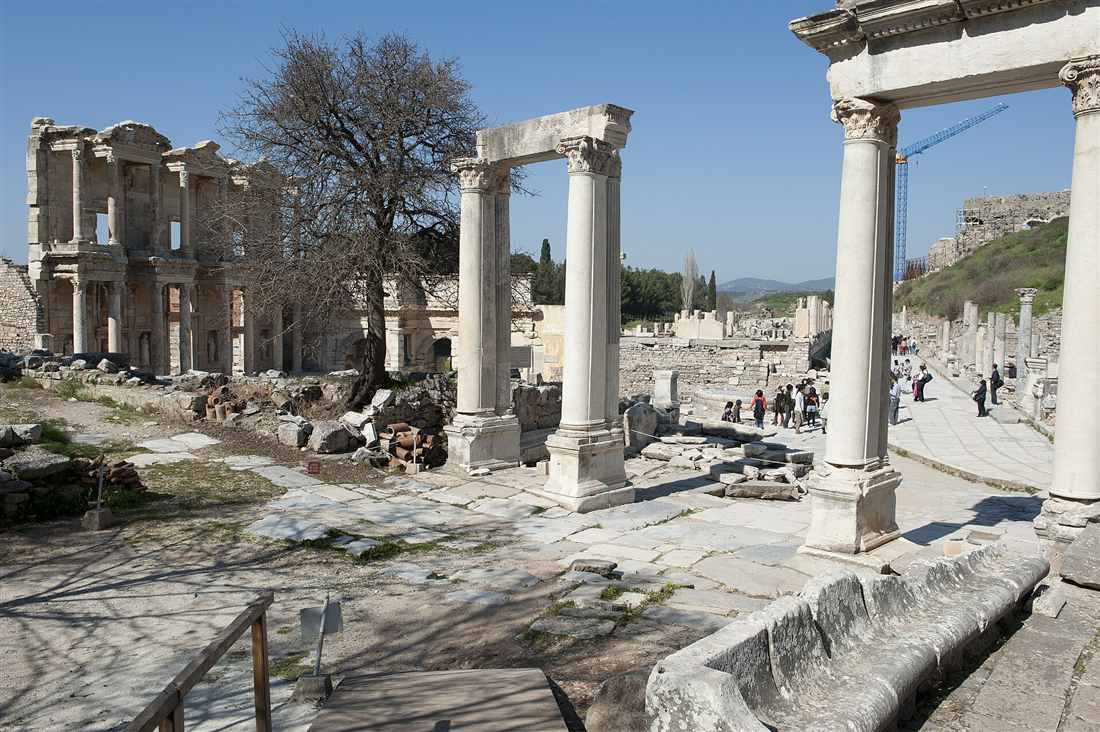
The Upper Gate stands at the higher, southern end of the ancient city beside the Magnesia road. From the entrance, the path passes the Odeon, the State Agora and the Memmius Monument, then descends the marble-paved Curetes Street between the Temple of Hadrian, the Terrace Houses and the public latrines. The gradient carries walkers down to the Library of Celsus, the standout façade of the site, and on to the Marble Road and the Great Theatre.
Finishing at the Lower Gate places visitors at the northern car park, the dolmuş stop and the road back to Selçuk town, the station and the museum. Walking the reverse route from the Lower Gate forces an uphill climb back to the Upper Gate under the Aegean sun. Coach tours and shore excursions unload passengers at the Upper Gate and collect them at the Lower Gate for this reason. The full downhill walk covers 1.5 km and takes 90 minutes to two hours with stops at the monuments.
How do you get around Ephesus and nearby sites?
The ruins are walked on foot along a single downhill spine of 1.5 km. Nearby sites need transport: the House of the Virgin Mary sits 7 km up Bülbül Dağı, the Temple of Artemis stands beside the Selçuk road, and Şirince village lies 8 km east.
Inside the archaeological site, walking is the only way to move, as vehicles are barred beyond the gates. The main axis runs from the Upper Gate down Curetes Street to the Library of Celsus and the Great Theatre, a marble path suited to flat shoes. The Terrace Houses, a covered complex of Roman mosaics and frescoes, carry a separate ticket at their entrance halfway down the street. Allow two to three hours to cover the open ruins at an unhurried pace.
The House of the Virgin Mary (Meryemana), the shrine where tradition places the Virgin’s last home, sits 7 km southwest up the wooded slope of Bülbül Dağı (Mount Koressos). No public minibus climbs the mountain, so a taxi, a hire car or an organised tour reaches it in 15 minutes from the Upper Gate. The Temple of Artemis, one of the Seven Wonders of the ancient world, stands as a single reconstructed column beside the Selçuk road, a free stop on the walk between town and the Lower Gate.
Şirince, a hillside village of Ottoman Greek houses, fruit wines and craft stalls, lies 8 km east of Selçuk and is reached by a Selçuk–Şirince dolmuş from the otogar in 15 minutes or by taxi. The Ephesus Archaeological Museum in Selçuk town holds the finds lifted from the site, including the two statues of Artemis, and stands within walking distance of the station and otogar. Linking the ruins, the museum, Meryemana and Şirince fills a full day, and a hire car or a guided tour ties the four together without waiting on minibus timetables. A half-day tour from Kuşadası or Selçuk bundles the transfer, the site guide and the entrance run into a single fixed price, and the guide leads the downhill walk from the Upper Gate so the group ends at the waiting vehicle by the Lower Gate.
Frequently Asked Questions
What is the nearest town to Ephesus?
Selcuk is the nearest town to Ephesus, 3 kilometres from the ruins. It holds the train station, the bus otogar, the Ephesus Museum and the Basilica of St John, and dolmus minibuses and taxis run from Selcuk to both site gates.
How do you get from Izmir to Ephesus?
From Izmir, take a TCDD regional train from Basmane station to Selcuk in about 90 minutes, or an intercity bus from Izmir otogar to Selcuk otogar, then a dolmus or taxi 3 kilometres to the Ephesus gate.
How do you get to Ephesus from a Kusadasi cruise?
From the Kusadasi cruise port, Ephesus lies 18 kilometres north, 30 minutes by taxi, shuttle or shore-excursion coach. A booked tour returns passengers to the ship on time, the safest option for a cruise call.