
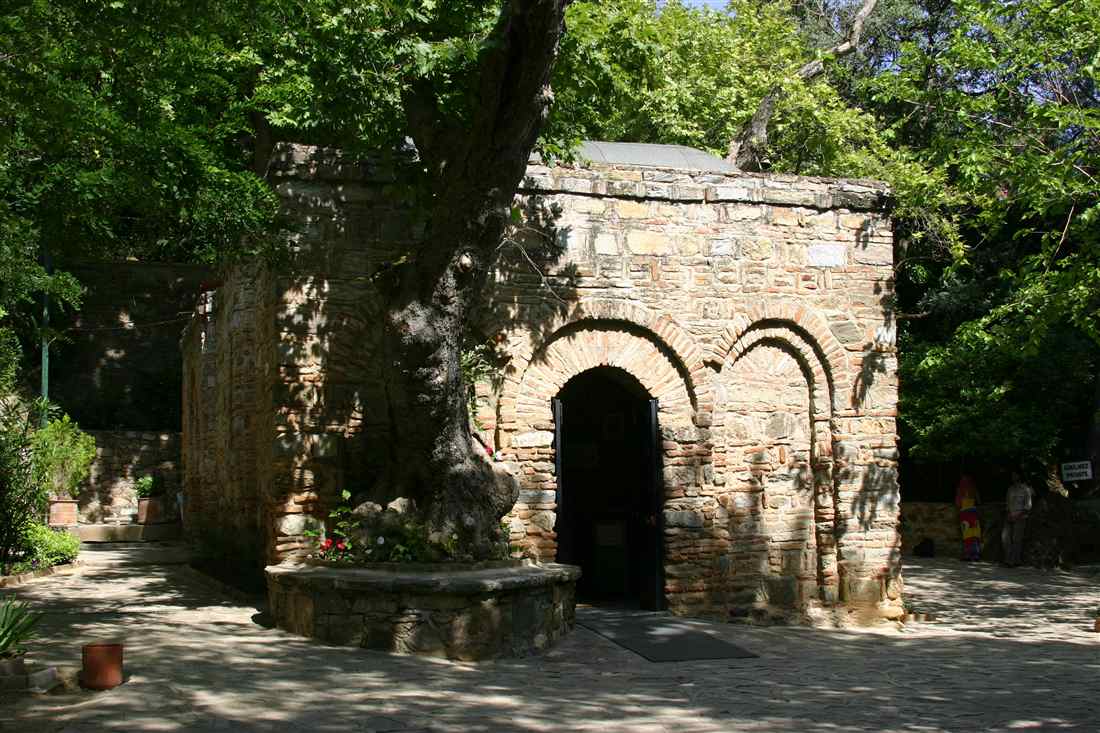
The House of the Virgin Mary is a small stone house-chapel on a wooded hill near Ephesus, venerated by Christians and Muslims as the last home of Mary, the mother of Jesus, and one of the most visited pilgrimage sites in Turkey. Plan the whole trip with Greece Tours.
This guide covers the House of the Virgin Mary in full: what it is and where it stands, the tradition that Mary lived at Ephesus, how the house was rediscovered from a nun’s visions, its recognition by the Catholic Church and the papal visits, what you see there, the wishing wall and the holy spring, why Muslims also honour it, and how and when to visit.
What is the House of the Virgin Mary?
The House of the Virgin Mary, called Meryem Ana Evi in Turkish, is a small restored stone house-chapel on a wooded hilltop near Ephesus, revered as the last earthly home of Mary, mother of Jesus, and honoured today by both Christian and Muslim pilgrims.
The building is a modest single-storey structure of unmortared and later mortared stone, laid out on a cruciform plan with a domed central room and a small apse. Its walls rest on foundations that archaeologists date to the first century AD, while the upper courses belong to a later reconstruction. A Christian traveller planning a wider trip through the region alongside a Greece Tours itinerary treats this compact shrine as the spiritual anchor of the Aegean coast, a place of quiet prayer rather than monumental scale. The interior holds a single altar and a bronze statue of Mary, and the whole chapel measures only a few metres across.
The site draws two distinct streams of devotion. Roman Catholic and Orthodox Christians venerate the house as the dwelling where the Apostle John sheltered Mary in her final years, in fulfilment of Christ’s charge from the cross. Muslim visitors honour Mary as Maryam, the mother of the prophet Isa and the only woman named in the Quran, and they arrive in large numbers, especially on Fridays and during religious festivals. This shared reverence makes the hilltop one of the rare sanctuaries in the world where two faiths pray at the same altar without friction.
Several physical features define the experience of the house and set it apart from the grand ruins of the ancient city below:
- A spring beneath the chapel feeds three taps where pilgrims collect water associated with healing.
- A long wishing wall of stone and metal grilles carries thousands of paper and cloth petitions tied by visitors.
- The reddish line painted around the exterior marks the division between the ancient first-century foundation stones and the reconstructed masonry above.
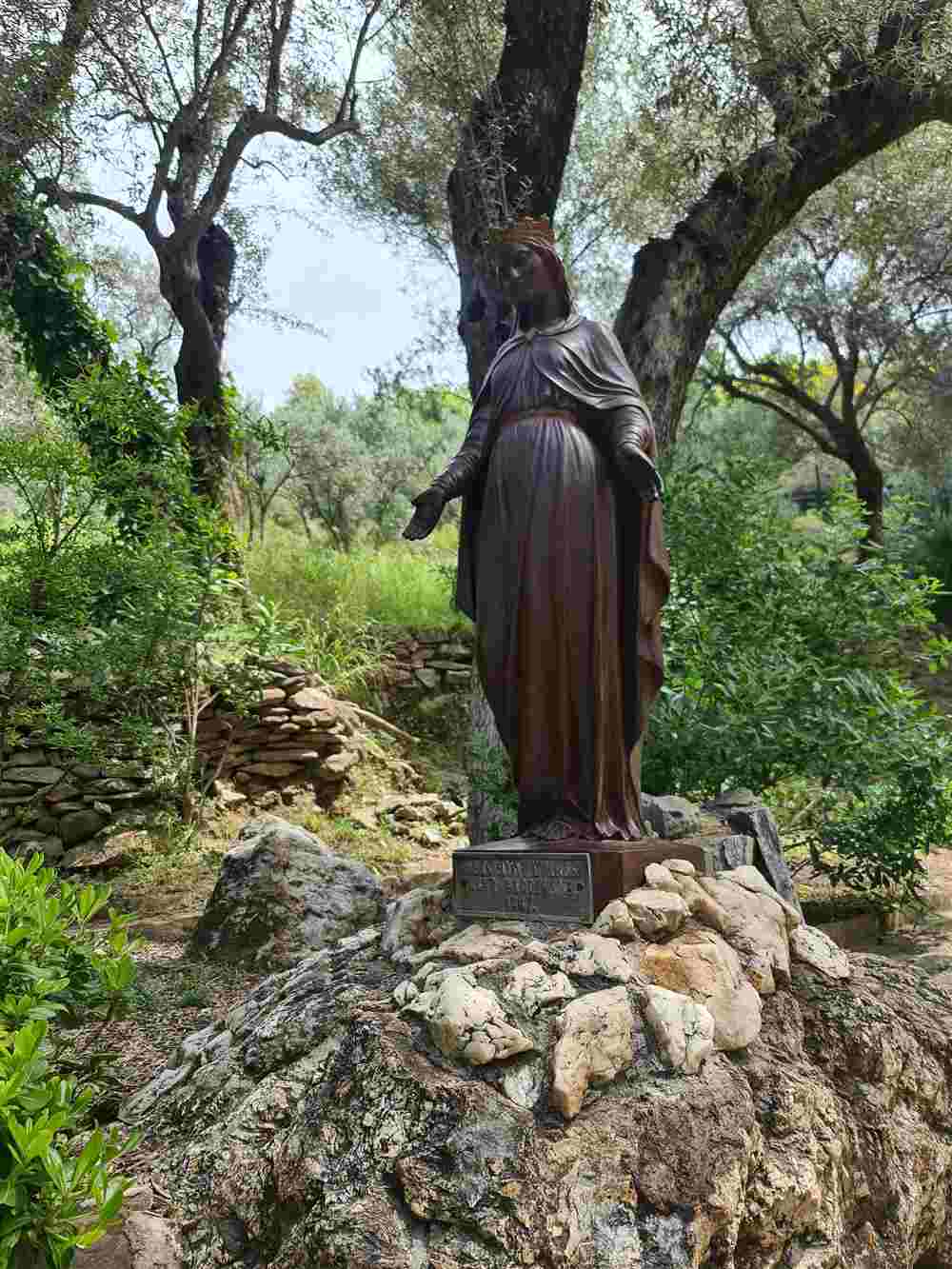
- A statue of Mary in bronze stands on the terrace outside, arms open toward the approaching path.
The house functions as an active place of worship rather than a museum. A Catholic Mass is celebrated at the outdoor altar for organised pilgrim groups, and a resident religious community maintains the grounds, the candle stands and the daily rhythm of prayer. Photography is barred inside the chapel itself to protect the atmosphere of devotion, and visitors move through the small interior in a slow, single file, pausing before the altar and the statue.
The dimensions of the shrine reinforce its intimate character. The central prayer room holds a handful of worshippers at a time, and the side chamber is smaller still, so the flow of pilgrims is metered and unhurried. The masonry itself tells the building’s layered history: the lower foundation stones carry the rough, dark patina of first-century construction, while the reconstructed courses above them present cleaner, lighter blocks laid during the modern restoration. This visible seam, marked by the painted red line, lets every visitor read the two eras of the house in a single glance at the wall.
What gives the House of the Virgin Mary its weight is the convergence of scripture, oral tradition, private revelation and archaeology at one point on a Turkish hillside. The Gospel entrustment of Mary to John, the memory of the early Ephesian church, the nineteenth-century visions that pinpointed the ruin, and the excavated first-century foundations all fasten to this single small building. For the traveller who reaches the neighbouring metropolis of Ephesus, the contrast is striking: below lie marble avenues, a vast theatre and a library facade, while above sits a plain stone room that carries a heavier spiritual charge than any of the imperial monuments. That combination of humility and significance is the essence of the shrine, and it explains why heads of the Roman Catholic Church have travelled to this remote hilltop to pray in person.
Where is the House of the Virgin Mary?
The House of the Virgin Mary stands on the summit of Mount Koressos, known in Turkish as Bulbul Dagi or Nightingale Mountain, about seven kilometres from the ruins of Ephesus and the town of Selcuk, inside a protected national park of pine and plane trees in Izmir Province.
The shrine sits at roughly 420 metres above sea level, high enough that the air stays cool and resinous with pine even in the fierce Aegean summer. A single winding asphalt road climbs the forested slope from the Ephesus valley, threading through dense stands of Aegean pine, plane and wild olive before opening onto the terrace where the chapel rests. The elevation and the tree cover give the place a hushed, sheltered quality that the exposed marble ruins of the ancient city entirely lack, and the view from the terrace stretches across the coastal plain toward the modern town of Selcuk and the distant sea.
Geographically the house belongs to a tight cluster of major sites in Turkey’s western Aegean corner, which makes it easy to fold into a single day of travel:
- Ancient Ephesus, one of the largest classical cities in the Mediterranean, lies seven kilometres north down the same mountain.
- Selcuk town, with its train station, castle and the Basilica of Saint John, sits about nine kilometres away at the foot of the hill.
- The Temple of Artemis, one of the Seven Wonders of the ancient world, stands on the Selcuk plain within sight of the mountain.
- The seaside resort of Kusadasi, a busy cruise port, lies around twenty kilometres to the southwest.
- Izmir, the province’s capital and its nearest large airport, is roughly eighty kilometres to the north.
The mountain carries deep classical roots of its own. Mount Koressos formed the southern rampart of ancient Ephesus, and its slopes were quarried and walled in antiquity, so the pilgrim road passes fragments of old fortification and terracing on the ascent. The name Bulbul Dagi, Nightingale Mountain, records the songbirds that fill the pine canopy at dusk, and the national park status protects both the forest and the archaeological layers beneath it from development. This protection keeps the immediate surroundings of the shrine free of hotels, shops and traffic beyond a single car park and a small refreshment area.
Reaching the house is straightforward for a visitor already in the Ephesus area. Cruise passengers docking at Kusadasi arrive by coach in under forty minutes, and organised tours from Izmir, Selcuk and the resort towns combine the shrine with the ancient city in one loop. Independent travellers drive or take a taxi up the mountain road, since no public bus climbs to the summit. The remoteness is deliberate and part of the appeal: the final approach on foot from the car park, through the pines and past the statue of Mary, delivers pilgrims to the chapel in a frame of silence and forest that reinforces the sense of arrival at a place set apart from the crowded coast below.
The setting inside the national park shapes the whole visit. Dense pine and plane cover the summit, and the resin scent, the birdsong and the cool shade mark an abrupt change from the heat and dust of the exposed valley floor. Signposted paths link the car park, the chapel terrace, the spring and the wishing wall, and shaded benches under the trees let pilgrims rest between the stages of the visit. The protected status of the forest fixes the character of the place for the long term, since the ban on commercial development keeps the summit a precinct of prayer rather than a strip of shops.
Did the Virgin Mary live in Ephesus?
An ancient Christian tradition holds that the Apostle John brought Mary to Ephesus after the Crucifixion, and that she spent her final years on the mountain above the city, following Christ’s dying command that entrusted his mother to the beloved disciple’s care.
The scriptural root of the tradition lies in the Gospel of John, which records that from the cross Jesus looked at his mother and at the disciple he loved and said, “Woman, behold your son,” and to the disciple, “Behold your mother.” The same passage states that from that hour the disciple took Mary into his own home. This entrustment created a direct bond of guardianship between John and Mary, and it forms the textual foundation for every account that places the two of them together in the years after the Resurrection and Ascension.
Ephesus enters the picture through the well-documented later life of John. Early Christian writers place the apostle in Ephesus as the leader of the church there, where he wrote, taught and died at a great age, and where his tomb was venerated on the hill of Ayasuluk in Selcuk. The Basilica of Saint John, built over that tomb, remains one of the region’s principal Christian monuments. If John made Ephesus his base, the tradition reasons, then Mary, placed under his protection, travelled with him to the same city and lived out her days within his household on the quiet mountain slope away from the crowded port.
The historical case draws on a chain of connected evidence and argument rather than a single decisive document:
- The Gospel entrustment establishes John as Mary’s guardian from the moment of the Crucifixion.
- Multiple early sources fix John’s ministry and death firmly at Ephesus.
- The Third Ecumenical Council convened at Ephesus in AD 431 and there proclaimed Mary as Theotokos, the God-bearer, a choice of venue that reflects the city’s strong Marian associations.
- The council met in a church already dedicated to the Virgin Mary, the first such dedication recorded in the Christian world.
A rival tradition places Mary’s final years and her Dormition in Jerusalem, and the Church has never issued a binding ruling that settles the question between the two cities. Both claims rest on old and respected memory, and both anchor major shrines. The Ephesian tradition gains weight from the concentration of first-century Christian activity along this stretch of the Aegean coast, from the apostolic prominence of the local church, and from the emphasis the great council of AD 431 placed on Mary at this exact location. For the pilgrim standing on Bulbul Dagi, the decisive point is that the community which knew John best chose to remember Mary here, on the mountain above his city, and preserved that memory through the centuries until the ruined house on the summit gave the tradition a physical form.
The Ephesian claim also fits the wider apostolic geography of the region. Paul the Apostle spent years teaching at Ephesus and addressed a letter to its church, the Book of Revelation names Ephesus first among the seven churches of Asia, and the city grew into one of the great centres of early Christianity in the eastern Mediterranean. A settlement so saturated with first-generation Christian activity forms a natural home for the mother of Jesus under the guardianship of the leading apostle resident there. The living devotion of the Kirkindje villagers, who climbed the mountain each year to honour Mary’s house long before scholars examined the ruin, adds an unbroken thread of local memory to the documentary and scriptural threads.
How was the House of the Virgin Mary discovered?
The house was located in the nineteenth century by Lazarist priests from Izmir who followed the detailed visions of the German nun Anne Catherine Emmerich, whose descriptions of Mary’s dwelling, recorded by the poet Clemens Brentano, matched a forgotten ruin on the mountain with astonishing precision.
Anne Catherine Emmerich was a bedridden Augustinian sister in Germany who reported vivid mystical visions of the life of Christ and of Mary. She never travelled to Anatolia and had no direct knowledge of the Ephesus region, yet in her accounts she described a small stone house on a hill near Ephesus where Mary lived after the Crucifixion. The poet and writer Clemens Brentano sat at her bedside for years and transcribed her narrations, publishing them after her death. Her descriptions were remarkably concrete: a rectangular house of stone with a rounded rear section, a hearth in the centre, an elevated position on a mountain a few hours’ walk from the ruined city, with a view toward the sea and terraces below.
Decades later a group of Lazarist, or Vincentian, priests based in Izmir read the published visions and resolved to test them against the ground. A search party set out into the wooded slopes of Bulbul Dagi with Emmerich’s text in hand, using her details as a map. The expedition traced her landmarks up the mountain and arrived at the ruins of a small stone building beside a spring, at a place local Orthodox Christians from the nearby village of Kirkindje already visited each summer under the name Panaya Kapulu, meaning the Doorway to the All-Holy Virgin. The villagers’ own ancestral pilgrimage confirmed a continuous memory of the spot that predated the nun’s book.
The correspondence between the vision and the site convinced the searchers on multiple counts:
- The ruin stood on a mountain at the distance from Ephesus that Emmerich had specified.
- Its shape matched her account of a rectangular house with a curved rear chamber.
- A spring rose beside it, as she had described.
- The surviving foundations were dated by later study to the first century AD, the era of Mary’s life.
- A living local tradition, independent of the German text, already treated the place as Mary’s house.
The convergence of an unlettered nun’s bedside vision, a poet’s careful transcription, a priest’s fieldwork and a peasant community’s inherited devotion turned a moss-covered ruin into a recognised shrine. Investigators and Church commissions examined the claim in the years that followed, and the site was cleared, studied and gradually restored. What impresses visitors is the exactness of the match: Emmerich supplied measurements, orientation and the presence of a spring that field investigators verified on the ground before excavation confirmed the first-century date of the walls. The discovery stands as one of the most unusual episodes in the history of Christian archaeology, a case in which mystical testimony guided searchers directly to a buried structure that oral tradition and stone alike upheld.
Is the House of the Virgin Mary recognized by the Catholic Church?
The Roman Catholic Church has granted the House of the Virgin Mary the status of a pilgrimage shrine and blessed the devotion of the faithful there, while stopping short of a formal ruling on the authenticity of the site, and successive popes have travelled to the hilltop to pray.
The Church’s approach to the shrine follows its long-established pattern for places of Marian devotion. Ecclesiastical authorities recognise and encourage the piety of pilgrims, grant the site the standing of a place of worship and pilgrimage, and attach spiritual blessings to visits, without issuing a definitive judgement on whether Mary physically lived and died in the house. This distinction matters: the Church endorses the pilgrimage and the prayer while leaving the historical question open, since binding declarations of authenticity fall outside the scope of what the tradition and evidence permit. The result is a fully sanctioned shrine whose theological standing rests on devotion rather than on a decreed fact.
The strongest expression of that recognition is the succession of papal visits, an extraordinary honour for a remote Anatolian hillside in a country with a small Christian minority. Three consecutive holders of the papacy have made the journey:
- Pope Paul VI travelled to the house during his pilgrimage to the region and prayed at the chapel, giving the shrine its first modern papal recognition.
- Pope John Paul II visited the sanctuary, celebrated the liturgy there and reinforced its standing as a place of Christian pilgrimage.
- Pope Benedict XVI came to the hilltop during his apostolic journey to Turkey, offered Mass at the outdoor altar and prayed before the statue of Mary.
Each papal visit carried practical and symbolic weight. The celebration of Mass by a reigning pope at the outdoor altar affirmed the house as a legitimate site of Catholic worship in the eyes of the universal Church, and the presence of the papacy on Turkish soil underlined the shrine’s role as a meeting point for Christians and Muslims. The visits drew global attention to the sanctuary, lifted pilgrim numbers and confirmed the pattern set decades earlier, when the Church first extended its blessing to the place following the nineteenth-century investigations into Emmerich’s visions and the local tradition.
For a Catholic pilgrim, the shrine’s status delivers concrete spiritual benefits. The house is an approved destination where the sacraments are administered, where organised pilgrimages receive the Church’s blessing, and where the faithful pray in a setting the papacy itself has honoured in person. The absence of a formal verdict on authenticity does not diminish this standing; it reflects the Church’s careful separation of confirmed devotion from unprovable history. Muslim recognition runs in parallel, since Islamic authorities and ordinary Turkish visitors honour Maryam at the same altar, making the sanctuary a rare officially respected meeting ground of the two faiths. The combined effect is a shrine that carries the full endorsement of the Catholic Church as a place of prayer, sealed by the footsteps of three popes, even as the deeper question of Mary’s residence remains a matter of faith and tradition.
What do you see at the House of the Virgin Mary?
Visitors see a restored cruciform stone chapel built on ancient first-century foundations, a bronze statue of Mary on the terrace, a candlelit interior centred on a single altar and a small side niche, a healing spring with three taps, and a long wall covered in tied prayer petitions.
The chapel itself is the heart of the visit. From the outside it presents as a low, thick-walled building of warm grey and honey-coloured stone, roofed with a shallow dome over the central room and marked by a reddish line painted around the walls to separate the original first-century foundation courses from the reconstructed masonry above. The plan is cruciform, with a domed central chamber opening into a small apse that holds the altar, and a side room to the right associated in tradition with Mary’s bedroom. Entry is through a single low doorway, and pilgrims pass through in a slow, reverent file.
Inside, the atmosphere is dim, cool and heavy with candle smoke and the scent of stone. The interior arranges itself around a few clear focal points that structure every visitor’s passage through the tiny space:
- A stone altar in the apse, set beneath a statue of Mary, where the sanctuary lamp burns and where clergy celebrate Mass for pilgrim groups.
- The bronze figure of the Virgin above the altar, the devotional centre of the chapel interior.
- The small side chamber to the right, honoured as the room where Mary rested.
- Banks of votive candles that pilgrims light and leave burning as offerings and prayers.
Outside the chapel the grounds hold the features that give the shrine its distinctive character. On the approach terrace stands a life-sized bronze statue of Mary with her arms open toward the arriving path, the image most visitors photograph before entering. Below the chapel, a spring feeds three taps set into a stone wall, and pilgrims of both faiths drink and fill bottles with water long associated with healing of the body, spirit and family. A short walk further on runs the wishing wall, a long stretch of metal grilles and stone where thousands of visitors tie strips of cloth, paper napkins and written petitions, until the whole barrier turns white with knotted prayers. The dense layering of these petitions is one of the most striking sights on the hill.
Beyond these central elements the site offers a quiet, self-contained precinct in the forest. A small chapel and a Catholic religious community maintain the grounds, and an outdoor altar area accommodates the larger open-air Masses celebrated for pilgrimage groups and honoured by visiting popes. Stalls near the car park sell candles, religious articles and refreshments, and shaded benches under the pines give worshippers a place to rest and reflect after the intensity of the chapel interior. Photography is forbidden inside the house itself, which preserves the hush of the sanctuary, so the enduring images most pilgrims carry away are of the statue on the terrace, the ribbon-white wishing wall and the three streams of spring water, framed by the pine forest of Bulbul Dagi and the long view down toward the ruins of the ancient city and the Aegean shore beyond.
What is the wishing wall at the House of the Virgin Mary?
The wishing wall is a stone barrier below the House of the Virgin Mary where pilgrims tie written prayers, cloths, ribbons and scraps of paper. Each knotted note carries a request for health, family, love or forgiveness, forming a dense white curtain of fabric that renews itself daily.
The wall sits on the terrace below the chapel, along the path that leads down from the house toward the spring. Visitors write a wish on a strip of paper, a tissue, a handkerchief or a length of ribbon, then fasten it to the wire mesh and stone frame that lines the walkway. Over the course of a single morning the surface fills with thousands of small white knots, and staff clear and burn the accumulated notes at intervals to make room for the next wave of pilgrims. The custom crosses religions: Catholic and Orthodox Christians, Turkish Muslims and secular tourists all leave a fragment of cloth, and the wall reads as a shared human archive of longing rather than a single-faith shrine.
The tradition of tying a rag or ribbon to a holy place predates Christianity in Anatolia. Anatolian folk practice knots strips of fabric to the branches of sacred trees near tombs, springs and shrines, a gesture that binds a promise to a place until the wish is granted. At Meryem Ana Evi this ancient reflex attached itself to a Christian sanctuary, and the wall now channels the impulse into one concentrated spot. The written form adds a Marian dimension: pilgrims address Mary directly as intercessor, asking her to carry the request to God, and the paper becomes a physical stand-in for a spoken prayer.
Practical details govern the ritual and reward a little preparation:
- Bring your own paper, tissue or ribbon; the site sells strips near the entrance, and the shop by the car park stocks cloth for the purpose.
- Write the wish before you reach the wall so the moment of tying stays quiet and unhurried.
- Fasten the note low and toward the edges where free mesh remains, since the central sections fill first each day.
- Photograph the wall from the path above for the fullest view of the white expanse, then descend to add your own.
The wishing wall functions as the emotional core of a visit for people who arrive as pilgrims rather than sightseers. The chapel above holds the liturgy and the relics of the tradition, but the wall holds the private hopes of the crowd, exposed and anonymous side by side. A grandmother’s plea for a grandchild’s recovery hangs beside a honeymooner’s note and a student’s exam wish, and the sheer density of the fabric makes the volume of human need visible in a way that no single icon does. Guides on the day trip pause here for a few minutes, and the wall photographs as the site’s most recognisable image after the house itself.
The renewal of the wall each day reinforces its meaning. Nothing tied here lasts, and the burning of the old notes turns the accumulated wishes into smoke and ash, a release that mirrors the act of handing a worry to a higher power. Pilgrims accept that their paper joins thousands of others and vanishes within days, and the transience is the point: the wall is a place to let go of a wish, not to preserve it. That understanding separates the ritual from a tourist gimmick and roots it in a genuine devotional logic that draws returning visitors year after year.
What is the holy spring at the House of the Virgin Mary?
The holy spring is a set of three fountains fed by natural water that flows below the House of the Virgin Mary. Pilgrims drink and collect the water, which tradition links to health, love and wealth, one theme to each of the three spouts along the terrace wall.
The spring emerges from the hillside beneath the chapel and feeds three taps set into a low stone wall on the terrace below the house. Each fountain carries its own association in the pilgrim tradition: one spout for health and healing, one for love and fertility, and one for wealth and prosperity. Visitors cup the water in their hands to drink, splash it on their faces, and fill bottles to carry home, treating it as blessed by its proximity to the sanctuary. The flow runs cool and steady throughout the year, drawn from the aquifer inside Bülbül Dağı, the wooded mountain that shelters the site, and the water tests as potable, so pilgrims drink it without hesitation.
The reverence for spring water at holy sites reaches deep into Anatolian and Mediterranean religious practice. Springs marked sacred ground long before the Christian era, and early Christian shrines frequently rose over existing water sources, absorbing the older devotion into a new frame. At Meryem Ana Evi the water reinforces the identification of the place as a living sanctuary rather than an archaeological ruin. The house is a home where a person lived, and a home needs water; the spring grounds the tradition of Mary’s residence in a tangible, functioning feature that visitors touch and taste for themselves.
The three-theme structure gives the fountains a clear devotional grammar that guides handle in a fixed order:
- Health — the first spout, where pilgrims pray for recovery from illness and drink for physical strength.
- Love and fertility — the second, sought by couples, newlyweds and those hoping for children.
- Wealth and prosperity — the third, for material blessing and success in work.
Practical use of the spring rewards a small routine. Pilgrims bring an empty bottle to fill, since the site limits large containers and the queue for the taps builds when cruise groups arrive mid-morning. Many drink a mouthful at each of the three spouts to touch every blessing, then carry a filled bottle to sprinkle on family members who stayed home. The water keeps for weeks in a sealed container, and returning visitors report bringing it to relatives too ill to travel, extending the reach of the pilgrimage beyond the terrace. The gesture of carrying holy water home mirrors the practice at Lourdes and other Marian shrines and connects Meryem Ana Evi to the wider network of Catholic pilgrimage sites.
The spring completes the physical circuit of a visit. A pilgrim enters the house at the top of the path, prays inside the small chapel, descends past the wishing wall on the terrace, and finishes at the fountains, drinking and filling a bottle before the walk back to the car park. The sequence — house, wall, water — turns a short visit into a compact devotional journey, and the spring provides the natural closing act. For travellers arriving on a combined itinerary with the ancient city, the fountains offer a cool, quiet finish before the drive on to the ruins, and the water itself becomes a keepsake carried out of the sanctuary and across borders to homes throughout Europe and beyond.
Why do Muslims also venerate the House of the Virgin Mary?
Muslims venerate the House of the Virgin Mary because the Quran honours Mary — Maryam — as the purest of women and devotes an entire chapter to her name. Turkish Muslims visit the shrine as Meryem Ana, “Mother Mary,” making the site a rare shared Christian-Muslim pilgrimage destination.
Mary holds a place of exceptional honour in Islam. The Quran names her more times than the New Testament names her, dedicates its nineteenth chapter, Surah Maryam, to her story, and presents her as chosen above the women of the worlds. Islam affirms the virgin birth of Jesus — Isa — and treats Mary as a model of faith, obedience and purity. For a Muslim visitor, a sanctuary marking the final home of Maryam carries direct religious weight, and the Turkish name of the site, Meryem Ana Evi, uses the Islamic form of her name rather than a Christian one. That naming signals the shared ownership of the place across the two faiths and explains the steady presence of Turkish Muslim pilgrims alongside Catholic and Orthodox Christians.
The shared veneration has practical and historical roots in the region. The local Christian community of Şirince, descended from the villagers who first identified the house through their own oral tradition, maintained the memory of Mary’s dwelling, and Turkish Muslim neighbours absorbed the reverence into their own devotional map. The result is a sanctuary where a Muslim family and a Catholic pilgrim group move through the same rooms, drink from the same spring and tie notes to the same wall without friction. The Turkish state protects the site, popes have visited it as a Catholic shrine, and Turkish Muslims claim it as a place tied to a woman their scripture exalts. Few sites in the world hold that dual devotion so comfortably.
Several features of the shrine reinforce its cross-faith appeal:
- The name Meryem Ana uses the Quranic form of Mary, making the site legible to Muslim visitors as one of their own holy places.
- The wishing wall and holy spring draw on Anatolian folk practices shared by Muslim and Christian villagers alike.
- The absence of large statues or elaborate figurative art inside the plain stone chapel keeps the space acceptable to Muslim sensibilities about imagery.
- Turkish signage and Muslim guides present the house within a framework both faiths accept.
The interfaith character of Meryem Ana Evi gives it a significance beyond its size. The house is a modest stone structure that takes minutes to walk through, yet it stands as one of the clearest points of contact between Christianity and Islam anywhere in the eastern Mediterranean. Popes have celebrated Mass on the terrace, Turkish Muslim families arrive on weekend outings, and the two communities treat the ground with equal seriousness. For a traveller interested in the shared roots of the Abrahamic faiths, the site delivers a lesson no museum matches: two religions honouring the same woman at the same address.
This shared devotion also shapes the atmosphere on the ground. The crowd is more varied than at a purely Christian shrine, with headscarves and rosaries in the same queue, and the guides frame the story in terms both faiths recognise. The veneration does not dilute either tradition; it layers them, so a Muslim visitor prays to God through the example of Maryam while a Catholic pilgrim asks Mary to intercede, each at home in the same small house. That coexistence, rather than any single relic or view, is what travellers remember most from the visit.
How do you visit the House of the Virgin Mary?
Reach the House of the Virgin Mary by road from the Kusadasi cruise port in about 25 minutes, from Selçuk or the ancient city of Ephesus in 10 to 15 minutes, or on a day trip from the Greek island of Samos. Most visitors arrive on a combined tour that pairs the shrine with the ruins.
The house sits on Bülbül Dağı, the wooded mountain 7 kilometres from Ephesus and 9 kilometres from Selçuk, at the end of a winding uphill road. From the Kusadasi cruise terminal the drive runs about 25 minutes, which makes the shrine a fixed stop for cruise passengers on a half-day excursion. Booked transfers and shore excursions handle the logistics, and a guided Ephesus from Kusadasi tour bundles the house with the ancient city so the two headline sites fit into a single morning. Independent travellers hire a taxi in Selçuk for the round trip with a wait, since no public bus climbs the mountain to the sanctuary itself.
Travellers based in the Greek islands reach the shrine by sea and road in a single day. The island of Samos lies a short ferry ride across the strait from Kusadasi, and a day trip crosses the water in the morning, clears Turkish immigration at the port, and continues by coach to the mountain. An Ephesus from Samos excursion combines the ferry, the ancient city and the House of the Virgin Mary into one guided day, returning to the island by the evening boat. The crossing turns a Greek beach holiday into a Turkish pilgrimage without an overnight stay, and the fixed ferry timetable sets the pace of the day.
On arrival, a short list of practicalities governs the visit:
- Entrance fee — the site charges a per-person admission at the gate, and the road toll up the mountain adds a small fee per vehicle.
- Dress code — modest clothing covering shoulders and knees, in respect for an active place of worship visited by both Christians and Muslims.
- Time needed — 45 minutes to an hour covers the house, the wishing wall and the spring at an unhurried pace.
- Facilities — a car park, a café, toilets and a gift shop sit at the entrance, with the chapel a short walk up the path.
- Photography — permitted on the grounds, restricted inside the chapel, where silence is expected.
The combined-tour route is the standard way in, and for good reason. The shrine alone justifies a short stop, but the surrounding sites — the ancient city of Ephesus, the Temple of Artemis at Selçuk, the Basilica of St John and the mastic-scented hill village of Şirince — reward a full day, and a single guide threads them together. A morning tour reaches the house before the cruise coaches, moves down to Ephesus for the main archaeological circuit, and returns to port or ferry by mid-afternoon. Booking a guided excursion removes the friction of transfers, tickets and timing on the Turkish mainland, which matters most to travellers arriving by cruise or ferry on a tight schedule.
Independent visitors who prefer to set their own pace hire a driver in Selçuk or Kusadasi for a private circuit. This route trades the fixed timetable of a group coach for flexibility at each stop, and it suits pilgrims who want longer at the chapel and the spring than a standard tour allows. Either way, the mountain road, the gate fee and the modest dress code apply, and the last stretch to the summit demands a vehicle, since the walk up from the valley floor is long and steep. Plan the day around the site’s opening from early morning, and reach the summit before the heat and the crowds converge at midday.
When is the best time to visit the House of the Virgin Mary?
Visit the House of the Virgin Mary in spring or autumn for mild weather and thinner crowds, and arrive early in the morning before the cruise coaches climb the mountain. The Assumption commemoration on 15 August draws the largest gathering of the year, worth planning around for pilgrims and against for peace-seekers.
The shoulder seasons deliver the finest conditions. From April to early June and again from September to October the mountain air stays warm without the fierce heat of high summer, the surrounding pine forest holds its green, and the coach traffic thins between the peak cruise months. These windows suit both the walk through the shrine and the longer circuit through Ephesus that most visitors pair with it, since the open ruins offer little shade and punish a midday visit in July or August. Spring adds wildflowers on Bülbül Dağı and a freshness to the terrace, while autumn brings soft light and comfortable afternoons on the exposed archaeological sites below.
The hour of the day matters as much as the season. The cruise ships dock at Kusadasi in the morning and disgorge coach groups that reach the summit from mid-morning onward, so the quietest interval falls at opening, before the first buses climb the road. A pilgrim who arrives at the gate as it opens has the chapel, the wishing wall and the spring in relative calm, with time to pray and drink from the fountains before the crowd density peaks around late morning and midday. Guided tours that promise an early start earn their premium here, since the difference between an 8 a.m. and an 11 a.m. arrival is the difference between a hushed sanctuary and a packed terrace.
One date stands apart on the calendar:
- 15 August — the Assumption of Mary, commemorated with a special Mass on the terrace and the year’s largest pilgrim gathering, drawing Catholic and Orthodox faithful from across the region.
- The days around 15 August — heavy crowds and heightened devotion, powerful for pilgrims and demanding for anyone seeking quiet.
- Sunday mornings year-round — a regular Mass draws local worshippers, adding a liturgical dimension to the visit.
High summer tests the visitor. July and August push temperatures on the coast and in the sun-baked ruins of Ephesus toward uncomfortable extremes, and the cruise season runs at full volume, so the mountain road, the car park and the terrace all crowd. The shrine itself sits under forest cover and stays cooler than the exposed archaeological sites, which makes it a welcome refuge on a hot day, but the surrounding circuit suffers. Travellers locked into a summer cruise date offset the heat by starting at first light, carrying water, and reaching the open ruins before the sun climbs high, leaving the shaded shrine for the hotter part of the day.
Winter offers a contrarian’s reward. From November to March the crowds vanish, the cruise season pauses, and a pilgrim finds the chapel almost empty, though the mountain air turns cold and rain closes in. The terrace views over the valley stay clear on bright winter days, and the absence of coach groups restores the contemplative quality the site loses in peak season. For a traveller whose priority is solitude and prayer rather than warm weather, the off-season delivers the House of the Virgin Mary as its resident nuns and local worshippers know it — quiet, cool and undisturbed — provided the visit works around the shorter daylight and the chance of a wet mountain road.
Is the House of the Virgin Mary worth visiting?
The House of the Virgin Mary is worth visiting for pilgrims and history travellers alike. The shrine itself takes under an hour, but paired with the ancient city of Ephesus and the Temple of Artemis it anchors one of the richest day trips on the Turkish coast, blending devotion, archaeology and cross-faith history.
Judged on its own, the house is a modest stone building — a small chapel of two rooms at the end of a mountain road, holy by tradition rather than grand by architecture. A visitor expecting a cathedral leaves puzzled; a visitor expecting the last home of Mary, tended by nuns and honoured by two faiths, leaves moved. The verdict turns on what the traveller brings to it. For a pilgrim, the chapel, the wishing wall and the healing spring form a compact devotional circuit charged with meaning, worth the climb for the prayer alone. For a secular history traveller, the site rewards a different curiosity: the story of its rediscovery through a bedridden visionary’s dream, the pope’s endorsements and the rare spectacle of Christians and Muslims venerating the same ground.
The strongest case for the visit rests on the surrounding cluster. The house sits minutes from a concentration of world-class sites that together justify a full day and rank among the finest in the Mediterranean:
- Ephesus — the vast marble ancient city, home to the Library of Celsus, the Great Theatre and streets that once held a quarter-million people.
- The Temple of Artemis at Selçuk — one of the Seven Wonders of the Ancient World, now a single re-erected column amid the foundations.
- The Basilica of St John — the ruined church built over the traditional tomb of the apostle on Ayasuluk Hill.
- Şirince — the hillside village of stone houses, fruit wine and mastic, a short drive from the shrine.
The pairing logic drives the itinerary. A traveller who crosses from Samos or steps off a cruise ship at Kusadasi invests a full day in the mainland regardless, and the House of the Virgin Mary slots into that day as its spiritual counterweight to the archaeology. Ephesus supplies the scale and the grandeur; the shrine supplies the intimacy and the faith. Standing in the two-room chapel after walking the marble avenues of a dead metropolis reframes both — the empire’s ruined splendour beside the quiet survival of a single household’s memory. Guides build the day around this contrast, and travellers consistently name the combination, rather than either site alone, as the highlight of the coast.
The site suits certain travellers more than others, and honesty about that sharpens the recommendation. Pilgrims of any Christian or Muslim tradition find it essential, a destination in its own right that anchors a trip. History and culture travellers find it a rewarding stop that deepens the Ephesus visit and delivers a story unavailable anywhere else. Beach tourists chasing sun and sand find a short, reverent detour that most still count as time well spent for the view and the atmosphere. The visitor least served is the one seeking spectacle, since the building delivers meaning rather than magnificence. Set expectations toward reflection, pair the shrine with the ruins below, and the House of the Virgin Mary earns its place on any Aegean itinerary — a small stone house that holds a large share of the region’s history and faith.
Frequently Asked Questions
What is the House of the Virgin Mary?
The House of the Virgin Mary is a restored stone house-chapel on Mount Koressos near Ephesus, held by tradition to be the last home of Mary, the mother of Jesus. It is a Catholic pilgrimage shrine and a site venerated by Muslims.
Did the Virgin Mary live in Ephesus?
Tradition holds that the Apostle John brought Mary to Ephesus after the Crucifixion, following the Gospel account in which Jesus entrusted his mother to John. The house on the hill is identified with her final years.
How do you visit the House of the Virgin Mary?
The House of the Virgin Mary sits about 25 minutes from the Kusadasi cruise port and 7 kilometres from Ephesus, reached by taxi, tour or combined excursion, including a day trip from the Greek island of Samos.