
Ephesus from Kusadasi is the flagship shore excursion of Turkey’s Aegean coast, a short 20-kilometre transfer from the Kusadasi cruise port to Ephesus, one of the best-preserved ancient cities in the Mediterranean. Plan the whole trip with Greece Tours.
This guide covers Ephesus from Kusadasi in full: how to get there and how far it is, the best way to visit on a cruise day, what a shore excursion includes and costs, the monuments you see, how long you need, visiting independently, what else is near Kusadasi, the best time to go, and whether the trip is worth it.
How Do You Get to Ephesus from Kusadasi?
Ephesus sits about 20 kilometres northeast of Kusadasi, a 25 to 30 minute drive by coach or taxi along the D550 highway toward Selçuk. Cruise passengers ride an air-conditioned coach or private car straight from the port gate to the ancient city’s lower entrance.
The route leaves the Kusadasi cruise terminal, follows the coastal road north, then turns inland at Selçuk toward the archaeological site. The road is paved, flat, and direct, passing peach orchards, olive groves, and the flat valley of the Küçük Menderes River, the ancient Cayster. Coaches drop passengers at the Lower Gate near the Great Theatre, and guides lead the walk uphill through the ruins to the Upper Gate, a downhill-to-flat route that suits the cruise-day timetable. For readers planning wider Aegean itineraries, Greece Tours pairs Turkish coast excursions with Greek island stops across the same sailing region.
Three transport formats dominate the Kusadasi-to-Ephesus run:
- Organised coach excursion — a licensed guide, group of 15 to 40, fixed departure and return times synced to the ship.
- Private car and guide — a driver and a separate licensed guide, flexible pace, direct door-to-gate service.
- Taxi transfer — a metered or fixed-fare car from the port rank to the site entrance, no guide included.
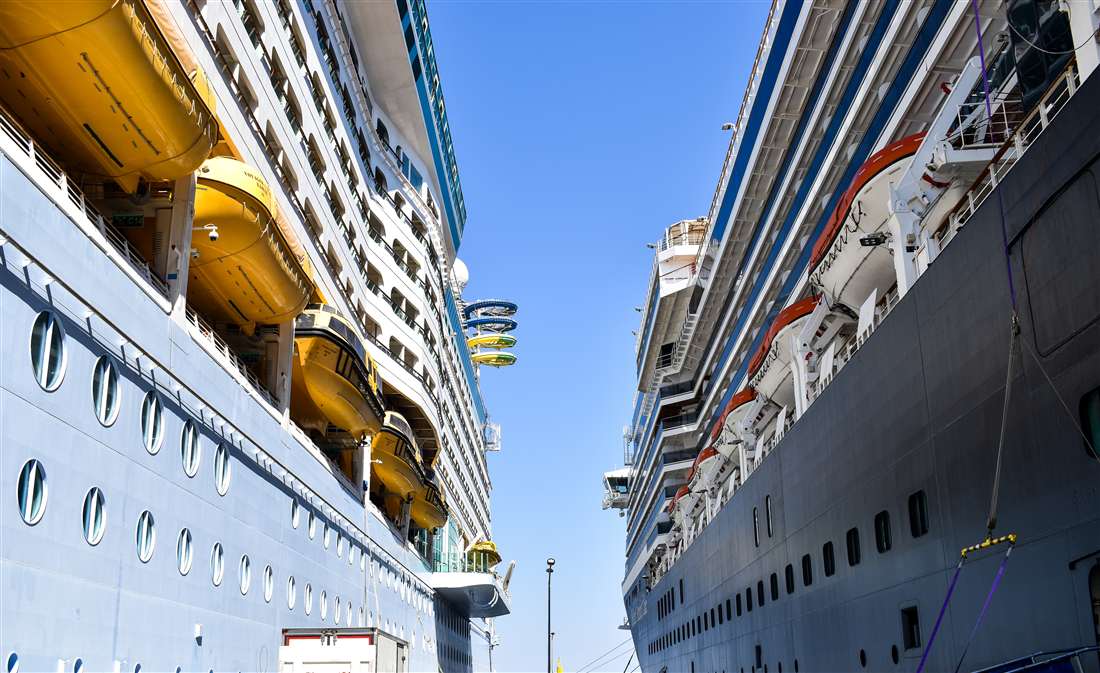
Ships dock at the Ege Ports terminal in central Kusadasi, and the port opens directly onto Scala Nuova, the shopping and taxi zone. Coaches queue in the dedicated bus lot beside the terminal, so the transfer to Ephesus starts within the port compound itself. The proximity of port to ruins is the reason Ephesus ranks as the single most-visited shore excursion on the Turkish Aegean. Travellers comparing the Turkish gateway with the Greek one review the Ephesus from Samos route, which crosses the strait by ferry before the same coach drive.
Ege Ports handles the largest cruise ships on the Turkish coast, with berths for vessels over 300 metres and a terminal that clears passengers straight onto the Kusadasi waterfront. The port sits at the head of the Gulf of Kusadasi, sheltered by Pigeon Island and the Dilek Peninsula to the south. Guides board their groups inside the secure zone, check headsets, and confirm the all-aboard time against the coach schedule before the wheels turn. The D550 highway that carries the transfer forms the main artery of the Küçük Menderes valley, linking Kusadasi, Selçuk, and the inland road to Izmir 80 kilometres north. Traffic thins the moment the coach leaves the Kusadasi town grid, so the run to the ruins holds its 25-minute timing across the busiest summer weeks.
Drivers use two gates. The Upper Gate (Magnesia Gate) opens onto the top of Curetes Street; the Lower Gate opens beside the Great Theatre and the Arcadian Way. Guided cruise groups start high and finish low, walking downhill past the Library of Celsus. The full transfer, from stepping off the gangway to standing before the first monument, runs 30 to 45 minutes including the port-lot boarding. The return mirrors it. This tight loop is what makes Ephesus reachable, toured, and re-boarded inside a single port call, with hours to spare for the museum at Selçuk or the town bazaar.
How Far Is Ephesus from the Kusadasi Cruise Port?
The Kusadasi cruise port to Ephesus distance is 20 kilometres by road, a 25 to 30 minute drive north on the D550 through Selçuk. Traffic stays light outside the town centre, so transfer time holds steady across the April-to-October cruise season.
Measured straight-line, the port and the ruins sit roughly 16 kilometres apart, but the paved road tracks the coast and valley for the full 20 kilometres. The drive climbs no serious gradient; the valley floor stays flat from the Aegean shore to the foot of Mount Pion and Mount Coressus, the two hills that frame the ancient city. A short stretch through Selçuk adds a few minutes when the town’s Saturday market fills the streets, so early departures clear it before the crowd.
Transfer options split by budget and control over timing:
- Private transfer — a saloon car or minivan for two to six, direct port-to-gate, 25 minutes, driver waits at the site.
- Shared shuttle — a minibus pooling passengers from the same ship, 30 to 40 minutes with pickup stops.
- Organised tour coach — a full-size bus tied to the shore-excursion schedule, guaranteed return before all-aboard.
- Metered taxi — the port taxi rank on Scala Nuova, fixed round-trip fare negotiated before departure.
The road passes three landmarks that anchor the geography. The House of the Virgin Mary crowns Mount Koressos (Bülbül Dağı) at 420 metres, reached by a 7-kilometre switchback road that branches off the main route above Ephesus. The Temple of Artemis, one of the Seven Wonders of the Ancient World, stands on the flat ground at the Selçuk edge, a two-minute detour off the D550. The Basilica of St John and the Selçuk castle sit on Ayasuluk Hill directly above the temple.
The ancient geography explains why Ephesus stands 20 kilometres inland from a working cruise port. In antiquity Ephesus was a harbour city, its docks fed by the Cayster River, but centuries of silt from the river pushed the coastline west and stranded the harbour. The old port basin now lies buried under the flat farmland that the transfer road crosses, and the sea that once lapped the Arcadian Way retreated to the modern shore at Pamucak and Kusadasi. This silting killed the ancient economy and preserved the ruins, freezing the abandoned city rather than burying it under a living successor. The same retreat set the modern harbour where Kusadasi grew, so today’s cruise passengers dock at the new coast and drive the reclaimed valley to reach the stranded classical port.
Because the ruins lie so close, a taxi round trip with two hours at the site fits comfortably inside a standard eight-to-ten-hour port call. The 20-kilometre figure holds whether the destination is the Upper Gate or the Lower Gate; the two entrances stand about 1.5 kilometres apart along the ancient street grid. Detailed monument-by-monument coverage of the site itself appears on the dedicated Ephesus hub. The short, reliable distance is the practical foundation of every Kusadasi shore excursion.
What Is the Best Way to Visit Ephesus from a Cruise Ship at Kusadasi?
The best cruise-day option is a small-group or private shore excursion with a guaranteed return to the ship, because the operator carries liability for all-aboard timing. Independent taxi visits cost less but shift the re-boarding risk onto the passenger.
Cruise lines and independent operators sell three tiers of Ephesus visit from Kusadasi, and the right pick turns on group size, pace, and tolerance for timing risk:
- Small-group shore excursion — 8 to 16 travellers, a licensed archaeological guide, headsets for the guide’s commentary, a set 5-to-6-hour loop covering Ephesus plus one or two extra sites.
- Private shore excursion — a dedicated car and guide for one party, custom pace, the freedom to add the Terrace Houses or skip the shopping stop, priority walking speed through the crowds.
- Ship-operated tour — booked through the cruise line, the highest price, the firmest all-aboard guarantee because the ship holds departure for its own excursions.
- Independent taxi — the cheapest, a driver from the port rank, no guide, the passenger owns the clock.
Small-group and private tours run by licensed local operators book a guide accredited by the Turkish Ministry of Culture and Tourism, a legal requirement inside the archaeological zone. The guide reads Curetes Street, the Library of Celsus façade, and the Terrace House frescoes with detail that a self-guided walk misses. Headset systems keep the group audible in the crush around the Library and the Great Theatre, the two densest choke points on a full cruise day.
The decisive advantage of any organised excursion is the return contract. A licensed operator commits in writing to deliver passengers back before all-aboard, and a ship-operated tour holds the vessel if the coach runs late. An independent taxi carries no such promise, so a flat tyre or a Selçuk traffic snarl becomes the traveller’s problem alone. For a first Turkish port call with one shot at a Wonder of the ancient world, the guaranteed-return format removes the single biggest risk of the day.
Group size shapes the day more than any other factor. A 40-seat coach unloads a wall of travellers who bunch at each monument, slow the walking pace, and queue for the Terrace Houses entrance together. A small group of a dozen moves as one unit, hears every word through the headset, and reaches the Library plaza before the coach crowds arrive. A private party of two to six sets its own tempo, lingers at the Temple of Hadrian frieze, skips the carpet-shop stop, and adds the Ephesus Museum in Selçuk if the clock allows. The licensed guide requirement holds across all three, so the depth of commentary matches; the difference lies in pace, crowd exposure, and the freedom to reshape the route on the day.
Private tours suit families, mobility-limited travellers, and anyone who values a self-set pace; small groups suit solo travellers and couples after guided depth at a lower fare. Booking direct with a Kusadasi-based licensed operator undercuts the ship’s price while keeping the return guarantee, the combination most independent-minded cruisers pick.
What Does a Kusadasi Shore Excursion to Ephesus Include?
A standard Kusadasi shore excursion includes round-trip port transfer, a licensed guide, and Ephesus entrance, with most tours adding the House of the Virgin Mary and the Temple of Artemis. The Terrace Houses carry a separate ticket that premium tours bundle in.
The core cruise-day package bundles the elements a passenger needs to reach the ruins, tour them with expert commentary, and re-board on schedule. A typical inclusion list reads:
- Round-trip transfer — air-conditioned coach or private car, port gate to site gate and back.
- Licensed guide — a Ministry-accredited archaeological guide for the full site walk.
- Ephesus entrance ticket — the main archaeological site, Upper Gate to Lower Gate.
- House of the Virgin Mary — the shrine on Mount Koressos, a Catholic and Muslim pilgrimage chapel.
- Temple of Artemis stop — the Wonder-of-the-World site at Selçuk, usually a short photo halt.
- Headset audio system — on group tours, for clear guide commentary in crowds.
The House of the Virgin Mary (Meryem Ana Evi) is a stone chapel identified in the nineteenth century from the visions of Anne Catherine Emmerich and confirmed by later church investigation. Popes have visited it, and it draws Christian and Muslim pilgrims alike, since Islam venerates Mary as the mother of the prophet Isa. The site includes a wishing wall and a spring, and it opens onto valley views from the mountaintop.
The Temple of Artemis stop shows the single re-erected column of what was a 127-column marble temple, the largest of the Greek world and one of the Seven Wonders. The Terrace Houses, the hillside mansions of Ephesus’s Roman elite, carry a separate entrance fee and a protective roof; premium and private tours fold this ticket in, while budget group tours leave it optional.
The order of the day follows a fixed logic that guards the return time. Tours reach the House of the Virgin Mary first, driving high onto Mount Koressos before the site fills, then descend to Ephesus for the main two-to-three-hour walk, and finish at the Temple of Artemis and the Selçuk sites on the way back to the port. This sequence puts the mountaintop chapel in the cool morning, the exposed marble streets before the midday peak, and the flat roadside temple as a quick closing stop. Shopping halts at a leather or carpet outlet appear on lower-priced tours as the operator’s commission arrangement; premium and private tours cut them. Reading whether a shopping stop sits inside the itinerary separates a tour built around the ruins from one built around the sales floor.
Meals split by tier. Half-day tours skip lunch to guard the timetable; full-day tours add a lunch stop in Selçuk or Sirince village at a fixed set menu. Every reputable excursion builds in a return buffer, aiming to have passengers back at the port 60 to 90 minutes before all-aboard. Read the inclusion list before booking: the difference between a cheap tour and a premium one is the Terrace Houses ticket, the lunch, and the guaranteed-return clause.
What Do You See at Ephesus on a Kusadasi Day Tour?
A Kusadasi day tour walks the marble spine of Roman Ephesus: the Library of Celsus, the Great Theatre, Curetes Street, the Temple of Hadrian, the Terrace Houses, the Odeon, and Marble Street. These monuments make Ephesus the best-preserved classical city on the Mediterranean.
The guided route starts at the Upper Gate beside the Odeon and descends through the civic and commercial heart of the ancient metropolis. The headline monuments in walking order:
- Odeon — a 1,400-seat roofed council chamber (bouleuterion) for the city senate and small concerts.
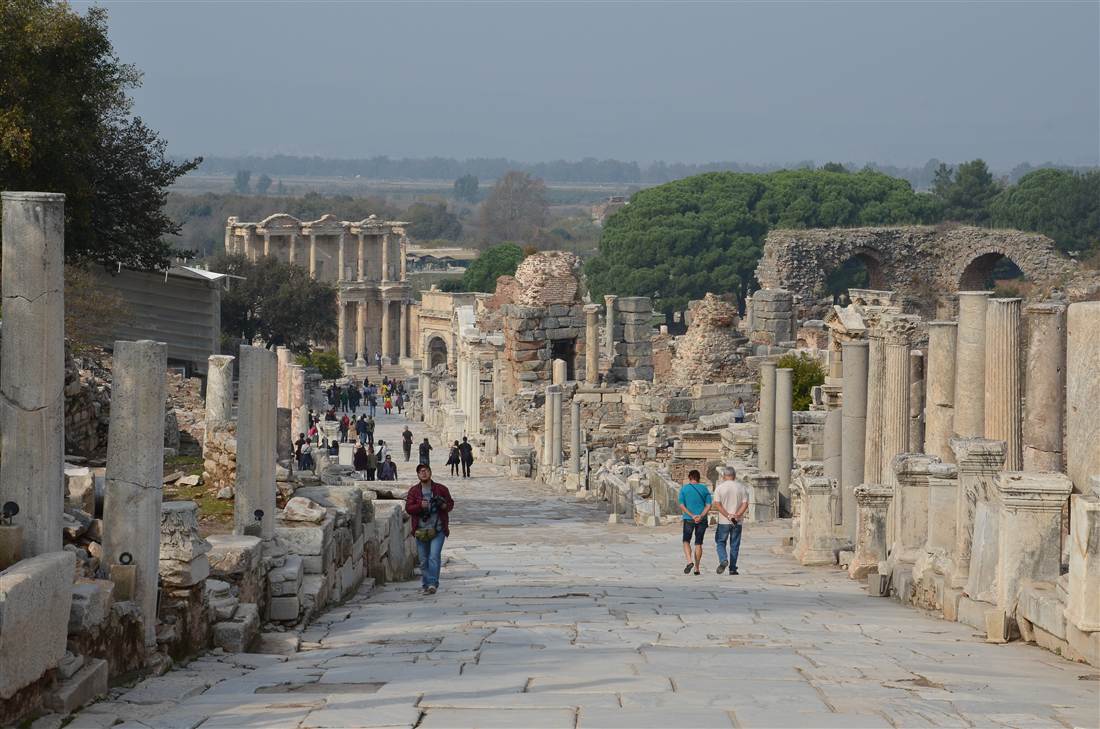
- Curetes Street — the sloping marble avenue lined with columns, statue bases, and shop foundations.
- Temple of Hadrian — a small, ornate façade with a Tyche keystone and Medusa relief, dedicated in the second century AD.
- Terrace Houses — the roofed hillside mansions with mosaic floors and painted wall frescoes.
- Library of Celsus — the two-storey façade of the third-largest library of antiquity, the icon of Ephesus.
- Great Theatre — the 25,000-seat auditorium built into Mount Pion, the largest in Asia Minor.
- Marble Street — the paved processional way from the Library to the Theatre, grooved by cart wheels.
The Library of Celsus, completed around AD 117 as a tomb-monument to the Roman senator Tiberius Julius Celsus Polemaeanus, holds 12,000 scrolls in its wall niches at its peak. Its restored façade, re-erected by Austrian archaeologists in the twentieth century, presents four statue niches representing Wisdom, Knowledge, Intelligence, and Virtue. The façade faces east to catch the morning light, and it stands as the most photographed structure in Turkey after the monuments of Istanbul.
Curetes Street forms the ceremonial spine that ties these monuments together. It runs downhill from the Hercules Gate past the Fountain of Trajan, the Temple of Hadrian, and the public latrines to the Library plaza, paved in marble slabs and flanked by the pedestals of honorific statues that named the city’s benefactors. The street took its name from the Curetes, a college of priests tied to the cult of Artemis, and its colonnades sheltered shops, offices, and mosaic-floored porticoes. Along its edge stand the Fountain of Trajan, once crowned by a colossal statue of the emperor, and the Scholastikia Baths, the public bathing complex restored by a Christian benefactress named in its inscription. Walking Curetes Street reads the civic life of the city in stone, from imperial cult to daily commerce.
The Great Theatre, carved into the western slope of Mount Pion, staged drama, gladiatorial contests, and the riot of the silversmiths recorded in the Acts of the Apostles, when the crowd chanted “Great is Artemis of the Ephesians.” The Temple of Hadrian on Curetes Street carries a frieze of the city’s foundation myth and reliefs of Androklos hunting the boar. The Terrace Houses, protected under a modern shelter, preserve marble-panelled rooms, glass mosaics, and a domestic scale that shows how the wealthy lived. Together these monuments turn a two-hour walk into a full portrait of an imperial Roman provincial capital of 200,000 people.
How Long Do You Need at Ephesus from Kusadasi?
Plan two to three hours at the archaeological site itself and five to six hours for the full excursion including transfer, the House of the Virgin Mary, and the Temple of Artemis. That window returns cruise passengers to the ship with a comfortable buffer.
The site walk from the Upper Gate to the Lower Gate covers about 1.5 kilometres of downhill-to-flat marble path. A brisk transit takes 90 minutes; a guided tour with stops at each monument runs two hours; adding the Terrace Houses pushes it to three. The time budget breaks down cleanly:
- Site walk, no Terrace Houses — 2 hours Upper Gate to Lower Gate with guide commentary.
- Site walk plus Terrace Houses — 2.5 to 3 hours with the roofed mansions.
- House of the Virgin Mary — 45 minutes including the mountain drive and chapel visit.
- Temple of Artemis — 15 to 20 minutes at the single column and foundation.
- Ephesus Museum, Selçuk — 45 minutes for the finds, including the Artemis statues.
- Transfers — 60 minutes total, port to site and back.
A half-day cruise excursion compresses the site to two hours and adds one extra stop, fitting a 4.5-to-5-hour loop. A full-day excursion runs six to seven hours and layers in lunch at Sirince plus the Ephesus Museum. Both formats build a return buffer, targeting arrival at the port 60 to 90 minutes before all-aboard so a late coach never threatens the sailing.
Heat governs the pace in July and August, when midday temperatures on the exposed marble hit 35 degrees Celsius with no shade across Curetes Street. Early-morning tours, boarding within the first hour after docking, clear the main monuments before the sun and the peak-crowd surge from the fleet of ships in port. The Great Theatre and the Library plaza turn shoulder-to-shoulder between eleven and one, so an early start buys both cooler stone and cleaner photographs.
Mobility shapes the timing as much as heat. The site walk descends a continuous marble slope worn smooth over two millennia, and the stones turn slick and uneven underfoot, so travellers with limited mobility set a slower pace and add time. A wheelchair route exists along the flatter lower section near the Library and the Great Theatre, reached from the Lower Gate, which trims the steep upper stretch. Sturdy closed shoes, a hat, water, and sun protection turn a hot two-hour walk from an ordeal into a comfortable one. Rest points cluster at the Library plaza and the Great Theatre steps, the two spots where a group pauses longest, so a realistic plan budgets standing time at each icon rather than a continuous march from gate to gate.
The takeaway for planning: two hours is the minimum for a satisfying site visit, three hours captures the Terrace Houses, and the surrounding excursion structure adds two to three hours of transfer and secondary sites. Anything under two hours reduces Ephesus to a rushed march past the Library, which shortchanges the best-preserved ancient city on the coast.
What Does an Ephesus Tour from Kusadasi Cost?
An Ephesus tour from Kusadasi costs roughly 40 to 70 euros per person for a small-group shore excursion and 120 to 250 euros for a private car and guide. Independent taxi plus entrance runs 50 to 90 euros for two travellers.
Price turns on group size, guide inclusion, and the number of secondary sites. The main cost bands for a cruise-day visit:
- Small-group shore excursion — 40 to 70 euros per person, guide and transfer and Ephesus entrance included.
- Private tour — 120 to 250 euros total for the party, dedicated car and guide, flexible pace.
- Ship-operated excursion — 80 to 130 euros per person, the premium for the cruise line’s return guarantee.
- Independent taxi — 30 to 50 euros round trip plus entrance per head, no guide.
The Ephesus site entrance is priced in euros at the gate, and the Terrace Houses carry a separate ticket on top. A Museum Pass Aegean covers Ephesus, the Terrace Houses, the Ephesus Museum, the Temple of Artemis area, and the Basilica of St John under one purchase, a saving for travellers hitting three or more sites. Cruise excursions fold these fees into the headline price, so the quoted per-person figure covers the gate.
What the price includes decides the real value. A budget group tour covers transfer, guide, and Ephesus entrance, and stops short of the Terrace Houses ticket and lunch. A premium private tour bundles the Terrace Houses, the House of the Virgin Mary, the Temple of Artemis, a Selçuk lunch, and priority pacing. Read the exclusions: Terrace Houses entrance, lunch, drinks, and shopping-stop purchases are the line items that separate a stripped fare from a complete day.
Booking channel moves the price as much as the tour tier. A tour bought through the cruise line’s excursion desk carries the line’s markup and the firmest return guarantee, landing at the top of the range. The same itinerary booked direct with a Kusadasi-based licensed operator strips that markup while keeping a written return commitment, which is why independent-minded cruisers book ahead online and meet the guide at the port gate. Currency adds a wrinkle: the Ephesus and Terrace Houses gate tickets price in euros, tours quote in euros or dollars, and the Kusadasi bazaar trades in Turkish lira, so carrying a small euro float covers gate fees and tips without a poor dockside exchange rate. Group tours split the fixed cost of guide and coach across the passengers, which is the structural reason they undercut a private car per head.
Tipping the guide and driver is customary and sits outside the ticket price. Independent taxi visits demand a fixed round-trip fare agreed before departure, with the driver waiting at the site; a metered open fare risks a padded bill on the return. For the guaranteed-return security and expert commentary, the 40-to-70-euro small-group tier delivers the strongest value on a Kusadasi port day, undercutting the ship’s own excursion while matching its coverage.
Is Independent Travel to Ephesus from Kusadasi Possible?
Yes. Independent travellers reach Ephesus from Kusadasi by taxi direct to the gate or by public dolmus minibus to Selçuk, then a short taxi or 3-kilometre walk to the site. A gate ticket plus a rented audio guide replaces a live guide.
The independent route rewards travellers who prize control over cost and pace. Two self-guided methods work from the Kusadasi port:
- Direct taxi — a fixed round-trip fare from the port rank to the Ephesus gate, driver waits, 25 minutes each way.
- Dolmus and taxi — a public minibus from the Kusadasi bus station to Selçuk, then a short taxi or walk to the ruins.
The dolmus (shared minibus) runs a fixed route between Kusadasi and Selçuk every 20 to 30 minutes through the cruise season, a low-cost link that drops passengers at the Selçuk otogar. From there the Ephesus Lower Gate stands 3 kilometres west, reached by a local taxi, a second dolmus toward Pamucak, or a flat 35-minute walk past the Temple of Artemis. The return runs the same way, so timing the last convenient dolmus back matters for a ship deadline.
At the gate, an independent visitor buys the Ephesus entrance ticket and the separate Terrace Houses ticket, then rents an official audio guide or loads a reputable offline map app for self-paced commentary. The audio guide names the Library of Celsus, the Temple of Hadrian, and the Great Theatre monument by monument, delivering the historical layer that the ruins do not label in depth on site. The Museum Pass Aegean bought at the gate bundles multiple sites for a single fare.
The independent route unlocks a flexibility no coach matches. A self-guided traveller pairs Ephesus with the Temple of Artemis on the walk between the Selçuk otogar and the Lower Gate, since the single re-erected column stands directly on that path. From the ruins, a short taxi reaches the House of the Virgin Mary on the mountain, and a return leg through Selçuk adds the Ephesus Museum and the Basilica of St John on Ayasuluk Hill without a fixed group schedule. The traveller sets each stop’s length, skips the shopping outlet entirely, and eats where the locals do rather than at a commission restaurant. The dolmus fare and the gate ticket total a fraction of a guided excursion, so the saving funds a museum pass and a Sirince detour with money to spare.
The trade-off is timing risk. No operator holds the ship for an independent visitor, so the self-guided traveller owns every minute of the schedule and builds a large return buffer against a late dolmus or a traffic delay in Selçuk. Independent travel cuts the cost to a fraction of a guided tour and suits confident, punctual travellers on a long port call; nervous timekeepers and first-time cruisers lean toward the guaranteed-return excursion. For those weighing the parallel Greek gateway, the Ephesus from Samos crossing follows a comparable self-guided logic once the ferry lands at Kusadasi.
What Else Is Worth Visiting Near Kusadasi Besides Ephesus?
Near Kusadasi the standout sites beyond Ephesus are the House of the Virgin Mary, the Temple of Artemis, Sirince village, the Ephesus Museum in Selçuk, and Kusadasi town with its Grand Bazaar and Pigeon Island fortress. Each folds into a full port day.
The valley around Selçuk packs a dense cluster of sites within 15 kilometres of the port, so a single excursion strings three or four together:
- House of the Virgin Mary — the hilltop pilgrimage chapel on Mount Koressos, 7 kilometres above Ephesus.
- Temple of Artemis — the Wonder-of-the-World foundation and single column at the Selçuk edge.
- Ephesus Museum, Selçuk — the finds gallery holding the two marble Artemis statues and the Eros dolphin.
- Sirince village — the hillside wine village of Greek-built stone houses, fruit wines, and craft stalls.
- Basilica of St John — the sixth-century church on Ayasuluk Hill built over the apostle’s tomb.
- Kusadasi Grand Bazaar — the covered market of leather, carpets, spices, and Turkish delight beside the port.
- Pigeon Island — the Byzantine-Ottoman fortress on a causeway islet in Kusadasi harbour.
Sirince, 8 kilometres east of Selçuk in the hills, was a Greek Orthodox village until the population exchange of the early twentieth century, and its whitewashed stone houses now hold wineries pressing peach, pomegranate, and mulberry fruit wines. The village lanes sell olive-oil soap, dried figs, and hand-loomed textiles, and its two nineteenth-century churches anchor the old square. It ranks as the standard lunch and shopping stop on a full-day Ephesus excursion.
Pigeon Island (Güvercinada) guards the Kusadasi harbour on a rocky islet joined to the shore by a stone causeway a few hundred metres from the cruise terminal. Its fortress, raised in the Byzantine era and rebuilt under the Ottomans, ringed the harbour with a defensive wall and gave the town its Italian trading name, Scala Nuova. The walk out to the fortress crosses landscaped gardens and delivers the classic view back over the marina and the town’s whitewashed hillside. Back on the mainland, the Kusadasi Grand Bazaar packs its covered lanes with leather jackets, hand-knotted carpets, spice sacks, evil-eye charms, and trays of Turkish delight, the standard last-hour stop before all-aboard. The bazaar sits a two-minute walk from the terminal gate, so shopping needs no transfer at all.
The Ephesus Museum in Selçuk gathers the movable finds that the open site cannot display, above all the two statues of Artemis of Ephesus, the multi-breasted goddess bristling with bull-testicle rows and animal reliefs. The Basilica of St John, built by the emperor Justinian, marks the traditional burial place of John the Evangelist, and its hilltop stands beside the Selçuk castle and the İsa Bey Mosque, a fourteenth-century Seljuk landmark. In Kusadasi itself, the Grand Bazaar and the waterfront promenade fill any hour left before all-aboard, and Pigeon Island’s fortress guards the harbour mouth on its stone causeway.
When Is the Best Time to Visit Ephesus from Kusadasi?
The best time to visit Ephesus from Kusadasi is spring, from April to June, and autumn, from September to October, when temperatures stay mild and cruise crowds thin. On any day, an early-morning start beats both the midday heat and the peak-hour crush.
The cruise season on the Turkish Aegean runs April through October, and the shoulder months bracket it with the finest conditions:
- Spring (April to June) — 18 to 27 degrees Celsius, green valley, wildflowers along Curetes Street, moderate ship traffic.
- Autumn (September to October) — 22 to 28 degrees Celsius, warm dry stone, softening crowds after the summer peak.
- Summer (July to August) — 30 to 38 degrees Celsius, full exposure on the marble, the heaviest cruise volume.
- Winter (November to March) — 10 to 16 degrees Celsius, quiet ruins, sparse cruise calls, cool clear light.
Ephesus offers almost no shade. Curetes Street, the Library plaza, and the Great Theatre bake under open sun, so a July or August midday visit tests stamina and hydration. The early-morning window, boarding within the first hour after the ship docks, delivers cooler marble and empties the main monuments before the mid-morning arrival wave from a harbour that holds three or four ships at once in high season.
Crowd timing matters as much as heat. The Library of Celsus and the Great Theatre reach their densest between eleven in the morning and one in the afternoon, when every ship’s excursion converges on the same downhill path. A tour that starts at opening time walks the site nearly clear, then exits as the crush arrives, a rhythm that improves the photographs and the pace alike.
Cruise-fleet density drives the crowd pattern as hard as the calendar month. In high summer the Kusadasi harbour holds three or four large ships at once, each discharging thousands of passengers onto the same 20-kilometre road and the same downhill marble path within the same two-hour window. That convergence, not the site’s own capacity, produces the shoulder-to-shoulder crush at the Library plaza. Checking the port’s ship schedule for the sailing date reveals whether one vessel or four share the day, and a light-traffic port call transforms the visit even in July. A tour that departs at the ship’s earliest release beats the arrival wave regardless of fleet size, reaching the icons while the other ships’ passengers still clear their gangways and board their coaches.
For the finest single combination, target a spring or autumn port call and book the earliest departure the ship allows. That pairing delivers mild air, dry footing on the marble, thin crowds at the icons, and full hours in hand for the House of the Virgin Mary and the Selçuk museum before the return deadline. The season sets the comfort; the hour sets the crowd.
Is an Ephesus Tour from Kusadasi Worth It?
An Ephesus tour from Kusadasi is worth it without qualification. Ephesus is the best-preserved ancient city on the Mediterranean, it sits 20 kilometres from the cruise gate, and it delivers a Wonder of the Ancient World plus a Roman metropolis in a single half-day excursion.
The verdict rests on a rare alignment of significance and access. Ephesus was the capital of Roman Asia, a port city of 200,000 people, the seat of the Temple of Artemis, and a centre of early Christianity where Paul preached and John is buried. Its marble streets, its Library of Celsus, its 25,000-seat theatre, and its frescoed Terrace Houses survive in a completeness that Pompeii’s brick and Rome’s fragments do not match. The reasons it tops the Kusadasi shore-excursion list:
- Proximity — 20 kilometres and 25 minutes from the port gate, the closest world-class ruin to any Aegean cruise stop.
- Preservation — standing façades, paved streets, and roofed mansions, not just foundations.
- Density of sights — the Library, the Theatre, the Temple of Hadrian, and the Terrace Houses within one 1.5-kilometre walk.
- Bundled wonders — the Temple of Artemis and the House of the Virgin Mary on the same route.
- Guaranteed return — organised excursions contract the re-boarding, removing the cruise-day risk.
The counterweights are heat and crowds, both manageable. An early departure in spring or autumn defeats each, turning the exposed marble into a comfortable walk and clearing the Library plaza for its restored two-storey façade. The Terrace Houses reward the extra ticket with mosaic floors and painted walls that show private Roman life at close range, a layer the open street cannot supply.
Set against other Aegean shore excursions, Ephesus wins on every axis a cruise passenger weighs. A beach day delivers relaxation but no substance; a bazaar afternoon delivers shopping but no history; a distant inland site burns the port call in transfer time. Ephesus alone pairs a 25-minute drive with a UNESCO World Heritage city that carried the Temple of Artemis, hosted an ecumenical council of the early church, and preserves standing Roman architecture across a walkable kilometre and a half. The visit rewards the historian, the pilgrim, the photographer, and the first-time traveller in equal measure, and it folds in a Wonder of the Ancient World and a Marian shrine at no extra drive. No competing excursion from Kusadasi matches that combination of proximity, preservation, and significance.
For a first Turkish port call, Ephesus is the flagship, and the choice of format tunes the experience rather than the destination: a small-group tour for guided depth at low cost, a private car for pace and comfort, an independent taxi for the confident planner. Whichever route, the day returns a Wonder of the ancient world, an imperial Roman capital, and a Christian pilgrimage site inside one short drive. Fuller monument detail and route comparisons live on the Ephesus hub. The tour earns its place at the top of every Kusadasi excursion list.
Frequently Asked Questions
How far is Ephesus from the Kusadasi cruise port?
Ephesus lies about 20 kilometres from the Kusadasi cruise port, a drive of 25 to 30 minutes by coach or taxi. It is the closest major ancient site to the port, which makes it the standard cruise-day excursion.
What is the best way to visit Ephesus from Kusadasi?
A guided shore excursion is the fastest route: round-trip transfer, a licensed guide, and skip-the-line entry, with a guaranteed return to the ship. Small-group and private tours add the House of the Virgin Mary and the Temple of Artemis.
How long do you need for Ephesus from Kusadasi?
Plan five to six hours for the full excursion: the transfer each way plus two to four hours at the site. That timing covers Ephesus with the House of the Virgin Mary and returns to the cruise ship before departure.