
Tholos of Delphi
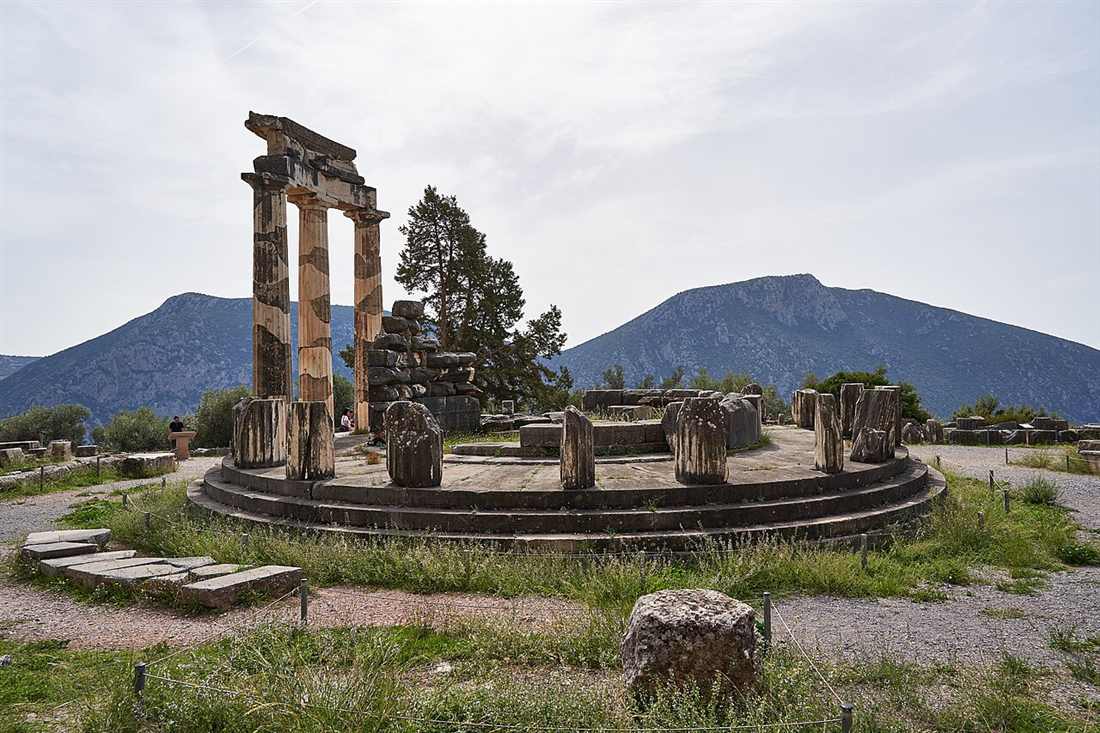
The Tholos of Delphi is the circular marble temple in the Sanctuary of Athena Pronaia at Marmaria, below the main archaeological site. A ring of twenty Doric columns once surrounded a marble wall lined inside with Corinthian half-columns, and the three re-erected outer columns against the green Pleistos valley form the single most recognizable image of Delphi. Plan the whole trip with Greece Tours.
This guide covers the Tholos of Delphi in full: what it is, where it stands within the Sanctuary of Athena Pronaia, how it was designed and built by Theodoros of Phokaia, what it was used for and why that stays unresolved, why the round temple became the icon and symbol of Delphi, and how to reach the Marmaria terrace and view it today.
What is the Tholos of Delphi?
The Tholos of Delphi is a circular Doric temple in the Sanctuary of Athena Pronaia at Marmaria, below the main Apollo sanctuary. A ring of twenty Doric columns surrounds a marble wall lined inside by ten Corinthian half-columns, all in white Pentelic marble.
The building rests on a dark limestone platform, and the contrast between the pale marble of the columns and the grey stone of the base gives the monument its distinctive two-tone appearance. The architect Theodoros of Phokaia designed the structure and set down its proportions in a written treatise, an act that fixes the Tholos among the small group of ancient buildings whose designer is named and whose method survives in record.
Three of the outer Doric columns and a section of the entablature above them stand re-erected on the terrace, lifted back into place by excavators who matched the surviving marble drums and blocks. The re-erected fragment carries the curved architrave, triglyphs and part of the cornice, so the visitor reads the rhythm of the ring even though the full circle of twenty columns no longer stands. The rest of the marble lies in ordered rows around the foundation, drums numbered and catalogued.
Inside the outer colonnade, a solid circular wall enclosed the cella, and against its inner face ran the ten Corinthian half-columns that mark one of the earliest uses of the Corinthian order in Greek architecture. The building carries no cult statue of Apollo and belongs to Athena’s precinct, which places it apart from the god’s oracle further up the slope. Its exact function within the Athena sanctuary is not recorded in surviving texts, and the monument is read today through its architecture rather than through any inscription naming its purpose. The Tholos stands as the signature image of the Delphi archaeological site, reproduced more often than any other single structure on the mountain.
Where is the Tholos, and what is the Sanctuary of Athena Pronaia?
The Tholos sits on the Marmaria terrace east of the main archaeological site, inside the Sanctuary of Athena Pronaia. This was the first sacred ground pilgrims reached as they approached Delphi from the east, the forecourt to Apollo’s oracle on the slope above.
Marmaria, the name the terrace carries today, records the marble that later builders quarried from the ruined temples for lime and fresh construction. The ground lies at the foot of the Phaedriades cliffs, on a shelf of land below the road, and a visitor walking the sanctuary descends from the modern route down into the enclosure. Anyone arriving on foot from the plain of the Pleistos river and the harbour at Kirrha passed this precinct before climbing to the Temple of Apollo, which fixes the Athena sanctuary as the threshold of the whole oracular complex.
Athena Pronaia means Athena “before the temple”, the guardian who stood in front of the forecourt to Apollo’s shrine. The epithet ties the goddess to her role as protector of the approach, and her sanctuary opened the sacred way of the pilgrim’s journey. The precinct held more than the Tholos alone, and its layout groups several structures along the terrace:
- The older Temple of Athena Pronaia at the eastern end, built in the Doric order, of which the column stumps and platform survive.
- The newer Temple of Athena, raised further west after damage struck the earlier building.
- Two treasuries, one Doric and one built by the people of Massalia in the Aeolic order, that held offerings to the goddess.
- The Tholos itself, set between the two temple sites at the heart of the terrace.
- Altars and the boundary wall that framed the sacred enclosure.
The full history and monuments of the precinct are set out in the guide to the Sanctuary of Athena Pronaia, which walks the terrace temple by temple. The Athena sanctuary also drew rockfall and flood from the cliffs above, and repeated damage from the Phaedriades explains why the precinct holds two temples of the goddess rather than one: the eastern building suffered, and a replacement rose to the west. The Tholos occupies the centre of this ground, framed on both sides by the temples of the goddess it served.
What did the Tholos look like and how was it built?
The Tholos was a marble rotunda on a stepped circular base, ringed by twenty Doric columns and crowned with a conical roof. Inside, a circular cella wall carried ten Corinthian half-columns, and carved metopes ran in two bands around the entablature above the outer colonnade.
The plan is a double circle: the outer ring of freestanding Doric columns and the inner cella wall set concentrically within it, with a walkway between the two. The outer diameter of the building measures close to fourteen and a half metres across the platform, and the twenty columns stood evenly spaced around the ring. Each column carried the entablature of architrave and frieze, and the frieze held sculpted metopes, so relief carving circled the whole exterior. A second, smaller band of metopes ran around the interior above the Corinthian half-columns, doubling the sculptural programme.
The marble-and-limestone contrast defined the building’s colour. Theodoros raised the white Pentelic marble superstructure on a base of dark grey local limestone, and the eye reads the pale ring lifting off the darker platform. The stepped foundation of three levels carried the marble drums, and the joints between drums were cut with a precision that let the columns rise true around the curve. Cutting Doric flutes onto a column that stands in a ring, where every drum turns a fraction of the circle, demands geometry worked out drum by drum, and the surviving marble shows that the flutes align down each shaft.
The roof closed the rotunda as a cone. Marble tiles rose from the circular entablature to a central point, and the conical form crowned the drum of columns beneath. The whole composition, ring of Doric columns, sculpted frieze, curved cornice, and pointed marble roof, made the Tholos the most elaborate of the round buildings that Greek architects raised. Theodoros of Phokaia set the design and its measurements down in a treatise on the building, and the ancient writer Vitruvius records his authorship, which is the reason the architect’s name reaches the present. The re-erected columns on the Marmaria terrace stand as the working proof of that design, the surviving marble lifted back into the ring that Theodoros drew.
What was the Tholos of Delphi used for?
The Tholos served the cult of Athena Pronaia, the goddess guarding the approach to Delphi, yet its exact function stays unresolved: the round form marks it as a special sacred building rather than a treasury or a rectangular cult temple, and no single use is proven.
The building stands in the Sanctuary of Athena Pronaia, the precinct pilgrims reached before the main oracle of Apollo. Its circular plan sets it apart from the two rectangular temples of Athena that flank it on the same terrace. A treasury holds a city’s offerings and takes a rectangular strong-room shape; a standard cult temple houses a cult statue in a long cella. The Tholos matches neither pattern, which is why scholars read it as a monument tied to the sanctuary itself rather than to one dedicant city.
Several readings compete. One treats the Tholos as a shrine that framed a statue or a sacred object within its inner ring of columns. Another treats it as a votive monument, a display of wealth and architectural skill offered to Athena and to the prestige of Delphi. A third links the round form to chthonic or hero cult, since circular structures across the Greek world mark tombs, heroes, and deities of the earth. The Delphic ground carried older earth-cult associations before Apollo, and a round building on that ground reaches toward those roots.
The archaeology fixes what the plan and the sculpture confirm and leaves the rest open. Excavation established the outer ring of Doric columns, the inner ring of Corinthian half-columns against the cella wall, and a rich carved metope program, all of it costly and deliberate. What excavation did not recover is a cult statue, an altar tied only to this building, or an inscription naming its purpose. The material proves a high-status sacred monument inside Athena’s sanctuary; the specific rite it hosted stays unnamed, and honest accounts of Delphi report the question as unsettled.
Why is the Tholos the icon and symbol of Delphi?
Three re-erected marble columns carrying a curved entablature, set against the deep green Pleistos valley and the grey Phaedriades cliffs, give the Tholos the most recognizable silhouette on the whole site, and that image fills the postcards, the guidebook covers, and the mental picture of Delphi itself.
The power of the image comes from the circular form. A row of temple columns reads as a flat colonnade from most angles, but the Tholos columns stand on a curve, so the eye follows them around and the fragment of entablature above them arcs rather than runs straight. That curve signals “round temple” instantly, and the round temple is rare enough that the shape alone identifies Delphi. The partial ruin helps: three standing columns and a broken cornice suggest the complete rotunda without hiding the sky behind a solid wall, so photographs keep both the marble and the landscape in one frame.
The setting carries the rest. The Tholos sits low on the Marmaria terrace, below the road, with the ground dropping away toward the Pleistos gorge and its sea of olive trees, and the twin Phaedriades cliffs rising behind the sanctuary. White marble against green valley and pale rock produces a contrast that reads in any light and reproduces in print. The columns catch the sun while the valley stays in shadow, and that is the composition on the covers.
Recognition then feeds on itself. Once an image becomes the shorthand for a place, every new guidebook, poster, and travel feature repeats it, and repetition cements the Tholos as the emblem of Delphi ahead of the Temple of Apollo, the theatre, and the stadium. Visitors arrive already carrying the picture and walk down to Marmaria to match the view to the memory, which makes the Tholos the single most photographed structure on the site.
How do you visit the Tholos of Delphi today?
Walk to the Marmaria terrace, the Sanctuary of Athena Pronaia, which lies below the main road a short distance east of the principal archaeological site and museum; a brief path leads down from the roadside to the Tholos, and you view the columns from the terrace walkway.
Marmaria sits apart from the main enclosure of the Temple of Apollo. From the museum and the main gate you follow the road eastward and reach a marked descent to the terrace; the walk down takes a few minutes on a stepped path. Entry to the Athena Pronaia sanctuary is open along the terrace, and the Tholos stands near the centre of it, with the two temples of Athena beside it. You look at the columns from the surrounding path rather than walking among them, so the best positions are the points where the curve of the colonnade lines up against the valley behind.
Timing rewards the early visitor. Morning light strikes the marble from the east and warms the columns while the Pleistos valley below holds its shade, which is the frame the photographers want. A sensible circuit runs in this order:
- Start at the Castalian Spring, the sacred water source in the ravine between the Phaedriades, on the way in.
- Continue to the main Sanctuary of Apollo for the temple, the theatre, and the stadium above it.
- Visit the archaeological museum for the Charioteer and the Tholos metopes.
- Finish at the Marmaria terrace for the Tholos, downhill and quieter than the main site.
Season shapes the experience as much as the hour. Spring covers the valley in green and wildflowers and keeps the marble cool to photograph; autumn brings clear light and thinner crowds; high summer turns the open terrace hot by midday, so an early arrival protects both the light and the comfort of the walk. Firm shoes handle the stepped path and the uneven ground, and a plan built around the site’s rhythm helps, which is why it pays to read up on the best time to visit Delphi before you set out. Reach the Tholos in the first hour of opening and the columns stand lit against the valley with the terrace almost to yourself.
What are the carved metopes and sculpture of the Tholos?
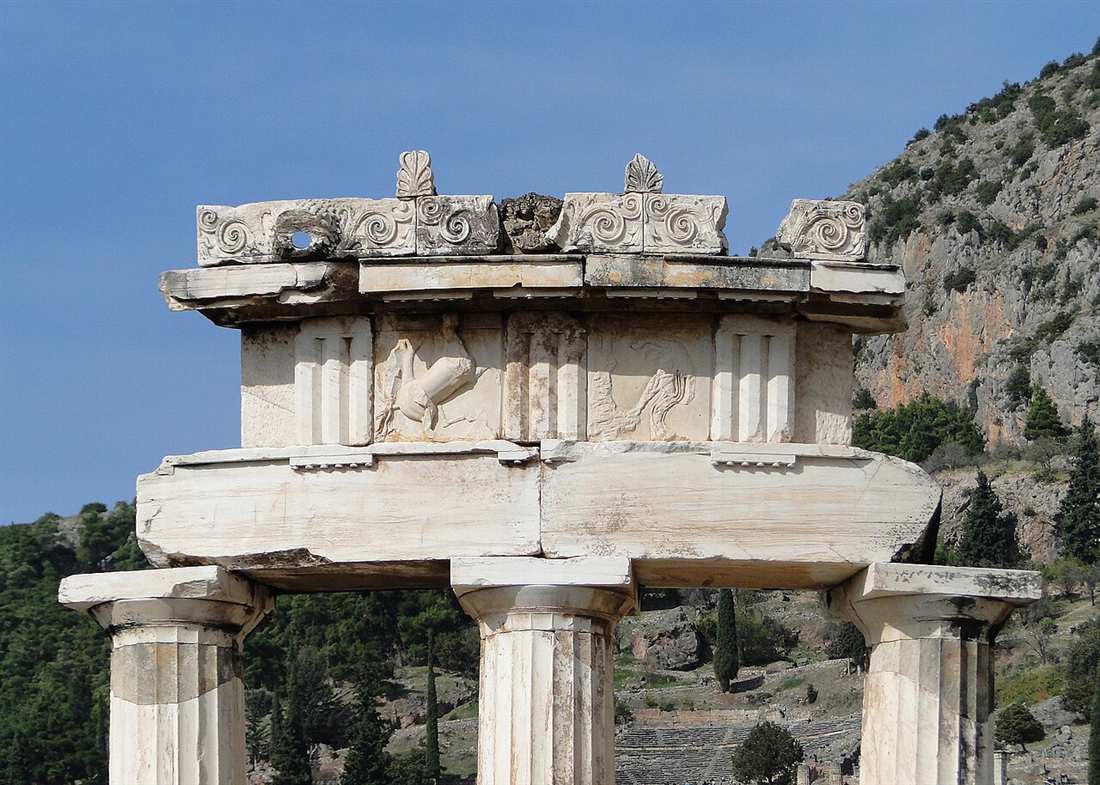
The Tholos carried two sculpted Doric friezes of carved metopes, one high on the outer wall and one within the colonnade. The panels showed battle scenes, chiefly an Amazonomachy and a Centauromachy, cut in fine white marble. The programme wrapped the circular building in a continuous ring of combat.
The outer frieze ran above the encircling columns and faced the open terrace. Its metopes depicted the Amazonomachy, the fight between Greek warriors and the Amazons, with figures lunging, falling and gripping shields across each square panel. The inner frieze sat above the wall of the round chamber, and its metopes carried the Centauromachy, the struggle between the Lapiths and the centaurs. Together the two registers set myth-battle against myth-battle around the whole drum.
The carving reaches a high standard of relief work. The sculptors modelled taut muscle, twisting torsos and deep folds of drapery, and they undercut the marble so limbs and weapons stand clear of the ground. The small scale of each metope concentrates the action, and the repetition of paired combatants gives the ring a steady rhythm as a viewer walks around the base.
Fragments of both friezes survive and are displayed in the Delphi Archaeological Museum. The surviving metopes show heads, torsos and fighting groups broken from their panels, and they let a visitor read the quality of the original hand up close. Seeing the sculpture in the galleries and then the standing columns on the terrace joins the two halves of the monument, the way the sacred precinct once joined the Tholos to the Temple of Apollo above it.
What happened to the Tholos over time — its history and re-erection?
Builders raised the Tholos in the early fourth century BC. Across the following centuries the structure fell, losing its roof, columns and sculpture until only foundations and scattered blocks remained. French excavators cleared the Marmaria terrace, and an anastylosis re-erected three outer columns with a length of entablature.
The building stood complete through antiquity as one of the ornaments of the sanctuary of Athena Pronaia, the precinct that greeted travellers before the main terrace of Apollo. Earthquake, collapse and the removal of stone for other uses brought the round temple down over the long span after the classical age. The marble drum, the encircling colonnade and the carved friezes came apart, and the blocks lay across the ground where they had settled.
The record of loss and recovery runs through clear stages:
- Construction of the round temple in the early fourth century BC.
- Collapse of the roof, colonnade and walls across the centuries that followed.
- Reduction of the monument to its circular foundation and a field of fallen blocks.
- Excavation of the Marmaria terrace by the French School at Athens.
- Anastylosis of three outer columns and a section of the entablature they carry.
The French School at Athens excavated the Marmaria terrace and uncovered the foundations of the Tholos along with the scattered architectural members. The dig sorted the marble drums, capitals and cornice blocks that had lain in the earth, and it fixed the exact plan and diameter of the round building from the surviving base. That work turned a heap of stone into a legible monument and made the re-erection possible.
The anastylosis that visitors see today raised three of the outer Doric columns and set a section of the entablature across their capitals. The reconstruction uses the original marble members returned to their places, with new material only where a block was missing, so the standing fragment shows the true height and curve of the colonnade. The three white columns above the terrace now mark the Tholos from a distance and stand as the image most travellers carry away from Marmaria.
Frequently Asked Questions
What is the Tholos of Delphi?
The Tholos of Delphi is a circular temple of the fourth century BC in the Sanctuary of Athena Pronaia, built with an outer ring of twenty Doric columns and an inner ring of Corinthian half-columns in white Pentelic marble on a dark limestone base. Three columns stand re-erected today.
Who built the Tholos of Delphi?
The architect Theodoros of Phokaia designed the Tholos and wrote a treatise on it. It stands on the Marmaria terrace among the temples and altars of Athena Pronaia, the goddess who guarded the approach to Apollo’s oracle at Delphi.
Can you go inside the Tholos of Delphi?
You view the Tholos from the walkway around the Marmaria terrace rather than walking among the columns. The terrace lies below the road east of the main site and museum, reached on a short stepped path.