
Delphi and Meteora 2-Day Tour
The Delphi and Meteora 2-day tour joins the two headline sites of central Greece in one loop from Athens: the oracle sanctuary of Delphi on Mount Parnassus on the first day, an overnight at the foot of the rocks in Kalambaka, and the cliff-top monasteries of Meteora on the second. The overnight turns a punishing single-day dash into two unhurried half-days. Plan the whole trip with Greece Tours.
This guide sets out the Delphi and Meteora 2-day tour in full: what the tour is, the itinerary day by day, what you see at Delphi on the first day and at Meteora on the second, what the package includes and what it costs, and where you stay overnight, from Kalambaka and Kastraki beneath the pillars to Delphi village and Arachova on the mountain.
What is the Delphi and Meteora 2-day tour?
The Delphi and Meteora 2-day tour joins the two headline sites of central Greece in one loop from Athens: the oracle sanctuary of Delphi on the slopes of Mount Parnassus and the cliff-top monasteries of Meteora on their sandstone pillars, with an overnight in Kalambaka between the two.
The tour runs as a single circuit rather than two separate excursions. A coach or minibus collects travellers in central Athens, climbs northwest through the Boeotian plain to Delphi on the first morning, then continues north across the Thessalian plain to the town of Kalambaka at the foot of Meteora for the night. The second morning covers the monasteries, and the vehicle returns to Athens by early evening. The full loop spans roughly 850 kilometres of driving split across the two days.
Delphi and Meteora sit on the UNESCO World Heritage list, and the pairing places a classical sanctuary and a monastic complex within a single trip. At Delphi the Greeks consulted the oracle of Apollo through the priestess Pythia, and the sanctuary held the omphalos stone that marked the navel of the ancient world. At Meteora, monks built six active monasteries on natural rock towers that rise 400 metres above the valley, reached in earlier centuries by rope ladders and nets. The Delphi leg supplies the archaeology and the mythology; the Meteora leg supplies the geology and the living Orthodox tradition.
Guided departures pair a licensed guide with the driver, and the format suits travellers who base themselves in Athens yet want to reach two inland sites that lie in opposite directions from most one-day routes. The overnight removes the strain of a single 12-hour dash and gives time for the sanctuary, its museum, and a full morning at the rock monasteries.
What does the two-day Delphi and Meteora itinerary look like?
Day one runs from Athens to Delphi through the mountain town of Arachova, covers the sanctuary and its museum, then drives north to an overnight in Kalambaka. Day two takes in the Meteora monasteries across the morning and returns south to Athens by evening.
The structure fixes Delphi to the outbound afternoon and Meteora to the second morning, the two windows that match each site’s opening hours and light. Kalambaka anchors the middle of the loop because it sits directly beneath the Meteora rocks, so the second day starts with a short climb rather than a long transfer. The parallel outline below sets out both days.
- Day one, morning: Departure from central Athens and the drive northwest across Boeotia toward Mount Parnassus.
- Day one, midday: A stop at Arachova, the stone-built town on the Parnassus slopes, for lunch and views over the valley.
- Day one, afternoon: The archaeological site of Delphi, the Sacred Way to the Temple of Apollo, and the Delphi Archaeological Museum.
- Day one, evening: The drive north to Kalambaka and an overnight stay at the foot of the Meteora pillars.
- Day two, morning: The Meteora monasteries by road, with stops at the accessible complexes and viewpoints across the sandstone towers.
- Day two, midday: Free time in Kalambaka or Kastraki for lunch beneath the rocks.
- Day two, afternoon: The return drive south across the Thessalian plain to Athens, arriving in the early evening.
Arachova earns its place on the first day as a working mountain town at 950 metres, known for its woven textiles, its formaella cheese, and a main street of tavernas that break the climb to Delphi. Guides schedule the lunch stop here so travellers reach the sanctuary in the afternoon, when the tour groups of the morning have cleared the Sacred Way.
The Kalambaka overnight splits the driving into two manageable halves and puts travellers within minutes of the monasteries at opening time. Standard departures reserve rooms in Kalambaka or the neighbouring village of Kastraki, both of which sit under the rock towers. The second day keeps the monastery circuit to the morning because the complexes close in the early afternoon and observe rest days that rotate through the week, so the itinerary lists which monasteries open on the day of the visit.
Total road time comes to about five hours on day one and six hours on day two, the longer stretch falling on the return from Thessaly to Attica. The itinerary front-loads the sightseeing on both days and leaves the driving for the ends, so each site gets its hours of daylight.
What do you see at Delphi on the first day?
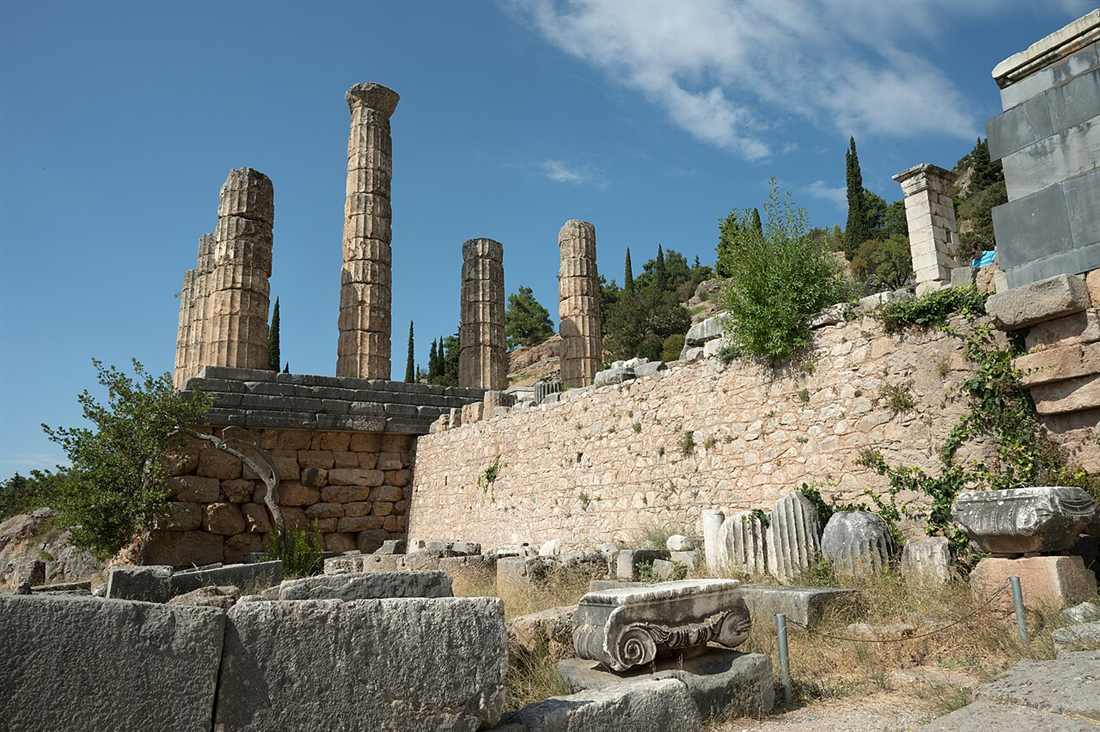
Delphi opens with the Sacred Way climbing to the Temple of Apollo, continues up to the theatre and the stadium above it, passes the Castalian Spring at the gorge, and ends inside the museum with the bronze Charioteer, the site’s most famous survivor.
The Sacred Way is the paved processional route that pilgrims followed from the entrance up to the temple terrace. It threads between the foundations of treasuries, the small buildings that Greek cities raised to hold their offerings, and the reconstructed Treasury of the Athenians stands beside the path in its marble. The route ends at the Temple of Apollo, where six Doric columns of the fourth-century-BC rebuild mark the platform on which the oracle Pythia delivered the god’s answers to kings and cities.
Above the temple the ground rises to the theatre, cut into the hillside with 35 rows of seating and a view straight down the sanctuary to the Pleistos valley and the olive groves below. A further climb reaches the stadium on the highest terrace, where the Pythian Games were held every four years and where the stone starting line and the spectator banks survive. The Castalian Spring sits east of the sanctuary at the mouth of the gorge between the two Phaedriades cliffs, and pilgrims washed here before they approached the oracle.
The visit closes at the Delphi Archaeological Museum, which holds the finds from the sanctuary in a sequence of galleries beside the site. The bronze Charioteer of Delphi stands at the centre, a life-size figure cast to commemorate a chariot victory, with inlaid eyes and copper lips intact. The same halls display the twin kouroi statues, the sphinx of the Naxians on its tall column, and the silver bull, so the museum completes the story that the ruins outside begin. The guide moves the group from the ruins to the galleries in one continuous route, the sanctuary read first in stone and then in the objects it once held.
What do you see at Meteora on the second day?
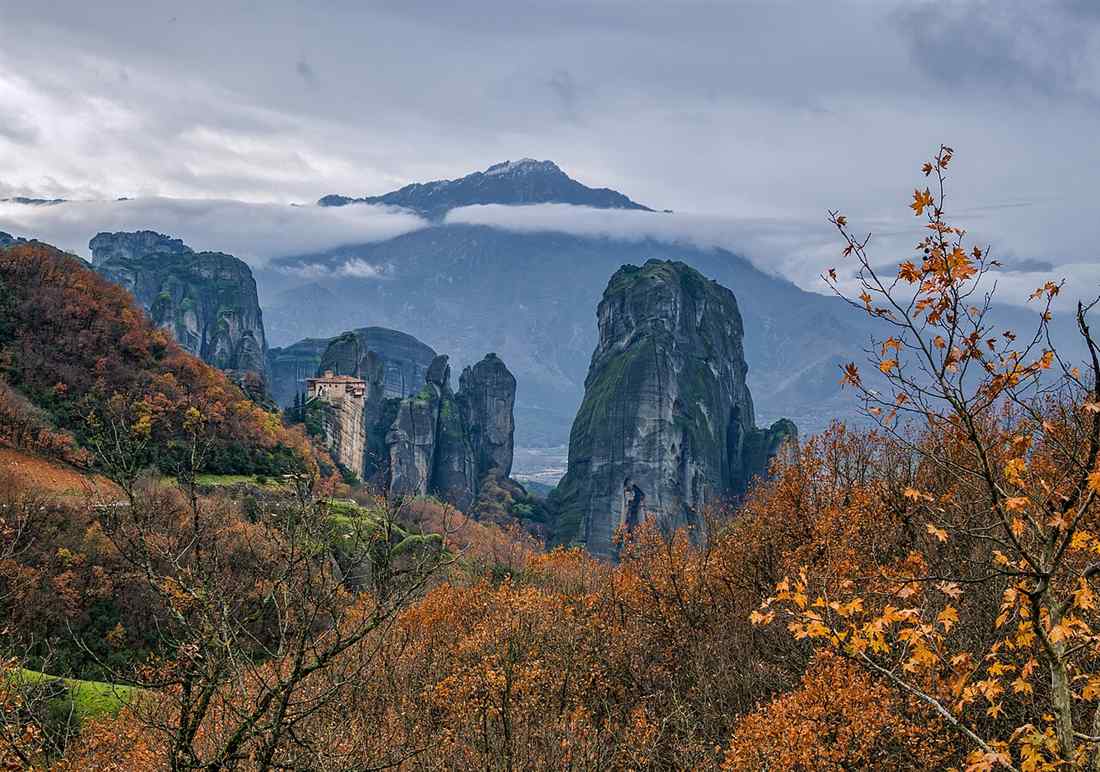
The second day delivers Meteora: six active Orthodox monasteries perched on sheer sandstone pillars above the plain of Thessaly. You tour the Great Meteoron and Varlaam, look down on Kalambaka and Kastraki, and drive the winding road that threads between the towering rocks.
Meteora means “suspended in the air,” and the name states the geology exactly. Grey conglomerate pillars rise straight from the flat Thessalian plain, some of them 400 metres tall, and monks built stone monasteries on their summits from the fourteenth century onward. Six monasteries remain active today. The Great Meteoron, formally the Monastery of the Transfiguration, sits highest and largest; it houses a katholikon with post-Byzantine frescoes, an old refectory now used as a museum, and a former hoist room where monks once raised supplies and visitors in a rope net. Varlaam stands on the neighbouring pillar and holds a katholikon painted by Frangos Katelanos, plus a barrel-vaulted store and a wooden ascent tower.
The coach climbs the paved road that loops through the rock forest, and the driver stops at railed viewpoints where the monasteries line up against the plain. From these points you photograph Roussanou clinging to a narrow spur, and the Holy Trinity monastery standing alone on its isolated column. Below the rocks spread two settlements: Kalambaka, the market town at the base, with the eleventh-century Church of the Dormition of the Virgin at its edge, and Kastraki, the smaller village tucked directly under the largest pillars. Your guide explains which monasteries open on your day of travel, because each one closes on a fixed weekday, and the itinerary enters two of the six.
Inside every monastery a dress code applies: covered shoulders for all visitors, long trousers for men, and a wrap skirt for women, provided at the entrance. The walk to each summit runs up cut-stone steps carved into the rock, and the licensed guide leads you through the frescoed churches, the reliquaries, and the terraces that overlook the Pineios valley. The Meteora leg of this trip anchors the wider Meteora region, and the two-day format gives you the full morning and early afternoon among the rocks before the return drive to Athens begins.
What does the two-day Delphi and Meteora tour include, and what does it cost?
The package bundles round-trip transport from Athens, a licensed English-speaking guide, one overnight in a hotel with breakfast, and entry logistics for the sites. A shared coach tour costs a set per-person fare; a private tour with a driver-guide costs a higher flat rate for the whole group.
The standard inclusions on a two-day Delphi and Meteora tour cover the following:
- Round-trip transport from central Athens by air-conditioned coach or private vehicle across both days
- A licensed, English-speaking guide for the Delphi archaeological site and the Meteora monasteries
- One overnight stay in a hotel in Kalambaka or Kastraki, with breakfast the next morning
- Guided commentary during the drive, covering the route through Boeotia, Thermopylae, and the Thessalian plain
- Hotel pickup and drop-off, or a fixed central meeting point in Athens
Two formats dominate the market. The shared coach tour runs on a set departure schedule, seats a full group, and prices per person; it delivers the lowest cost and follows a fixed itinerary with fixed stops. The private tour assigns one vehicle and one driver-guide to your party alone, prices as a single flat rate for the group regardless of size up to the vehicle capacity, and adapts the pace and the stops to your preferences. A family of four often finds the per-group private rate competitive against four separate coach seats once the numbers are compared directly.
Site entrance fees and lunches sit at the edge of the package and vary by operator. Delphi charges a combined ticket for the sanctuary and the archaeological museum, and the Meteora monasteries each charge a small entrance donation collected at the door. Some operators fold these entrances into the headline price; others list them as extras paid on the day. Researched fares place shared two-day coach tours in the lower per-person band, private two-day tours in a higher flat-rate band that falls per head as the group grows, and the hotel-upgrade options for a sea-view or higher-category room add a supplement stated at booking. Confirm at reservation whether the museum ticket, the monastery donations, and dinner sit inside your quoted rate or outside it.
Where do you stay overnight on the Delphi and Meteora tour?
The standard overnight falls in Kalambaka or the village of Kastraki, directly beneath the Meteora rocks, so day two starts at the monasteries within minutes. Some itineraries instead stop the first night in Delphi village or Arachova, which shifts the long drive to day two.
Most two-day tours drive from Athens to Delphi in the morning, tour the sanctuary through the middle of the day, then continue north across the plain to reach Kalambaka by evening. Kalambaka is the market town at the foot of the pillars; its hotels line the streets under the rock walls, and several rooms face straight up at the monasteries lit after dark. Kastraki, ten minutes further and higher, is the quieter village pressed against the largest columns, with family-run guesthouses and tavernas. Basing here means the second morning opens with a five-minute drive up to the first monastery instead of a long transfer, and that early start buys extra time among the rocks before the return south.
The alternative arrangement stops the first night at Delphi. In this version the coach reaches Delphi in the afternoon, tours the site late in the day or early the next morning, and stays over in Delphi village or in nearby Arachova, the stone mountain town on the slopes of Parnassus. This base sits closer to Athens and suits travellers who want an unhurried first evening in the mountains, though it loads the long transfer to Meteora onto the second day. The choice of base shapes the rhythm of the whole trip: a Meteora overnight front-loads the driving on day one and frees day two for the monasteries, while a Delphi overnight keeps day one short and pushes the distance into day two.
Your operator states the overnight town at booking, and the hotel category follows the fare tier you select. Standard packages place you in a three-star or four-star property with breakfast included; upgrade tiers move you to a room with a direct view of the pillars. For travellers weighing an extra night at the Delphi end of the route, the options for where to stay in Delphi range from village guesthouses beside the sanctuary to the balconied hotels of Arachova. Confirm the exact town, the hotel name, and the breakfast arrangement in your reservation, because the base sets the timing of both driving days.
Frequently Asked Questions
Is the Delphi and Meteora 2-day tour worth it?
Yes. The tour pairs two UNESCO World Heritage sites that lie in opposite directions from Athens, the oracle sanctuary and the rock monasteries, in one loop. The overnight in Kalambaka gives each site its full daylight hours instead of a single rushed run.
How far is Meteora from Delphi?
Meteora lies about 230 kilometres north of Delphi, roughly three to four hours by road across the Thessalian plain. The two-day tour covers the distance with an overnight in Kalambaka at the foot of the Meteora pillars between the two sites.
Where do you stay overnight on the Delphi and Meteora tour?
The standard overnight falls in Kalambaka or the village of Kastraki, directly beneath the Meteora rocks, so the second day starts at the monasteries within minutes. Some itineraries instead stop the first night in Delphi village or Arachova.