
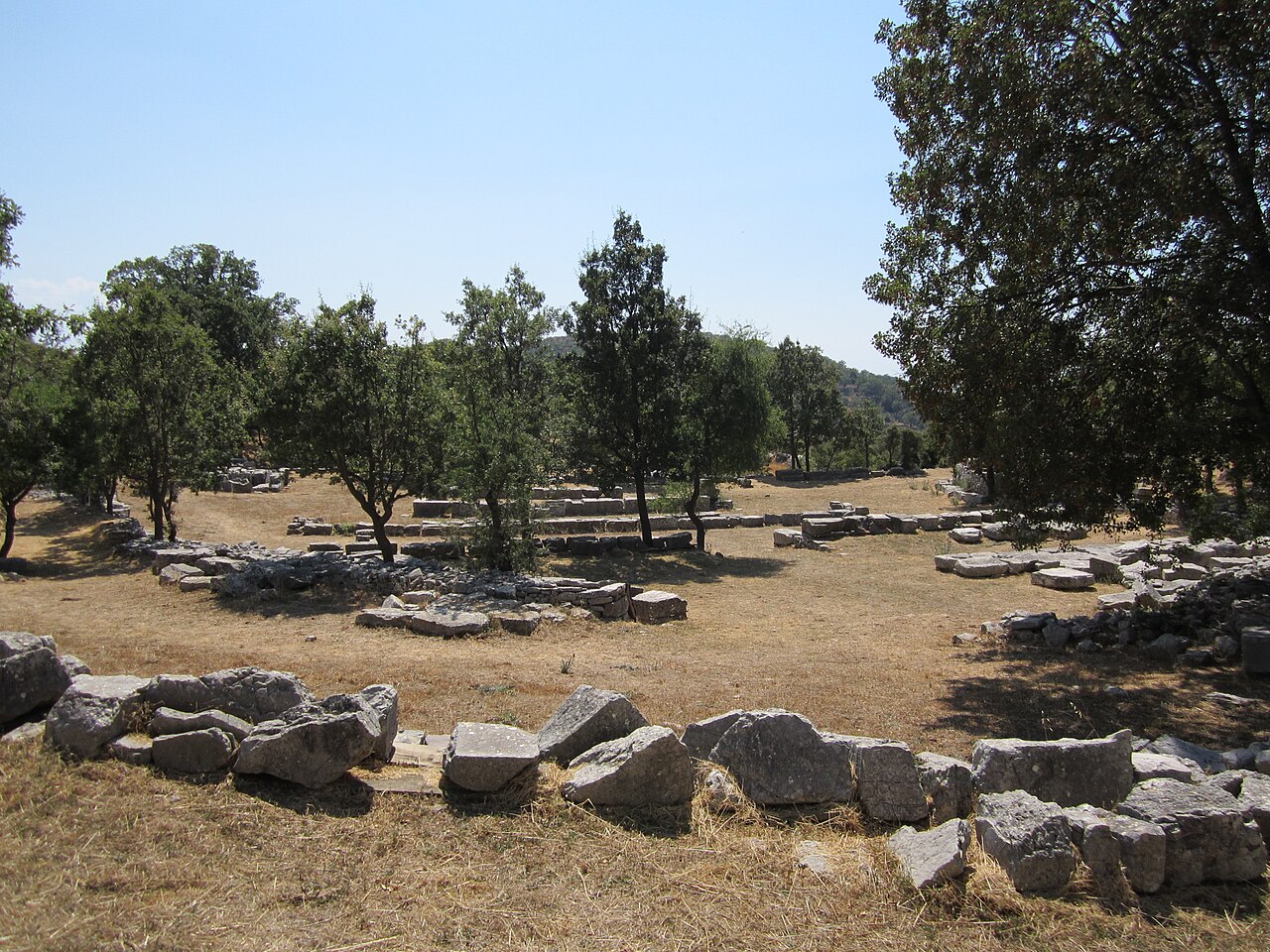
The Temple of Apollo Epicurius at Bassae stands alone in the wild Arcadian mountains of the Peloponnese, one of the most remarkable temples of the ancient Greek world. Built in the fifth century BC and attributed by the ancient traveller Pausanias to Iktinos, the architect of the Parthenon, it was the first Greek monument inscribed on the UNESCO World Heritage List. The temple is famous for uniquely combining all three orders of Greek architecture, the Doric, the Ionic and the Corinthian, and for holding the oldest known Corinthian capital. Dedicated to Apollo the Healer after a plague, it survives in its remote setting under a great protective tent. This guide tells its full story.
This guide covers the Temple of Apollo Epicurius at Bassae in full: its history, its architecture and the three orders, the lost frieze, the conservation tent, its mountain setting, and how to visit. Read it beside the full Ancient Olympia guide and the guide to the Temple of Zeus at Olympia, as both are masterworks of the classical Peloponnese.
What is the Temple of Apollo Epicurius at Bassae?
The Temple of Apollo Epicurius at Bassae is a classical Greek temple high in the mountains of Arcadia, in the western Peloponnese, dedicated to Apollo the Healer. Built in the fifth century BC, it was the first Greek monument added to the UNESCO World Heritage List. It is celebrated for combining all three architectural orders and for the oldest surviving Corinthian capital.
It honours Apollo the Healer. The temple was dedicated to Apollo Epicurius, the god as healer and helper, so its name records his protective role.
It is a UNESCO landmark. Bassae was the first Greek site on the World Heritage List, so it holds a special place among the country’s monuments.
It stands in the mountains. The temple sits alone in the high Arcadian hills, so its remote setting is part of its fame.
Who built the Temple of Apollo at Bassae?
The Temple of Apollo at Bassae was built in the second half of the fifth century BC and is attributed by the ancient traveller Pausanias to Iktinos, one of the two architects of the Parthenon in Athens. The temple was raised by the people of nearby Phigaleia, in thanks to Apollo for delivering them from a plague, which gave the god his title of Epicurius, the Helper.
Iktinos is named as architect. Pausanias credited the temple to Iktinos, the Parthenon architect, so Bassae is linked to the greatest building of Athens.
Phigaleia raised it. The nearby city of Phigaleia built the temple, so it was a local act of devotion in a remote region.
A plague inspired it. The temple thanked Apollo for ending a plague, so the god was honoured as the Healer, Epicurius.
Why is the Temple of Apollo Epicurius a UNESCO site?
The Temple of Apollo Epicurius is a UNESCO World Heritage Site, and the first Greek monument ever inscribed, for its extraordinary architectural innovation and its exceptional preservation. Uniting the Doric, Ionic and Corinthian orders in one building, and containing the earliest known Corinthian capital, it is a landmark in the history of architecture, standing almost intact in its lonely mountain setting.
It was Greece’s first listing. Bassae was the first Greek site added to the World Heritage List, so it opened the country’s place on the list.
It is an architectural landmark. Its union of the three orders and its early Corinthian capital make it a milestone in building, so it is prized for innovation.
It is exceptionally preserved. The temple survives largely intact in its remote setting, so its condition adds to its outstanding value.
What is special about the architecture of Bassae?
The architecture of Bassae is unique among Greek temples for combining all three classical orders. Its outer colonnade is Doric, its inner hall has Ionic half-columns, and a single central column carried the oldest known Corinthian capital. This blend of orders in one temple, along with an unusual north-south orientation and a side door, marks Bassae as a bold and experimental work of the fifth century BC.
It unites three orders. Doric outside, Ionic within and a Corinthian capital at the centre make Bassae the first temple to combine all three, so it is architecturally unique.
It held the first Corinthian capital. The central column carried the oldest known Corinthian capital, so the temple is the ancestor of all later Corinthian architecture.
Its plan is unusual. A north-south orientation and a side door set it apart from the usual temple design, so it shows real experiment.
What is the Corinthian capital at Bassae?
The Corinthian capital at Bassae is the oldest known example of the Corinthian order, the third and most ornate of the Greek architectural orders, with its capital carved as a basket of acanthus leaves. A single such column stood at the heart of the temple’s inner hall. The original is lost, but the Bassae capital is regarded as the ancestor of every Corinthian column in Greek, Roman and later architecture.
It is the earliest Corinthian capital. The single central column carried the oldest known Corinthian capital, so Bassae marks the birth of the order.
It is carved with acanthus. The Corinthian capital is decorated with acanthus leaves, so it is the most ornate of the Greek orders.
It shaped later architecture. The Bassae capital is the ancestor of all later Corinthian columns, so its influence runs through Roman and modern building.
What happened to the frieze of Bassae?
The famous sculpted marble frieze from the inner hall of Bassae, showing battles of Greeks against Amazons and Lapiths against Centaurs, was removed in the early nineteenth century and taken to the British Museum in London, where it remains on display. Its loss stripped the temple of its finest sculpture, and the frieze is now one of the treasures of the museum, far from its mountain home.
The frieze showed great battles. It carved the Greeks fighting Amazons and Lapiths fighting Centaurs, so it was a masterpiece of classical sculpture.
It was taken to London. The frieze was removed in the early nineteenth century to the British Museum, so it left its temple long ago.
The temple lost its sculpture. Its removal stripped Bassae of its finest art, so the temple stands without its carved masterpiece today.
Why is there a tent over the Temple of Apollo at Bassae?
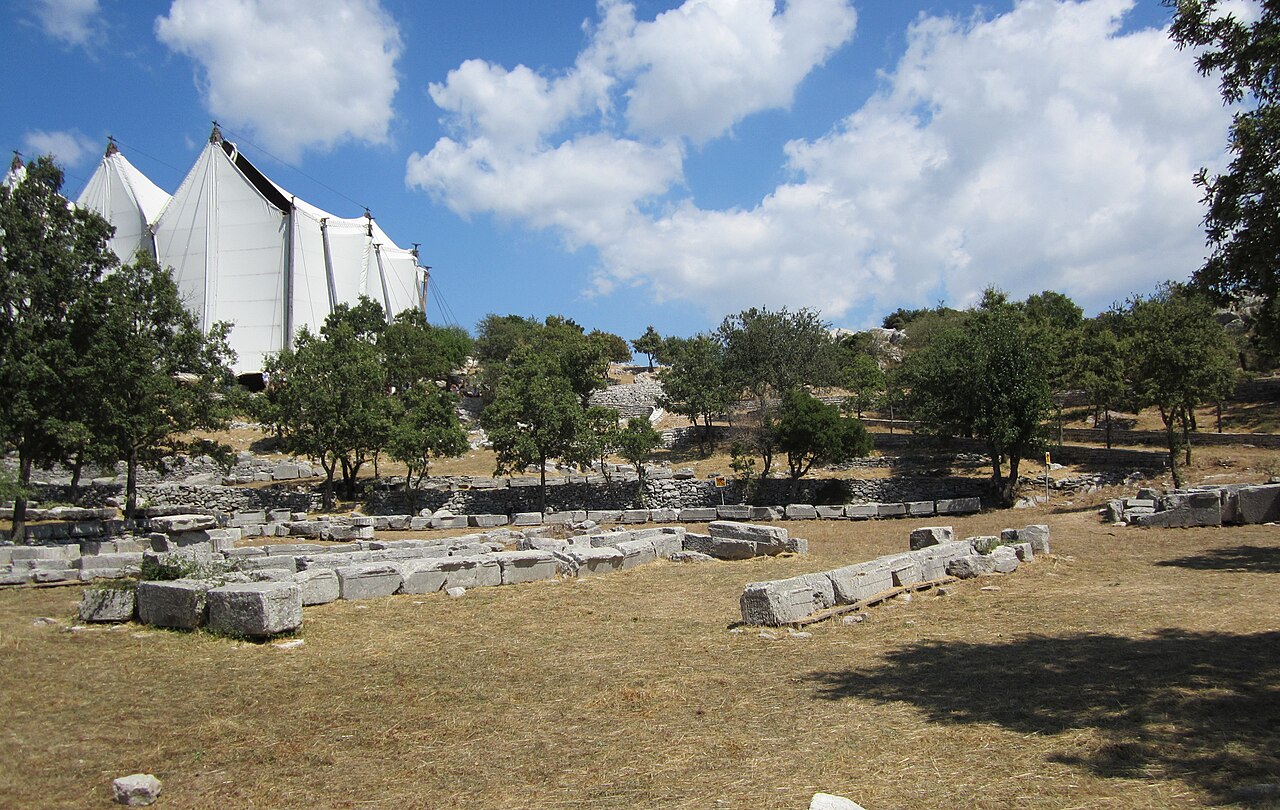
A great white tent covers the Temple of Apollo at Bassae to protect it from the harsh mountain weather while conservation work continues. At over a thousand metres in the Arcadian hills, the temple is exposed to frost, rain and wind that damage the stone, and it also suffers from earthquakes. The tent shelters the fragile building, so visitors today see the temple beneath a striking protective canopy.
The weather threatens the stone. Frost, rain and wind at altitude damage the temple, so the tent shields it from the elements.
Earthquakes add risk. The mountain region is prone to earthquakes, so the temple needs careful protection and study.
Conservation continues. Work to preserve the temple goes on beneath the tent, so the canopy is part of an ongoing rescue.
Where is the Temple of Apollo Epicurius at Bassae?
The Temple of Apollo Epicurius at Bassae stands at over eleven hundred metres above sea level in the rugged mountains of Arcadia, in the western Peloponnese, near the village of Andritsaina. Remote and hard to reach, it lies away from the main tourist routes, approached by winding mountain roads from Andritsaina, from Ilia along the river Neda, or from Megalopolis and Tripoli to the east.
It sits high in Arcadia. The temple stands above eleven hundred metres in the mountains, so its setting is wild and remote.
Andritsaina is the nearest town. The village of Andritsaina lies closest, so most visitors approach the temple from there.
Mountain roads lead to it. Winding roads climb to Bassae from several directions, so reaching it is part of the adventure.
How do you visit the Temple of Apollo at Bassae?
You visit the Temple of Apollo at Bassae by car, on a long and scenic mountain drive, as there is no public transport to the remote site. The nearest base is Andritsaina, and the temple can be reached from Olympia to the north-west or from Megalopolis and Tripoli to the east. The site is open to visitors, and the temple is viewed beneath its protective tent.
A car is needed. There is no bus to the remote temple, so visitors reach Bassae by car or private tour.
Andritsaina is the base. The village of Andritsaina is the nearest place to stay, so many visits start there.
It joins a Peloponnese tour. The temple can be reached from Olympia or from the east, so it fits a wider tour of the region for those willing to make the climb.
Is the Temple of Apollo Epicurius worth visiting?
Yes, the Temple of Apollo Epicurius is well worth visiting for those who make the effort to reach it. As Greece’s first UNESCO site, a unique blend of the three architectural orders and the birthplace of the Corinthian capital, it is one of the most important temples in the country. Its wild mountain setting and its air of solitude make a visit deeply memorable, unlike the busier ancient sites.
It is historically vital. As Greece’s first UNESCO site and an architectural milestone, Bassae is a monument of the first rank, so it rewards the journey.
Its setting is unforgettable. The temple’s lonely mountain perch gives it a magic the crowded sites lack, so the experience stays with the visitor.
It suits the dedicated. The remote location keeps crowds away, so those who make the climb have the temple almost to themselves, a rare privilege in Greece.
How does Bassae compare to the Parthenon?
Bassae and the Parthenon share the architect Iktinos, who built both in the fifth century BC, but they differ greatly in setting and design. The Parthenon crowns the Athenian Acropolis in gleaming marble at the heart of a great city, while Bassae stands alone in remote grey limestone in the mountains. Yet Bassae is the bolder experiment, uniting three orders where the Parthenon perfects the Doric.
They share an architect. Iktinos is credited with both temples, so Bassae carries the hand of the Parthenon’s designer.
They differ in setting. The Parthenon rises over Athens while Bassae hides in the mountains, so the two stand in utterly different worlds.
Bassae is the bolder. Where the Parthenon perfects the Doric order, Bassae experiments with all three, so it is the more inventive design.
What was Phigaleia, the city that built the temple?
Phigaleia was an ancient Greek city in the mountains of the western Peloponnese, whose people built the Temple of Apollo Epicurius at Bassae. A remote and rugged community, Phigaleia dedicated the temple in thanks to Apollo for saving it from a plague. The city lay some distance below the temple, and its ruins survive near the modern village that bears its name.
It was a mountain city. Phigaleia was a rugged community in the western Peloponnese, so its great temple stood in wild country.
It built the temple. The people of Phigaleia raised Bassae, so the temple was their act of civic devotion.
Its ruins remain. The remains of Phigaleia survive near the modern village, so the city that built the temple can still be traced.
How was the Temple of Apollo at Bassae rediscovered?
The Temple of Apollo at Bassae was rediscovered by European travellers in the eighteenth century, its remote mountain setting having kept it hidden and largely intact for centuries. Early in the nineteenth century antiquarians excavated the site and removed the sculpted frieze to the British Museum. The temple has since been studied and conserved, and it remains one of the best-preserved classical temples in Greece.
Travellers found it. European travellers rediscovered the remote temple in the eighteenth century, so it returned to notice after long obscurity.
Antiquarians excavated it. Early digs uncovered the temple and removed its frieze, so the site was explored, though at a cost to its sculpture.
It is well preserved. Thanks to its isolation, Bassae survives among the best-preserved Greek temples, so much of the building still stands.
What is the mythology of Apollo the Healer?
Apollo was one of the great gods of ancient Greece, the god of the sun, prophecy, music and healing. As a healer he both sent and cured plagues, so cities turned to him in times of disease. At Bassae the people of Phigaleia honoured him as Epicurius, the Helper, for delivering them from a plague, giving the mountain temple its distinctive dedication.
He was a god of healing. Apollo governed health and disease, so he was invoked against plague across the Greek world.
He was many things. Apollo was also god of the sun, prophecy and music, so he was among the most powerful of the gods.
He saved Phigaleia. The city thanked Apollo for ending a plague, so it built the temple to him as the Healer.
What is the best time to visit Bassae?
The best time to visit Bassae is late spring, summer and early autumn, when the mountain roads are clear and the high site is pleasant. Winter can bring snow, ice and closed roads to the altitude of over eleven hundred metres, so the warmer months are safest. Even in summer the mountain air is cool and fresh, and clear days give the finest views over the Arcadian hills.
Warm months are best. Late spring to early autumn brings clear roads and pleasant weather, so these months suit the high site.
Winter can close it. Snow and ice reach the mountain temple in winter, so access can be difficult in the cold season.
The air stays cool. Even in summer the altitude keeps the air fresh, so a visit is comfortable in the warm months.
Frequently Asked Questions About the Temple of Apollo Epicurius at Bassae
Why is the temple called Epicurius?
The temple is called Epicurius, meaning the Helper or the Healer, because the people of Phigaleia dedicated it to Apollo in thanks for saving them from a plague. Apollo was worshipped as a god of healing as well as of the sun and prophecy, and the title Epicurius records the role in which the mountain community honoured him at Bassae.
The name records Apollo’s role as protector against plague, so it ties the temple directly to the disaster that inspired its building high in the mountains of Arcadia.
Can you see the frieze of Bassae?
You cannot see the frieze of Bassae at the temple itself, as it was removed to the British Museum in London in the early nineteenth century and remains there today. Casts and reconstructions exist, but the original marble frieze, showing the battles of Greeks and Amazons and of Lapiths and Centaurs, is displayed in London, far from its mountain temple.
Because the frieze is in the British Museum, visitors to Bassae see the temple without its finest sculpture, which survives abroad.
How high is the Temple of Apollo at Bassae?
The Temple of Apollo at Bassae stands at over eleven hundred metres above sea level, high in the mountains of Arcadia. This great altitude, unusual for a major Greek temple, gives the site its wild character and its clear mountain air, but it also exposes the temple to the harsh weather that the protective tent now shields it from.
Its high mountain setting is a large part of what makes Bassae so unusual and so memorable among Greek temples.
What is nearby the Temple of Apollo at Bassae?
Near the Temple of Apollo at Bassae lie the mountain village of Andritsaina, with its traditional houses and a notable old library, the ruins of ancient Phigaleia, and the dramatic gorge of the river Neda. Further afield lie the medieval castle-town of Karytaina and the ancient city of Megalopolis. The temple thus sits within a rich if remote corner of Arcadia and the western Peloponnese.
Andritsaina is the gateway. The traditional village of Andritsaina, with its old library, is the nearest base, so it anchors a visit to Bassae.
Phigaleia and the Neda lie close. The ruins of Phigaleia and the wild Neda gorge are nearby, so they reward those exploring the region.
Karytaina and Megalopolis are within reach. The medieval town of Karytaina and ancient Megalopolis lie further off, so the temple fits a wider Arcadian tour.
Is the Temple of Apollo at Bassae hard to reach?
Yes, the Temple of Apollo at Bassae is one of the harder ancient sites in Greece to reach, high in the mountains with no public transport and only winding roads for access. This isolation is why it sees few visitors and why it has survived so well. Reaching it needs a car and a willingness to drive mountain roads, but the reward is a great temple in near solitude.
Because it lies far from the main routes and needs a mountain drive, Bassae is reached only by the determined, who are rewarded with a masterpiece almost to themselves.
Can you go inside the Temple of Apollo at Bassae?
You cannot fully enter the Temple of Apollo at Bassae, as it stands beneath a great protective tent and is roped for its conservation. Visitors walk around and close to the temple, viewing the surviving columns and structure from the marked paths beneath the canopy. The tent and barriers protect the fragile building, so the experience is one of walking around a sheltered masterpiece rather than through open ruins.
Because the temple is under conservation beneath its tent, visitors admire it from close by rather than walking freely inside, yet the sight of the sheltered columns remains deeply impressive.