
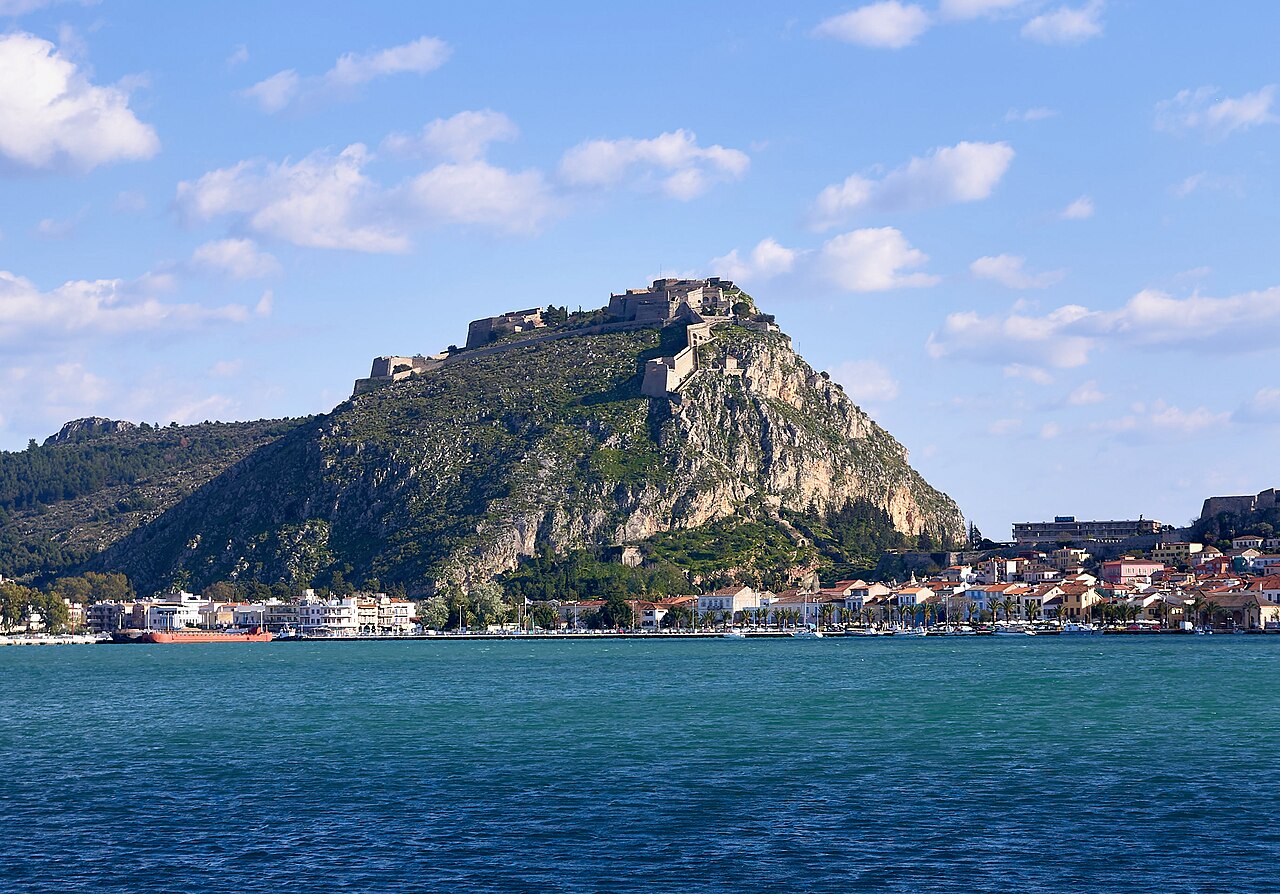
Palamidi is the great fortress that crowns Nafplio, one of the finest Venetian strongholds anywhere in Greece. Built in just three years in the early eighteenth century on a rock some 200 metres above the town, it is not a single castle but a chain of eight self-contained bastions linked across the hilltop, reached by a stone stairway famous for its nearly a thousand steps. From its walls the view sweeps over the old town, the island castle of Bourtzi and the Argolic Gulf, and it is the essential sight of Nafplio. Plan the whole trip with Greece Tours.
This guide covers Palamidi in full: its history and the story of the 999 steps, how to get up by stairs, car or taxi, what to see among its eight bastions, the tickets and opening hours, the best time to visit and the views from the top. Read it beside the full Nafplio travel guide.
What is Palamidi fortress?
Palamidi is a Venetian fortress on a hill above Nafplio, built between 1711 and 1714, and one of the finest of its age. It is a complex of eight independent bastions linked by walls and stairways, rising about 200 metres above the town, and it is the great landmark of Nafplio.
It is the crown of the town. Rising on a steep rock directly above the old town of Nafplio, Palamidi dominates the skyline and can be seen from across the Argolic Gulf, a vast fortified hilltop that is the first thing most visitors notice and the sight they most want to reach.
It is a masterpiece of military engineering. Built by the Venetians in only three years using the most advanced fortification design of the early eighteenth century, and attributed to the military architect Antonio Gambello, Palamidi was among the most formidable fortresses of its time, and it survives remarkably complete today.
It is a fortress of separate strongholds. Rather than a single castle, Palamidi is made up of eight independent bastions spread across the hilltop, each able to hold out on its own if the others fell, connected by walls, gates and stairways, so exploring it means moving through a whole fortified landscape, as the full Nafplio travel guide describes.
What is the history of Palamidi?
Palamidi was built by the Venetians between 1711 and 1714 during their second occupation of Nafplio. The Ottomans captured it in 1715, and Greek forces retook it in 1822 during the War of Independence. From 1840 it served for nearly a century as a prison.
The Venetians built it fast. During their second period of rule over Nafplio, the Venetians raised Palamidi in just three years in the early eighteenth century to guard the town and its harbour, an extraordinary feat of speed and engineering that produced one of the strongest fortresses in the Mediterranean.
It changed hands quickly. Only a year after its completion, in 1715, the Ottomans took the fortress, holding it through the eighteenth century, until, on the night of 29 November 1822, a small force of Greek fighters under Staikos Staikopoulos scaled the walls and captured Palamidi, a decisive moment in the liberation of Nafplio during the War of Independence.
It later became a prison. From 1840 and for nearly a hundred years Palamidi served as a prison, and the hero of the Greek revolution Theodoros Kolokotronis was among those held here, imprisoned in one of its bastions, so the fortress carries the weight of the modern Greek nation’s founding as well as its Venetian past.
How many steps does Palamidi have?
Palamidi is famously said to have 999 steps up from the old town of Nafplio, though the actual count is closer to 857. The exact number is disputed and part of local legend, but the climb is a long, steep stone stairway, and there is also a road to the top.
The 999 steps are the stuff of legend. Tradition holds that a stairway of exactly 999 steps climbs from the old town to the fortress, a number so often repeated that it has become part of Nafplio’s identity, and reaching the top on foot is a rite of passage for many visitors.
The real number is lower. Counts by visitors put the actual figure closer to 857, and the discrepancy has become a running debate, but whether 857 or 999, the stairway is a long and steep ascent that takes a good half hour and rewards the effort with the finest views in the town.
You do not have to climb. For those who would rather not tackle the steps, especially in the heat of summer, a road leads to a car park near the top of the fortress, so Palamidi is reachable by car or taxi as well as on foot, making it accessible to everyone.
How do you get up to Palamidi?
You can reach Palamidi three ways: by climbing the stone stairway of nearly a thousand steps from the old town, by driving up the road to the car park near the entrance, or by taxi. The steps start near the church of Agia Sofia in the old town.
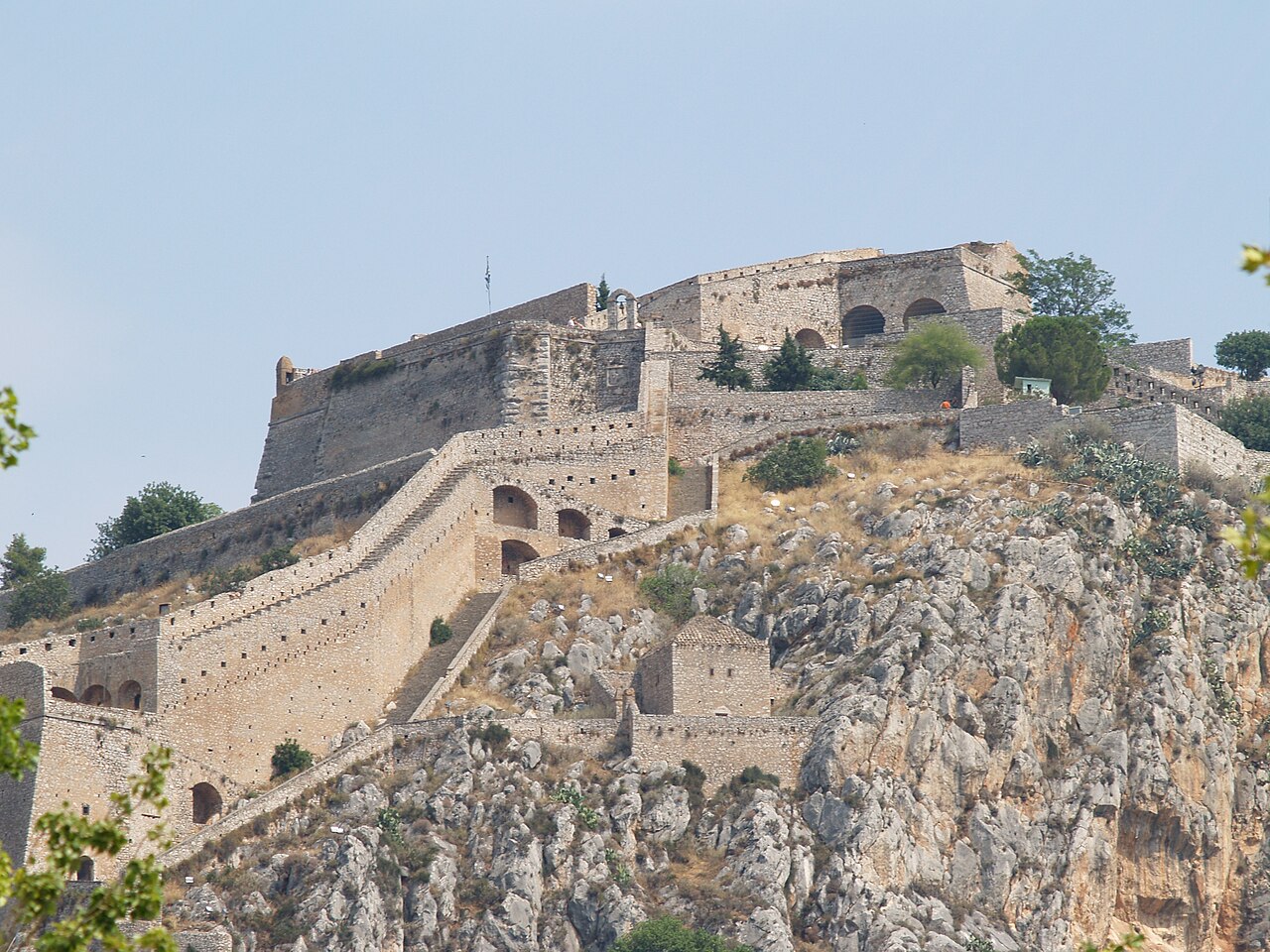
The stairway is the classic approach. The stone steps begin in the old town, near the church of Agia Sofia at the eastern edge, and zigzag up the rock to the fortress entrance, a steep climb of around half an hour that rewards walkers with changing views over the town and gulf as they rise.
The road suits those short on energy. A surfaced road winds up the landward side of the hill to a car park close to the fortress entrance, so visitors with a hire car, or those who take a taxi from the town, can reach the top without the climb, which is the sensible choice in the midday heat of summer.
Timing helps whichever way you go. The climb is best made in the cool of the early morning or the late afternoon rather than the middle of a hot day, and starting early also means quieter paths and better light, as the full Nafplio travel guide notes.
What can you see inside Palamidi?
Inside Palamidi you can explore its eight bastions, walk the connecting walls and stairways, visit the little church of Agios Andreas, and see the bastion where the hero Kolokotronis was imprisoned. The reservoirs, gates and ramparts of the Venetian fortress are all preserved.
The eight bastions are the heart of the visit. Each bastion is a self-contained stronghold with its own walls, and the largest, named for Saint Andrew, holds the fortress chapel of Agios Andreas, while others carry the names of ancient Greek heroes, so wandering between them reveals the scale and cleverness of the design.
The prison bastion recalls Kolokotronis. The Miltiadis bastion served as a prison and held Theodoros Kolokotronis, the great general of the War of Independence, and the small, grim cell shown to visitors is a moving reminder that the fortress was a place of confinement as well as defence.
The Venetian details reward a close look. The gates, the vaulted chambers, the water reservoirs that let the garrison withstand a siege, and the ramparts with their gun positions all survive, so Palamidi is not just a viewpoint but a complete early-eighteenth-century fortress to explore, best given two to three hours.
What are the tickets and opening hours for Palamidi?
Palamidi charges a modest admission of around 8 euros, with reduced and free entry for children and eligible visitors, and it is generally open daily from about 08:00 into the evening in summer, with shorter winter hours. Tickets are bought at the fortress entrance.
Admission is inexpensive. A ticket to Palamidi costs in the region of 8 euros, with reductions for students and seniors and free entry for children and on certain days, and tickets are bought at the gate, so no advance booking is needed for the fortress itself.
Opening hours vary with the season. Palamidi generally opens from around eight in the morning and stays open into the evening in the long days of summer, with earlier closing in winter, so it is worth checking the current hours before a visit, particularly late in the day or out of season.
Allow enough time. Because Palamidi is a large fortress of eight bastions rather than a single building, most visitors spend two to three hours exploring it and taking in the views, so it is best given a good half day rather than a rushed hour, as the full Nafplio travel guide advises.
When is the best time to visit Palamidi?
The best time to visit Palamidi is spring and autumn, from April to June and September to October, for comfortable temperatures on the climb, and the early morning or late afternoon in summer to avoid the midday heat and to catch the best light for the views.
The shoulder seasons are ideal. In spring and autumn the weather is mild enough to enjoy the climb and the exposed ramparts without the fierce heat of high summer, and the light is clear and the crowds thinner, making these the finest months to visit the fortress.
Summer demands good timing. Palamidi is exposed and shadeless, and the stone stairway is a hard climb in the July and August heat, so a summer visit is best made in the cool of the early morning or the late afternoon, both for comfort and for the softer light on the town and gulf below.
The light rewards early and late. The low sun of morning and evening flatters the old town, the Bourtzi and the Argolic Gulf spread out beneath the fortress, so timing a visit for these hours gives both an easier climb and the best photographs, avoiding the flat glare of midday.
What are the views from Palamidi?
The views from Palamidi are among the finest in the Peloponnese: the whole old town of Nafplio laid out below, the island castle of Bourtzi in the harbour, the Acronafplia citadel, the Argolic Gulf and the mountains of the Argolid stretching into the distance.
The town lies directly below. From the ramparts the marble-paved old town of Nafplio spreads out at your feet, its red roofs, squares and waterfront clearly laid out, with the Acronafplia citadel on its lower ridge between the fortress and the sea, a view that explains the whole shape of the town.
The Bourtzi and the gulf complete the scene. Beyond the town, the little island castle of Bourtzi sits alone in the harbour, and the Argolic Gulf opens out to the sea and the mountains of the Argolid, so the panorama takes in fortress, town, island and gulf in a single sweep.
It is the reason to make the climb. Whether reached by the steps or the road, the top of Palamidi offers the defining view of Nafplio, and it is worth timing for sunset when the town and gulf glow in the low light, one of the great sights of the Peloponnese, as the full Nafplio travel guide describes.
Frequently Asked Questions
How many steps are there to Palamidi?
Palamidi is famously said to have 999 steps leading up from the old town of Nafplio, a number so often repeated that it has become part of the town’s identity. In reality, counts by visitors put the figure closer to 857, and the exact number is a long-running and good-natured debate. Whatever the true count, the stone stairway is a long, steep zigzag climb that takes most people around half an hour and is best tackled in the cool of the early morning or late afternoon rather than the midday heat. The steps begin in the old town near the church of Agia Sofia. For those who would rather not climb, a road leads up the landward side of the hill to a car park near the fortress entrance, so Palamidi can also be reached by car or taxi.
How much does it cost to visit Palamidi, and what are the hours?
Admission to Palamidi costs in the region of 8 euros, with reduced rates for students and seniors and free entry for children and on certain days of the year. Tickets are bought at the fortress entrance, so no advance booking is needed. The fortress is generally open daily from around eight in the morning and stays open into the evening during the long days of summer, with shorter opening hours in winter, so it is worth checking current times before visiting, especially late in the day or out of season. Because Palamidi is a large fortress made up of eight separate bastions rather than a single building, most visitors spend two to three hours exploring it and enjoying the views, so it is best to allow a good half day rather than a rushed visit.
Is Palamidi worth visiting?
Yes, Palamidi is the essential sight of Nafplio and one of the finest Venetian fortresses in Greece, well worth the visit. Built by the Venetians in just three years between 1711 and 1714, it is a complex of eight self-contained bastions spread across a hilltop some 200 metres above the town, complete with gates, reservoirs, ramparts and the little church of Agios Andreas. Its history spans the Venetian and Ottoman periods and the Greek War of Independence, when Greek fighters scaled its walls in 1822, and it later served as a prison that held the revolutionary hero Kolokotronis. Beyond the history, the views from the top, over the old town, the island castle of Bourtzi, the Acronafplia and the Argolic Gulf, are among the best in the Peloponnese. Whether you climb the famous steps or drive up, Palamidi is the highlight of any visit to Nafplio.
Can you drive up to Palamidi or do you have to climb?
You do not have to climb the steps to reach Palamidi. While the famous stone stairway of nearly a thousand steps from the old town is the classic and most atmospheric way up, a surfaced road also winds up the landward side of the hill to a car park close to the fortress entrance, so visitors with a hire car can drive to the top, and taxis run up from the town as well. This makes Palamidi accessible to those who cannot manage the steep climb, and it is the sensible choice in the heat of high summer. Many visitors drive up and then explore the fortress on foot, or climb the steps in the cool of the morning and take a taxi back down. Either way, the fortress itself is explored on foot once you reach the top.