
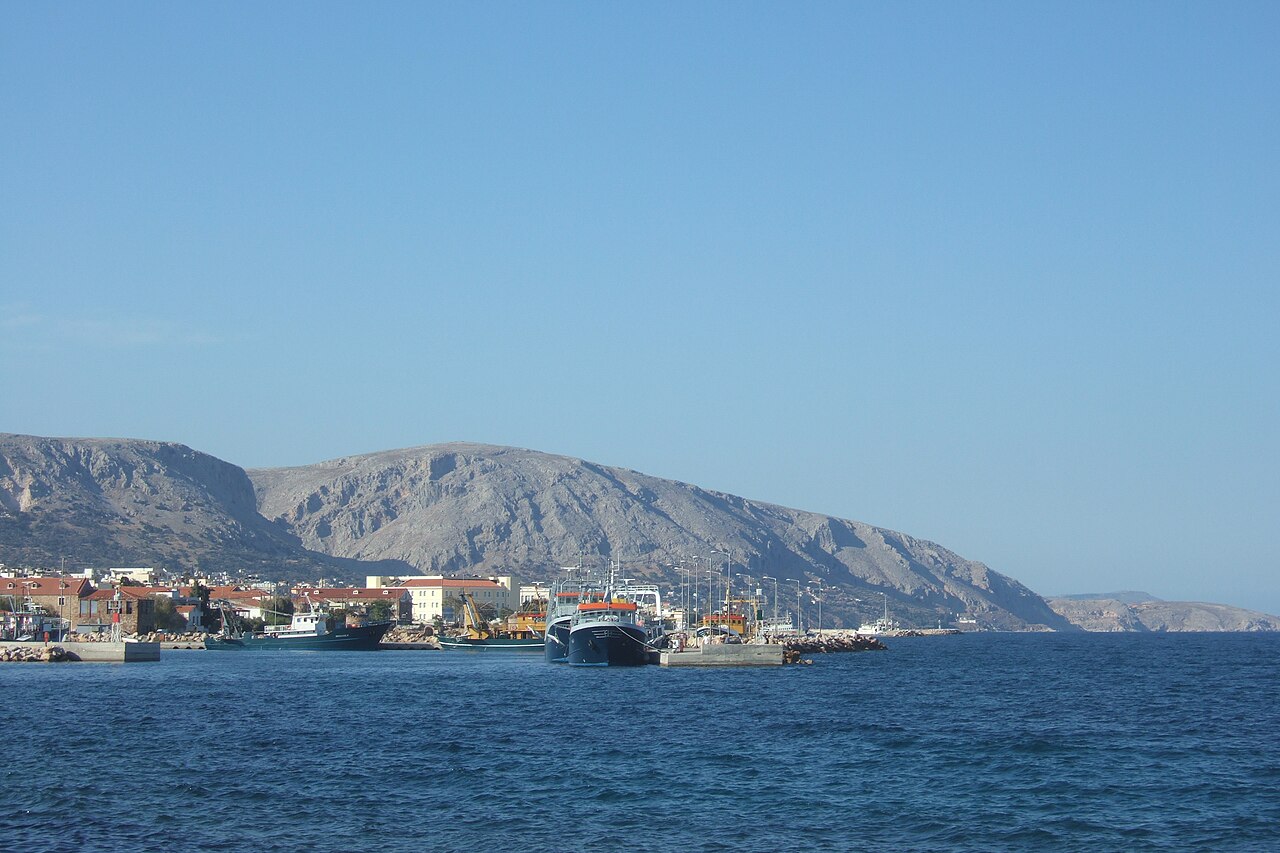
Chios rewards drivers more than almost any other Greek island of its size. The island runs about 50 kilometres from the northern mountains to the mastic villages of the south, and its finest places sit far apart: a medieval village here, a black-pebble bay there, a Byzantine monastery in the hills between them. Buses connect the main towns, but they run to the rhythm of local life rather than the visitor’s, and a hire car turns a fragmented island into a single trip. Plan the whole trip with Greece Tours.
This guide covers renting and driving a car on Chios: what it costs across the seasons, where to collect one at the airport, in Chios Town or at the port, which size of car suits the roads, the licence and insurance rules, and where to park, refuel and drive. Read it beside the guide on how to get to Chios and the full Chios travel guide.
Do you need a car in Chios?
Yes for most visits. Chios is large and its attractions are widely spread, so a car is the only practical way to combine the mastic villages, Nea Moni, the northern beaches and the Kampos estates. Visitors staying only in Chios Town manage without one.
The island’s sights sit in three separate regions. The medieval mastic villages occupy the south, Nea Moni and the ghost village of Anavatos stand in the central mountains, and the quiet beaches and stone villages lie in the north and west. A drive between the far south and the far north takes about an hour and a half, and no bus route links them directly.
Public buses run from Chios Town to Pyrgi, Mesta, Kardamyla and Volissos, and they serve residents rather than sightseers. Services thin out in the afternoon and at weekends, and a return trip to a village often consumes the whole day. That pattern works for a single excursion and defeats any attempt to see two regions in one day.
Visitors who base themselves in Chios Town or Karfas for a short stay manage on buses, taxis and organised excursions, and they trade breadth for simplicity. Anyone staying in a village, in the north, or for longer than three days gains far more from a car. The guide on where to stay in Chios sets out how each base changes that calculation.
Where do you rent a car in Chios?
Cars are rented at Chios Island National Airport, on the waterfront of Chios Town near the ferry quay, and through hotels in Karfas. International names and Greek family firms both operate, and most deliver the car to your hotel or the port at no extra charge.
The airport, coded JKH, sits about 4 kilometres south of Chios Town and handles domestic flights from Athens and Thessaloniki along with seasonal charters. Desks operate inside the small terminal, and collection takes minutes because the car park stands beside the door. Booking in advance matters here, as the fleet is small and the summer flights fill it.
Chios Town offices cluster along the harbour front within walking distance of the ferry berth, which suits arrivals from Piraeus, Lesbos or Çeşme. Local firms in the town frequently undercut the international chains and hand over cars with fewer formalities. Delivery to a hotel in Karfas or the town is standard practice and usually free.
Village bases are a different matter. Rental offices outside the Chios Town and airport area are scarce, so visitors staying in Mesta, Pyrgi or Volissos arrange delivery to the village or collect on arrival and drive south. Confirm delivery and return points in writing when you book, along with the time of your outbound flight or ferry.
Which companies rent cars on Chios?
International names including Europcar, Hertz, Avis and Thrifty operate on Chios alongside Greek networks such as Autounion and Global Rent A Car, and local firms including Vassilakis, which keeps stations in Chios Town and at Megas Limnionas.
The two types of supplier behave differently. The international brands hold their fleets at the airport and the town, quote through the familiar booking sites, and apply the standard excess-and-upsell model at the desk. Greek networks such as Autounion and Global operate several points on the island and sit between the chains and the local firms on both price and formality.
Local operators are the ones visitors remember. Family firms in Chios Town deliver to hotels, the port and the airport, hand over the car in minutes, and frequently quote a single price with full cover included rather than a low headline rate plus extras. Vassilakis is the best-known of them, with pick-up points at the airport, the port, hotels and private addresses across the island.
Comparison is worth the effort here precisely because the models differ. A chain rate that looks cheaper often excludes the excess reduction that a local firm has already built in, and the local firm frequently wins once both quotes carry the same cover. Reading what the price includes is more useful on Chios than chasing the lowest headline figure.
How far ahead should you book a car on Chios?
Book two to three months ahead for July and August, and two to four weeks ahead for the shoulder season. Booking data puts the typical lead time at around eleven weeks, and the island’s fleet is small enough that August sells out.
Fleet size is the reason the advice is firmer here than on the mainland. Chios is not a package-holiday island, so the total number of hire cars on it is modest, and the peak weeks of late July and August draw Greek holidaymakers and the island’s diaspora home at exactly the moment foreign visitors arrive. Cars run out before prices peak.
Price follows the same curve. January sits at the bottom of the range at a fraction of the summer rate, prices climb through spring, and August stands at the top, commonly three to five times the winter figure. May, June, September and October combine low rates with full availability, which is the practical argument for travelling in the shoulder months.
Two specifics matter when booking. Automatic transmission is scarce on the island and disappears first, so anyone who cannot drive a manual books months ahead. Chios airport has no rental desks staffed in the terminal in the way a large airport does, so a reservation is required in advance and the supplier meets the flight, which makes walking up on arrival a poor plan.
What does car rental cost in Chios?
Car rental on Chios costs roughly 20 to 40 euros a day in spring and autumn and 50 to 90 euros a day in July and August for a small hatchback. Longer rentals lower the daily rate, and full insurance adds about 8 to 15 euros a day.
Season drives the price more than the car. The shoulder months of May, June, September and October sit at the lower end of the range, while the peak weeks of late July and August push rates to their highest as Greek holidaymakers and the island’s diaspora return. Booking two or three months ahead for August is the difference between a fair rate and no car at all.
Rental length matters next. A week costs far less per day than three days, and firms quote sharply better rates from seven days upward. Automatic transmission carries a premium and is in short supply, so anyone who needs one books early. Air conditioning is standard on all but the cheapest older cars.
Read what the headline rate includes. Greek rentals normally quote with basic third-party cover and a large excess, and the reduction of that excess is charged separately. Unlimited mileage is usual on Chios, and extra drivers, child seats and out-of-hours collection each carry a fee. Local firms often bundle full cover into a single price, which makes comparison simpler than it first appears.
Which car suits Chios roads?
A small hatchback suits Chios best. The medieval villages have narrow lanes and tight outer parking, mountain roads climb in hairpins, and a compact car handles both. Larger cars gain nothing on an island where no drive exceeds ninety minutes.
The case for small is practical. Mesta, Pyrgi, Olympi and Volissos were built around donkeys and defence, and their lanes exclude cars entirely, so drivers park at the village edge in spaces designed for local vehicles. A compact car slots into those gaps and turns on the narrow approach roads without a three-point manoeuvre in front of an audience.
Engine size counts on the climbs. The road to Nea Moni and Anavatos, the crossing to Volissos and the northern route above Kardamyla all gain height in sustained bends, and a car with the smallest engine and four passengers labours on them. A modest step up in engine size costs a few euros a day and makes those roads comfortable.
Four-wheel drive is unnecessary. The paved network reaches every village and beach a visitor needs, and the unsealed tracks that remain lead to remote coves where rental agreements normally forbid driving anyway. Check the contract for the clause on dirt roads, as damage sustained on them is routinely excluded from cover.
What are the roads like in Chios?
Chios roads are paved, well surfaced on the main routes and free of tolls. Inland and northern roads narrow into mountain hairpins with steep drops, village lanes exclude cars, and goats on the carriageway are a routine hazard away from the east coast.
The east coast carries the island’s best road, running from Chios Town south past the airport and Karfas and north towards Langada, and it moves quickly. Traffic is light once you leave the capital, and the run from the airport to Pyrgi or Mesta takes about forty to fifty minutes on good tarmac with clear signposting in Greek and Latin script.
Mountain sections demand more. The climb to Nea Moni, the crossing of the island’s spine towards Volissos and the coastal road above Kardamyla wind in tight bends with limited barriers, and progress averages far below the map’s suggestion. Drive to the sight lines rather than the speed limit, sound the horn on blind hairpins, and expect oncoming vehicles in the middle of the road.
Two local hazards recur. Herds of goats cross without warning on inland roads, and patience rather than the horn clears them. Loose stones wash onto the surface after rain and sit at the outside of bends, where they puncture tyres and chip paint. Fuel stations close in the evening across the island, so filling up before a long inland drive is standard practice.
What do you need to rent a car in Chios?
Renting on Chios requires a full driving licence held for at least one year, a passport or identity card, and a credit card in the main driver’s name for the deposit. Drivers from outside the European Union also carry an International Driving Permit.
Age rules follow the Greek pattern. The minimum is normally 21, and firms add a young-driver surcharge below 23 or 25. Licences issued in an EU or EEA country are accepted as they stand. Licences from the United Kingdom, the United States, Australia and other non-EU countries are accepted alongside an International Driving Permit, and Greek police enforce that requirement at roadside checks.
The deposit is held on a credit card, and the sum reflects the insurance excess rather than the value of the car. Firms that accept debit cards or cash deposits exist among the local operators, and confirming this before booking avoids a problem at the desk. Add every driver to the contract, because cover lapses entirely for an unlisted driver.
Insurance deserves five minutes at handover. Basic cover leaves an excess that runs into four figures, and tyres, glass, the underside of the car and the roof are usually excluded even from the upgraded policy. Photograph the car from every angle before leaving, film a slow walk-around, and note existing scratches on the sheet. That record settles disputes at return.
Where do you park in Chios?
Parking is free across most of Chios. Chios Town has paid and time-limited bays on the waterfront and free parking on its edges, and the medieval villages exclude vehicles entirely, so drivers leave cars in marked areas outside the walls.
Chios Town is the only place that tests patience. The harbour front and the central streets fill through the day and the evening, and bays there are marked and controlled. Parking on the southern and northern edges of the centre, then walking five to ten minutes, is faster than circling. The castle quarter is best approached on foot from outside.
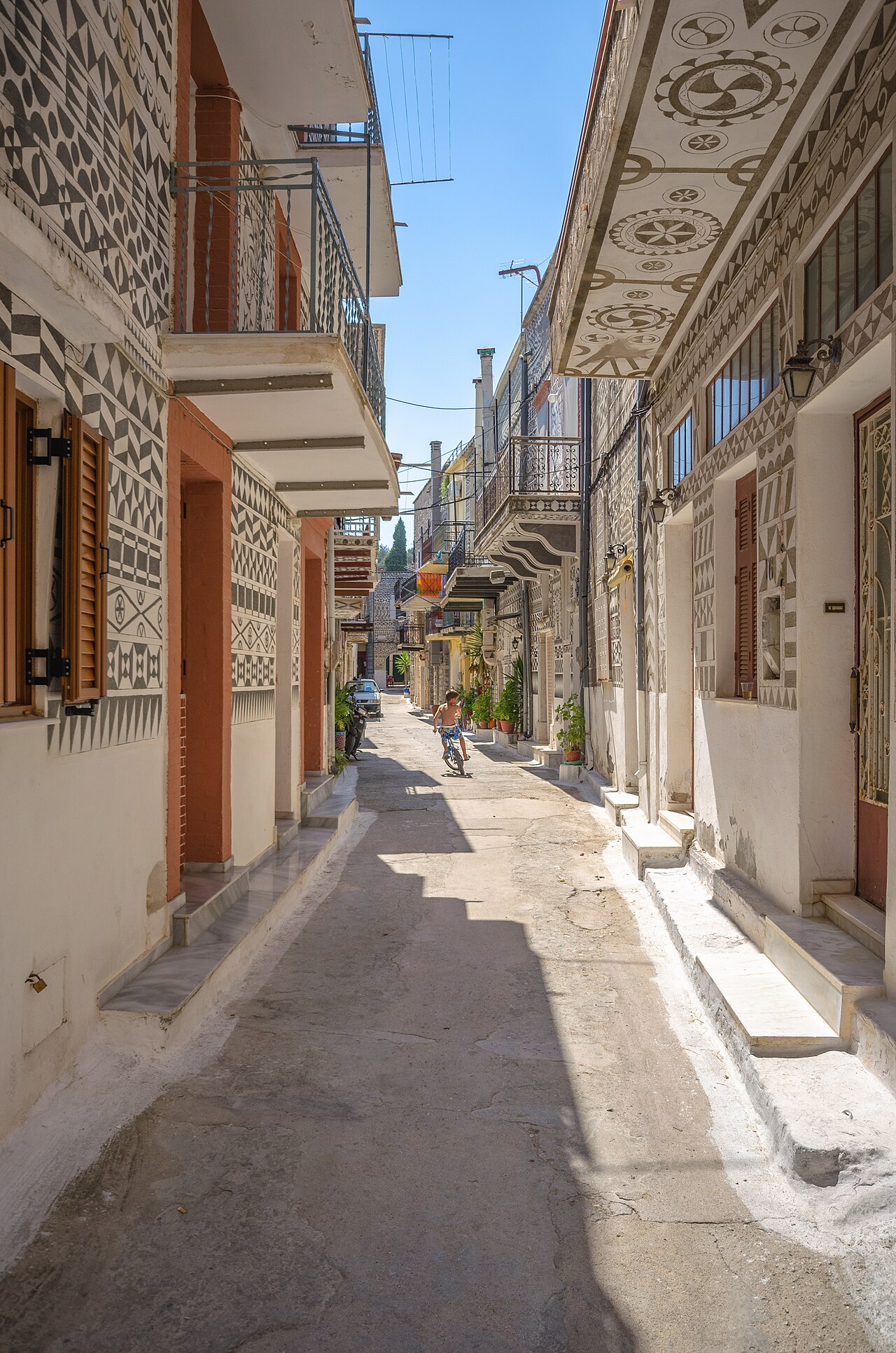
The mastic villages solve the problem by design. Mesta, Pyrgi and Olympi were built as sealed fortresses with covered lanes, and cars stop at the perimeter in open areas that are free and rarely full outside high summer. Arriving before mid-morning or after five in the afternoon avoids the coach parties that come for the xysta façades of Pyrgi.
Beaches and monasteries have informal parking that fills on August weekends. Nea Moni has limited space at the gate, and arriving early suits both the parking and the light. Beach parking at Mavra Volia, Komi and Nagos is unpaved and free. Leave nothing visible in the car, which is the only precaution the island’s low crime rate calls for.
Where do you refuel, and what does fuel cost?
Fuel stations concentrate in Chios Town, along the east coast and at the larger villages such as Pyrgi and Volissos. Island prices sit above the Greek mainland average, and most stations close between 20:00 and 23:00, with limited Sunday opening.
Plan refuelling around the island’s geography. The east coast between Chios Town and the airport carries the densest cluster of stations, and inland and northern routes go long distances without one. Filling the tank in town before a day in the mountains or the far south removes the one genuine risk of running dry on Chios.
Evening and Sunday closures catch visitors out. Stations shut in the early or late evening depending on the village, and rural sites keep shorter hours than those in the capital. Attendants serve the pumps in Greece rather than customers serving themselves, and card payment is accepted at the larger stations while smaller village pumps prefer cash.
Consumption stays low because distances are short. A week of touring the island in a small hatchback rarely exceeds two tanks, even taking in the south, the north and the mountain monasteries. Rental cars are supplied full and returned full, and the refuelling charge applied by the desk is far above the pump price, so the last stop before the airport is worth making.
What are the driving rules in Greece that apply on Chios?
Greece drives on the right. Seat belts are compulsory front and rear, handheld phone use is prohibited, the drink-drive limit is lower than in Britain or the United States, and speed limits run to 50 km/h in built-up areas and 90 km/h on open road.
Enforcement on Chios is real but low-key. Police conduct roadside checks on the main east-coast road and at village entrances, and they ask for the licence, the rental agreement and, from non-EU drivers, the International Driving Permit. Fines for seat belts, phone use and speeding are issued on the spot, and rental firms pass on any penalty charged to the vehicle.
Alcohol deserves particular care because the limit is stricter than visitors expect and the penalties are severe. A carafe of wine at a village taverna followed by a mountain road at night is the classic mistake. The island’s tavernas are spread out and taxis are limited outside the town, so agreeing a driver before dinner is the practical answer.
Local conventions differ from northern Europe. Drivers straddle the centre line on empty roads, overtake on bends, and use the hard shoulder to let faster traffic through, which is expected rather than rude. Sounding the horn before a blind hairpin is standard on Chios and worth adopting, as is slowing for the goats that treat the carriageway as pasture.
What do you do if you break down or have an accident?
Call the rental company’s emergency number first, and 112 for police, ambulance or fire. Greek insurance requires a police report for any accident claim, so never move the vehicles or settle privately before the police attend.
The paperwork rule catches people out. If a rental car is damaged in a collision and no police report exists, the insurer routinely refuses the claim and the excess falls on the driver, whatever was agreed at the roadside. Photograph the scene, the positions of both vehicles, the plates and the damage before anything moves, and record the other driver’s details.
Breakdowns are simpler. Rental agreements include roadside assistance, and the number is on the contract and usually on a sticker in the glovebox. Chios distances are short, so recovery reaches most of the island within a reasonable time, though the mountain roads to Volissos and the far north take longer than the east coast.
Prevention matters more than either procedure. Check the spare wheel and jack at handover, because loose stones on the outside of bends puncture tyres and tyre damage is excluded from most policies. Note the fuel type before the first fill, keep the tank above a quarter on inland days, and photograph the car from every angle at collection so the return inspection has nothing to argue with.
What are the alternatives to hiring a car on Chios?
The alternatives are the two bus stations in Chios Town, taxis, scooters and quad bikes, and organised excursions. Buses reach the main villages on a residents’ timetable, and organised day tours cover the mastic villages and Nea Moni without a car.
Buses divide into two networks with separate stations beside the harbour, one for the town and its suburbs including Karfas and Vrontados, and one for the island’s villages, running to Pyrgi, Mesta, Kardamyla and Volissos. Town routes are frequent and cheap. Village routes are built around school and work journeys, so departures thin out in the afternoon and at weekends.
Taxis wait on the Chios Town waterfront and at the airport, and they work well for short hops such as the airport, Karfas or Vrontados. Fares for a long day of touring add up quickly, though a negotiated half-day rate to the mastic villages is a reasonable option for a single excursion.
Two-wheelers and organised tours fill the remaining gaps. Scooters and quad bikes are rented in the town and at Karfas and suit short coastal runs rather than the mountain crossings, and helmets are compulsory. Coach and minibus excursions run from Chios Town through the summer, covering the mastic villages and Nea Moni in a guided day, which is the simplest answer for non-drivers, as the guide to day trips from Chios sets out.
Which drives are worth making on Chios?
Three drives cover the island: the southern loop through Pyrgi, Olympi, Mesta and the Mavra Volia beaches; the mountain road to Nea Moni and Anavatos; and the northern run through Kardamyla and Nagos or west across to Volissos.
The southern loop is the essential day. From Chios Town the road runs down the east coast, turns inland to Pyrgi with its carved geometric façades, continues to Olympi and its cave, and reaches Mesta for lunch in the square. The return goes by the black volcanic pebbles of Mavra Volia at Emporios and the sandy bay of Komi, described in the guide to the best beaches in Chios.
The mountain drive is shorter and steeper. The road climbs west from Chios Town into pine forest, arrives at the eleventh-century monastery of Nea Moni with its mosaics, and continues to the abandoned village of Anavatos on its cliff. The whole circuit takes half a day at an unhurried pace, and the detail sits in the guide to Nea Moni monastery.
The north repays a full day. One route follows the coast through Langada and Kardamyla to the beaches at Nagos and Giosonas; the other crosses the island’s spine to Volissos, its Byzantine castle and the long west-coast sands at Managros and Limnia. Both roads bend constantly, and both end at the kind of empty beach that explains why visitors hire a car on Chios at all.
Frequently Asked Questions
Do you need a car to get around Chios?
For most visits, yes. Chios covers about 840 square kilometres and its attractions are spread across three distinct regions: the medieval mastic villages of the south, the mountain monastery of Nea Moni in the centre, and the beaches and stone villages of the north and west. Public buses link Chios Town with the main villages, but they run on a timetable built for residents, with few afternoon and weekend services, so a single village return consumes a day. Visitors staying in Chios Town or Karfas for two or three days manage on buses, taxis and organised excursions, while anyone staying longer or basing themselves in a village gains far more from a hire car.
How much does it cost to rent a car in Chios?
A small hatchback costs roughly 20 to 40 euros a day in the shoulder months of May, June, September and October, and about 50 to 90 euros a day in the peak weeks of late July and August. Weekly rentals bring the daily rate down sharply compared with bookings of two or three days. Reducing the insurance excess adds around 8 to 15 euros a day unless the quoted price already includes full cover, which is common with the island’s local firms. Automatic transmission carries a premium and the supply on Chios is limited, so it is booked well ahead. Unlimited mileage is standard.
Is driving in Chios difficult?
Driving on Chios is straightforward on the east coast and demanding inland. The main road from Chios Town south past the airport to the mastic villages is wide, well surfaced and lightly trafficked, and there are no tolls anywhere on the island. Roads into the mountains and along the northern coast narrow into sustained hairpins with steep drops and few barriers, so journeys take longer than the distance suggests. Goats crossing the road are common away from the east coast, and loose stones gather on the outside of bends after rain. The medieval villages exclude cars altogether, so drivers park outside the walls and walk in.
Can you rent an automatic car in Chios?
Yes, but the supply is limited and it goes early. Greek rental fleets are predominantly manual, and on an island the size of Chios the number of automatics across all suppliers is small, so they are the first category to sell out for July and August and they carry a premium of several euros a day over the equivalent manual. Anyone who cannot drive a manual books two to three months ahead for the summer and confirms the transmission in writing on the reservation rather than relying on a category code. The most commonly rented cars on the island are small hatchbacks such as the Hyundai i10 and the Toyota Yaris, which suit the narrow village approaches and the tight parking at the edges of Mesta and Pyrgi, and a modest step up in engine size is worth the small extra cost for the mountain climbs to Nea Moni and Volissos.
Is it safe to drive in Chios at night?
Driving on the east coast between Chios Town, the airport and Karfas is straightforward after dark, as the road is wide, well surfaced and lit in places. Inland and northern routes are a different matter: the mountain roads to Nea Moni, Volissos and Kardamyla wind in sustained hairpins with steep drops, few barriers and no lighting, and goats and loose stones remain on the carriageway at night. Add that fuel stations close between roughly 20:00 and 23:00, so a tank that looked adequate in daylight becomes a problem, and that the drink-drive limit in Greece is stricter than many visitors assume after a taverna dinner. The practical approach is to plan mountain and village driving for daylight and keep night journeys to the east coast.
Do you need an International Driving Permit for Chios?
Drivers holding a licence issued in an EU or EEA country need nothing beyond that licence. Drivers with licences from outside the EU, including the United Kingdom, the United States, Canada and Australia, are required to carry an International Driving Permit alongside the home licence, and Greek police check for it at roadside stops and after any incident. The permit is obtained in the country that issued the licence before travelling, as it cannot be arranged on Chios. Rental firms also require a passport or identity card, a licence held for at least a year, and a credit card in the main driver’s name for the deposit.