
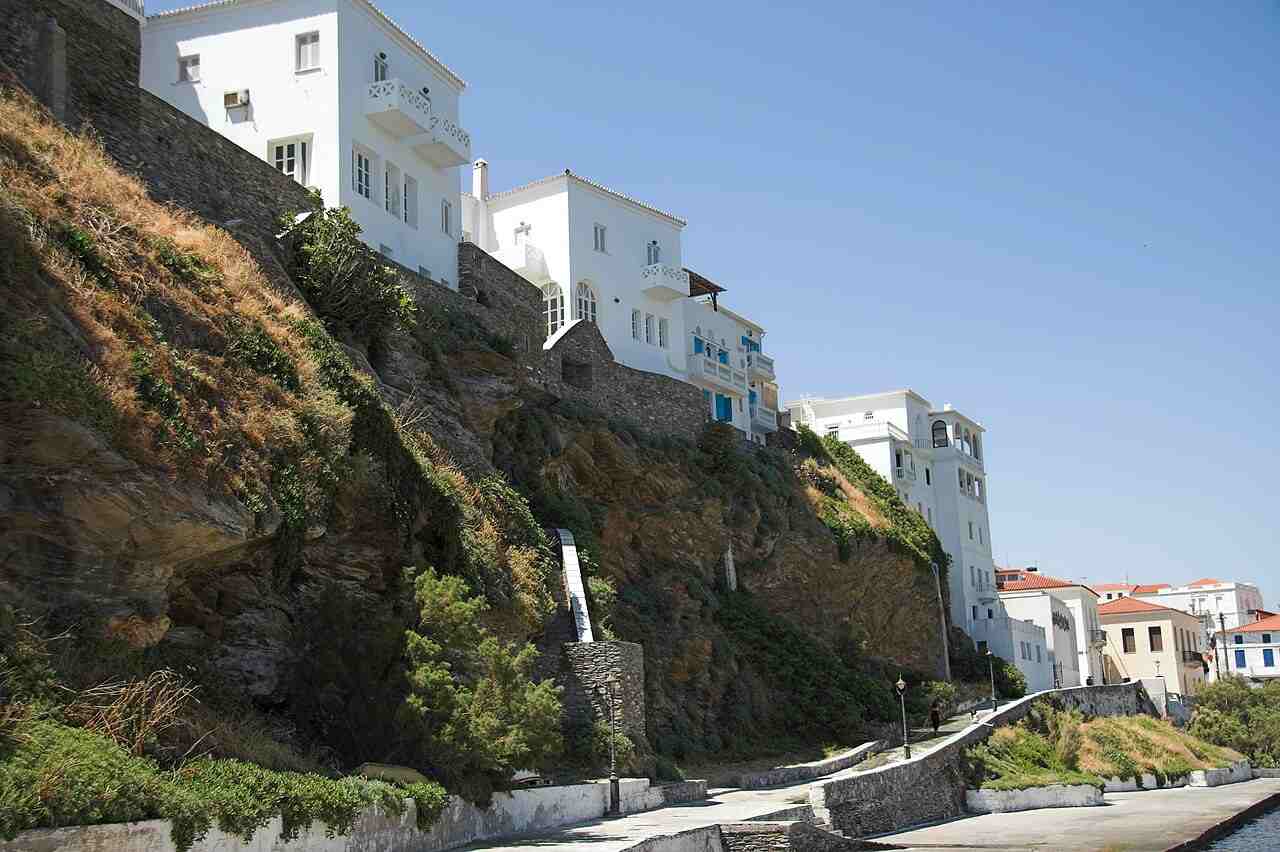
Andros is the greenest and one of the largest of the Cyclades, a walker’s island of springs. Waterfalls and terraced valleys that feels a world away from the barren, party-driven islands to the south. Just two hours by ferry from the port of Rafina near Athens, it rewards visitors with an award-winning network of hiking trails. An elegant maritime capital, wild beaches and a green interior laced with running water rare in the Aegean.
This guide ranks the experiences that define a visit: the hundred-kilometre Andros Route, the neoclassical streets and museums of Chora. The emblematic Tourlitis lighthouse, the waterfalls of Pythara and Menites, the mountain villages. The beaches that ring the long coast. It also covers windsurfing, boat trips, the ancient capital of Palaiopolis and the island’s distinctive food. Read it beside the wider Andros travel guide to plan ferries, dates and a base.
What are the top things to do in Andros?
The signature experiences are hiking the Andros Route, exploring the capital Chora and its museums, seeing the Tourlitis lighthouse, swimming at wild beaches like Achla, and touring the green villages and waterfalls of the interior.
Andros splits neatly into a green, mountainous interior and a long, indented coast, and the best of the island lies in both. The heart of a visit is walking: the Andros Route, a certified European trail network of old stone paths, threads the valleys past waterfalls. Bridges and villages. It is the single feature that sets the island apart from the rest of the Cyclades. Around it sit the beaches, the culture and the food.
The capital, Chora, is the cultural centre, an elegant maritime town of shipowners’ mansions, fine museums and the iconic Tourlitis lighthouse offshore. The green interior holds the springs of Menites, the waterfalls of Pythara and a string of old stone villages, while the long coast ranges from organised family sands in the west to wild, emerald coves in the remote north and east.
A first visit works best by mixing the two: days walking the trails and touring the villages inland. Days swimming at the beaches. Time in Chora for its fine museums and its seafront. The sections below take each of the island’s highlights in turn, with the practical detail to fit them into a stay of four or five days.
Why is Andros the best Cyclades island for hiking?
Andros holds one of the finest trail networks in Greece, the Andros Route, over a hundred kilometres of signposted old stone paths certified as a Leading Quality Trail of Europe.
Hiking is the island’s defining activity. The Andros Route is a cleared, waymarked network of the old kalderimia. The stone-paved mule paths that once linked every village. Its main long-distance trail runs the length of the island. The quality of the paths and the signposting earned it certification as one of Europe’s leading walking trails. A rare distinction that has made Andros a destination for walkers from across the continent.
The trails cross an unusually green landscape for the Aegean, passing waterfalls, old watermills, arched stone bridges. Springs and terraced fields, with routes ranging from gentle valley strolls to demanding mountain crossings with wide sea views. The green interior stays comfortable in spring and autumn when the rest of the Cyclades is parched and shadeless, extending the walking season well beyond the summer.
A favourite route runs from Chora up to the spring village of Apoikia, past chapels and terraces, while others link the waterfalls of Pythara, the villages of the interior and secluded beaches reached only on foot. For visitors the trail network is the main reason to choose Andros. Even a single half-day walk on one of the marked routes gives a sense of the green island that the beaches alone cannot.
What is there to see in Chora, the capital of Andros?
Chora, the capital, is an elegant town on a narrow peninsula, with a marble main street of neoclassical shipowners’ mansions, the bronze Unknown Sailor statue at the Riva, a ruined Venetian castle reached by an arched bridge, and fine museums.
Andros town, known as Chora, is among the most refined capitals in the Cyclades, its wealth built on a proud shipowning history. A pedestrian marble street runs the spine of the peninsula, lined with grand neoclassical mansions, churches and squares. Ending at the open terrace of the Riva where the bronze statue of the Unknown Sailor gazes out to sea, one of the island’s best-loved landmarks.
From the Riva, an old arched stone bridge crosses to a small islet crowned by the ruins of the medieval Venetian castle. The Mesa Kastro, with the Tourlitis lighthouse rising from the sea just beyond. The setting, with bays on either side of the peninsula and the lighthouse offshore. Makes Chora one of the most scenic capitals in the whole of the Aegean and a place to wander slowly.
The town is also the island’s cultural hub, home to a cluster of museums and a lively summer season of exhibitions and events. Between the mansions, the seafront, the castle and the museums, Chora rewards an unhurried day. Ideally ending with a sunset over the lighthouse from the castle bridge or a seafront cafe.
What museums you visit in Andros?
Andros has an exceptional cultural offering, led by the Museum of Modern Art of the Goulandris Foundation in Chora, which stages major summer exhibitions. The Archaeological, Maritime and Olive museums complete the circuit.
The standout is the Museum of Modern Art, founded by the Goulandris family, which has made Andros a cultural destination in its own right. Each summer it stages important exhibitions of Greek and international artists alongside its permanent collection. Drawing art lovers from Athens and beyond, an unexpected pleasure on a green Cycladic island and reason enough for a day in Chora.
The Archaeological Museum of Andros displays finds from the island’s ancient sites, most famously a celebrated statue of Hermes recovered from the ancient capital of Palaiopolis, while the Maritime Museum celebrates the shipowning heritage that built the town. Together they tell the story of the island’s classical past and its seafaring golden age in a compact, walkable circuit.
Inland at the village of Pitrofos, the Olive Museum of the Cyclades explains the traditional oil-making that shaped the island’s terraced landscape, with old presses and tools. For a small island, this cultural depth is remarkable, and it gives Andros a rainy-day and rest-day appeal that the beach-only Cyclades lack, part of the guide to Andros as a whole.
Should you see the Tourlitis lighthouse in Andros?
Yes. The Tourlitis lighthouse, the only lighthouse in Europe built on a rock in the open sea, rises from a lone pinnacle below the castle of Chora.
Rising from a weathered stone pinnacle just off the shore beneath the medieval castle of Chora, Tourlitis is the island’s icon. It holds the distinction of being the only lighthouse in Europe erected on a rock in the open sea rather than on land or a harbour. Its white tower against the deep blue water is the image most visitors carry away from Andros.
The best view is from the ruined Venetian castle at the tip of the Chora peninsula. Reached by the old arched stone bridge, from where the lighthouse appears to rise straight out of the waves. Sunrise and sunset are the finest times, when the low light gilds the tower and the sea. The short walk out to the castle is a highlight of any visit to the capital.
Combining the lighthouse with a wander through Chora, its museums and its seafront makes for a full and rewarding day in the capital. As the symbol of the island, Tourlitis appears on every postcard and guidebook. Seeing it in person, framed by the castle and the open Aegean, is one of the essential experiences of Andros.
What are the best beaches to visit in Andros?
Andros has over eighty beaches along 176 kilometres of coast, from the family sands of Golden Beach and Agios Petros in the west to the wild emerald coves of Achla and Zorkos in the north.
The west coast around Batsi and Gavrio holds the most accessible, organised beaches, including the shallow. Family-friendly Golden Beach and the long yellow sand of Agios Petros, the largest on the island, with beach bars and calm water. These are the easiest beaches for a straightforward day by the sea, sheltered from the summer meltemi wind.
For wilder scenery the north and east reward the effort of reaching them: Achla, backed by a river and plane trees, is counted among the finest beaches in Greece. Zorkos is a long golden strand at the end of a rough road. The iconic Tis Grias to Pidima frames a tall rock pinnacle in turquoise water near Korthi. Many of these are reached by dirt track, on foot or by boat.
With such a long and varied coastline, Andros suits every kind of beach day, from organised family sands to remote coves you have to yourself. The dedicated guide to Andros beaches covers each in turn, with access, facilities and which to choose on a windy day.
Where can you see waterfalls and springs in Andros?
The Pythara waterfalls near Apoikia flow through a shaded valley of plane trees, while the village of Menites is famous for spring water pouring from carved marble lion heads. Running water is one of the island’s rare Cycladic pleasures.
The green interior of Andros hides waterfalls and springs that feel far from a typical Aegean island. The Pythara valley, near the village of Apoikia, is the best known, a shaded gorge of plane trees. Pools and small waterfalls that comes alive after the spring rains and offers a cool, green walk in the heat of summer, complete with frogs and dragonflies among the water.
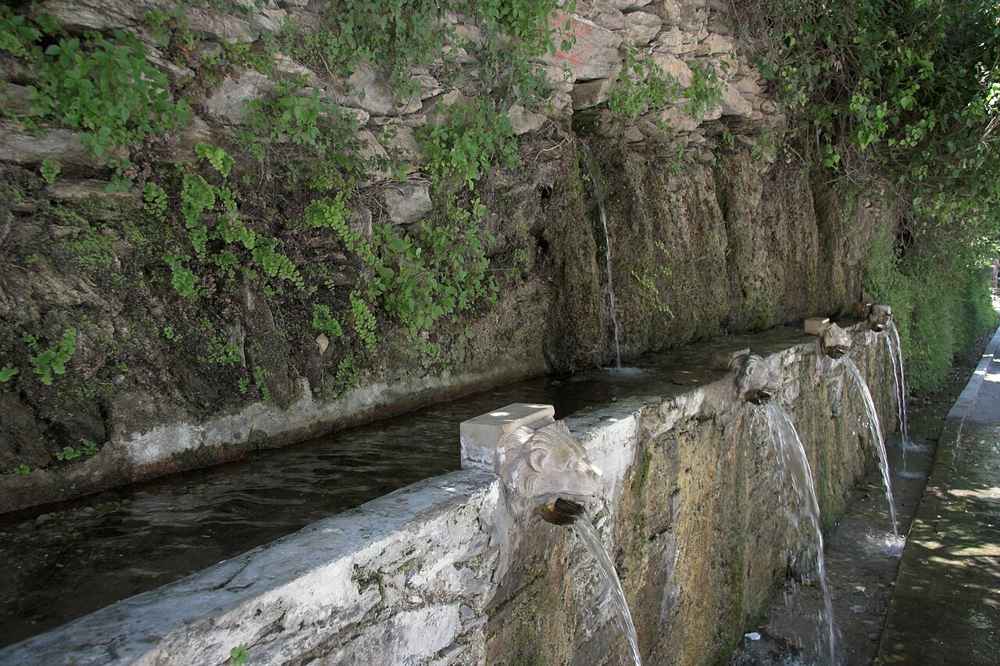
At the village of Menites, spring water flows year-round from a row of carved marble lion-head spouts beneath a canopy of plane trees. A scene of greenery and running water that has made it one of the island’s most photographed spots. Nearby Apoikia is the source of the well-known Sariza mineral water, bottled and drunk across Greece.
These springs and waterfalls are easily combined with a village tour or a short hike, and they are among the experiences that make Andros distinctive. Seeking out the running water of the interior, so unexpected in the Cyclades, is one of the quiet pleasures of the island and a welcome contrast to the beaches.
Which villages you visit in Andros?
Beyond Chora, the villages of Menites, Apoikia, Stenies and Messaria reward exploring. Each keeps its own springs, churches or captains’ mansions amid the green interior, linked by the island’s old stone footpaths.
The mountain villages of Andros are strung through green valleys and terraced slopes, and touring them by car or on foot is one of the pleasures of the island. Menites and Apoikia, with their springs and plane trees, sit close to Chora, while Stenies is famous for the grand mansions built by returning ship captains. Set among gardens above the sea, once the wealthiest village on the island.
Messaria holds the fine Byzantine church of the Taxiarchis, and inland the highland villages of Vourkoti and Arnas sit amid the greenest scenery, high on the slopes with wide views. Each village guards its own character, its own churches and often its own spring, and the old footpaths that link them make the villages themselves a walking destination.
Drive or walk the village loop in the late afternoon when the light softens the stone and the tavernas open. Stopping for spring water at Menites and a meal in a mountain taverna. The villages are the heart of the island’s food culture and its traditional life, and they reward the unhurried exploring that Andros invites.
Can you windsurf and do watersports in Andros?
Yes. The bay of Ormos Korthiou on the east coast is the island’s windsurfing centre, catching the strong summer meltemi, and watersport centres at Ormos and Kipri offer scuba diving, stand-up paddleboarding and wakeboarding.
The steady summer wind that blows across Andros in the afternoons has made it a good island for windsurfing. The bay of Ormos Korthiou on the south-east coast is the main centre, its open water and reliable breeze suiting the sport. With windsurfing schools and rental kit for beginners and improvers alike. A relaxed, uncrowded atmosphere far from the busier wind spots of the Cyclades.
Beyond windsurfing, watersport centres at Ormos and at Kipri, near Batsi, offer a range of activities including scuba diving in the clear water, stand-up paddleboarding and wakeboarding. The clarity of the sea rewards divers and snorkellers, and the sheltered west-coast bays are calm enough for gentle paddling and family watersports.
For active visitors, the combination of windsurfing on the breezy east coast and calmer watersports on the sheltered west adds another dimension to a stay. Alongside the hiking and the beaches. Andros balances land and sea in a way few Cycladic islands do, and its watersports are part of that appeal.
What boat trips can you take in Andros?
Boat trips from Batsi and Gavrio explore the island’s wilder coast, reaching remote coves, sea caves and the waters below the Tourlitis lighthouse. They are the best way to see the beaches that no road serves.
Andros has a long, indented coastline with beaches and coves that no road reaches, and boat trips are the way to see them. Excursions run in season from the west-coast harbours of Batsi and Gavrio, cruising along the shore to remote sandy coves. Dramatic sea caves and clear water for swimming and snorkelling, turning a beach day into a relaxed cruise.
Some trips take in the waters below the Tourlitis lighthouse and the rugged coast around Chora, offering a view of the island’s icon from the sea, while others focus on the wild northern and eastern beaches that are otherwise reached only by rough track or on foot. Private charters and small-boat rentals allow a group to set its own route.
For visitors who want to reach the emptiest, most pristine stretches of the coast. A boat trip is the answer. It pairs well with the hiking and village touring of an inland day. The clear water and the remote coves make these excursions one of the more rewarding ways to experience the island’s long shoreline.
What is Palaiopolis, the ancient capital of Andros?
Palaiopolis was the ancient capital of Andros on the west coast, reached by a long flight of old stone steps.
Long before Chora, the ancient city of Palaiopolis was the capital of Andros, occupying a dramatic position on the terraced west-coast slopes above the sea. Much of the ancient city now lies below the modern village of the same name and along the shore. A long stone stairway of hundreds of steps descends through the site toward the water, past scattered ruins and terraces.
The site is famous for the Hermes of Andros. A classical statue found here and now among the treasures of the National Archaeological Museum in Athens, with a copy in the island’s own museum. Scattered remains, a small archaeological collection in the village and the sweeping view over the sea reward those willing to tackle the steps.
Palaiopolis makes a rewarding half-day for anyone interested in the island’s history, combining ancient ruins with one of the best coastal panoramas on Andros. The steep descent and climb back demand reasonable fitness, but the sense of the island’s deep past, set against the wide Aegean, makes the effort worthwhile.
What caves can you explore in Andros?
The Foros cave near the village of Aladinos is the most impressive on Andros, a chamber of stalactites, stalagmites and coloured limestone formations. It is reached by a short cobbled path of about three hundred metres from the Aladinou bridge.
Hidden in the green interior, the Foros cave, sometimes called the Aladinou cave, is a world beneath the surface of the island. Its chambers hold stalactites, stalagmites and colourful limestone formations built up over vast spans of time. A striking contrast to the sunlit landscape above and a cool retreat on a hot summer day.
The cave is reached on foot by following a cobbled path of around three hundred metres from the old Aladinou bridge. Near the village of Aladinos, one of the many stone bridges that lace the island’s valleys. The short walk in makes it an easy addition to a day exploring the interior, and the geology inside rewards the detour.
For visitors curious about what lies beneath the green slopes, the cave adds another dimension to the natural riches of Andros, alongside the waterfalls and springs. It suits families and anyone wanting a change from the beaches, and it fits naturally into a village-and-interior tour of the island’s heart.
Can you visit the Panachrantou monastery in Andros?
Yes. The Panachrantou monastery, founded in the tenth century on the slopes of Mount Kouvara, is the most important on Andros. Fortress-like and perched high above the sea, it holds sacred relics and offers sweeping island views.
The monastery of Panachrantou is the spiritual heart of Andros, founded over a thousand years ago in the Byzantine era on the rugged slopes above Chora. Built like a small fortress into the mountainside, it clings to the rock at altitude. The approach. Whether by a winding road or on foot along an old path, is part of the experience, climbing through wild scenery to the whitewashed complex.
Inside, the monastery preserves sacred relics and icons venerated by the islanders, and it remains a working religious community. The setting is the great reward, with the buildings hanging above the terraced slopes and the sea far below. Giving some of the widest views on the island and a profound sense of peace.
A visit to Panachrantou combines history, faith and landscape, and it pairs naturally with a day exploring the interior and the villages. Dress respectfully as at any Greek monastery, and time the visit to the opening hours, since it is a living community rather than a museum. The climb and the views make it a memorable stop.
What food you try in Andros?
Andros is known for fourtalia, a hearty omelette of potatoes, sausage and herbs, and for amygdalota, soft almond sweets. Local cheeses like kopanisti, honey, olive oil and the Sariza spring water round out the island’s table.
The island’s fertile land gives it a richer cuisine than the average Cycladic island. The signature dish is fourtalia, a thick country omelette made with potatoes, local sausage or bacon and mint, filling and rustic, served best in the mountain village tavernas. Local cheeses such as the soft, tangy kopanisti appear on every menu, alongside wild greens, honey and olive oil pressed from the island’s groves.
For something sweet, the almond sweets called amygdalota are the island’s speciality. Sold in the bakeries of Chora and the villages, while the Sariza mineral water from Apoikia is bottled and drunk across Greece. Seafood features on the coast at Batsi, Gavrio and Korthi, where the tavernas serve the day’s catch grilled by the water.
Eating on Andros means seeking out the mountain tavernas of the interior as much as the seafront ones, since the green heart of the island is the source of its food culture. A meal of fourtalia and local cheese in a village taverna, followed by amygdalota and a glass of local wine. Is one of the authentic pleasures of a visit to the greenest of the Cyclades.
When is the best time to visit Andros?
Late May to early October is best for the beaches, and spring and autumn for hiking, when the island is green and cool. Unusually for the Cyclades, Andros stays comfortable even in August, as its size keeps the crowds thin.
For a beach holiday, the warm, settled months of late May through September are ideal, with the sea comfortable for swimming into October. The shoulder weeks of late spring and early autumn bring the best balance of warm weather. Thinner crowds and lower prices. They are especially rewarding on an island where the green interior is as much of a draw as the sea.
For walkers, spring, from March to May, is the finest season, when the island is at its greenest. The waterfalls flow and the wildflowers are out, with autumn a close second as the heat fades. The trails cross a landscape that stays green and comfortable when the rest of the Cyclades is parched, extending the walking season well beyond the summer.
Unusually for the Cyclades, Andros stays comfortable even in August, since its size and its lack of mass tourism mean the crowds spread thin across its beaches and villages. July and August bring the strongest meltemi wind, which favours windsurfers but pushes swimmers to the sheltered west coast, so reading the wind helps whatever the month.
Where you stay in Andros?
The best bases are Batsi for beaches and life, Chora for culture and elegance, and Gavrio for the port. The villages and Stenies offer character and quiet, and a hire car makes any of them practical on this large island.
Batsi on the west coast is the most popular base, with the widest choice of hotels and rooms. A good beach and a lively but relaxed waterfront, ideal for a first visit centred on the sea and the sheltered west-coast beaches. Chora, the capital, suits travellers drawn to its mansions, museums and refined atmosphere, though it is quieter in the evenings and a short drive from the best beaches.
The port town of Gavrio offers convenience for arrivals and departures and access to the north-western beaches, while the mountain villages and the captains’ village of Stenies give a peaceful, authentic stay amid greenery for those with a car. Each base gives a different flavour of the island, from resort life to cultural elegance to rural quiet.
With the island’s size, choosing a base near the beaches or the trails you most want, and hiring a car, is the practical approach. For a comparison of the bases and the island’s accommodation, see the wider Andros travel guide, which sets out where to stay for different kinds of trip.
What day trips can you take from Andros?
The easiest island day trip is to neighbouring Tinos, reached by ferry from Gavrio, while boat trips explore Andros’s own wild coves, sea caves and lighthouse. A day by car can tour the interior’s villages, waterfalls and trails.
The nearest island day trip is to Tinos, the next island south, reached by ferry from Gavrio and known for its great pilgrimage church and its marble villages, a rewarding contrast to green Andros. The wider Cyclades ferry network also puts Mykonos and Syros within reach for longer excursions from the island.
On Andros itself, boat trips from Batsi and Gavrio reach the wild coves and sea caves of the coast and the waters below the Tourlitis lighthouse. Opening up the beaches that no road serves. These make a relaxed day on the water and a fine way to see the island’s dramatic, indented shoreline from the sea.
A day by car, meanwhile, can string together the waterfalls of Pythara, the springs of Menites. The villages of the interior and a section of the Andros Route, showing the green heart of the island. Between the neighbouring islands, the boat trips and the inland tours, Andros offers plenty of day-trip variety for a longer stay.
How days do you need in Andros?
Four to five days let you enjoy the beaches, walk a stretch of the Andros Route, explore Chora and its museums, and tour the villages and waterfalls of the interior. Keen hikers and beach lovers can happily stay a week.
Andros is a large island with a lot to offer on both land and sea, so it repays more than a fleeting visit. A stay of four to five days allows time to relax on a few of the best beaches, spend a day in Chora among its mansions and museums. Walk at least one section of the celebrated hiking trails. Tour the springs, waterfalls and villages of the interior.
Walkers drawn by the Andros Route can fill a week or more, tackling different sections of the trail network and combining them with swims at the remote coves along the way, while beach lovers can spend their days working through the island’s eighty-odd beaches. The island’s size means there is always another valley, village or cove to discover.
It also works as a shorter escape from Athens, though a fleeting visit barely scratches the surface. For a first trip, four or five days captures the island’s distinctive mix of green landscapes, beaches and culture without rushing, leaving the deeper trails and the remotest coves for a return. See the Andros travel guide for planning a stay.
Frequently Asked Questions
What is Andros best known for?
Andros is best known for being the greenest of the Cyclades and one of the finest Greek islands for hiking. With the certified Andros Route trail network of over a hundred kilometres. It is also famous for the Tourlitis lighthouse, the elegant capital Chora with its shipowners’ mansions and Museum of Modern Art, its waterfalls and springs, and its wild beaches.
Is Andros worth visiting?
Yes. Andros rewards travellers who want an authentic, green and uncrowded Greek island with hiking, culture and beaches rather than nightlife and crowds. It offers an award-winning trail network, waterfalls and springs rare in the Cyclades. The refined town of Chora with its museums. Over eighty beaches, all just two hours by ferry from Athens.
Do you need a car in Andros?
For most visitors, yes. Andros is large and mountainous, with its beaches, villages and trailheads spread far apart, and buses run only times a day between the main towns. A hire car or scooter, collected at the port of Gavrio, is the practical way to explore, though a stay focused on Batsi and its beaches can partly manage without one.
When is the best time to visit Andros?
Late May to early October is best for the beaches, while spring and autumn are ideal for hiking, when the island is green and cool and the waterfalls flow. Unusually for the Cyclades, Andros stays comfortable even in August, since its size and lack of mass tourism keep the crowds thin across its beaches and villages.