
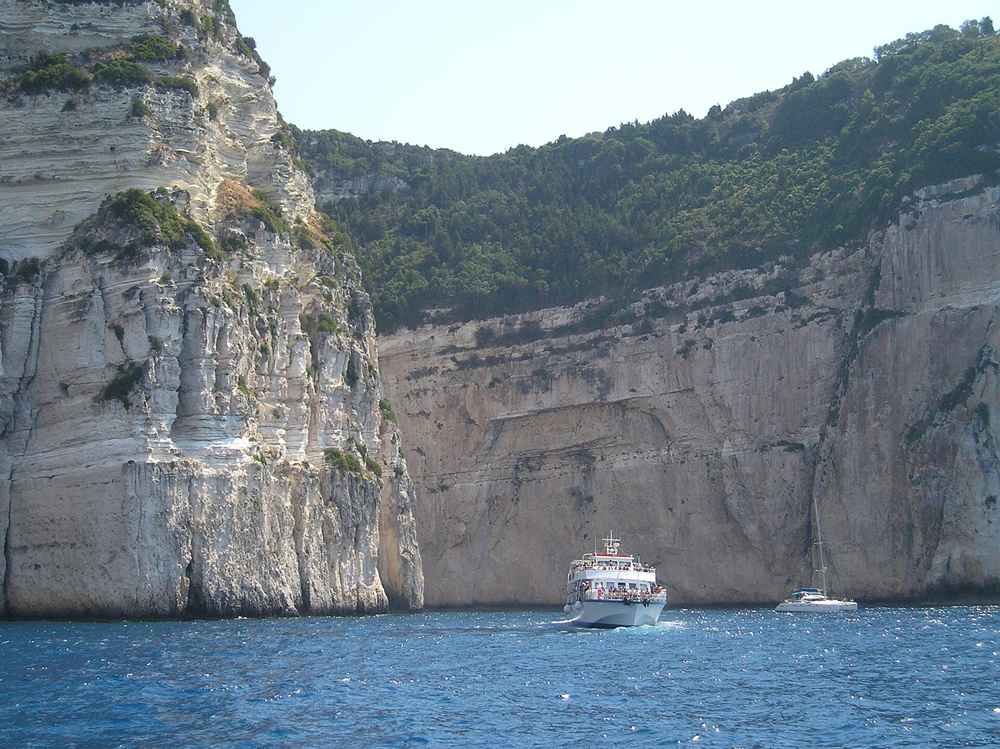
The Paxos blue caves are the spectacular sea caves and grottoes carved into the steep white cliffs of the island’s west coast. Where towering limestone walls plunge into deep, luminous blue water. Reached only from the sea, they are the scenic highlight of a boat trip around Paxos. Admired for the extraordinary way sunlight turns the water inside them an intense, glowing blue. Alongside the caves rise dramatic sea arches such as the great natural bridge at Tripitos. The whole rugged coast forms one of the most striking stretches of scenery in the Ionian. This guide explains what the blue caves are, where to find them, why the water shines so blue. Plan the whole trip with Greece Tours.
How to visit them by boat, the best time to go. What else you will see along the way.
Here you will find everything you know about the Paxos blue caves: what they are, where they lie on the west coast, why the water glows blue. How to visit them by boat from Gaios, Lakka and Loggos, the best time of day and year to go, what else you see on the trip. Whether they are worth visiting. Whether you plan to join a cruise or captain your own small boat. This guide will help you make the most of one of the finest natural sights in the Ionian.
What are the blue caves of Paxos?
The blue caves of Paxos are sea caves and grottoes carved into the white limestone cliffs of the island’s west coast.
The blue caves are a series of sea caves, arches and grottoes hollowed out by the waves along the exposed western side of Paxos and Antipaxos. Here the coast is a wall of sheer white limestone cliffs. Over the ages the sea has carved openings and caverns into the soft rock at the waterline. Creating a dramatic and beautiful coastline.
Their name comes from the remarkable colour of the water in and around them. As sunlight passes through the clear sea and reflects off the pale limestone below, the water takes on an intense, luminous blue. That the caves seem to glow from within. It is this striking effect, set against the white cliffs, that draws visitors to see them.
The blue caves are the natural centrepiece of a boat trip around Paxos, and no road reaches them, so they can be admired only from the water. Cruising beneath the towering cliffs and peering into the shadowy, blue-lit caverns is an unforgettable experience and one of the defining sights of the island.
Where are the Paxos blue caves?
The Paxos blue caves lie along the steep, rugged west coast of the island, facing the open Ionian Sea.
The blue caves are found along the western coast of Paxos, the wild side of the island that faces the open sea. In contrast to the gentle, sheltered east coast with its harbours and coves, this western shore is a dramatic line of steep white cliffs. Exposed to the wind and waves that have sculpted it into caves and arches.
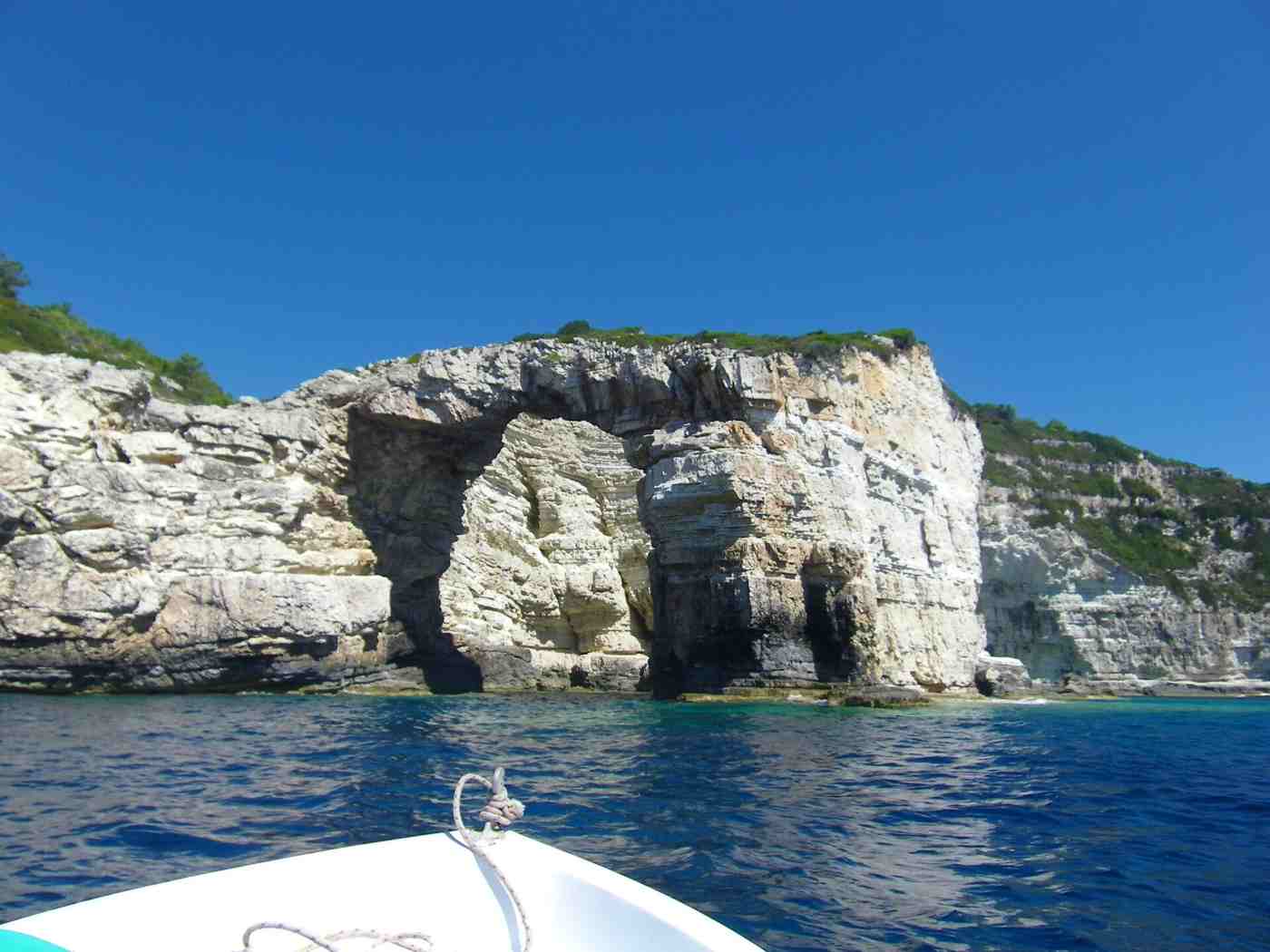
The largest and most famous of the caves is Ipapanti, a tall, arched opening in the cliff face that extends back some way into the rock. Long associated with local legend, including the old tale that it sheltered a hidden palace beneath the sea. Nearby, the great sea arch at Tripitos forms a natural stone bridge rising from the water. One of the most photographed sights of the coast and a favourite backdrop for passing boats.
The caves and arches can be reached only by boat. Trips set out from the island’s harbours of Gaios, Lakka and Loggos. Rounding the coast to bring visitors to the caves. Seeing them is naturally combined with a wider cruise along the western shore and a swim in the clear water below the cliffs.
Why is the water in the Paxos blue caves so blue?
The water in the Paxos blue caves glows blue because of the way sunlight passes through it.
The intense blue colour that gives the caves their name is a natural optical effect, produced by the interaction of sunlight and clear water. As sunlight enters the sea, the water gradually absorbs the longer wavelengths of light, the reds, oranges and yellows, leaving mainly the shorter blue wavelengths to travel on through the water.
This remaining blue light then reflects off the white limestone floor and walls beneath the surface and bounces back up. That the water appears to shine with a pure, luminous blue. The pale rock is key to the effect, acting like a mirror that returns the blue light and intensifies the colour within the caves.
The result is most striking when the sun is high and the sea is calm and clear, especially inside the caves and grottoes where the light is concentrated. It is this glowing blue, set against the shadowy caverns and white cliffs, that makes the blue caves so mesmerising and so rewarding to visit on a bright, calm day.
How do you visit the Paxos blue caves?
You visit the Paxos blue caves by boat, the only way to reach them.
A boat is the only way to see them, and there are ways to make the trip. Organised day cruises run from the island’s harbours and from nearby Corfu, taking in the caves as part of a wider tour, while private skippered boat trips offer a more personal outing with an experienced local captain.
The most independent option is to hire a self-drive boat, which the smaller licence-free craft allow you to captain yourself after a short lesson. Setting out from Gaios, Lakka or Loggos to explore the coast at your own pace. This gives complete freedom, though on this exposed shore it calls for calm conditions and a little care.
For a fuller picture of the choices, costs and routes, see our guide to Paxos boat trips. Whichever way you go, the trip to the blue caves is usually combined with the beaches of Antipaxos and other coves, making a varied and memorable day on the water.
When is the best time to visit the Paxos blue caves?
The best time to visit the Paxos blue caves is on a calm, sunny day in summer, between about ten in the morning and two in the afternoon, when the high sun lights the water most vividly.
The blue caves are at their most spectacular when two conditions come together: bright sunshine and a calm sea. The vivid blue glow depends on strong, high sunlight entering the water. The middle of the day. Roughly between ten in the morning and two in the afternoon, is the ideal window, when the sun angles deepest into the caves.
A calm sea is just as important, both for the clarity of the water and for safety, since boats need settled conditions to approach the cliffs and cave mouths on this exposed coast. Mornings are often the calmest, before the afternoon breeze gets up, so an late-morning visit frequently offers the best combination of light and calm water.
In terms of the season, the summer months from June to September bring the warmest, calmest and clearest seas. Are the prime time to see the caves at their best. These are also the busiest months, so those seeking a quieter experience find May or early October rewarding, accepting that the weather and sea are a little less reliable.
What else do you see on a Paxos blue caves boat trip?
On a blue caves boat trip you also see the towering white cliffs and sea arches of the Paxos west coast, including the natural bridge at Tripitos, along with the turquoise beaches of Antipaxos and quiet coves, usually with stops.
A trip to the blue caves is rarely just about the caves themselves, as the whole west coast of Paxos is a procession of dramatic scenery. Boats cruise beneath towering white cliffs and past sea arches, stacks and grottoes. With the great natural bridge at Tripitos among the highlights, offering some of the finest coastal views in the Ionian.
Most trips combine the caves and cliffs with a visit to the neighbouring island of Antipaxos, whose beaches of Vrika and Voutoumi have some of the clearest turquoise water in Greece. Here the boats usually anchor for a swim, so the day mixes dramatic cliff scenery with time to relax on or in the beautiful sea.
Along the way there are often further stops in quiet coves for swimming and snorkelling in the crystal-clear water. Glimpses of the island’s harbours and green, olive-covered slopes from the sea. This variety, from glowing caves to sandy beaches, is what makes a blue caves boat trip such a rich and rewarding day out.
Are the Paxos blue caves worth visiting?
The Paxos blue caves are well worth visiting, offering some of the most dramatic coastal scenery in the Ionian.
For anyone visiting Paxos, the blue caves are one of the sights not to be missed. The combination of the luminous blue water, the sheer white cliffs and the sculpted caves and arches creates a scene of rare natural drama. Quite different from the gentle beaches and harbours of the island’s other side. All the more memorable for being reachable only by sea.
Part of what makes the caves so rewarding is that seeing them is bound up with a wider day on the water. Taking in the beaches of Antipaxos, quiet coves for swimming and the whole spectacular west coast. Few excursions pack so much beauty and variety into a single trip, which is why the blue caves feature on almost every boat tour of the islands.
Provided you go on a calm, sunny day to see the water at its most vivid. A visit to the blue caves is one of the great experiences of a holiday on Paxos and Antipaxos. Whether on an organised cruise or your own hired boat, it is an outing that stays in the memory long after the trip is over.
Frequently Asked Questions
Can you swim in the Paxos blue caves?
Swimming near the Paxos blue caves is often possible, but it depends on the type of trip you take and the conditions on the day. Many boat excursions to the caves include swimming stops in the clear water along the west coast or, more commonly. In the sheltered bays of Antipaxos, whose turquoise beaches of Vrika and Voutoumi are a standard part of a blue caves trip. Inside and immediately around the caves themselves, whether you can swim depends on the sea state and on the skipper’s judgement, since this is an exposed coast of sheer cliffs where boats must take care. It is safest to follow the guidance of the crew.
On calm days trips allow passengers to slip into the wonderfully clear, blue-lit water near the caves for a memorable swim, while on rougher days the boats keep a safe distance and swimming is done elsewhere. If swimming in and around the caves is important to you, it is worth choosing a calm, settled day and a trip that specifically allows for it. Always heeding the captain’s advice. Either way, a blue caves excursion almost always includes plenty of swimming in the crystal-clear sea of the area, making it a refreshing as well as a scenic day out.
How long does a Paxos blue caves boat trip take?
How long a Paxos blue caves boat trip takes depends on where you start and what the trip includes. A dedicated outing from one of the Paxos harbours of Gaios, Lakka or Loggos to see the blue caves and the west coast, combined with a visit to the beaches of Antipaxos and a swim or two. Typically fills a half-day to a full day, giving a relaxed amount of time to enjoy the caves, the cliffs and the sea. Full-day cruises that set out from the harbours in the morning and return in the late afternoon offer the most complete experience. Taking in the caves, the sea arches, Antipaxos and several swimming stops at an unhurried pace.
Trips that come all the way from the larger neighbouring island of Corfu are longer still, usually lasting a full day of eight to twelve hours, since they include the crossing to and from Paxos as well as the tour of the caves and the islands. If you hire your own self-drive boat, you can spend as long as you like exploring the caves and coast, tailoring the day entirely to your wishes. In every case, it is best to time the visit to the caves themselves for the calm. Bright hours around the middle of the day, when the water glows at its most vivid blue.
Are the Paxos blue caves the same as the blue caves of Zakynthos?
No, the Paxos blue caves are not the same as the better-known blue caves of Zakynthos, although the two share a name and a similar natural effect. Both are sea caves where sunlight passing through clear water and reflecting off pale limestone makes the sea glow a vivid blue. Both can be reached only by boat. But they lie on entirely different islands in different parts of the Ionian Sea. The blue caves of Zakynthos are on that island’s northern tip, often visited together with the famous Navagio shipwreck beach, while the Paxos blue caves are carved into the west coast of the small island of Paxos, close to Corfu and Antipaxos in the northern Ionian.
The Paxos caves form part of a dramatic coastline of white cliffs and sea arches. Such as the natural bridge at Tripitos. Are usually visited on a boat trip that also takes in the beautiful turquoise beaches of neighbouring Antipaxos. So while the two sets of blue caves are alike in their glowing blue water and their appeal to visitors, they are distinct attractions on separate islands, each well worth seeing in its own right as part of a holiday in its corner of the Ionian.