
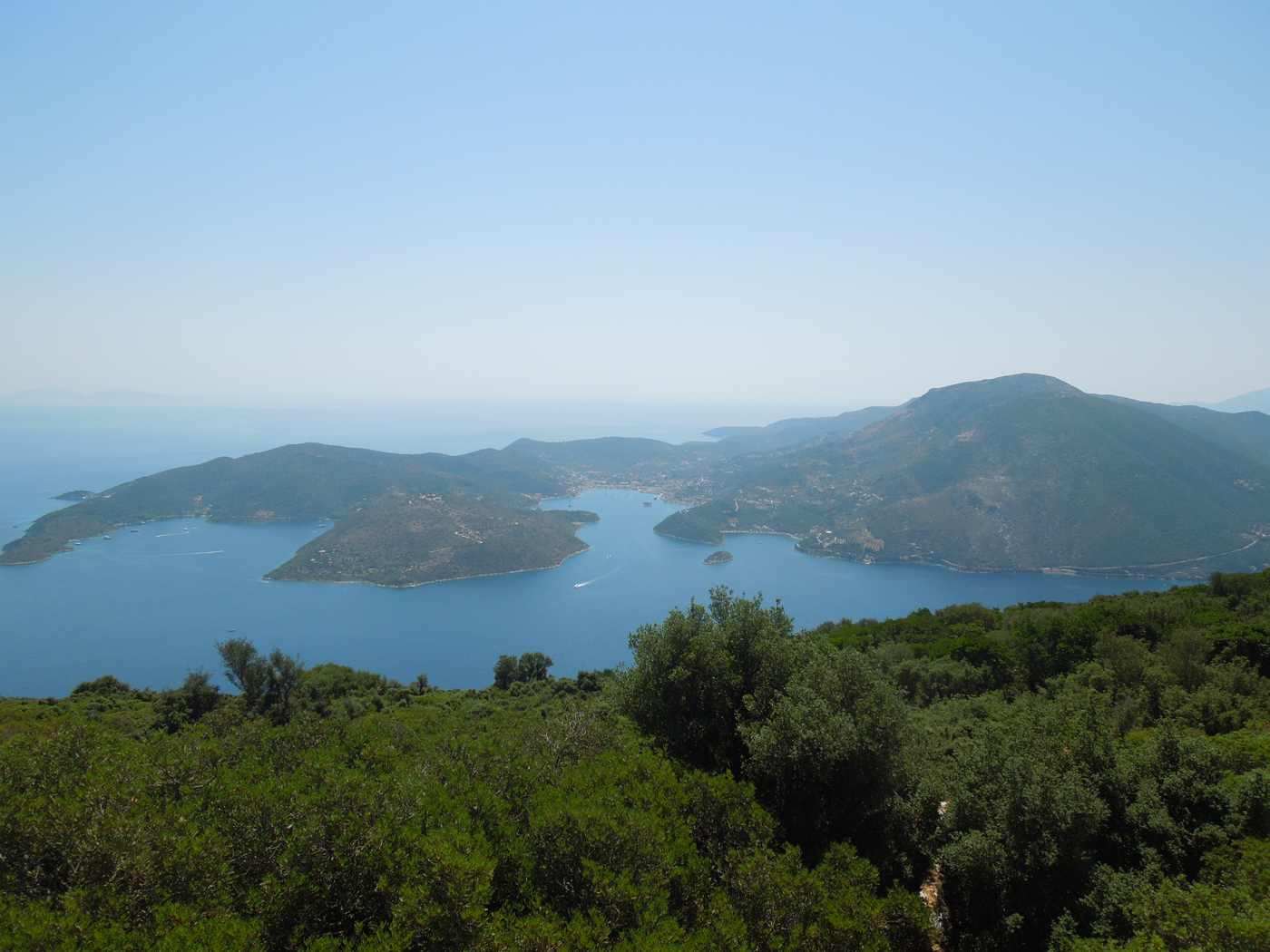
Ithaca sits across a narrow strait from Kefalonia’s east coast. Close enough that the ferry crossing runs about 30 to 45 minutes from the port of Sami to the landing at Pisaetos. That short hop turns Homer’s island into a straightforward day out rather than a separate stay. A single day covers the capital Vathy at the head of its deep bay, the northern harbours of Kioni and Frikes. One of the Homeric sites above Dexa. A swim on a pebble cove before the evening return sailing. Plan the whole trip with Greece Tours.
Ithaca rewards a plan more than most Ionian islands, because public buses run rarely and the road spine climbs and twists between harbours. Foot passengers rely on taxis waiting at Pisaetos; drivers bring a car across on the same ferry and cover the island end to end in about an hour. This guide sets out the crossing, the towns, the sites tied to the Odyssey. The beaches worth the detour. The timing that keeps the day unhurried from first sailing to last.
Why does Ithaca work as a day trip from Kefalonia?
Ithaca sits directly across a narrow strait from Kefalonia’s east coast, and the ferry from Sami to Pisaetos takes about 30 to 45 minutes, which leaves six or seven hours ashore for Vathy, Kioni and a beach.
Ithaca lies just east of Kefalonia, separated by a strait that narrows to about 4 kilometres. The island covers around 96 square kilometres and holds close to 3,000 permanent residents, so one day reaches the places that matter. Ferries from Sami land at Pisaetos in about 30 to 45 minutes, leaving six or seven hours ashore on a morning-out, evening-back pattern. That window covers Vathy, one northern harbour and one swim. Travellers based in Kefalonia treat the crossing as a short hop between neighbours rather than a second holiday, and sleep in the same room that night.
Distances on Ithaca stay small, which is what makes the arithmetic work. Pisaetos to Vathy runs about 12 kilometres and takes around 20 minutes by road. Vathy to Kioni covers roughly 25 kilometres of winding coast road, about 40 minutes at a steady pace. Frikes sits 5 kilometres beyond Kioni. A driver who lands at mid-morning reaches the northern harbours before lunch, turns back through Stavros, and still has two hours for Filiatro or Dexa. Walkers without transport concentrate on Vathy and the bay beaches within 4 kilometres of the quay.
Ithaca reads differently from its larger neighbour. The island carries no airport, no resort strip and no large hotels, so the harbours keep working quays where fishing boats moor beside visiting yachts. Green slopes of cypress, olive and holm oak rise straight from the water. The two halves of the island join at the isthmus of Aetos. A neck barely 600 metres wide. That shape puts a sea view on both sides of the road for much of the drive north, and it keeps the whole island legible within a single afternoon.
Day trippers arrive for three reasons: the Homeric name, the harbour scenery and the quiet. Ithaca appears in the Odyssey as the kingdom Odysseus spends ten years trying to reach, and place names on the ground still echo the poem. The harbours of Vathy, Kioni and Frikes hold masted yachts against pastel houses. Beaches such as Gidaki and Filiatro stay free of sunbed rows. A visitor who wants monuments and museums stays in Athens; a visitor who wants a working Ionian island at half speed takes the morning boat from Sami.
How does the ferry from Sami to Pisaetos work?
Ferries leave the east-coast port of Sami and dock at Pisaetos on Ithaca’s west coast after about 30 to 45 minutes. Sailings run times daily in high summer and thin out sharply outside the warm months.
The crossing starts at Sami, the second port of Kefalonia and the island’s main link eastward. Ferries load from the concrete quay on the south side of the bay, a five-minute walk from the waterfront tavernas, with parking on the pier itself. Boats carry cars, vans and foot passengers on the same deck. The route leaves the bay, rounds the headland below Antisamos, and crosses open water with Ithaca filling the horizon ahead. Crossing time runs about 30 to 45 minutes depending on the vessel, and the sea stays sheltered on most summer mornings.
Pisaetos is a landing, not a village. The pier sits below a steep hillside on Ithaca’s west coast, with a ticket kiosk, a small car park and a taverna, and nothing else. Taxis meet the arriving boats, and drivers negotiate a return trip or a half-day circuit before leaving the quay. Foot passengers who arrive without a plan face a 12-kilometre climb over the ridge to Vathy, so arranging transport at the pier matters more here than at larger ports. Cyclists face the same ridge, with about 200 metres of ascent in the first 4 kilometres.
A second crossing runs in the warm season from Fiskardo in Kefalonia’s far north, landing on Ithaca’s northern side close to the harbours of Frikes and Kioni. That route suits anyone staying around Assos, Myrtos or the northern villages, because it removes the long drive south to Sami. Sailings on this link operate on a summer timetable only and stop outside the season, so confirm departures locally the day before. Smaller boats work this route, and strong afternoon winds in the channel occasionally shift the schedule.
Foot passengers and drivers face different economics. Bringing a car across costs more than a foot ticket and requires arriving at the Sami quay early, since vehicle space on the smaller vessels fills first in July and August. Leaving the car in Kefalonia and hiring a scooter or taxi on Ithaca suits a single-town visit. Booking the return leg at the same time as the outbound avoids a scramble at Pisaetos in the evening. Check the last sailing before setting off, and treat that departure as the fixed point the whole day is built around.
What is there to see in Vathy, the capital of Ithaca?
Vathy wraps around the head of a long sheltered inlet, with pastel houses, a working quay, an archaeological museum and a ring of tavernas. The waterfront circuit takes about 40 minutes on foot.
Vathy occupies the innermost point of one of the deepest natural harbours in the Ionian Sea, a bay so enclosed that the open water disappears from view. Low two-storey houses in ochre, pink and pale blue line the quay, rebuilt in the same scale after the earthquake that levelled most of the island. Yachts moor bow-to along the northern side, fishing boats along the southern. The walk right around the water from one arm to the other covers roughly 2 kilometres and takes about 40 minutes with stops.
The small green islet of Lazaretto sits in the middle of the bay, carrying a single chapel and a stand of cypress. It appears in every view from the waterfront. Behind the quay, the streets climb two or three blocks to the church of Taxiarchis and a shaded central square. The Archaeological Museum of Vathy holds pottery, bronze tripods and inscriptions found across the island, including material from the sanctuary above Pisaetos. Opening hours run mornings, so a visitor landing on the first boat fits the museum before lunch.
Tavernas along the Vathy waterfront serve fish, grilled meat and Ionian dishes from about noon, and the tables under the tamarisk trees fill by half past one in August. Bakeries and two supermarkets sit one street back, which matters for anyone heading to Gidaki, where no facilities exist. A rack of rental scooters and a taxi stand operate near the ferry berth on the town side. Vathy also handles the seasonal boats that connect Ithaca with Astakos on the mainland, so the quay works through the day.
Vathy sits at the crossroads of the island’s road network, which makes it the natural first stop of a day trip. The road north climbs the ridge towards Stavros, Frikes and Kioni. The road east reaches Filiatro in about 10 minutes. The track to the Cave of the Nymphs branches off above Dexa, 1 kilometre west of town. A visitor with limited time parks once in Vathy, walks the quay, sees the museum and takes a single drive outward rather than attempting the whole island.
Are Kioni and Frikes worth the drive north on Ithaca?
Kioni and Frikes hold the island’s most photographed harbours, both reached by a winding coast road from Vathy in about 40 to 50 minutes. Their quays stay quiet, and their coves take under ten minutes to reach on foot.
The road north from Vathy climbs the shoulder of Mount Neritos, crosses the ridge above the bay and runs high along the east coast with long drops to the water. Distance to Kioni measures about 25 kilometres, and the drive takes 40 to 50 minutes because the surface twists constantly between olive terraces and pine. Two viewpoints on the way look back over the whole strait towards Kefalonia. The route passes through Stavros, the largest northern village, where the shops, bakery and petrol station make the last practical stop before the harbours.
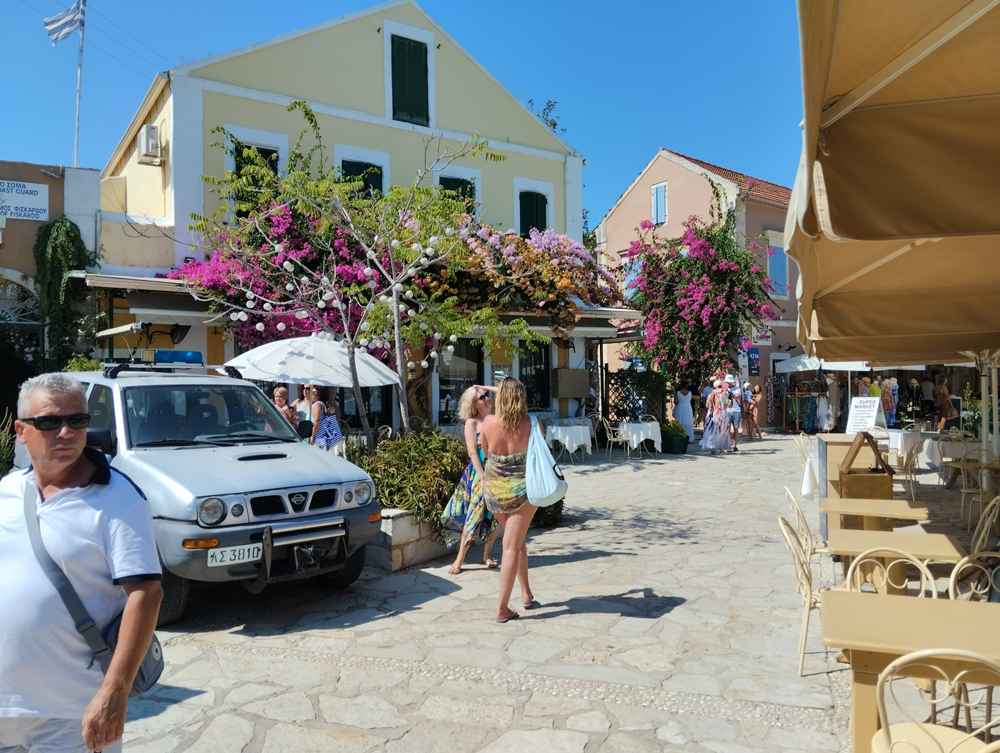
Kioni sits at the foot of a steep green amphitheatre, its houses stacked on both sides of a narrow inlet. Three ruined stone windmills stand on the headland at the harbour mouth and mark the entrance from the sea. The quay carries no through traffic, so tables sit almost at the water’s edge, and visiting yachts tie up stern-to along the wall. A pebble cove lies about 400 metres round the shore path on the northern side, with clear water over white stones and shade from a line of trees behind.
Frikes lies 5 kilometres beyond Kioni, at the mouth of a valley between two bare ridges, and functions as the northern ferry harbour of Ithaca. The village runs to one short waterfront street with tavernas, a bakery and a handful of rooms. Windmill ruins stand on the slope above the bay. Seasonal boats connect Frikes with Lefkada and with northern Kefalonia. Which makes it the arrival point for anyone crossing from the far north of the neighbouring island rather than from the port of Sami.
Stavros repays a stop on the way back. The village sits about 300 metres above the sea on the northern saddle. With a bust of Odysseus in the square and a small archaeological collection holding finds from the surrounding hills. The bay of Polis lies 2 kilometres downhill, where a cave produced bronze tripods now displayed in Vathy. Excavations at the site known as the School of Homer, near Exogi above Stavros, have uncovered terraces. A staircase cut into rock and a well. The site opens to visitors free of charge.
Which Homeric sites can you visit on Ithaca in one day?
Three Homeric stops fit a day: the Cave of the Nymphs above Dexa, the hilltop site at Alalkomenes over Pisaetos, and the Monastery of Kathara on the slopes of Mount Neritos with its view down the bay.
Ithaca carries its literary identity in its place names. The Odyssey names the island as the kingdom of Odysseus. The home he spends ten years at sea trying to reach. The poem describes a rugged land good for goats, ringed by smaller islands. Travellers have matched the poem’s landmarks to real ground for centuries. The labels have stuck: the harbour of Phorkys. The cave of the nymphs, the spring of Arethusa, the field of Laertes. Scholars dispute nearly every identification, and the signs on the ground present them as tradition rather than proof.
The Cave of the Nymphs, also called Marmarospilia, opens on the hillside above Dexa bay, about 2.5 kilometres by road from Vathy plus a short walk from the parking area. Tradition places here the spot where Odysseus hid the treasure given to him by the Phaeacians after they set him ashore. The chamber runs roughly 20 metres wide with stalactites and a hole in the roof that admits daylight. Access depends on safety works, so check in Vathy before driving up, and carry a torch for the interior.
The Monastery of Kathara stands about 550 metres up the slope of Mount Neritos, reached by a paved road of roughly 8 kilometres of hairpins from Vathy. The monastery holds an icon of the Virgin found, by tradition, by shepherds clearing scrub, and the name derives from that clearing. The bell tower and terrace look straight down the length of Vathy bay to the town and out across the strait to the mountains of Kefalonia. The drive up takes about 20 minutes and rewards a stop even for visitors who skip the church interior.
Alalkomenes, the ridge above Pisaetos, carries the remains that a nineteenth-century excavator identified as the castle of Odysseus. Along with the walls of an ancient acropolis on the slopes of Aetos. Bronze tripods, pottery and inscriptions from these hills sit in the museum at Vathy and in the Stavros collection. The site lies close to the ferry pier, which makes it the practical choice for a foot passenger with an hour to spare before the return sailing. A rough track climbs from the main road, and the walk up takes about 30 minutes.
What are the best beaches on Ithaca for a day visit?
Dexa, Filiatro and Gidaki cover the range near Vathy. Dexa lies a 15-minute walk from town, Filiatro sits 4 kilometres east on a paved road, and Gidaki is reached by boat taxi or a footpath.
Dexa sits about 1.5 kilometres west of Vathy on the road towards Pisaetos, a curve of coarse sand and small pebbles at the head of its own inlet. Tradition identifies this bay with the harbour of Phorkys, where the Phaeacians put the sleeping Odysseus ashore. Depth increases gently, trees behind the sand give shade by mid-afternoon, and a canteen operates through the warm months. The walk from the Vathy quay takes about 20 minutes on the coast road. Dexa suits foot passengers precisely because it needs no vehicle and no boat.
Filiatro lies roughly 4 kilometres east of Vathy along a paved road that drops through olive groves to the coast. The beach curves for about 250 metres in white pebbles, and the water reads pale turquoise over a clean stone bed. Sunbeds occupy the central section in summer, while the two ends stay open. A canteen sells drinks and snacks. Parking sits on terraces behind the shore, and the last stretch of road narrows, so drivers arriving after noon in August park higher and walk down for five minutes.
Gidaki ranks as the longest and least developed beach on the east coast, a 500-metre strip of white pebbles backed by steep green slopes with no road access at all. Small boats run from the Vathy quay through the summer and take about 15 minutes each way. Walkers reach it instead by a marked footpath from the far end of Filiatro, a climb over the headland of roughly 30 to 40 minutes each way in full sun. Take water and shade, because facilities on the sand are limited to one seasonal canteen.
Beach logistics on Ithaca reward an early decision. The island keeps no sunbed rows on most coves, so a towel, water and shoes for pebbles cover the essentials. Afternoon breeze builds on the east coast from about three o’clock, which makes late morning the calmest swimming window. Anyone catching the last ferry from Pisaetos allows 30 minutes of driving from Filiatro plus the ridge crossing, so leaving the water by half past four keeps the departure comfortable. Learning how to get to Kefalonia helps travellers plan the onward legs that bracket the day.
How do you get around Ithaca in a single day?
Car, scooter and taxi cover Ithaca reliably; buses run only a handful of times weekly and skip most beaches. Bringing a vehicle across on the Sami ferry gives the widest reach for a compressed day.
Public transport on Ithaca stays minimal. One bus route links Vathy with Stavros, Frikes and Kioni, running a small number of services and not every day, and it reaches none of the beaches. Taxis operate from Vathy and meet the ferries at Pisaetos, and drivers quote a fixed price for a half-day circuit taking in Kioni, Frikes and a viewpoint. Rental cars and scooters exist in Vathy in limited numbers, and stock runs out in August, so arranging a vehicle in advance beats hoping at the quay.
Bringing a car from Kefalonia removes the uncertainty. The vehicle deck on the Sami crossing takes cars and small vans. Boarding takes about 20 minutes. The island’s road network is short enough that fuel is rarely an issue, though the single petrol station near Stavros closes early. Roads are paved and well surfaced on the main spine, narrow with blind bends on the descents to Kioni and Filiatro. Drivers used to Kefalonia’s mountain roads find nothing harder here, only tighter turns and steeper gradients.
A workable one-day route runs clockwise. Land at Pisaetos, drive 12 kilometres to Vathy, walk the quay and the museum, then take the coast road north to Kioni for lunch. Return through Frikes and Stavros, drop to Filiatro or Dexa for a swim, and reach the ferry pier 30 minutes before departure. That circuit covers about 70 kilometres of driving and roughly two hours behind the wheel. Visitors ranking this against the wider list of things to do in Kefalonia find Ithaca fits between two beach days without strain.
Timing decides the shape of the day more than anything else. Take the first morning sailing from Sami, confirm the last return before boarding, and build in a 30-minute buffer at Pisaetos, since queues form for the evening boat in August. Anyone crossing from the north on the seasonal Fiskardo route works the itinerary in reverse, starting at Frikes and Kioni. A day that starts by eight and ends by seven gives seven hours ashore, which covers the capital, one northern harbour, one Homeric site and one swim.
Frequently Asked Questions
How long is the ferry from Kefalonia to Ithaca?
The crossing from Sami on Kefalonia’s east coast to Pisaetos on Ithaca takes about 30 to 45 minutes, depending on the vessel working the route. Sami and Pisaetos face each other across a strait that narrows to roughly 4 kilometres. The boat spends most of the trip clearing the two bays rather than in open water. Sailings run more frequently through the warm months and thin to a reduced service outside the season, which makes an early check of the day’s departures worthwhile. A second seasonal link crosses from Fiskardo in northern Kefalonia to Ithaca’s northern side, useful for anyone staying around Assos or Myrtos.
Both routes carry cars and foot passengers, and both leave enough daylight for a full day ashore and an evening return.
Can you visit Ithaca from Kefalonia without a car?
Yes, though the day needs planning. Foot passengers land at Pisaetos, a pier with a kiosk and a taverna and no village, sitting about 12 kilometres over a ridge from Vathy. Taxis meet the ferries, and negotiating a return fare or a half-day circuit at the quay solves the transport problem in one step. Buses link Vathy with Stavros, Frikes and Kioni a handful of times weekly and reach no beaches, so they suit only a flexible schedule. Once in Vathy, the waterfront, the archaeological museum and Dexa beach all sit within a 20-minute walk, and Filiatro lies about 4 kilometres east.
Scooter and car rental operate in Vathy in limited numbers, and booking ahead beats arriving to find nothing available in August.
What you see in Vathy on a short visit?
Walk the quay first. Vathy curls around the head of a deep inlet. The circuit from one arm of the harbour to the other covers about 2 kilometres and takes 40 minutes with photo stops. The islet of Lazaretto with its chapel sits in the middle of the bay and anchors every view. The Archaeological Museum of Vathy, one street behind the water, displays pottery, bronze tripods and inscriptions from Polis bay and the hills above Pisaetos, and opens in the mornings. Tavernas along the waterfront start serving around noon. Two supermarkets and a bakery a block inland cover provisions for Gidaki, where facilities are limited.
From the quay, the road east reaches Filiatro in ten minutes and the Cave of the Nymphs branches off above Dexa.
Is Ithaca really the island of Odysseus?
Ithaca carries the name Homer gives the kingdom of Odysseus, and the modern island has held that identity since antiquity. Sites on the ground echo the poem directly: the Cave of the Nymphs above Dexa, tied to the treasure Odysseus hid after the Phaeacians landed him. The bay of Phorkys. Identified with Dexa itself. The spring of Arethusa in the south. And the ridge of Alalkomenes above Pisaetos, excavated in the nineteenth century as a candidate for the palace. Archaeology at the School of Homer near Stavros has uncovered terraces, a rock-cut staircase and a well from the Mycenaean period.
Scholars still argue about which ruins match which passage, and rival theories place the Homeric Ithaca elsewhere, so treat the labels as tradition supported by finds rather than settled fact.
Which Ithaca beach suits a day trip best?
Dexa suits anyone without transport, sitting 1.5 kilometres west of Vathy on the Pisaetos road. A 20-minute walk from the quay, with coarse sand, shallow entry, trees for shade and a seasonal canteen. Filiatro gives the clearest water within easy reach, about 4 kilometres east of Vathy on a paved road, a 250-metre curve of white pebbles with parking on terraces behind. Gidaki ranks as the finest stretch on the east coast, 500 metres of white pebbles with no road access. Reached by boat taxi from Vathy in about 15 minutes or by a footpath from Filiatro that takes 30 to 40 minutes over the headland.
Choose Dexa for convenience, Filiatro for water quality with a car, and Gidaki when the schedule allows an unhurried half day.
Is one day enough for Ithaca, or is an overnight better?
One day covers the headline sights comfortably. A morning sailing from Sami puts a visitor ashore by mid-morning. Seven hours handles Vathy. The drive north to Kioni and Frikes, a Homeric site and a swim, with about 70 kilometres of driving in total. An overnight changes the character rather than the checklist: the harbours empty when the day boats leave. Tavernas in Kioni and Frikes serve later. The light on the strait at dusk becomes the reason to stay. Two days also open the south, where the spring of Arethusa and the fishing hamlet of Perachori sit away from the usual circuit.
Visitors on a Kefalonia holiday of a week or more usually find the single day sufficient and keep the extra nights for Myrtos and Assos.