
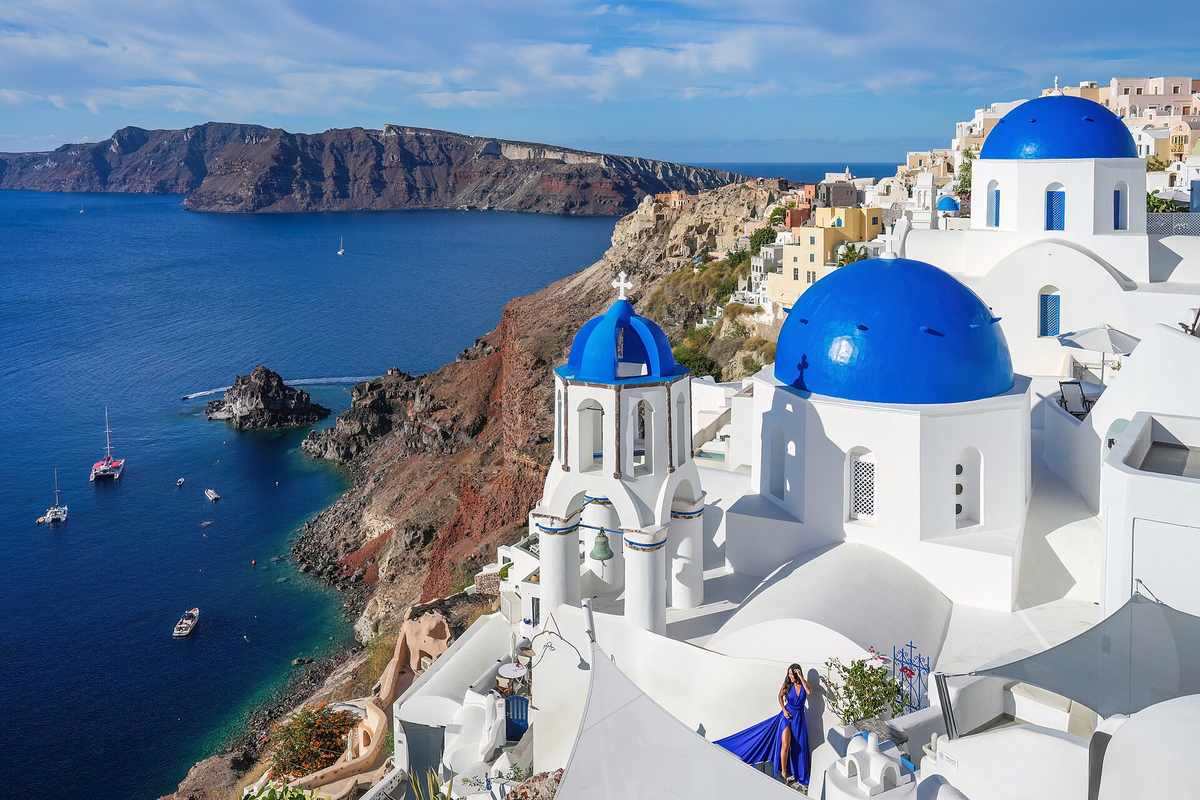
A Santorini photoshoot captures couples, honeymooners and travellers against the island’s caldera, blue domes and famous sunset with a professional local photographer. From Oia to Imerovigli, the backdrops are unmatched. This guide covers the best locations, the timing, flying-dress shoots, the cost and how to book a photoshoot.
A photoshoot is a memorable keepsake of the wider Santorini travel guide. The island ranks among the world’s most photogenic destinations. The sections below cover photoshoots.
What is a Santorini photoshoot?
A Santorini photoshoot is a professional photography session on location across the island, led by a local photographer who knows the best light and quietest corners. It runs one to three hours and moves between two and four backdrops.
A Santorini photoshoot turns the island’s beauty into lasting memories. A professional photographer who knows Santorini intimately leads you to the best locations, choosing where the light falls beautifully, when the crowds thin and which corners of Oia, Imerovigli or Fira have the loveliest, least-clich\u00e9d backdrops. A typical session runs between one and three hours, moving between two and four locations, usually a mix of a caldera viewpoint, a quiet architectural lane and a clifftop setting.
The photoshoot is hugely popular with honeymooners, couples celebrating anniversaries or proposals, and families travelling together. It captures the magic of the island professionally, set within the wider Santorini honeymoon. The photographer handles the route, the timing and the posing, so you simply enjoy the island while the camera does the work. The result is a set of edited, high-resolution images you keep for life. The locations shape everything that follows.
What are the best photoshoot locations?
The best locations are the caldera edge from Fira through Imerovigli to Oia, plus Oia’s blue domes and windmills, Ammoudi Bay and Firostefani’s quieter views. Firostefani suits couples wanting caldera shots without crowds.
The caldera is the defining backdrop of Santorini photography. Accessible at points all along the rim from Fira through Imerovigli to Oia, it offers a combination of sheer height, the volcanic islands far below and the extraordinary quality of light over the water. Oia adds its blue-domed churches, windmills and whitewashed lanes, the most iconic if busiest scenes. For couples who want stunning caldera views without feeling watched, Firostefani is a favourite, quieter and more relaxed, which photographers often recommend for those who feel shy in front of the camera.
Beyond the rim, several spots deliver signature images. Ammoudi Bay below Oia frames red cliffs, fishing boats and turquoise water for a warm, Mediterranean feel. Skaros Rock at Imerovigli gives a dramatic promontory and open sea. Pyrgos, the island’s old capital, offers cobbled lanes and a hilltop castle away from the crowds. A good local photographer matches the spot to your style, set out alongside the guides to Oia, Firostefani, Ammoudi Bay, Skaros Rock and Pyrgos.
The blue domes of Oia and the Santorini windmills remain the most requested backdrops for a reason. They read instantly as Santorini in any photograph, and a single frame carries the whole island’s identity. Cave-house terraces add whitewashed geometry, plunge pools and framed caldera views for a more private, styled look. The best photographers rotate between these headline scenes and quieter corners, so an album mixes recognisable landmarks with intimate, uncrowded moments. Timing decides how each of these locations photographs.
When is the best time of day for a photoshoot?
The best times are sunrise, roughly 6.30 to 8.30am, and the golden hour about ninety minutes before sunset, when light is soft and crowds thinnest. Sunrise gives empty lanes in Oia; golden hour bathes the caldera in colour.
Light and crowds make the timing crucial. Photographers overwhelmingly recommend two windows: sunrise, roughly 6.30 to 8.30 in the morning, and the golden hour, the ninety minutes or so before sunset. At these times the light is soft, warm and flattering rather than the harsh overhead glare of midday, and the famous spots are at their quietest. A sunrise shoot in Oia is especially memorable, with the iconic lanes and domes almost empty and bathed in gentle morning light, while golden hour floods the caldera and cliffs with rich colour.
Sunrise and sunset each suit a different traveller. Sunrise means an early start, but rewards you with deserted lanes, cool air and the softest light of the day, ideal for anyone who wants clean backgrounds without other visitors. Golden hour is easier to reach and delivers the warm, glowing tones most associated with Santorini, though the popular viewpoints fill quickly as sunset nears. Both windows avoid the packed, sun-blasted middle of the day, when Oia in particular fills with visitors, set out alongside the guide to the Santorini sunset.
Weather shapes the plan too. Clear mornings give crisp shadows and defined domes, while light cloud can soften harsh contrast and add drama to caldera images. A local photographer watches the forecast and adjusts the meeting time or route accordingly, and most keep a flexible reschedule policy for the rare wind or rain that spoils a session. Checking the Santorini weather before you travel helps you set realistic expectations for your chosen dates. The season you visit matters as much as the hour you shoot.
What is the best time of year for a photoshoot?
The best months are the spring and autumn shoulder seasons, roughly April to early June and September to October, when light is soft, temperatures are mild and crowds lighter than in peak summer. High summer still works but demands sunrise starts.
Season affects light, crowds and comfort as much as the daily timing. The spring and autumn shoulder seasons, roughly April to early June and September into October, are widely regarded as the sweet spot for a Santorini photoshoot. Temperatures are mild, the island is green in spring and warm-toned in autumn, and the famous viewpoints are far less crowded than in July or August. The softer, lower sun of these months flatters portraits and reduces the harsh contrast of high summer.
High summer remains popular because that is when most travellers visit, and the island photographs beautifully in July and August. The trade-off is heat and crowds, so a summer shoot almost always means a sunrise start to beat both. Winter offers dramatic skies, empty streets and moody caldera scenes for photographers who want something different, though shorter days and the chance of wind narrow the options. Reviewing the best time to visit Santorini and the monthly guides to Santorini in May and Santorini in September helps you match your shoot to the light you want. What you wear then completes the picture.
What should you wear for a Santorini photoshoot?
Flowing dresses, light neutrals and soft colours photograph best against Santorini’s white walls and blue sea, while long trains catch the breeze. Avoid busy patterns and heavy black. Bring a second outfit for variety across locations.
Wardrobe shapes the whole look of a Santorini album. Flowing fabrics that move in the island’s breeze, such as long dresses with a train, read beautifully against the whitewashed walls and open sea. Soft neutrals, pastels, warm earth tones and classic white harmonise with the palette of the caldera, while a single bold colour, a deep red or royal blue, makes a portrait pop against the pale backdrops. Photographers generally steer clients away from busy prints and large logos, which distract from the setting.
Practical choices matter as much as the palette. Santorini’s lanes are cobbled and its viewpoints reached by steps, so comfortable footwear for the walk between spots saves sore feet, with heels carried and worn only for the frames that call for them. Bringing a second outfit, one relaxed and one dressier, gives the album variety across two or three locations without a long change. Layers help on breezy clifftops at sunrise. A light wrap or jacket that photographs well doubles as warmth between setups. The flying dress is the styling choice travellers ask about most.
What is a flying-dress photoshoot?
A flying-dress photoshoot uses a long, flowing gown with a dramatic train that catches the wind or is lifted for the camera, creating striking images against the caldera. The dress is usually provided by the photographer in several colours.
The flying dress has become an iconic Santorini photo experience. The shoot dresses you in a long, voluminous gown with a sweeping train that is caught by the island’s breeze or lifted and released for the camera, producing dramatic, romantic images of the fabric billowing against the blue domes, the caldera and the sea. Especially popular with couples, honeymooners and solo travellers, it makes for show-stopping photographs, and the photographer or studio usually provides a choice of dresses in different colours and sizes as part of the package.
The flying dress works best in the two low-light windows, when the wind is gentle enough to lift the fabric without flattening it against the body. Ammoudi Bay, the Oia windmills and open clifftops at Imerovigli are favourite backdrops, because the fabric needs space and a clean horizon behind it. It ranks among the most requested types of Santorini photoshoot, capturing the island’s romance vividly, set out alongside the guide to Santorini weddings. Who the shoot is for changes how it is planned.
Who are Santorini photoshoots for?
Santorini photoshoots suit honeymooners, engaged couples, proposal surprises, pre-wedding and anniversary sessions, families and solo travellers. Couples make up the majority, but solo portraits and family groups are common, and each type shapes the pace.
Couples form the core of Santorini photography. Honeymooners, newlyweds and partners marking an anniversary book the bulk of sessions, drawn by the island’s romance and the ready-made backdrop of the caldera. Proposal shoots are a growing category, where the photographer arrives discreetly to capture the moment and then continues with a full couple’s session once the answer is yes. Pre-wedding and engagement shoots let couples celebrate before or after the ceremony without the pressure of the wedding day itself.
Solo and family shoots round out the picture. Solo travellers commission portraits or flying-dress sessions as a personal keepsake, and the format works just as well for one person as for two. Families use the island as a backdrop for group portraits that feel like a holiday memory rather than a studio sitting, though these run best in the calmer morning window with younger children. Whoever the shoot is for, the photographer tailors the route, pace and posing, set out alongside the Santorini honeymoon guide. Avoiding the crowds is the next practical concern.
How do you avoid the crowds during a shoot?
You avoid crowds by shooting at sunrise, starting early in Oia, and choosing quieter spots like Firostefani, Pyrgos and Ammoudi Bay instead of the busiest viewpoints. A local photographer routes you around the peak visitor times.
Crowds are the single biggest challenge in Santorini photography. The famous viewpoints, especially the Oia castle and the blue-domed rooftops, fill with visitors from mid-morning until well after sunset, and empty backgrounds are hard to find at those hours. The most reliable fix is the sunrise shoot, when the same lanes that heave by noon stand almost deserted and the light is at its softest. Starting at the busiest landmark first and moving to quieter spots as the island wakes keeps backgrounds clean throughout.
Location choice does the rest. Firostefani and Imerovigli offer the same caldera drama as Oia with a fraction of the foot traffic, while Pyrgos, Megalochori and the back lanes of Fira give whitewashed architecture without the tour groups. Ammoudi Bay is quietest early, before the boats and diners arrive. A local photographer who knows these rhythms plans a route that stays a step ahead of the crowds, so you spend the session shooting rather than waiting, drawing on the guides to Imerovigli and Megalochori. Drone photography raises its own considerations.
Can you use a drone for photos in Santorini?
Drone use in Greece is regulated and restricted near people, buildings and busy areas, so most Santorini photoshoots rely on ground cameras. Any drone footage should be arranged with a licensed operator who checks current rules first.
Drone photography tempts many visitors, because aerial views of the caldera and the white villages are spectacular. Greek and European rules govern where and how drones may fly, with restrictions around crowds, buildings, airports and other sensitive areas, and the crowded villages of Santorini leave little clear space during the day. For these reasons most on-location photoshoots use ground cameras, which capture the island’s character at eye level far more practically.
Travellers who want aerial footage should work with a licensed, insured operator who checks the current regulations and any local restrictions before flying. A reputable photographer will explain honestly what is and is not possible rather than promising shots that break the rules. Confirming this in advance avoids disappointment and keeps the session focused on the ground-level images that make Santorini instantly recognisable, from the Santorini caldera to the Oia rooftops. How long the shoot takes shapes your day.
How long does a Santorini photoshoot take?
A Santorini photoshoot usually lasts one to three hours, covering two to four locations at a relaxed pace. Shorter sessions focus on a single spot, while longer ones allow outfit changes, more backdrops and the walking time between viewpoints.
Session length depends on how much you want to cover. A short session of about an hour concentrates on one or two nearby locations, ideal for a quick keepsake or a proposal moment. The standard couple’s or honeymoon shoot runs closer to two hours, enough to visit three backdrops, work in one outfit change and capture a real variety of frames without rushing. Longer sessions of three hours suit flying-dress shoots, families or anyone wanting several distinct looks across the island.
Walking time is part of the plan. Santorini’s viewpoints are linked by cobbled lanes and steps rather than short hops, so a route from Fira to Imerovigli or across Oia builds in travel between setups. A good photographer maps a realistic path so the session flows and you are never rushed, and factors the early start of a sunrise shoot into how the day unfolds. Slotting the shoot into a wider Santorini itinerary keeps the rest of your trip relaxed. Whether to hire a local photographer is the decision that follows.
Do you need a local photographer?
A local photographer is worth it for the best results, because they know the light, the quiet corners and the crowd patterns, and they handle the route and posing. Travellers on a tight budget can still get good self-shot images with planning.
A local photographer brings knowledge no visitor can match on a short trip. They know which lane in Oia empties first at sunrise, where the light falls best at each hour, and how to route a session so backgrounds stay clean. They handle the posing, so couples who feel awkward relax into natural images, and they deliver a set of professionally edited, high-resolution photographs. For a once-in-a-lifetime honeymoon or proposal, that expertise turns a beautiful setting into a genuinely memorable album.
Travellers on a tight budget can still come away with strong images. Shooting at sunrise, using a tripod and a phone timer, and scouting the quiet spots in advance produces respectable results at no cost, set out alongside the guide to Santorini on a budget. The difference is the polish, the direction and the local shortcuts that only a resident professional provides. Weighing that trade-off against your trip and occasion decides whether to book. The cost and booking process are the final pieces.
How do you book a Santorini photoshoot?
You book a Santorini photoshoot by enquiring four to six weeks ahead for peak summer, then confirming the locations, the timing, the session length and how many edited photos are included. Costs vary widely with the package and extras.
Booking early secures the best photographers and the prime slots. Because the finest studios fill quickly, it is wise to enquire and reserve four to six weeks in advance, particularly for the peak June to August season when demand is highest. Sunrise slots and popular flying-dress packages go first, so travellers with fixed dates should plan ahead rather than hope for availability on arrival. Off-season shoots are easier to arrange at shorter notice.
Confirm the details before you commit. Ask about the locations, the timing of sunrise or golden hour, the session length and how many edited, high-resolution images the package includes, so you know exactly what you will receive. Costs vary widely with the photographer’s reputation, the session length and extras such as a flying dress, hair and make-up or multiple outfit changes, so compare packages rather than headline figures alone. Clarify the delivery timeline for the final gallery and any reschedule policy for bad weather, set out alongside a Santorini itinerary. The table below compares the headline locations at a glance.
Which Santorini photoshoot location suits you?
Oia suits iconic blue-dome and windmill shots, Firostefani and Imerovigli suit quieter caldera portraits, Ammoudi Bay suits warm waterside frames, and Pyrgos suits crowd-free village scenes. Each location has a best time and a signature feature.
Every headline location photographs differently, and matching the spot to your style produces the strongest album. The table sets out the best light, the crowd level and the signature feature of each, so you can plan a route that mixes iconic landmarks with quieter, more personal backdrops across the session.
| Location | Best light | Crowd level | Iconic feature |
|---|---|---|---|
| Oia | Sunrise | High | Blue domes and windmills |
| Firostefani | Golden hour | Low | Quiet caldera views |
| Imerovigli | Golden hour | Medium | Skaros Rock promontory |
| Ammoudi Bay | Sunrise | Low | Red cliffs and fishing boats |
| Fira | Golden hour | High | Cliff-edge caldera panorama |
| Pyrgos | Late afternoon | Low | Castle and cobbled lanes |
The location attributes below summarise what each backdrop delivers, so you can prioritise the scenes that match your occasion and pace.
- Best for iconic images: Oia, for the blue domes, windmills and instantly recognisable rooftops.
- Best for quiet portraits: Firostefani and Pyrgos, away from the tour crowds.
- Best for waterside frames: Ammoudi Bay, with red cliffs and fishing boats.
- Best for drama: Imerovigli and Skaros Rock, on an open promontory over the sea.
- Best for panoramas: Fira, along the cliff edge above the caldera.
Frequently Asked Questions
How much does a Santorini photoshoot cost?
Costs vary widely with the photographer’s reputation, the session length and any extras such as a flying dress, hair and make-up or multiple outfit changes. Because packages differ, compare the locations, session length and number of edited photos included rather than headline figures alone, and enquire early for the peak June to August season.
What is the best time for a Santorini photoshoot?
The best times are sunrise, roughly 6.30 to 8.30am, and the golden hour about ninety minutes before sunset, when the light is soft and warm and the crowds thinnest. Sunrise gives almost empty lanes in Oia, while golden hour bathes the caldera in warm colour. Both avoid the harsh, crowded middle of the day.
Where are the best Santorini photoshoot locations?
The best locations are the caldera edge from Fira through Imerovigli to Oia, with its cliffs, volcanic islands and superb light, plus Oia’s blue domes and windmills, Ammoudi Bay and Skaros Rock. Firostefani and Pyrgos are ideal for couples wanting beautiful shots without the crowds of Oia.
What should I wear for a Santorini photoshoot?
Flowing dresses, light neutrals, pastels and classic white photograph best against the white walls and blue sea, and a single bold colour makes a portrait pop. Avoid busy patterns and large logos, bring a second outfit for variety, and wear comfortable footwear for the cobbled lanes and steps between locations.
Do I need a professional photographer for a Santorini photoshoot?
A professional local photographer is worth it for the best results, because they know the light, the quiet corners and the crowd patterns, and they handle the route, timing and posing. Travellers on a tight budget can still get good self-shot images by shooting at sunrise and scouting the quiet spots in advance.
How far in advance should I book a Santorini photoshoot?
Book four to six weeks ahead for the peak June to August season, when the best photographers and sunrise slots fill quickly. Off-season shoots in spring and autumn are easier to arrange at shorter notice. Confirm the locations, timing, session length and number of edited photos when you reserve.