
Milos vs Naxos pits dramatic volcanic coves and boat trips against a large fertile island of sandy beaches, villages and hikes. Plan island tours and tickets through My Greece Tours.
Choosing between the two is a common question in the Milos travel guide. The sections below compare the landscapes, the beaches, the activities, the food and which island suits you best.
Milos vs Naxos: which island is better?
Milos is the dramatic, sea-focused island, while Naxos is the large, varied one. Choose Milos for volcanic coves, boat trips and quiet beauty, or Naxos for sandy beaches, mountain villages, hiking and a lively local culture.
The two islands suit different trips. Milos is all about the sea and its coves. Naxos blends beaches, mountains, villages and history. Each offers a distinct kind of holiday.
Milos is the quieter, wilder choice. The volcanic coast gives surreal beaches and sea caves. The island stays sleepy, with quiet beauty and history. It rewards travellers who explore by boat.
Naxos is the larger, livelier choice. The biggest island in the Cyclades packs in variety. Fertile valleys, mountain peaks and long sandy beaches fill it. Village life and local culture thrive there.
The decision comes down to your priorities. Pick Milos for dramatic scenery and boat trips. Pick Naxos for variety, hiking and local charm. The sections below compare each side across the things to do in Milos. The next section covers the landscapes.
The two islands suit different kinds of trip. Milos is all about the sea and its coves. Naxos blends beaches, mountains, villages and history. Milos is the quieter, wilder choice of the pair. Its volcanic coast gives surreal beaches and sea caves. The island stays sleepy, with quiet beauty and history. Naxos is the larger, livelier choice instead. The biggest island in the Cyclades packs in variety. Fertile valleys, mountain peaks and long beaches fill it. The decision comes down to whether you want dramatic scenery and boat trips, or variety, hiking and lively local culture.
How do the landscapes of Milos and Naxos compare?
Milos is a small volcanic island of dramatic coves and white rock, shaped by ancient eruptions. Naxos is the largest Cyclades island, with fertile valleys, mountain peaks and rolling farmland. Milos wins on drama, Naxos on variety.
Milos is a geological wonder. Ancient volcanic forces shaped the dramatic coast. White rock, sea cliffs and tucked-away coves define it. The small island packs spectacle into its shores.
Naxos is large and fertile. The biggest island commands the central Cyclades. Fertile valleys blend with high mountain peaks. Rolling farmland covers the inland, unlike the volcanic Milos.
The scale differs sharply. Milos is compact and easy to circle in a day. Naxos sprawls across mountains and plains. It takes longer to explore the larger island.
The character sets them apart. Milos delivers surreal, dramatic coastlines best seen by boat. Naxos offers a varied land of mountains, villages and ruins. The moonscape of Sarakiniko beach headlines Milos. The next section covers the beaches.
The landscapes differ sharply in scale and style. Milos is a small volcanic wonder of dramatic coves. White rock and sea cliffs define its compact coast. The island is easy to circle in a single day. Naxos is the largest island in the Cyclades by far. Fertile valleys blend with high mountain peaks. Rolling farmland covers the inland of the bigger island. It takes longer to explore the varied land of Naxos. Milos delivers surreal coastlines best seen by boat, while Naxos offers a varied land of mountains, villages and ancient ruins to roam.
Which has better beaches, Milos or Naxos?
Milos dazzles with surreal volcanic rock formations and over 70 coves, from lunar Sarakiniko to hidden Tsigrado. Naxos offers long golden sandy beaches ideal for sunbathing and swimming. Milos wins on drama, Naxos on classic sand.
Milos wins on dramatic coves. The island counts more than 70 beaches around the coast. Surreal rock formations frame many of them. Sarakiniko, Tsigrado and Kleftiko are unlike anywhere else.
The volcanic style is the draw. White moonscapes and coloured cliffs line the shore. Many of the best coves are reached only by boat. The beaches reward adventure and a camera.
Naxos keeps it long and sandy. Classic golden beaches stretch along the west coast. Plaka, Agios Prokopios and Agia Anna draw sunbathers. The long sands suit easy, relaxed swimming.
The choice depends on your taste. Milos rewards dramatic scenery and boat trips. Naxos suits long, sandy beach days. The hidden cove of Tsigrado beach shows the Milos style. The next section covers the activities.
The beaches reward different tastes. Milos dazzles with surreal volcanic rock formations. More than 70 coves ring its dramatic coast. Sarakiniko, Tsigrado and Kleftiko are unlike anywhere else. Many of the finest are reached only by boat. Naxos keeps it long and sandy by comparison. Classic golden beaches stretch along the west coast. Plaka, Agios Prokopios and Agia Anna draw sunbathers. The long sands of Naxos suit relaxed swimming. Milos rewards dramatic scenery and boat trips, while Naxos suits long, sandy beach days for a more laid-back island holiday.
How do activities and food compare on Milos and Naxos?
Milos centres on sea caves, boat cruises and a dramatic coast best discovered from the water. Naxos suits hikers, history buffs and village explorers. Milos leans into seafood, while Naxos has a rich food culture of mountain produce and cheese.
Milos is best explored by water. Sea caves, boat trips and coastlines define the activities. The island is quiet and sleepy beyond the coast. It suits relaxing, swimming and soaking in the scenery.
Naxos is varied and lively. The island is a haven for hikers and history buffs. Mountain villages, ruins and trails fill the inland. Musicians and artisans keep local traditions alive.
The food differs in style. Milos leans into seafood and quiet tavernas by the sea. Fresh ingredients speak for themselves on the plate. Local dishes like pitarakia and ladenia feature.
Naxos has deep food roots. Mountain produce, homemade cheese and vibrant flavours define it. The agricultural island offers rich, hearty cooking. The food culture runs deeper than on Milos. The Milos food scene focuses on the catch. The next section covers the verdict.
The activities and food set the islands apart. Milos centres on sea caves, boat trips and coastlines. The quiet island suits swimming and soaking in scenery. Naxos is a haven for hikers and history buffs. Mountain villages, ruins and trails fill its inland. Milos leans into seafood and quiet tavernas by the sea. Local dishes like pitarakia and ladenia feature there. Naxos has deep food roots of mountain produce and cheese. Its vibrant flavours reflect a rich agricultural island. Milos is sleepy and scenic, while Naxos bursts with life, music and local craft beyond the coast.
The cost of the two islands runs broadly similar. Naxos sits a little lower on the daily budget. Milos favours the sea, scenery and a relaxed pace. Naxos favours variety, hiking and local charm. The large Naxos blends beaches, mountains and villages. The compact Milos packs spectacle into its coves and coast. Neither island is simply the better choice of the pair. The right pick depends on what you want from the holiday. For dramatic coves and boat trips, Milos leads the way. For sandy beaches, villages and depth, Naxos holds the edge in the Cyclades.
Should you choose Milos or Naxos?
Choose Milos to unwind, tour the coast by boat and drink in the dramatic volcanic scenery. Choose Naxos for variety, depth and local charm, with sandy beaches, mountain villages and hiking. Many travellers pair the two on one Cyclades route.
Pick Milos for the sea and scenery. The volcanic coves and boat trips are unmatched. The quiet island suits a relaxed, scenic holiday. It rewards travellers drawn to the water.
Pick Naxos for variety and culture. The large island blends beaches, mountains and villages. Hiking, history and local life fill the days. It suits those who want depth and activity.
Consider the daily cost too. The two islands run at a similar daily budget. Naxos sits a little lower on average. Both reward careful planning of the trip.
Many travellers visit both islands. A ferry can link them on one route. Pairing dramatic Milos with varied Naxos gives the best of both. Plan the legs through how to get to Milos and the wider Milos vs Paros comparison.
The verdict depends on what you want. Milos favours the sea, scenery and a relaxed pace. Naxos favours variety, depth and local charm. The two islands run at a similar daily budget. Naxos sits a little lower on average. Milos rewards travellers drawn to the water and dramatic coves. Naxos suits those who want beaches, hikes and villages. Many travellers pair the two on one Cyclades route. A ferry can link them across the central islands. Pairing dramatic Milos with varied Naxos gives the best of both worlds on a single Cyclades holiday.
The pairing of the two islands works beautifully. A ferry links Milos and Naxos across the central Cyclades. Dramatic Milos brings volcanic coves, sea caves and quiet beauty. Large Naxos adds sandy beaches, mountain villages and hikes. Together they cover the sea, the land and local culture. Naxos runs a little cheaper on the daily budget. Booking the ferry ahead secures seats on the summer sailings. Travellers torn between them can simply visit both. The dramatic coast of Milos balances the varied depth of Naxos. For a rich Cyclades holiday, pairing the islands gives the best of both worlds.
How many days do you need for Milos and Naxos?
Milos rewards three to five days for its beaches, a Kleftiko boat trip and the villages. Naxos needs four to six days to cover its long beaches, the mountain villages, Naxos Town and a hike up Mount Zas, since it is larger and more varied.
Milos fits a short, scenic break well. Three days cover Sarakiniko, a Kleftiko boat trip and an evening in Plaka. A fourth and fifth day add Tsigrado, Firiplaka and a slow taverna lunch by the sea. The compact island keeps drives short and the pace relaxed across the volcanic coast.
Naxos calls for a little longer to see fairly. Its sandy beaches, the marble villages of the Tragaea valley and the Portara arch fill several days. A hike up Mount Zas, the highest peak in the Cyclades, adds an active day. Naxos Town itself rewards an evening of tavernas, a castle and a lively harbour.
Which island has better nightlife, Milos or Naxos?
Naxos has livelier nightlife, with the bars and beach clubs of Naxos Town and Agios Prokopios drawing a younger crowd. Milos stays quiet, with relaxed tavernas and waterfront bars in Adamas rather than clubs, so it suits calm evenings over a party scene.
Naxos carries the busier evening scene of the two. Naxos Town lines its old harbour with cocktail bars, music venues and late tavernas. The resort strip at Agios Prokopios adds beach bars and a younger holiday crowd. The island balances this energy with quiet mountain villages inland for a calmer night.
Milos keeps its evenings gentle and scenic instead. The Adamas waterfront fills with relaxed tavernas and a handful of low-key bars. Plaka draws a quiet crowd for its famous sunset over the gulf. The island holds no clubbing scene, which suits couples and calm travellers more than partygoers after a lively night.
How do the villages of Milos and Naxos differ?
Milos villages hug the sea, from the painted boat garages of Klima and Mandrakia to hilltop Plaka. Naxos villages climb inland, with marble-paved Apeiranthos and Halki on the mountain slopes and a Venetian Kastro above Naxos Town.
Klima and Mandrakia are fishing hamlets on the Milos coast. Their houses sit above syrmata, boat garages cut into the soft rock at sea level. Doors and balconies are painted in bright colours. The Klima village page covers the waterfront.
Plaka is the hilltop capital of Milos. It looks west over the Gulf of Milos, a sunken caldera that forms one of the largest natural harbours in the Mediterranean.
Naxos keeps its old villages inland. Halki holds the Vallindras distillery, where kitron liqueur is made from citron leaves. Apeiranthos is built of marble and stone high on the slopes of Mount Zas. The Apeiranthos guide covers its lanes and small museums.
Which historic sights stand out in the Milos vs Naxos comparison?
In the Milos vs Naxos comparison, Milos is where the Venus de Milo was found, and it keeps early Christian catacombs and an ancient theatre near Plaka. Naxos answers with the Temple of Demeter at Sangri and unfinished kouros statues in old quarries.
A farmer found the Venus de Milo on Milos in the nineteenth century. The statue now stands in the Louvre in Paris. The find spot lies near the ancient theatre above Klima.
The Catacombs of Milos are early Christian burial tunnels cut into the rock at Trypiti. The Milos Mining Museum in Adamas explains the minerals that the volcano left behind. The Milos catacombs page covers the visit.
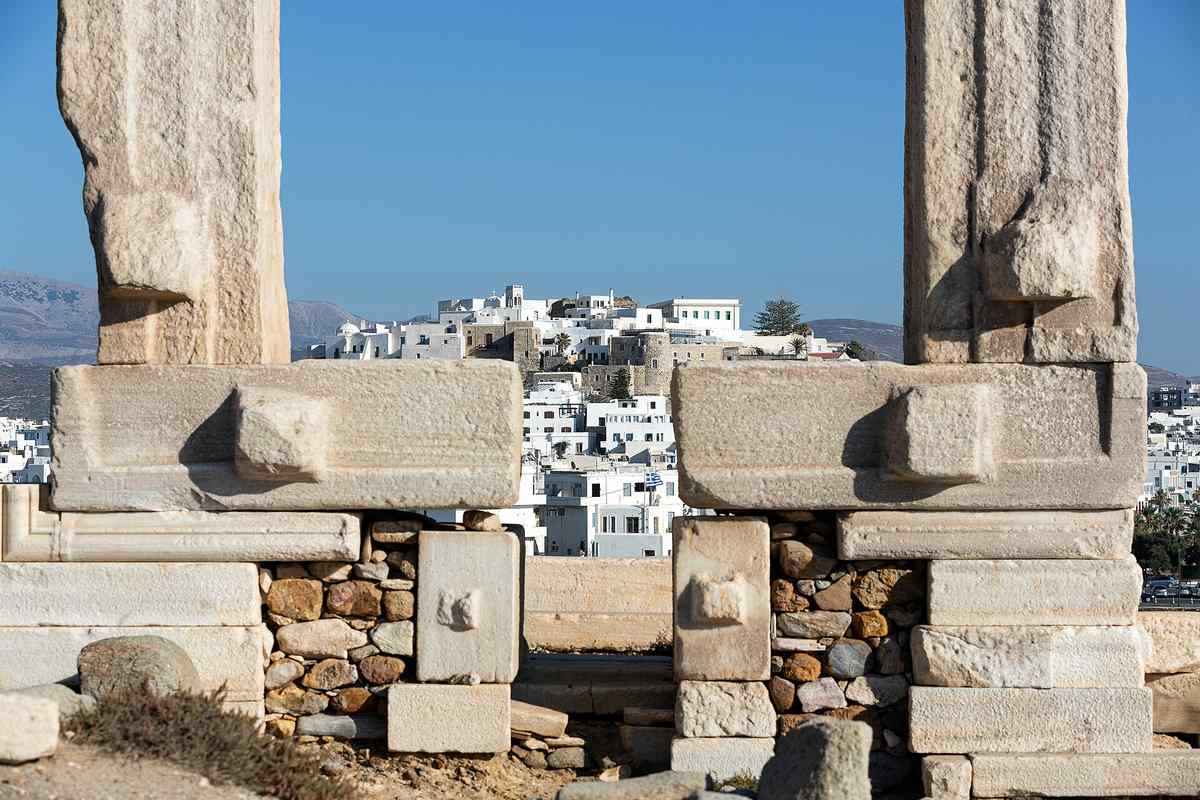
The Temple of Demeter stands in the fields near Sangri, in the centre of Naxos. Unfinished kouros statues lie where ancient sculptors left them, in the marble quarries at Melanes and Apollonas. The Temple of Demeter page covers the site.
How do you get around Milos and Naxos?
Naxos has a wide network of paved roads, so a hire car reaches its mountain villages and inland ruins. Milos needs a car for Plaka and the north coast, and a boat for the western sea caves and coves such as Kleftiko.
Naxos is the largest island in the Cyclades. Paved roads climb from the west coast to Halki, Filoti and Apeiranthos. The drive passes farmland, olive groves and bare mountain summits. The Naxos car rental guide covers hiring a car.
Milos is smaller. Its roads link Adamas, Plaka, Pollonia and the beaches of the north coast. Some tracks in the west of the island are rough and closed to standard hire cars.
Boat tours circle Milos to the sea arches of Kleftiko, the Sykia sea cave and the uninhabited islet of Poliegos. The Kleftiko page covers the boat trips.
Frequently Asked Questions
Is Milos or Naxos better?
Milos is the dramatic, sea-focused island, while Naxos is the large, varied one. Choose Milos for its volcanic coves, sea caves, boat trips and quiet beauty, best explored by water. Choose Naxos for its long sandy beaches, mountain villages, hiking and lively local culture. Milos is generally sleepy and scenic, while Naxos bursts with life and variety. The right choice depends on whether you want to chill and explore by boat, or seek depth, activity and local charm.
Which has better beaches, Milos or Naxos?
Milos dazzles with surreal volcanic rock formations and over 70 coves, from the lunar Sarakiniko to the hidden Tsigrado and the sea caves of Kleftiko, many reached only by boat. Naxos offers long golden sandy beaches such as Plaka, Agios Prokopios and Agia Anna, ideal for sunbathing and relaxed swimming. Milos wins on dramatic scenery and adventure, while Naxos wins on classic, easy-to-reach sandy beaches for a laid-back holiday.
Can you visit both Milos and Naxos?
Yes. Many travellers pair Milos and Naxos on one Cyclades route, linking them by ferry across the central islands. Pairing the two gives the best of both worlds: the dramatic volcanic coves, sea caves and boat trips of Milos, and the sandy beaches, mountain villages and hiking of larger Naxos. Planning the legs in advance secures seats on the summer sailings, since the crossing often calls at other islands on the way.
Which island is cheaper, Milos or Naxos?
Naxos is generally a little cheaper than Milos on a daily budget. The large island grows much of its own produce, so food costs run lower and a wide range of rooms keeps the average down. Milos, as a smaller and increasingly popular Cyclades island, sits slightly higher per day in peak summer, especially on accommodation. Both islands reward shoulder-season travel in June or September, which brings lower prices and thinner crowds on either one.
Which island is better for families, Milos or Naxos?
Naxos suits families better with its long, shallow sandy beaches at Agios Prokopios and Agia Anna, a wide choice of hotels and easy road access to most sights. Children paddle safely and the flat resort strip keeps logistics simple. Milos leans toward couples and active travellers, since its best beaches involve boat trips or a scramble over rock. Families still enjoy Milos on a calmer trip, but Naxos offers the easier, more classic family beach holiday of the two.