
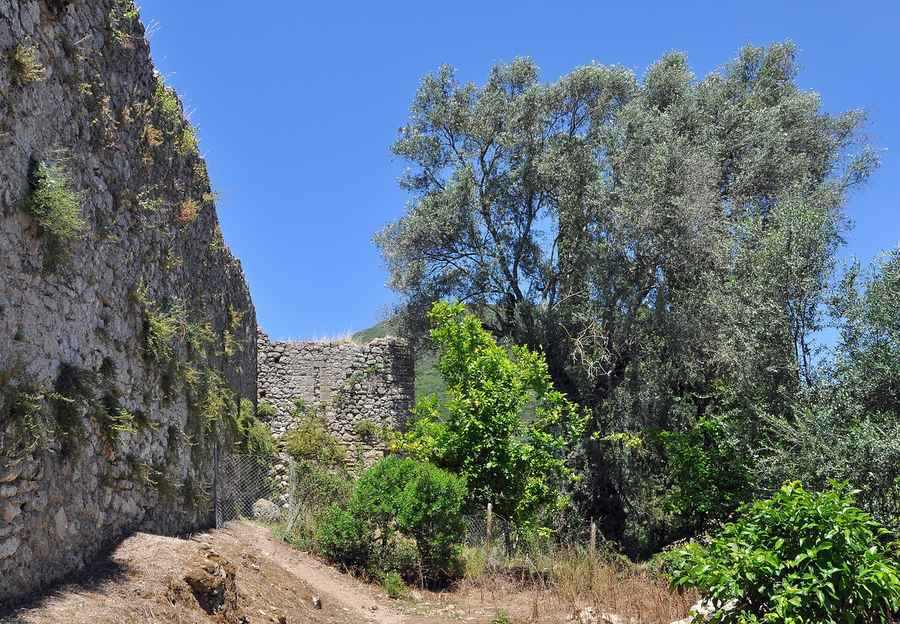
Gardiki Castle Corfu is a 13th-century Byzantine fortress on the southwestern coast, the south’s only surviving medieval castle, distinctive for its octagonal plan and eight towers. Always open and free to visit, it makes an atmospheric stop. This guide covers its history, architecture, what to see and how to visit. Plan the whole trip with Greece Tours.
Gardiki is a fascinating historic sight, a southern highlight of the wider Corfu tours and travel guide. It stands inland from the southwest coast. The sections below cover the castle.
What is Gardiki Castle?
Gardiki Castle is a 13th-century Byzantine stronghold on the southwestern coast of Corfu, the south’s only surviving medieval fortress. Raised by a ruler of Byzantine Epirus, it guarded the southern lowlands and is distinctive for its octagonal shape.
Gardiki is the south’s great medieval relic. Raised in the 13th century on a low hill inland from the southwest coast, it is the only medieval castle left standing in southern Corfu, raised by a ruler of Byzantine Epirus to protect the fertile fields and lowlands of the south. Though now a ruin, its striking octagonal circuit of walls and towers still stands, making it one of the most unusual and atmospheric historic sites on the island, and an easy, rewarding stop for anyone exploring the quieter south, set within the wider things to do in Corfu. Its history is tied to the island’s defences.
What is its history?
Gardiki was built in the 13th century by a ruler of Byzantine Epirus, one of three castles defending Corfu before the Venetian era. With Kassiopi Castle and Angelokastro, it formed a triangular line of defence around the island.
Gardiki’s story is one of strategic defence. Constructed in the 13th century by a ruler of Byzantine Epirus, before Venetian rule began in 1401, it was one of three Byzantine castles that together guarded Corfu. Its position on the narrow southwest flank of the island protected the southern fields and lowlands, and together with Kassiopi Castle in the island’s north-east and Angelokastro on the north-west shore, it formed a triangular line of defence covering the whole island in the pre-Venetian era. This trio of fortresses tells the story of how medieval Corfu was protected, set out alongside the guides to Angelokastro and Kassiopi. Its architecture is unusual.
What is the architecture like?
Gardiki’s walls form an octagon with eight sturdy towers, set with rows of tiles, enclosing about 4,700 square metres within a 255-metre perimeter. At the top of the southern tower survive faint traces of a chapel and its weathered frescoes.
The castle’s design is its most memorable feature. Unusually, the walls form a regular octagon, reinforced by eight strong towers and decorated with distinctive rows of tiles set into the stonework, enclosing a space of around 4,700 square metres within a perimeter of about 255 metres. The masonry reuses ancient material, hinting at older occupation of the site. At the top of the southern tower, traces of a small chapel survive, including faded remnants of religious frescoes portraying saints, a poignant reminder of the castle’s long history. Walking the walls reveals the full octagonal plan and the surrounding countryside, set out alongside the guide to the Old Fortress in the capital. Visiting is simple and free.
How do you visit Gardiki Castle?
Gardiki Castle is always open and free to visit. You need your own transport, a hire car or scooter, as no public transport reaches the site. You can climb the walls for a fine view of the octagonal structure and the countryside.
Gardiki is easy and inexpensive to see, but you will need your own wheels. The castle is always open and entry is completely free, with no ticket office or fixed hours, so you can wander the ruins at your leisure. Because no public transport reaches the site, getting there requires a hire car or scooter, following the roads inland from the southwest coast near Agios Mattheos.
Once there, you can climb onto the fortification walls for an overview of the complete octagonal structure and sweeping views across the green countryside and lowlands it once protected. It pairs well with the nearby beaches of Issos and the Korission Lagoon, set out alongside the guides to Corfu car rental and Issos beach. What survives at the site is worth knowing before you go.
What can you see at Gardiki today?
Gardiki survives as a roofless ruin whose octagonal curtain wall and eight towers still stand nearly to their full height. Inside, the enclosure is open ground, while the southern tower keeps faint frescoes and the outer masonry shows reused ancient blocks.
Gardiki is a shell rather than a furnished monument, which is part of its quiet appeal. The most complete survivors are the eight-sided ring of walls and the tiled towers, still tall enough to convey the fortress the Byzantines raised. The interior is now open grass, where visitors can picture the garrison buildings that once stood inside the walls, and close inspection of the stonework reveals ancient blocks reused from an earlier structure on the hill.
The southern tower still shelters the ghostly remains of chapel frescoes, the most delicate detail on the site. Because the castle is unstaffed, there are no facilities on hand, so visitors bring water and stout shoes for the uneven ground, and shade is limited in high summer. This raw, uncrowded character suits travellers exploring the south, and it complements the guide to things to do in Corfu. The questions below cover the points travellers ask most.
Why visit Gardiki Castle?
You visit Gardiki Castle for its unusual octagonal design, its history as the only medieval fortress in southern Corfu, and its peaceful, atmospheric setting away from the crowds. Free and always open, it pairs easily with the beaches and lagoon of the southwest coast.
Gardiki rewards the curious traveller. Its rare octagonal plan and eight tiled towers set it apart from the island’s other castles, and the sense of history is strong on a site that helped defend Corfu for centuries. Quiet and uncrowded, surrounded by green countryside, it offers an atmospheric contrast to the busy resorts, and being free and always open, it is an easy addition to a day in the southwest. Combining it with the wild dunes and birdlife of Issos and the Korission Lagoon, or the village of Agios Mattheos, makes a rewarding off-the-beaten-track outing, set out alongside a Corfu itinerary. The answers above and below cover the essentials.
Frequently Asked Questions
What is Gardiki Castle in Corfu?
Gardiki Castle is a 13th-century Byzantine stronghold on the southwestern coast of Corfu, the only surviving medieval fortress in the south of the island. Raised by a ruler of Byzantine Epirus, it is distinctive for its octagonal plan and eight tiled towers.
How much does Gardiki Castle cost to visit?
Gardiki Castle is free to visit and always open, with no ticket office or fixed hours. You need your own transport, a hire car or scooter, as there is no public transport to the site, and you can climb the walls for a fine view of the octagonal structure.
Is Gardiki Castle worth visiting?
Gardiki Castle is worth visiting for its unusual octagonal design, its history as the only medieval fortress in southern Corfu, and its quiet, atmospheric setting. Free and always open, it pairs easily with the nearby beaches of Issos and the Korission Lagoon, and with the village of Agios Mattheos just inland, making a rewarding half-day away from the busy resorts.