
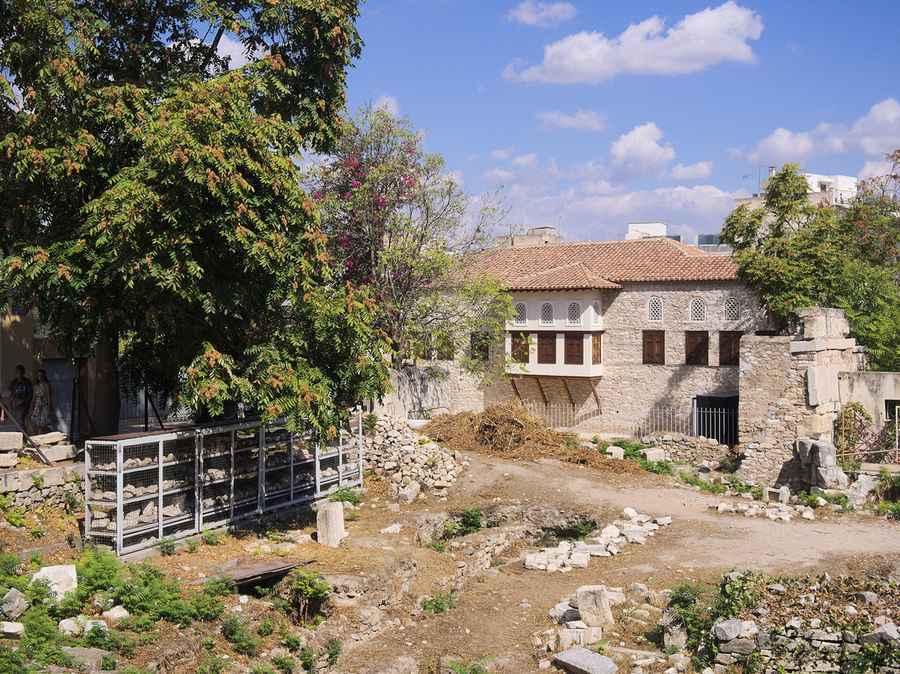
The Benizelos Mansion in Plaka is the oldest house in Athens, a rare and beautifully preserved Ottoman-era konaki linked to Saint Philothei, now a free little museum with digital exhibits and a peaceful courtyard. Discover this hidden gem alongside skip-the-line Acropolis tickets and tours from My Greece Tours.
This atmospheric old house is a hidden treasure of the Athens travel guide. The sections below cover what it is, the architecture, the Benizelos family and Saint Philothei, what to see inside, the digital exhibits and courtyard, the practical visit, and how to get there.
What is the Benizelos Mansion?
Athens’s oldest surviving house, the Benizelos Mansion is a rare two-storey mansion, or konaki, from the period of Ottoman rule, located on Adrianou Street in Plaka. Its oldest parts date to the 16th century, with the building completed in the 18th century. The last surviving mansion of its kind in the city, it belonged to the noble Benizelos family and is now a free museum offering a glimpse of old Athens.
Tucked away on a busy street in the Plaka district, often overlooked by the crowds heading for the Acropolis, the Benizelos Mansion is a genuine hidden treasure, holding the distinction of being the oldest house in Athens and one of the most evocative windows into the city’s pre-modern past. It is a rare and precious survival: a two-storey mansion, known in the local tradition as an archontiko or konaki, dating from the long centuries of Ottoman rule over Athens, when the city was a modest provincial town rather than a grand capital. The oldest parts of the structure are thought to date back to the sixteenth century, with the building largely completed in the eighteenth, and it stands today as the last surviving example of such an aristocratic Athenian mansion from that era, almost everything else of its kind having been swept away by the city’s later transformation.
The house belonged to the Benizelos family, prominent Athenian nobles, and it carries a deep connection to one of the city’s most beloved saints. Lovingly restored, it now serves as a free museum. It offers a rare glimpse of vanished Athens. Its architecture tells much of that story.
What is the architecture of the mansion like?
The Benizelos Mansion is a classic two-storey Ottoman-era Athenian mansion built around a courtyard. Its most striking feature is the hagiati, a covered wooden verandah running along the upper floor, while the ground floor has stone arches and storage and service rooms. A well and spring sit in the yard. The timber-framed upper living quarters, the arches and the courtyard make it a rare and authentic example of the domestic architecture of old Athens.
The Benizelos Mansion is treasured not only for its age but for its architecture, which preserves the form of a noble Athenian home of the Ottoman period in a way found nowhere else in the city. The building follows the classic pattern of the archontiko, arranged on two storeys around an inner courtyard that was the heart of family life. The lower, ground floor is built of sturdy stone, with characteristic arches, and traditionally housed the more functional spaces, the storerooms, service rooms, stables and cellars, including provision for the produce of the family’s lands. The upper floor, by contrast, contained the comfortable living quarters of the family, and its most distinctive and beautiful feature is the hagiati, a long covered wooden verandah or gallery running along the courtyard side, supported on timber posts, where the household could sit, work and enjoy the air in shade, a hallmark of this style of mansion.
In the courtyard below there is a well and a spring, essential to the self-sufficient household. Together the stone arches, the timber-framed upper storey and the hagiati make the mansion a uniquely authentic survival of the domestic world of old Athens. Its rooms breathe history. The family who lived here gave Athens a saint.
Who were the Benizelos family and Saint Philothei?
The mansion belonged to the noble Benizelos family of Athens, and is famed as the home of Saint Philothei. Born Revoula Benizelos in the 16th century, she was a devout noblewoman who used her wealth to build hospitals, shelters and schools, and to rescue Greek women enslaved by the Ottomans. Persecuted for her work, she died a martyr and was canonised as Saint Philothei, “friend of God”, one of the patron saints of Athens.
The deepest significance of the mansion lies in the family who lived here and, above all, in the remarkable woman it produced, for this was the birthplace and home of one of the most revered saints of Athens. The house belonged to the Benizelos family, descendants of an old and aristocratic Athenian lineage, and it was here that their daughter, born Revoula Benizelos in the sixteenth century, grew up. A deeply pious and compassionate noblewoman of considerable wealth, Revoula devoted her life and her fortune to charity and to the relief of suffering, founding hospitals, hospices, shelters and schools, and courageously working to ransom and protect Greek women who had been enslaved and forced into Ottoman harems, providing them refuge.
This dangerous philanthropy brought her into conflict with the Ottoman authorities, and she was ultimately persecuted and attacked for her faith and her work, dying as a result of her injuries and so regarded as a martyr. She was later canonised by the Orthodox Church as Saint Philothei, a name meaning friend of God, and is honoured as one of the patron saints of Athens, her relics venerated in the city’s cathedral. The mansion thus stands as a memorial to her life. Her story gives the house its soul. Inside, that story is brought to life.
What can you see inside the mansion?
Inside the restored mansion you can explore the atmospheric rooms of the upper and lower floors, the covered hagiati verandah and the courtyard with its well, gaining a vivid sense of domestic life in Ottoman-era Athens. The displays use modern museum techniques, including video projections, audio and interactive digital exhibits, to tell the story of the house, the Benizelos family and Saint Philothei, set against the historical backdrop of the city under Ottoman rule.
Stepping inside the Benizelos Mansion, visitors can wander through the carefully restored interiors and experience at first hand the atmosphere of a noble Athenian household of centuries past, an experience quite unlike that of any other site in the city. You can explore the rooms of both floors, walk along the lovely covered hagiati verandah overlooking the courtyard, and see the inner yard with its well and spring, all of which conjure the rhythms of domestic life in old Athens. Rather than filling the house with period furniture, the restoration takes an imaginative modern approach, employing a thoughtful array of contemporary museum techniques to interpret the building and its history: video projections bring scenes to life, audio elements and atmospheric lighting evoke the past, and interactive digital exhibits allow visitors to delve into the story of the mansion, the Benizelos family and the life of Saint Philothei, all set against the wider historical reality of Athens under Ottoman rule.
This blend of authentic old architecture and engaging digital storytelling makes the visit both moving and informative. It is a quietly captivating experience. The peaceful courtyard offers a further reward.
What is the courtyard like, and how do you visit?
The mansion’s tranquil inner courtyard, with its well, greenery and the shade of the hagiati above, is a peaceful oasis away from the bustle of Plaka. The museum, at 96 Adrianou Street in Plaka, opened to the public and entry is free, by donation. It is open on selected days and hours, so check before visiting. A visit takes around 30 to 45 minutes, easily combined with exploring Plaka and the nearby ancient sites.
One of the unexpected pleasures of a visit is the mansion’s tranquil inner courtyard, a green and shaded oasis of calm hidden just steps from the busy streets of Plaka, where the well and spring, a little greenery and the overhanging timber verandah create a serene spot to pause and imagine the daily life once lived here. As for visiting, the mansion stands at number 96 Adrianou Street, one of the main thoroughfares of the Plaka district, and it opened its doors to the public as a museum following its restoration. Admission is free, supported by a voluntary donation, making it an excellent and rewarding stop for any traveller, especially those exploring on a budget.
The museum is open on selected days and during set hours rather than daily, so it is wise to check the current opening schedule before making a special trip. A visit is fairly short, typically taking around thirty to forty-five minutes to explore the rooms, the verandah, the courtyard and the exhibits, which makes it very easy to combine with a wander through the picturesque lanes of Plaka and a visit to the nearby Acropolis, Roman Agora or other ancient sites.
Because it sits on busy Adrianou Street yet draws few visitors, it makes a peaceful and unexpected counterpoint to the crowds at the nearby ancient sites, and the free admission makes it an easy addition to any walk through the district. Entering the cool, quiet rooms after the heat and bustle of the streets is a small revelation, and the short visit leaves a lasting impression of a vanished Athens. It is a rewarding and uncrowded detour. The famous old quarter around it is detailed in the Plaka guide. The questions below cover the points visitors ask most.
Frequently Asked Questions
What is the oldest house in Athens?
The oldest house in Athens is the Benizelos Mansion in Plaka, a rare two-storey Ottoman-era mansion, or konaki, whose oldest parts date to the 16th century and which was completed in the 18th century. The last surviving aristocratic mansion of its kind in the city, it belonged to the noble Benizelos family and is now a free museum at 96 Adrianou Street.
Is the Benizelos Mansion free to visit?
Yes, the Benizelos Mansion is free to visit, with entry supported by a voluntary donation. The museum, in Plaka, opened to the public and uses digital exhibits, projections and audio to tell the story of the house and Saint Philothei. It is open on selected days and hours, so it is wise to check the current schedule before visiting.
Who was Saint Philothei of Athens?
Saint Philothei, born Revoula Benizelos in the 16th century, grew up in the Benizelos Mansion. A devout noblewoman, she used her wealth to build hospitals, shelters and schools and to rescue Greek women enslaved by the Ottomans. Persecuted for her work, she died a martyr and was canonised as Saint Philothei, meaning friend of God, and is a patron saint of Athens.