
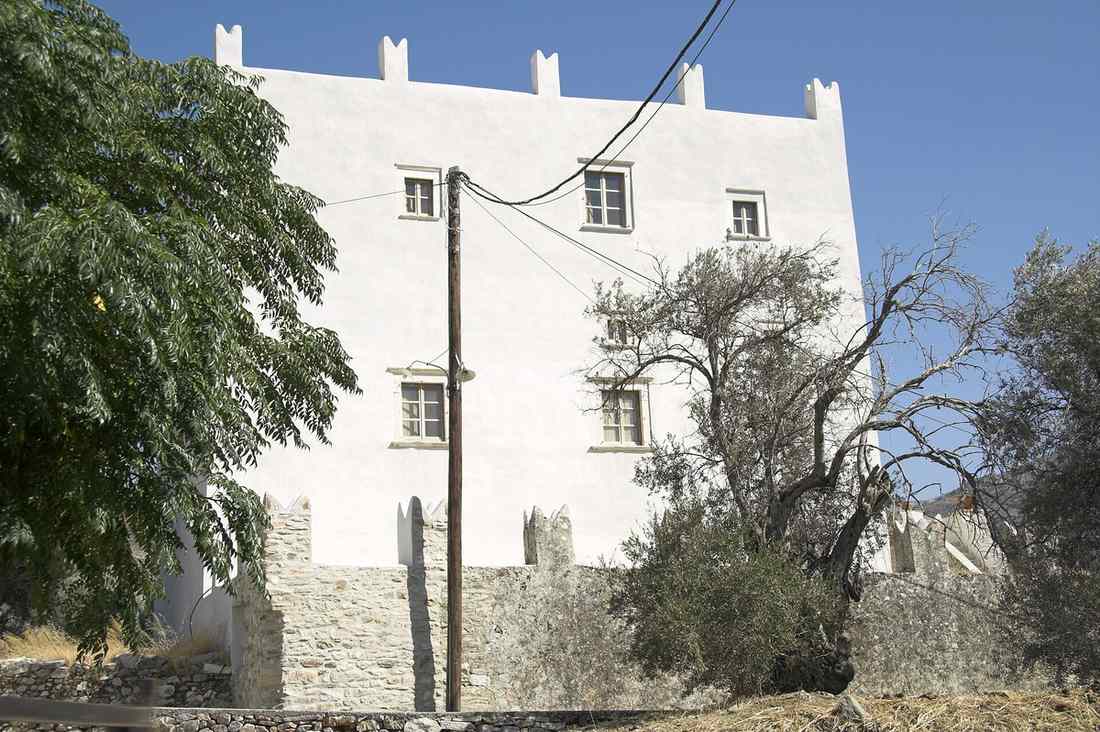
The Bellonia Tower, known locally as Pyrgos Bellonia, stands in an olive grove near Galanado on the road toward Sangri. This 16th-century Venetian fortified tower-house is one of the most photographed monuments on central Naxos. The tall stone block, the loopholes on its upper walls, and the small double church beside it make it a landmark for travelers crossing the island interior. The tower belonged to the Bellonia family, tied to the Venetian Catholic archbishop of Naxos, and it guarded fertile farmland below the Tragea plateau. This guide explains the architecture, the two-faith chapel, the coat of arms, and how to reach and view the site with My Greece Tours.
The tower sits a short drive from Naxos Town, and it pairs naturally with other inland monuments for a half-day loop. Our Naxos travel guide places Bellonia within the wider network of fortified estates that shaped the island under Venetian rule. The sections below cover the tower-house design, the double church of St John, the Bellonia coat of arms and archbishop link, the olive-grove setting, and the practical route for viewing the exterior. Each part gives concrete detail you can use on the ground.
What kind of building is the Bellonia Tower?
The Bellonia Tower is a 16th-century Venetian fortified tower-house, a tall square stone residence built for defense and estate control. It combined a noble family home with a lookout post over the surrounding farmland near Galanado.
The structure rises as a compact three-level block of local stone, with thick walls that taper slightly toward the top. Narrow loopholes and small windows sit high on the facade, a defensive choice that limited entry points during raids. The flat parapet once let defenders watch the road and the plain below. Naxos holds a network of these fortified estates, and the Bellonia Tower ranks among the best preserved. The nearby Bazeos Tower shows the same regional type in a monastic form, so seeing both clarifies how these towers worked. The design answered a real need for shelter from pirates and rival lords across the countryside.
The tower-house model came to Naxos with Venetian and Frankish landholders after the fall of Byzantine control. Each tower anchored an agricultural estate, storing produce and housing the family that ran the land. Ground-floor rooms held olive oil, wine, and grain, while upper floors served as living quarters reached by an internal stair. The history of Naxos under the Duchy of the Archipelago explains why so many towers rose across the island interior. Bellonia guarded the fertile approach toward the Tragea and the road link between Naxos Town and the villages inland. The building reads today as a clear record of that feudal system in stone.
Why does the Bellonia Tower have a double church of St John?
Beside the tower stands a small double church of St John, split into a Catholic half and an Orthodox half under one roof. The shared building reflects the two Christian communities that coexisted on Venetian Naxos.
The chapel presents two doors and two sanctuaries within a single stone shell, one serving the Latin Catholic rite and the other the Greek Orthodox rite. This arrangement let the Catholic landholding family and the Orthodox farm workers worship in the same place without merging their traditions. Such twin churches survive at a handful of tower estates on the island, and the Bellonia example is the most visited. The whitewashed bell-cote and the plain stone walls make it a striking foreground for photographs of the tower. The double dedication to St John gives the chapel its name and marks the religious balance that Venetian rule maintained for centuries across rural Naxos.
The double church also carried a practical message about power and tolerance on the estate. The Catholic lords depended on Orthodox labor, and a shared sanctuary eased daily relations without forcing either group to abandon its faith. The blue-domed and white forms you see today follow the classic Cycladic chapel look, yet the internal division sets Bellonia apart. Travelers often compare this rural expression of faith with the grander Catholic and Orthodox churches inside the Kastro of Naxos Town. Both settings show how two communities lived side by side under one Duchy. The chapel remains a quiet, moving detail that rewards a slow look before you turn to the tower itself.
What do the coat of arms and archbishop connection tell us?
A carved coat of arms on the tower marks its Bellonia owners, a family linked to the Venetian Catholic archbishop of Naxos. The tower is remembered as a residence tied to that high church office.
The heraldic emblem set into the stone identifies the noble family that held the estate and its rank within the Latin aristocracy of the island. Coats of arms on Naxian towers served as a public statement of ownership and status, readable to anyone passing on the road. The Bellonia family sat close to the top of the Catholic hierarchy, and tradition connects the tower to the archbishop of the diocese. This link raised the building above a simple farm estate into a seat of religious and social authority. The emblem, weathered but legible, remains one of the details guides point out to visitors standing at the gate.
The archbishop connection places Bellonia within the church-and-estate system that shaped inland Naxos for generations. Latin bishops and their kin controlled land, collected revenue, and maintained the towers that dotted the plains and slopes. Understanding this helps explain the density of monuments you meet on any inland route, from Galanado toward Sangri and beyond. The same authority that built and defended these towers also funded churches across the countryside. A visit to Bellonia works best when paired with the wider story of the history of Naxos, which frames the family within the Duchy of the Archipelago and its long Catholic elite.
What is the olive-grove setting like around the tower?
The Bellonia Tower stands within a working olive grove on gently rolling farmland near Galanado. The silver-green trees, the stone tower, and the small church together form the classic view travelers photograph from the road.
The grove frames the tower on nearly every side, and the trees have grown here for generations as part of the estate that the building once controlled. Olive cultivation shaped this stretch of Naxos, and the mill rooms inside such towers processed the harvest each winter. The setting explains the tower’s original purpose better than any label could, since the fortified house and the productive land belonged to one economic unit. Morning and late-afternoon light turn the stone warm and pick out the loopholes on the upper wall. The scene ranks among the signature images of inland Naxos and appears on many itineraries of things to do in Naxos.
The surrounding fields open toward the fertile Tragea and the villages that fill the island’s green heart. This is farming country, not resort coast, and the quiet adds to the appeal of a tower visit. The same soil that fed the Bellonia estate supports groves and orchards that still work today. Travelers exploring the interior often continue from the grove toward the ancient Temple of Demeter, a marble sanctuary set among the same agricultural landscape. The pairing of Venetian tower and classical temple within a short drive shows the depth of history layered across central Naxos, all held within these productive olive-covered slopes.
How do you reach and view the Bellonia Tower?
Drive from Naxos Town toward Galanado and Sangri; the tower stands beside the main road about six kilometers out, easy to spot in its olive grove. Viewing is exterior only, from the roadside and gate.
A rental car or scooter reaches the tower in roughly fifteen minutes from the port, and a signed pull-off lets you park briefly. Local buses on the Sangri and Chalki routes pass close by, so a short walk from a stop also works. The tower is private and closed to the interior, which means the visit centers on the exterior, the double church, and the coat of arms viewed from outside. This keeps the stop short, and it pairs well with a longer inland loop through the Tragea villages. Photographers favor the roadside angle that captures tower, chapel, and grove in one frame under the island light.
A sensible plan combines Bellonia with nearby monuments to fill a rewarding half day. Continue southeast for the ancient Temple of Demeter near Sangri, then return through the marble villages of the interior. Respect the private grounds, stay on the public roadside, and avoid entering the fenced estate. Early or late hours give the best light and the fewest cars on the narrow road. The tower demands little time yet delivers a strong sense of Venetian Naxos in a single view. Plan your visit and tours through our Naxos travel guide.
Frequently Asked Questions
Can you go inside the Bellonia Tower?
The Bellonia Tower is a private property, and the interior stays closed to visitors. The experience is exterior only, viewed from the public roadside and the gate that fronts the olive grove. This still gives a full appreciation of the monument, since the most distinctive features sit outside: the tall fortified facade with its loopholes, the carved coat of arms, and the small double church of St John beside it. Travelers photograph the tower from the road, walk the accessible edge of the grove, and read the exterior detail without needing entry. The lack of interior access keeps the visit short and easy to fit into an inland driving loop.
Guides describe the internal layout, the ground-floor storage and upper living rooms, so the closed interior does not reduce the value of the stop. A roadside pause of fifteen to twenty minutes covers the tower, the chapel, and the setting comfortably.
How far is the Bellonia Tower from Naxos Town?
The tower sits roughly six kilometers from Naxos Town, on the road that runs inland toward Galanado and Sangri. The drive takes about fifteen minutes by car or scooter, making it one of the easiest historic monuments to reach on the island. The route climbs gently from the port through farmland into the green interior, and the tower appears on the right in its olive grove, hard to miss. Public buses heading to Sangri and Chalki pass close, so travelers without a vehicle can reach it by a short walk from a nearby stop. The proximity to town makes Bellonia a natural first stop on a half-day inland tour.
Travelers often combine it with the Temple of Demeter near Sangri and the marble villages of the Tragea plateau. The short distance and roadside position mean the tower fits easily into a wider Naxos itinerary without much planning.
What makes the Bellonia Tower worth visiting?
The Bellonia Tower packs a lot of history into a single roadside view. It is a well-preserved 16th-century Venetian fortified tower-house, one of the finest of the fortified estates that once controlled the Naxos countryside. The rare double church of St John beside it, split between Catholic and Orthodox halves under one roof, tells the story of two faiths coexisting under the Duchy of the Archipelago. The carved coat of arms and the family’s link to the Venetian archbishop add a layer of church-and-power history you rarely see stated so plainly in stone. The olive-grove setting frames the tower in classic Cycladic light and explains its original role as the center of a working estate.
The stop takes little time, costs nothing, and pairs neatly with the nearby Temple of Demeter and the Tragea villages, making it a rewarding piece of any inland Naxos exploration.