
Naxos sits at the heart of Greek myth as few Cycladic islands do. The largest of the Cyclades held Mount Zas, the peak where legend says the infant Zeus was raised in a mountain cave. Naxos was also the sacred island of Dionysus, god of wine, and the stage for the story of Ariadne, the Cretan princess abandoned by Theseus and later crowned by a god. These threads are not distant fables. They map onto real ridges, ruined sanctuaries and a marble gateway you can still walk to. Explore the mythic landscape of the island and plan the journey through it with My Greece Tours.
This culture guide reads the island’s mythology alongside its geography, so each story points to a place. Our wider Naxos travel guide covers logistics, beaches and villages; here the focus stays on gods, heroes and the sites that carry their memory. The sections below cover the raising of Zeus on Mount Zas, the central Ariadne story, Naxos as the home of Dionysus and his ancient vineyards, and the real ruins where these myths still feel present today.
Why was the infant Zeus raised on Mount Zas in Naxos?
Naxos claimed Zeus as a foster child of its highest peak. Mount Zas, the tallest summit in the Cyclades, takes its name from the god, and a cave on its slope was honored as the place he was reared.
Naxos held one of the ancient world’s rival claims to the childhood of Zeus, a story Crete told of Mount Ida. On Naxos the setting was Mount Zas, whose name preserves an old form of the god’s own. The mountain rises above the island’s interior as the highest point in the Cyclades. Its slopes carried the memory of a nurtured god, hidden from his father Cronus. A cave on the western flank, the Cave of Zeus, marked the sacred spot. Ancient visitors climbed to leave offerings there. Walkers today follow a marked path from Filoti village, and the ascent up Mount Zas remains the clearest way to stand inside the myth on the ground.
An inscribed marble boundary stone found near the summit reads as a dedication to Zeus of the mountain, tying the cult to a fixed place. The god was worshipped here under a title binding him to rain and the peak. This detail grounds the legend in ritual practice rather than pure story. The cave itself is a genuine karst cavern, dim and cool, reached after a steady climb through stone terraces. Shepherds used it for shelter across the centuries. The link between the highest land and the sky god fits a wider Greek habit of placing Zeus on summits.
The deep history of Naxos shows this cult sitting beside later sanctuaries, so the island honored the king of the gods from its earliest recorded worship onward through antiquity.
What happened to Ariadne when Theseus abandoned her on Naxos?
Theseus sailed from Crete with Ariadne, who had saved him from the Minotaur, then abandoned her on Naxos while she slept. The god Dionysus found her there, married her and raised her to divine honor.
Ariadne was a princess of Crete, daughter of King Minos. She gave Theseus the thread that let him escape the Labyrinth after killing the Minotaur, then fled Crete with him. The hero’s ship stopped at Naxos on the voyage home. There, by the oldest telling, Theseus left her sleeping on the shore and sailed away at dawn. The reasons vary across the ancient sources, from a god’s command to plain faithlessness. Ariadne woke alone on an unfamiliar island, betrayed by the man she had rescued. Her lament became a favorite subject for later poets and painters.
The setting of her abandonment was the Naxian coast near the harbor, close to where Naxos Town now spreads below its Venetian castle, giving the story a concrete stretch of sand.
The story turns from grief to triumph. Dionysus, whose sacred island this was, came upon the sleeping princess and fell in love. He took Ariadne as his bride, and the marriage lifted her from mortal sorrow to divine standing. In one strand of the myth he set her bridal crown among the stars as the Corona Borealis. Their union bound the island doubly to the god, as both his home and the site of his wedding. The tale explains why Naxos guarded its link to Dionysus with such pride. Ariadne became a goddess of the island’s cult rather than a discarded mortal.
The marble Portara gateway on the harbor islet, where a temple once stood, is the monument most tied to this divine presence beside the sea.
Why is Naxos called the sacred island of Dionysus?
Naxos was the chief cult center of Dionysus, god of wine and revelry. Ancient tradition made the island his home and nursery, and its fertile valleys produced the wine that carried his worship across the Aegean.
Dionysus held Naxos as his own island above all others. The largest and greenest of the Cyclades, it grew vines where its neighbors held only rock and scrub. Ancient writers named Naxos among the birthplaces or nurseries of the wine god, raised by mountain nymphs. The island’s fame for wine ran back to the Archaic period, when Naxian vintages traveled the sea routes. Its coins carried the wine cup and grape cluster of Dionysus as civic emblems. The god’s festivals shaped the island’s calendar and its self-image. The cult reached beyond legend into daily economy and rite.
The great marble temple begun on the harbor islet, whose gateway survives as the Portara, is read by scholars as a sanctuary of this presiding god above his harbor.
The island’s vineyards were the material root of the myth. Naxian soil and mild slopes yielded strong wine that the ancients prized, and viticulture remains alive across the interior valleys today. The sanctuary at Yria, inland from the west coast, gave the god a formal home away from the shore. Excavation there revealed a sequence of temples built and rebuilt across centuries, one of the earliest roofed marble sanctuaries in Greece. The Sanctuary of Dionysus at Yria shows worship of the wine god set deep in the farmland that fed his cult. This pairing of vine and shrine, field and altar, is why Naxos wore the god’s name so firmly.
The island did not merely tell his story; it lived by his gift and honored him where the grapes grew.
Which real Naxos sites let you encounter these myths today?
The Portara gateway, Mount Zas with the Cave of Zeus, the Yria sanctuary and the Temple of Demeter each anchor a strand of the island’s mythology. All stand as visitable ruins tied to gods and heroes.
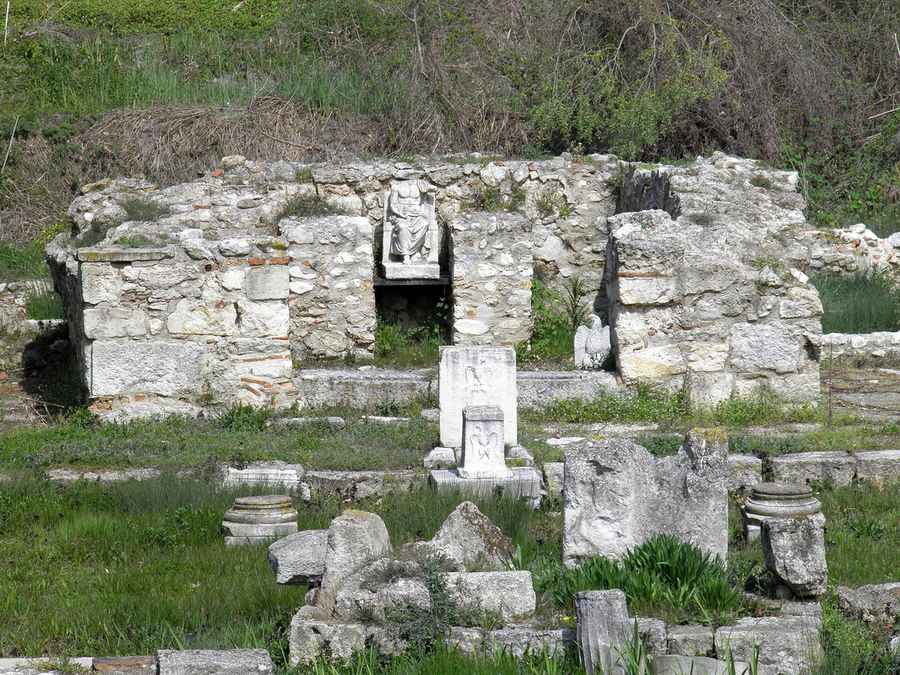
The Portara is the island’s signature monument and the easiest myth to reach. This colossal marble doorframe stands on the islet of Palatia, joined to the harbor by a causeway, at the very shore where Ariadne was said to be abandoned. It is the surviving gate of an unfinished Archaic temple, most often linked to Dionysus or Apollo. Sunset draws crowds to the frame as the light passes through it. A short walk inland, the Archaic marble sanctuary at Sanctuary of Dionysus at Yria gives the wine god his excavated home among the fields.
Northward near the village of Apollonas, a huge unfinished marble kouros lies in an ancient quarry, and the coast at Apollonas ties the island’s stone to its gods.
Mount Zas remains the most demanding and rewarding of the mythic sites. The marked trail from Filoti climbs to the summit and passes the Cave of Zeus, where the god was reared in legend. The view from the top spans the Cyclades that share these stories. On the fertile Sangri plateau stands the elegant Archaic marble Temple of Demeter, a shrine to the grain goddess that shows Naxos honored the full circle of Olympian deities, harvest beside wine. Together these ruins let the visitor read the mythology as a landscape rather than a book. Each stop pairs a story with stone you can touch.
What other gods and legends connect to Naxos?
Beyond Zeus and Dionysus, Naxos honored Demeter with an elegant marble temple, tied its harbor gate to Apollo, and told of the giant Aloadae who died on the island. Its myths knit gods, heroes and giants to Naxian soil.
Demeter, goddess of grain and harvest, held her own shrine on the fertile Sangri plateau. The gleaming marble Temple of Demeter honored the deity who governed the crops that fed the island. This pairing of Demeter with Dionysus, grain beside wine, shows Naxos worshipping the full cycle of abundance. Apollo also claimed a share of the island’s devotion. Ancient tradition links the great unfinished temple on the harbor islet, whose gateway survives as the Portara, to Apollo as well as Dionysus. Naxians were famed as sculptors of the god, dedicating the marble lions and a towering sphinx at the sanctuary of Apollo on nearby Delos, proof of the island’s close bond with the god of light.
Older and stranger legends cling to the island too. The Aloadae, the giant twin sons Otus and Ephialtes, were said in myth to have piled mountains upon one another to storm the heavens, then to have met their end on Naxos. Their story marks the island as a stage for the primeval struggles of gods and giants. Early settlers in the myths, from Thracian tribes to Carian seafarers, wove Naxos into the wider map of the Aegean past. These layered tales, reaching back before the Olympian order settled, run through the deep history of Naxos.
Together they make the island a dense weave of myth, where nearly every peak, plain and harbor carries the name of a god, a hero or a giant. Plan your visit and tours through our Naxos travel guide.
Frequently Asked Questions
Is Mount Zas really named after Zeus?
Yes. Mount Zas, also written Zeus or Zas, carries a dialect form of the god’s name, and ancient Naxians linked the peak directly to him. The mountain is the highest in the whole Cyclades, rising above the island’s interior near the village of Filoti. A boundary stone found on the slope bears a dedication to Zeus of the mountain, which shows the cult was fixed to this exact place rather than a floating legend. The Cave of Zeus on the western flank was honored as the spot where the infant god was raised, hidden from his father Cronus. The naming fits a broad Greek pattern of placing Zeus on high summits tied to rain and sky.
A marked walking path from Filoti reaches both the cave and the peak, so the connection between the god and the mountain can still be walked today across genuine ancient ground and open Cycladic views.
Where on Naxos was Ariadne abandoned by Theseus?
Ancient tradition places Ariadne’s abandonment on the coast of Naxos near the harbor, close to the site of the modern town. The islet of Palatia, where the great marble Portara gateway now stands, is the spot most strongly tied to the story in local memory and later art. Theseus stopped at Naxos on his voyage home from Crete after killing the Minotaur, and left the sleeping princess on the shore before sailing on at dawn. The exact reason differs across ancient sources, from divine command to simple betrayal. What the island preserved was not the sand alone but the sequel: Dionysus, whose sacred island this was, found Ariadne there and married her.
That divine wedding is why the abandonment site sits so close to the god’s presiding temple by the sea. Standing at the Portara at sunset, a visitor looks out on the exact stretch of coast the myth describes.
Can you still see ancient vineyards and wine culture on Naxos?
Yes. Naxos remains a working agricultural island, and viticulture continues across its interior valleys much as it did in antiquity. The island was famed for strong wine from the Archaic period onward, and its ancient coins carried the wine cup and grape cluster of Dionysus as civic symbols. The god was held to be raised on Naxos and to keep it as his sacred home, so wine and worship were bound together here from early times. The excavated sanctuary at Yria, set inland among the farmland, gave Dionysus a formal shrine near the vines that fed his cult, and it ranks among the earliest roofed marble temples in Greece.
Villages such as those on the fertile plains still grow grapes and produce local wine that visitors can taste. Walking the interior valleys, past terraced slopes and old presses, shows the material root of the myth: the gift of the wine god growing in the soil that honored him.