
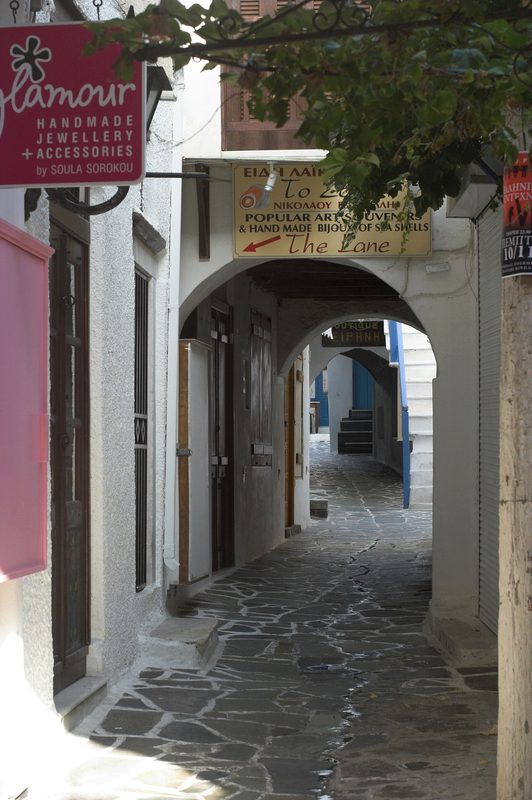
The Kastro of Naxos crowns the highest point of Naxos Town, and it is the oldest continuously inhabited fortified quarter on the island. Marco Sanudo raised it in the early 13th century as the seat of the Duchy of the Archipelago, and the Venetian aristocracy lived behind its walls for more than five hundred years. Today the Kastro is a maze of stone lanes, arched passages, coats of arms and quiet courtyards climbing toward a central tower. It is the single best place on Naxos to read the island’s medieval history in the buildings themselves. Discover its towers, gates and mansions with My Greece Tours.
Set above the harbour and the whitewashed Bourgos below, the Kastro rewards slow walking rather than a checklist. Use this page alongside our Naxos travel guide to fit the castle quarter into a wider island itinerary. The sections below cover who built the Kastro and why, the surviving Trani Porta gate and the central tower, the Catholic cathedral and aristocratic mansions, the Ursuline school and the museums inside the walls, and practical advice on how to visit the maze on foot.
Who built the Kastro of Naxos and why?
Marco Sanudo, a Venetian nobleman, built the Kastro of Naxos in the early 13th century after the Fourth Crusade. He made it the fortified capital of the Duchy of the Archipelago, a Venetian-ruled state governing Naxos and the surrounding Cyclades from behind its walls.
Marco Sanudo, a nephew of a Venetian doge, seized Naxos and the Cyclades in the years after the Fourth Crusade shattered the Byzantine Empire. He chose the hill above the natural harbour of Naxos Town and enclosed it with a defensive wall, twelve towers and a central keep, creating a compact stronghold that could shelter the ruling class. From here he declared himself Duke of the Archipelago, and the Kastro became the political heart of a Latin state that outlasted many larger powers. The choice of site was deliberate: it commanded the sea approaches, the fertile plains inland, and the trade routes threading through the central Aegean.
The Kastro was not simply a fort but a segregated Catholic town within the larger Greek Orthodox island. The Venetian and Frankish nobility lived inside the walls, while Greek residents and merchants filled the Bourgos quarter spilling down the slope. This social geography shaped Naxos for centuries and still reads clearly in the stones today. To understand how the duchy fits into the longer story of the island, from ancient Naxos through Byzantine rule to the Ottoman period, our guide to the history of Naxos traces each layer. The Kastro is where that Venetian chapter is written most plainly, in coats of arms carved above doorways that still bear the names of Latin families.
What are the main gates and towers of the Kastro?
The Kastro originally had seven gates and twelve towers. The best-preserved entrance is the Trani Porta, the northwest great gate, while the central Glezos Tower, also called the Crispi Tower, is the surviving keep and now houses a museum.
The Trani Porta, meaning the great or strong gate, is the most complete of the original entrances and the classic way to step into the Kastro on foot. Its marble threshold still shows a groove worn by the medieval iron portcullis that once sealed the quarter at night, and passing under it you move directly from the busy modern lanes into the hush of the medieval town. Of the seven gates that once controlled access, this is the one that best preserves the sense of crossing a boundary. Above and around it, sections of the defensive wall survive, incorporated over centuries into the walls of the houses that grew against them.
At the heart of the quarter stands the Glezos Tower, widely known as the Crispi Tower after the second Venetian dynasty that ruled from it. This square keep is the tallest surviving structure of Sanudo’s original design and the clearest reminder that the Kastro was a working fortress, not a decorative old town. From the tower the layout radiates outward through narrow lanes toward the vanished outer gates. If you are basing a first visit around Naxos Town, our overview of Naxos Town shows how the Kastro connects to the harbour, the Bourgos market streets and the causeway leading out to the island’s most famous landmark.
What is inside the Kastro: the cathedral and the mansions?
Inside the Kastro stand the Catholic cathedral on the central square, the archbishop’s residence, and a cluster of aristocratic Venetian mansions. Their tower-houses still display carved marble coats of arms above the doors, marking the Latin noble families who lived there.
The Catholic cathedral, dedicated to the Virgin Mary, sits on the small central square of the Kastro and remains the seat of the Catholic Archdiocese of Naxos. Its presence is a direct legacy of Venetian rule, since the ruling class was Roman Catholic while the wider island stayed Greek Orthodox. Beside it stands the archbishop’s residence, and around the square the finest mansions of the quarter press close together. Several of these houses have been owned by the same families for generations, and their heavy wooden doors, marble lintels and small shaded courtyards give the Kastro a lived-in dignity you rarely find in a purely archaeological site.
The carved coats of arms are the signature detail to look for as you walk. Above doorways and set into walls you can spot the emblems of families such as the Sommaripa, Barozzi, Della Rocca and Sanudo, each shield a small heraldic record of who held power here. These mansions were fortified homes as much as showpieces, built with thick walls and defensible layouts. The Kastro’s aristocratic architecture is one of the standout entries in any list of things to do in Naxos, precisely because it survives so intact. Take time to look up: the finest carvings are usually placed high, where they announced the household’s standing to everyone who passed below.
What is the Ursuline school and the museums in the Kastro?
The Ursuline school is a former Catholic girls’ school founded inside the Kastro, part of a strong tradition of Catholic education. The quarter also holds the Archaeological Museum in the old Jesuit College and the Venetian Museum in a restored tower-house.
Education was central to the Catholic community of the Kastro, and the Ursuline convent school for girls operated alongside the Jesuit and later Salesian schools for boys, some of which drew pupils from across the Aegean. The buildings that housed these institutions still stand within the walls, their scale a reminder that the Kastro was a centre of learning as well as of government. The Naxos Archaeological Museum now occupies the former Jesuit College, and it is one of the most rewarding stops inside the quarter, holding Cycladic figurines, pottery and finds that span the island’s very long prehistory.
Alongside the archaeological collection, the Venetian Museum, housed in the restored Della Rocca-Barozzi tower-house, lets you step inside an aristocratic Kastro home and see how the ruling families actually lived. Period furnishings, family heirlooms and a small garden used for evening concerts in summer complete the picture. Together the two museums turn a walk through the maze into a proper immersion in both deep antiquity and the medieval Latin period. If you are pairing culture with archaeology, remember that the great free-standing marble doorframe below the town, the Portara, dates to a far earlier era than the Kastro and makes a natural companion visit from the same starting point in Naxos Town.
How do you visit the Kastro of Naxos?
You visit the Kastro on foot, climbing from the harbour up through the Bourgos into the walled quarter, ideally in the early morning or golden hour. Entry to the maze itself is free; the museums inside charge admission and keep their own seasonal hours.
The Kastro sits at the top of Naxos Town, and there is no vehicle access inside the walls, so the visit is a walk. From the harbour, follow the stepped lanes up through the Bourgos and enter through the Trani Porta, then simply let yourself get lost in the maze. The quarter is small enough that you cannot go badly wrong, and every turn opens onto another arch, courtyard or coat of arms. Wear flat, grippy shoes for the smooth stone underfoot, carry water in summer, and aim for early morning or the hour before sunset when the light is soft and the lanes are quiet.
Allow one to two hours for the walk, more if you enter both museums.
The maze itself is open and free to wander at any hour, while the Archaeological Museum and the Venetian Museum charge admission and follow seasonal opening times, so check current hours before you climb. Because the Kastro is compact, it pairs easily with the rest of a Naxos day, and choosing accommodation nearby makes early and late visits effortless; our guide to where to stay in Naxos covers the neighbourhoods within easy reach of the old town. The lanes are unlit in places after dark, so a phone torch is handy if you linger past sunset, and note that many houses inside the walls are private homes, so keep to the public passages and courtyards.
With a little planning the castle quarter becomes the natural high point of a day in the capital rather than a rushed detour. Plan your visit and tours through our Naxos travel guide.
Frequently Asked Questions
Is the Kastro of Naxos worth visiting?
Yes, the Kastro of Naxos is one of the most rewarding half-day experiences on the island and arguably the best-preserved Venetian castle quarter in the Cyclades. Unlike ruined fortresses elsewhere in Greece, the Kastro is a living medieval town: people still inhabit the aristocratic mansions, the Catholic cathedral still holds services, and the coats of arms above the doorways still name the families who built the place in the 13th century. Wandering its maze of stone lanes, you move through more than five hundred years of Venetian rule in the space of an hour.
Two museums inside the walls, the Archaeological Museum in the old Jesuit College and the Venetian Museum in a restored tower-house, add real depth to the visit. The Kastro is free to enter, sits at the top of Naxos Town, and combines effortlessly with the harbour, the Bourgos market streets and a walk out to the Portara. That makes it an easy and memorable centrepiece for any day spent in the island’s capital.
How long does it take to walk through the Kastro?
A relaxed walk through the Kastro takes roughly one to two hours, and you can happily stretch that to half a day if you enter the museums or stop for coffee on the central square. The walled quarter itself is compact, so distances are short, but the pleasure of the Kastro lies in slowing down rather than rushing through. Plan on climbing up from the harbour through the Bourgos, entering through the Trani Porta, and then letting the maze lead you toward the central Glezos Tower. Pause to look up at the carved coats of arms above the mansion doorways as you go.
Visiting both the Archaeological Museum and the Venetian Museum adds another hour or more, since each deserves unhurried time. Many visitors do the Kastro in the cooler early morning, break for the middle of the day, and return for the golden hour before sunset when the stone glows and the crowds thin out.
What is the difference between the Kastro and Naxos Town?
Naxos Town, also called Chora, is the whole island capital that spreads around the harbour, while the Kastro is the fortified Venetian quarter crowning the hill at its highest point. Think of the Kastro as the medieval core inside the larger modern town. Historically the distinction was sharp: the Kastro was the walled, Catholic, aristocratic enclave built by Marco Sanudo, its seven gates sealing it off from the outside, while the Bourgos, the market district below, housed the Greek Orthodox residents and traders. That social division still shapes how the town reads today.
Climbing from the busy waterfront cafes and shops up through the winding Bourgos lanes and finally passing under the Trani Porta into the hush of the castle quarter, you physically cross the old boundary between the two worlds. The Kastro offers history, mansions and museums; the wider Naxos Town offers the port, restaurants, beaches nearby and the causeway leading out to the Portara.