
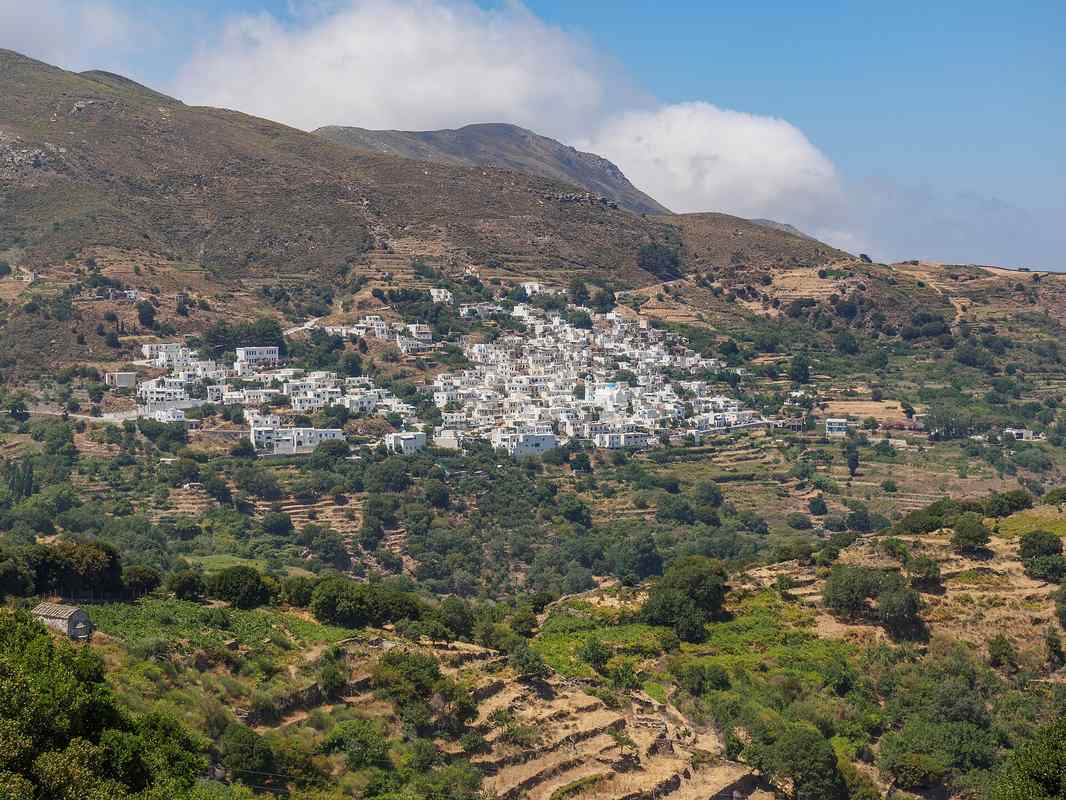
Koronida, still widely known by its older name Komiaki, is the highest traditional village on Naxos, set deep in the green northern mountains far above the coast. It is a place of terraced vineyards, cool mountain air, running springs and wide views over the northern Aegean, where daily life keeps a slow, authentic rhythm that has almost vanished elsewhere. The village is celebrated across the island for its wine and for souma, the local raki-like spirit distilled here for generations. Its amphitheatrical stone houses climb the slope in tight, shaded lanes. You can reach it independently by car or explore it with My Greece Tours on a guided journey through mountainous Naxos.
This page is part of our wider Naxos travel guide and focuses on one of the island’s most rewarding mountain destinations. The sections below cover what Koronida is and where it sits, why it is famous for wine and souma, what the village and its setting are like, the traditions and daily life that define it, and practical advice on how to visit this remote northern village.
What is Koronida (Komiaki) on Naxos?
Koronida, also called Komiaki, is the highest traditional village on Naxos, built high in the island’s northern mountains. It is a compact stone settlement surrounded by vineyards and terraces, known for cool air, springs and sweeping Aegean views.
Koronida sits near the top of the northern mountain range of Naxos, at one of the highest inhabited points on the island, well above the sea and the busier coastal resorts. Its two names cause gentle confusion for visitors: the official name is Koronida, but locals and older maps still use Komiaki, and both refer to the same village. The settlement grew where mountain springs and fertile terraces made permanent life possible at altitude, and it developed as a self-reliant community of farmers, vine-growers and distillers. The elevation shapes everything here, from the cooler climate to the crops that thrive on the slopes, giving Koronida a character quite unlike the sunbaked villages nearer the shore.
Koronida kept most of its old ways intact while other parts of Naxos modernised for tourism because of its height and remoteness. The population is small, and the pace of the place reflects a working mountain village rather than a resort. Visitors come for the authenticity, the panoramic outlook and the sense of stepping into an older Cyclades. It pairs naturally with a wider tour of the villages of Naxos in the north. What truly sets Koronida apart, though, is not just its altitude but what the villagers make from these high terraces, a reputation built above all on their vineyards and the spirit distilled from them. The next section explores in detail.
Why is Koronida famous for wine and souma?
Koronida is renowned as the home of Naxos souma, a raki-like grape spirit, and for the wine pressed from its terraced mountain vineyards. Generations of families have distilled souma here, making the village the island’s heartland of this tradition.
The steep slopes around Koronida are carved into stone-walled terraces where vines have been cultivated for centuries, taking advantage of the altitude, the cool nights and the mineral mountain soil. From these grapes the villagers make both local wine and, more famously, souma, a clear, potent distillate closely related to raki and to the citrus-scented kitro tradition of Naxos. Souma is produced from the pressed grape skins and must after the wine-making, then distilled slowly in traditional copper stills. Koronida is widely regarded as the place where the island’s best souma is made. Families guard their own recipes and methods, and the spirit remains a point of real local pride rather than a mass-market product.
Distilling here is a communal, seasonal event as considerable as a craft, tied to the grape harvest and shared among neighbours. Tasting souma straight from a village still is one of the most authentic experiences on Naxos. The wine and souma of Koronida are poured at every festival and gathering, binding the drink to the village’s identity and its calendar. This deep connection between the land, the vine and the still also shapes the physical look of the place, because the terraces, cellars and springs that make the wine possible are woven right into the fabric of the settlement. This is the focus of the section that follows.
What is the village and its setting like?
Koronida is an amphitheatrical village of grey stone houses stacked up a steep slope, threaded by narrow shaded lanes, running springs and small squares. The high setting brings cool air and panoramic views over the northern Aegean and Naxos.
The houses of Koronida climb the mountainside in an amphitheatrical arrangement, tier upon tier of traditional stone dwellings with flat or tiled roofs. That from a distance the whole village seems to cascade down the slope. Between them run narrow, stepped alleys, often shaded and cool even in high summer, opening now and then onto small squares where villagers gather. Water is a defining feature: mountain springs feed fountains and channels through the settlement, and the sound of running water is constant, a rare luxury in the Cyclades. Flowering plants, vines and old trees soften the stone.
The greenery of the surrounding terraces makes Koronida feel far greener than the arid image a wide range of visitors hold of Greek island villages.
The altitude gives the village a genuinely refreshing climate, noticeably cooler than the coast. On clear days the views stretch across ridges and valleys to the shimmering northern Aegean, with neighbouring islands visible on the horizon. Small tavernas and kafeneia occupy shaded corners, serving local wine, souma and mountain dishes to those who make the climb. The whole atmosphere is unhurried and lived-in, shaped by people who still work the land. That working character is inseparable from the customs, festivals and crafts that fill the village year. It is these living traditions that give Koronida its soul, as the next section describes.
What traditions and life define Koronida?
Koronida keeps strong mountain traditions: lively summer festivals with music and dancing, homemade wine and souma, weaving and handicrafts, and a close-knit farming community. Daily life still follows the rhythms of the vineyard, the seasons and the shared village calendar.
Life in Koronida is anchored in community and the agricultural year, and its festivals are among the most authentic on Naxos. Religious feast days and harvest celebrations fill the squares with traditional Cycladic music, the sound of the violin and lute, circle dancing and long tables of local food, wine and souma poured generously by the villagers themselves. These panigyria are not staged for tourists but grow from genuine local devotion and pride, and visitors who happen to be present are welcomed warmly into the celebration. Music and dance run deep here, and Koronida has long been associated with strong folk traditions carried down through families in an unbroken line.
Beyond festivals, craft and home production define daily life. Weaving on traditional looms, embroidery and other handicrafts survive as living skills, alongside the making of wine, souma, cheese and preserves from the surrounding terraces and flocks. The village remains a working farming and distilling community first, and its authenticity is precisely what draws thoughtful travellers up into the mountains. Experiencing this culture requires actually reaching Koronida, which sits at the far end of a long and beautiful mountain road, so understanding how to get there and how to fit it into a wider northern route matters. That practical guidance is what the final section provides.
How do you visit Koronida?
Reach Koronida by car on the long, scenic mountain road heading north from Naxos Town or Chalki, ideally as part of a northern loop. Allow time for the winding drive, and combine it with other mountain villages for a full day out.
Visiting Koronida means committing to a genuine mountain drive, as the village lies at the northern end of the island, high above the coast and roughly an hour or more from Naxos Town depending on your route and stops. The road climbs steadily through the central highlands and the mountain villages, offering dramatic views at every turn as it winds up ridges and through terraced slopes. Most travellers reach it by rental car or on an organised excursion, since public transport is limited and infrequent this far north. The drive itself is part of the experience, so leave ample time, take the bends carefully.
Stop at the viewpoints along the way to appreciate how dramatically the landscape changes with altitude.
Koronida works best as part of a northern loop rather than a single destination, and it pairs naturally with other mountain villages: the marble-built Apeiranthos and, closer by, the emery-mining village of Koronos just below Koronida on the same road. A good plan is to drive up through these villages, pause in Koronida for a long lunch of local wine, souma and mountain fare, then continue the loop back toward the coast or the beaches of the northeast. Bring a light layer for the cooler mountain air and comfortable shoes for the stepped lanes. Plan your visit and tours through our Naxos travel guide.
Frequently Asked Questions
Is Koronida the same village as Komiaki on Naxos?
Yes, Koronida and Komiaki are two names for the same mountain village in the north of Naxos, and the difference frequently confuses first-time visitors. Koronida is the official, administrative name that appears on a wealth of current maps and signposts. Komiaki is the older, traditional name still used by dozens of locals, in everyday speech and in a good deal of travel writing about the island. Both refer to the identical settlement, the highest traditional village on Naxos, perched high in the northern mountains and known for its vineyards, souma and stone houses. It helps to search under both names, as accommodation listings, taverna reviews and driving directions may use either one when planning a trip.
There is no separate village to look for and no need to visit twice; if you have located Komiaki you have found Koronida, and vice versa. Keeping both names in mind simply makes navigation and research easier.
What is souma and where does it come from in Koronida?
Souma is a traditional Naxos grape spirit, clear and strong, closely related to raki and to the wider family of Greek pomace distillates. Koronida is celebrated as the island’s heartland for making it. It is produced from the grape skins, seeds and must left over after the mountain vineyards are pressed for wine. These are then distilled slowly, usually in traditional copper stills, to yield a potent, fragrant spirit. In Koronida this is a seasonal, communal activity tied closely to the grape harvest, with families following their own recipes and often sharing the work and the results among neighbours.
The village’s high terraces, cool climate and centuries of vine-growing give its souma a reputation as certain of the finest on Naxos. Tasting it straight from a village still, alongside local wine and mountain food, is one of the most authentic experiences the northern mountains offer. Souma appears at every festival and gathering as an emblem of local hospitality and pride.
How long does it take to drive to Koronida from Naxos Town?
Driving from Naxos Town (Chora) up to Koronida typically takes somewhere around an hour to an hour and a quarter. The exact time depends on your route, the traffic and how often you stop for photographs along the way. The village lies at the far northern end of the island, high in the mountains. The journey is not a quick coastal hop but a steady climb inland along winding roads. Most people take the scenic mountain route that passes through the central highland villages, where the road twists up ridges and through terraced slopes with frequent panoramic viewpoints.
It is wise to drive carefully, avoid rushing, and allow extra time beyond what the raw distance suggests because the road is narrow and full of bends. Given the effort of getting there, it makes sense to treat Koronida as part of a full-day northern loop, combining it with nearby mountain villages, a long lunch and viewpoints, rather than as a brief there-and-back detour from the coast.