
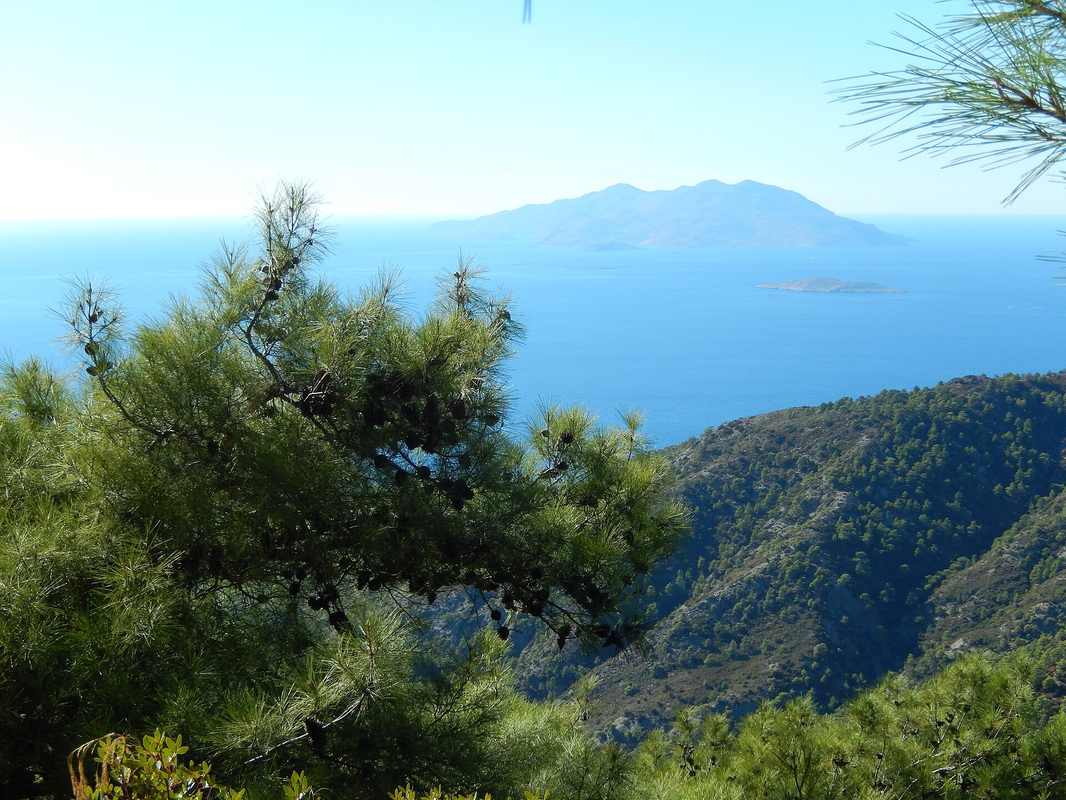
Mount Attavyros is the highest mountain on Rhodes, a bare, conical limestone summit rising to 1,215 metres in the west-central interior of the island, above the wine village of Embonas. Its smooth, treeless slopes give it a distinctive shape that is visible from much of Rhodes and, on clear days, from neighbouring islands and the Turkish coast. The peak rewards experienced walkers with one of the widest panoramas in the southern Aegean, and it carries the scattered remains of an ancient sanctuary of Zeus Atabyrios on its summit plateau. Surrounded by the island’s principal vineyards, it combines demanding hill-walking, archaeology and wine country in a single excursion. Plan your hike and tours with My Greece Tours.
For the wider context of where this peak sits among the island’s beaches, castles and villages, see our Rhodes travel guide. The sections below cover what makes Attavyros distinctive, how to walk the marked route, the safety supplies a treeless summit demands, the ancient sanctuary on top, and the wine villages and ruins that ring its base.
What makes Mount Attavyros the defining peak of Rhodes?
Mount Attavyros is the highest point on Rhodes at 1,215 metres, a bare conical limestone mass that dominates the western interior. Its treeless, rounded form, sweeping views and summit sanctuary make it the island’s most recognisable and ambitious natural landmark.
The mountain stands apart from the wooded ranges to its north and east because its upper slopes carry almost no tree cover, leaving a pale, stony dome that catches the light at dawn and dusk. This bareness is partly natural, the result of thin soils over hard limestone, and partly the legacy of centuries of grazing and old fires that stripped the higher ground. From a distance the cone looks deceptively gentle, but the gradient steepens sharply on the final pull to the top, and the lack of shade makes the climb feel longer than the distance suggests. The summit forms a broad, open plateau rather than a single sharp point.
From the top the panorama is vast, taking in much of Rhodes, the long western coastline and, in good visibility, the outlines of Halki, Tilos and the Turkish mainland across the water. The mountain’s prominence also gave it religious significance in antiquity, which is why a sanctuary was placed on so exposed a site. Today it draws hikers, naturalists and visitors curious about the vineyards spreading across its lower flanks. Our guide to Mount Profitis Ilias covers the island’s greener, forested second summit, and the next section covers how to walk the marked route to the top.
How do you hike to the summit of Mount Attavyros?
The ascent is a strenuous marked hike, usually begun from near Embonas or the village of Agios Isidoros. Expect several hours of steady climbing on rough ground to reach the 1,215-metre summit, and roughly the same time to descend safely.
Most walkers start from a trailhead reached by road above Embonas on the northern side, or from Agios Isidoros to the south, where a longer but clearly waymarked path climbs through old terraces before breaking out onto the open mountainside. The route is not technically difficult and requires no climbing equipment, but it is sustained and physically demanding, gaining a great deal of height over loose stones and rock. Sturdy boots with good ankle support are essential, as the surface is uneven throughout and twists an ankle easily. The waymarks, usually paint splashes and small cairns, need attention, since the trail fades across the bare upper slopes.
An early start is strongly advised, both to avoid the fierce midday heat on the unshaded slopes and to leave a comfortable margin for the return before light fades. Allow a full half-day or more for the round trip, and turn back in good time if cloud closes in, as the summit can be wrapped in mist that hides the waymarks. The reward is the steady opening of the view as you climb, until the whole island and the surrounding sea spread out below. Our guide to Embonas covers the village that serves as the usual base for the climb, and the next section covers the supplies a treeless summit demands.
What should you bring for a treeless, waterless summit?
Attavyros offers no shade and no water on its upper slopes, so walkers must be self-sufficient. Carry plenty of water, food, sun protection, a hat and warm layers, plus sturdy boots and a means of navigation, because the bare summit exposes you fully to sun, wind and cloud.
Water is the single most important item, as there are no springs or taps on the climb and the exposed limestone radiates heat through the warmer months. Most experienced walkers carry at least two to three litres per person, more in high summer, along with enough food to sustain a long, energetic day. Sun protection is equally vital on a slope with no trees to break the glare, so a wide-brimmed hat, sunglasses and high-factor sunscreen belong in every pack. Despite the heat lower down, the summit can be markedly cooler and windier, so a windproof layer is wise even on a hot morning, particularly if cloud rolls across the top.
Sound footwear matters as much as supplies, since the path crosses loose scree and broken rock where light trainers offer little grip or protection. A printed map or a phone with offline mapping helps when the waymarks thin out, and telling someone your plan and expected return time is a sensible precaution on a mountain with no facilities and limited mobile coverage. There are no shops, cafes or shelters on the route, so everything you need must be carried up and all litter carried down. Our guide to things to do in Rhodes covers gentler options for less demanding days, and the next section covers the ancient sanctuary waiting at the top.
What are the ruins of the sanctuary of Zeus Atabyrios?
The summit holds the remains of an ancient sanctuary of Zeus Atabyrios, the supreme weather god worshipped on the highest ground of Rhodes. Low walls, foundations and scattered stones mark where worshippers once climbed to honour the god of the heights.
In antiquity the people of Rhodes placed their cult of Zeus on the island’s loftiest point, a common Greek practice of dedicating high summits to the sky and weather god. The sanctuary of Zeus Atabyrios drew pilgrims who made the same arduous climb modern walkers undertake, leaving votive offerings on the exposed plateau. What survives today is modest, weathered by exposure to wind and storm at altitude, but the foundations and tumbled blocks still trace the outline of the sacred enclosure, and the setting itself conveys why the spot was chosen. Standing among the stones with the whole island falling away below makes the religious logic of the place immediately clear.
The cult was important enough that emigrants from Rhodes are said to have carried it overseas, founding sanctuaries to the same god in their new homes, which speaks to how central this mountain was to Rhodian identity. For the modern visitor the ruins reward the effort of the ascent with a tangible link between the strenuous walk and the island’s deep past, turning a tough hike into a journey to a place of ancient meaning. The summit plateau also makes a natural, if exposed, spot to rest and absorb the view before descending. Our guide to Ancient Kamiros covers another major archaeological site on the same western coast, and the next section covers the wine villages and castles ringing the mountain’s base.
What lies around the base of Mount Attavyros?
The mountain’s lower slopes hold the island’s main vineyards and the wine village of Embonas, with the medieval Monolithos Castle and the ancient city of Kamiros within easy reach. Together they make the western interior one of the most rewarding parts of Rhodes to explore.
Attavyros gives its name to a protected wine appellation, and its foothills are blanketed with vineyards that supply much of the island’s best-known wine. Embonas, on the northern flank, is the centre of this wine country, a working village where several producers welcome visitors to taste local reds and whites made from indigenous grapes grown on the mountain’s slopes. The combination of high, well-drained limestone soils and a cool elevation gives these wines their character, and a tasting after a morning on the mountain is a natural way to round off a visit. The surrounding landscape of terraced vines, stone walls and scattered chapels rewards an unhurried drive.
Beyond the vineyards, the dramatic clifftop ruin of Monolithos Castle stands to the south-west, while the excavated ancient city of Kamiros lies on the coast below the mountain’s northern side, so a single day can easily combine hill, history and wine. Our guide to Monolithos Castle covers the medieval fortress perched on its isolated rock, completing a western circuit around the peak. Plan your visit and tours through our Rhodes travel guide.
Frequently Asked Questions
How long does it take to hike Mount Attavyros?
Climbing Mount Attavyros is a serious half-day undertaking for fit, experienced walkers rather than a casual stroll. From the usual trailheads near Embonas or Agios Isidoros, the ascent to the 1,215-metre summit typically takes several hours of steady, sustained climbing over rough, stony ground, with a similar time needed for the descent. The exact duration depends on your fitness, the route chosen and the conditions, since heat, wind and loose footing all slow progress. It is wise to allow a generous margin and to plan a full half-day or more for the complete round trip, including rests and time at the top to enjoy the view and the ruins. An early start is strongly recommended so you finish the climb before the midday sun and return well before light fades, leaving room for the unexpected on a mountain with no facilities.
Do I need a guide to climb Mount Attavyros?
A guide is not strictly required, as the main routes are waymarked and need no technical climbing skill, but the walk should not be underestimated. The waymarks can fade across the bare upper slopes, mobile coverage is limited, and there is no water, shade or shelter on the mountain, so confident navigation and self-sufficiency are essential. Walkers experienced in steep, exposed terrain who carry a map or offline mapping, plenty of water and proper footwear can usually manage the ascent independently. Those less sure of their hill-walking or navigation will find a local guide adds both safety and insight, particularly into the sanctuary ruins, the geology and the surrounding vineyards. Whichever you choose, tell someone your plan and expected return time, set off early, and be ready to turn back if cloud closes in over the summit and obscures the route.
When is the best time to visit Mount Attavyros?
The most comfortable seasons for the climb are spring and autumn, when temperatures are moderate, the air is often clearer and the slopes are at their most colourful. Spring brings wildflowers across the lower ground, while autumn coincides with the grape harvest in the vineyards around Embonas, adding interest to the wider visit. High summer is best avoided for the ascent itself, as the treeless slopes become intensely hot and the lack of shade or water makes the climb genuinely demanding and potentially dangerous in the midday heat. If you do walk in summer, set off at first light and carry extra water. Winter can bring cold, wind and even snow to the summit, along with cloud that hides the waymarks, so it suits only well-equipped and experienced mountain walkers. Whatever the season, aim for a settled, clear day to enjoy the panorama.