
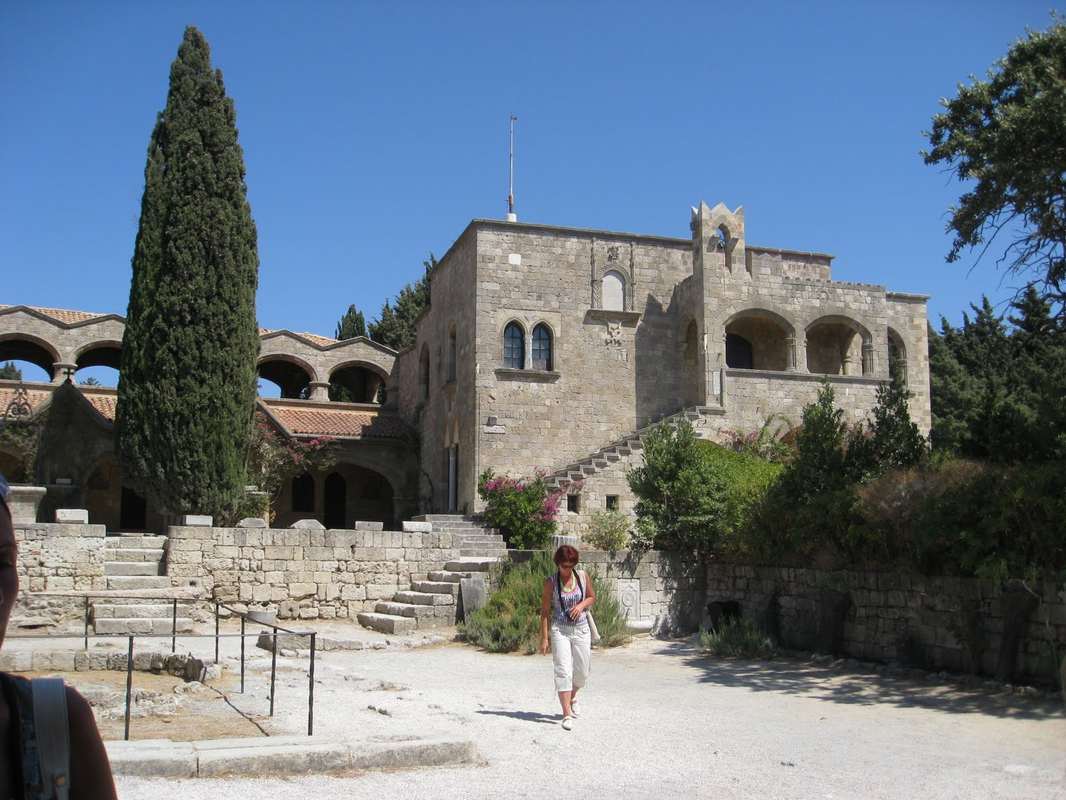
Ialysos is a coastal resort area on the north-west of Rhodes that grew around one of the three ancient Dorian cities of the island, with its ancient acropolis on Filerimos Hill rising just inland. Today it pairs a long, breezy beach loved by windsurfers with a quiet hilltop of temples, a monastery and panoramic views, making it an easy and rewarding half-day from Rhodes town. Plan tickets and tours through My Greece Tours.
For the wider island, our Rhodes travel guide sets Ialysos in context alongside its neighbours. The sections below cover what Ialysos is, what Filerimos Hill is, what you can see at Filerimos, where Ialysos sits and how to reach it, and the practical tips that help you visit both.
What is Ialysos?
Ialysos is a coastal area on the north-west of Rhodes built around one of the island’s three ancient Dorian cities. With Lindos and Kamiros, ancient Ialysos helped found the unified city of Rhodes. The modern resort, sometimes called Trianda, sits below its old acropolis on Filerimos Hill.
The name reaches back to the Dorian settlers who shaped Rhodes long before the classical period. Ialysos, Lindos and Kamiros were the three independent city-states of the island, and together they merged their fortunes to establish the great city of Rhodes near the northern tip. While Lindos kept its dramatic seaside acropolis and Kamiros its terraced ruins, Ialysos withdrew to the heights of Filerimos, where worship and defence could share the same commanding ground above the plain. The position controlled the fertile coastal plain and the sea approaches on the north-west side of the island, which is why successive rulers, from the Dorians to the Byzantines and the Knights, all valued and reused the same hilltop.
Today the coastal stretch is a relaxed holiday area, with hotels, tavernas and a long shingle-and-sand beach that runs towards neighbouring Ixia. The exposed north-west shore catches a steady afternoon breeze, which has made this one of the best windsurfing strips on Rhodes. Behind the resort the green hill keeps the older story alive. Our guide to Lindos covers its acropolis and village, and the next section covers what Filerimos Hill is.
What is Filerimos Hill?
Filerimos Hill is the wooded height rising behind Ialysos that served as the ancient acropolis of the city. It carries the remains of a Doric temple of Athena, a medieval monastery, Byzantine chapels and a tree-lined avenue leading to a tall summit cross, all set among pine woods where peacocks roam.
The hill takes its character from layer upon layer of settlement. The Dorians chose it as a natural stronghold and place of worship, the Byzantines added chapels, and the Knights of Saint John, followed in a later century by the Italians, restored its monastery and shaped much of what visitors see now. The result is an unusually calm site where ancient, Byzantine and medieval traces sit side by side under the trees, well above the noise of the coast below.
Filerimos is as much a parkland as an archaeological site. Shaded gravel paths wind between the ruins, resident peacocks call from the undergrowth, and the air is scented with pine and cypress. Because it stands apart from the busy resort, the hill feels contemplative rather than crowded, and it rewards an unhurried walk. Our guide to things to do in Rhodes covers the wider range of sights, and the next section covers what you can see at Filerimos.
What can you see at Filerimos?
At Filerimos you can see the foundations of a Doric temple of Athena, the restored Monastery of Our Lady of Filerimos, small Byzantine chapels, and the Way of the Cross, a tree-lined avenue with bronze reliefs that climbs to a tall cross at the summit. Peacocks wander the grounds throughout.
The ancient core is the temple of Athena, whose Doric foundations recall the religious heart of the old city-state. Beside the archaeological remains stands the Monastery of Our Lady of Filerimos, a serene medieval complex repaired during the period of the Knights and again under the Italians, with cloister-like walkways and modest chapels. Nearby, small Byzantine chapels and cisterns add to the sense of a place used and reused across many centuries of the island’s history. One subterranean chapel preserves faded frescoes, and the quiet, vaulted spaces of the monastery reward slow exploration, so it is worth stepping inside as well as walking the grounds among the trees.
The signature walk is the Way of the Cross, also known as the Via Crucis or Calvary, a straight avenue shaded by cypress trees and lined with bronze reliefs that tell the Passion story panel by panel. It leads to a tall cross at the very summit, which you can climb for a sweeping panorama over the coast, the airport plain and the sea towards Turkey. The peacocks, often seen displaying near the entrance, are a favourite with families. Our guide to Ancient Kamiros covers another of the three Dorian cities, and the next section covers where Ialysos sits and how to reach it.
Where is Ialysos and how do you get there?
Ialysos lies on the north-west coast of Rhodes, only a short way from Rhodes town and close to the island’s airport. The resort runs along the shore, while Filerimos Hill rises a short distance inland and is reached by a short drive up from the coastal road.
Because it sits between Rhodes town and the airport, Ialysos is one of the easiest areas on the island to reach. The coastal road links it directly with the old town to the north-east and with Ixia and the airport to the south-west, so transfers are quick whether you arrive by air or are already staying in the capital. Local buses and taxis serve the resort, and many visitors combine the beach with the hill in a single outing.
Filerimos itself is set back from the sea on its wooded height, reached by a clearly signed road that climbs gently inland from the coast. A car or taxi makes the ascent simple, and there is parking near the site entrance from which the paths begin. The short transfer from beach level to hilltop is part of the appeal, taking you from a lively shore to a quiet acropolis in a matter of minutes. Our guide to where to stay in Rhodes covers the resort areas nearby, and the next section covers the tips that help you visit Ialysos and Filerimos.
What tips help you visit Ialysos and Filerimos?
Visit Filerimos in the morning or late afternoon to avoid the midday heat, wear sturdy shoes for the gravel paths, and carry water. Dress modestly for the monastery, allow time for the Way of the Cross to the summit cross, and pair the hill with the breezy Ialysos beach below.
Filerimos is an open hillside site, so timing matters. Early morning and the cooler hours before sunset are kindest, both for walking the avenues comfortably and for the quality of the light over the coast. Comfortable shoes help on the gravel and stone paths, and a hat and water are sensible in the dry months. Because the monastery is an active religious site, modest dress, covering shoulders and knees, is appreciated, and a calm, quiet manner suits the contemplative mood of the grounds.
Give yourself enough time to walk the full Way of the Cross and climb the summit cross, as the panorama is the highlight of any visit. Children usually enjoy spotting the peacocks near the entrance. Down on the coast, the same trip can take in the long Ialysos beach, whose steady breeze suits windsurfing while quieter spells suit a swim. Combining hill and shore makes for a balanced half-day or relaxed full day. Plan your visit and tours through our Rhodes travel guide.
Frequently Asked Questions
Is Ialysos the same as ancient Ialysos?
The name covers two closely linked things. Ancient Ialysos, sometimes spelled Ialyssos, was one of the three Dorian city-states of Rhodes, alongside Lindos and Kamiros, and its acropolis stood on Filerimos Hill. The modern Ialysos, also called Trianda, is the coastal resort that spreads along the shore beneath that hill. So when people speak of visiting Ialysos today they usually mean the beach area and hotels by the sea, while the archaeological heritage of the old city is concentrated up on Filerimos. The two belong together: the resort grew on the fertile coastal plain that the ancient city once overlooked from its stronghold. A visit that takes in both the shore and the hill gives you the full picture, linking the relaxed holiday coast of the present with the religious and civic centre of the Dorian past that helped found the city of Rhodes itself.
How long should I spend at Filerimos?
For most visitors, around one and a half to two hours is comfortable for Filerimos, though enthusiasts may happily linger longer. That window lets you take in the foundations of the Doric temple of Athena, walk through the Monastery of Our Lady of Filerimos and its chapels, and follow the full Way of the Cross to the summit cross for the panoramic view over the coast. The site is compact but best enjoyed slowly, since much of its charm lies in the quiet, tree-shaded atmosphere and the resident peacocks rather than in covering ground quickly. If you are pairing the hill with the beach at Ialysos, plan a half-day overall, or a relaxed full day if you also want time to swim or windsurf. Visiting in the morning or late afternoon helps you avoid the midday heat on the open paths and gives softer light for photographs from the summit.
Can I combine Ialysos with other sights on Rhodes?
Yes, Ialysos and Filerimos sit conveniently for combining with other highlights of the island. Their position between Rhodes town and the airport means the medieval old town is only a short drive to the north-east, so many people pair a hilltop morning with an afternoon among the streets and walls of the capital. Heading the other way along the west coast brings you towards the ruins of Ancient Kamiros, the third of the Dorian cities, which makes a natural companion to Ialysos for anyone interested in the island’s classical past. The dramatic acropolis and village of Lindos lie further round the coast and deserve their own outing. Because Ialysos is so central and well connected, it works well either as a base or as one stop on a wider island itinerary. Our broader guide to things to do across the island can help you weave these places into a route that suits your time.