
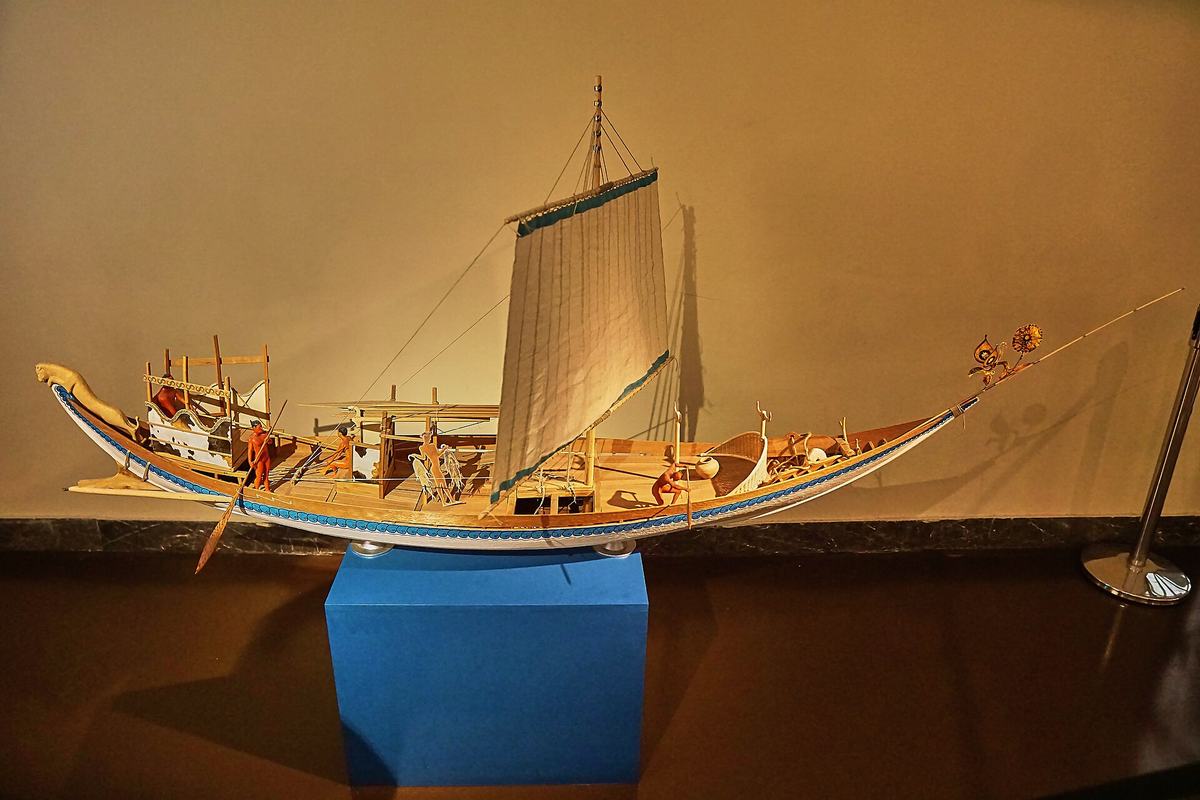
Minoan ships were the wooden oared galleys and single-sail vessels of Bronze Age Crete, the vehicles of a civilisation whose entire power rested on the sea rather than on armies or walls. Plan tickets and tours through My Greece Tours.
The same maritime wealth that built the unfortified Palace of Knossos flowed in along the keels of these ships. The sections below cover what Minoan ships were like, how they were built and crewed, the Minoan thalassocracy, what the Minoans traded and reached by sea, the harbours that served the fleet, how we know about Minoan ships, and why sea power mattered so much to them.
What were Minoan ships like?
Minoan ships came in two broad kinds: long narrow galleys driven by rows of oarsmen for speed and control, and broader hulls rigged with one square sail for cargo. Both carried the trade, fishing and travel of Bronze Age Crete across the Aegean.
The Minoan fleet was not a single design but a working range of vessels suited to different tasks. The long oared galleys sat low in the water and were manned by ranks of rowers, which gave the control needed to leave harbour against a contrary breeze and to hold a course through narrow island channels. These craft moved quickly when speed mattered, whether for carrying messages, patrolling routes or reaching a market ahead of rivals. Their narrow beam traded cargo room for handling, so they suited fast, light traffic rather than bulk freight across the open Aegean.
The broader hulls answered a different need. Set with a single square sail on a central mast, they used the simplest and most dependable rig of the age to carry weight over distance with a small crew. Wind did the work of many oarsmen, so a sailing trader could haul jars of olive oil, wine and pottery to Egypt or the Levant far more cheaply than a rowed galley. The two forms complemented each other, and a Cretan harbour would hold both the swift oared craft and the fuller sailing ships side by side.
Fishing boats, ferries and laden traders all belonged to the same maritime tradition. The craft were sturdy enough to cross open water to distant coasts, yet handy enough for short coastal hops between Cretan ports and the nearer Cyclades. Scale ranged from small inshore boats worked by two or three hands to larger sailing ships that needed a dozen or more. This was a practical system of movement rather than a fighting navy in the later sense. Our guide to Minoan trade covers the goods these hulls carried, and the next section covers how the ships were built and crewed.
How were Minoan ships built and crewed?
Minoan ships were built of worked timber planks assembled into a hull, driven by a single square sail on a central mast and by banks of oars. Crews of oarsmen, a helmsman at the steering oar and traders or fishermen worked each vessel.
Construction relied on timber, worked planks and the seafaring knowledge accumulated over generations of island life. Shipwrights shaped a hull from cut wood, raised a mast amidships to carry the square sail, and fitted a large steering oar at the stern for the helmsman to hold a course. The flotilla fresco and clay ship models show a raised prow and stern, cabins or shelters called ikria on the larger craft, and lines of oars along the sides. These features point to careful, repeatable boatbuilding rather than improvised rafts, worked by craftsmen who understood how a hull met the sea.
The crew brought the ship to life. Rowers supplied muscle on the oared galleys, pulling the vessel forward when wind failed or when handling demanded precision, while a helmsman leaned on the steering oar to steer through channels and into harbour. On the sailing traders a smaller crew tended a single square sail, trimming it to the wind and stowing it when oars were needed. The Akrotiri frieze shows figures seated in ranks, others standing by the cabins, and a helmsman at the stern, a picture of ordered, specialised work aboard each hull.
Movement combined sail and oar according to the weather. Sailors set the square sail to run before a following wind, then shipped oars to claw to windward or to hold station when the breeze died. Coastal knowledge mattered as much as muscle, since crews read landmarks, currents and seasonal winds to move island to island in safety. This blend of dependable rig, disciplined rowing and hard-won navigation let a small island fleet reach Egypt, the Levant and the Cyclades. Our guide to Minoan palaces of Crete covers the centres this seafaring supported, and the next section covers the Minoan thalassocracy.
What was the Minoan thalassocracy?
The Minoan thalassocracy was rule of the sea, a dominance built on ships rather than land armies. The word joins the Greek thalassa, sea, and kratos, power. The historian Thucydides credited the legendary King Minos with building the first navy.
The term captures how the Minoans projected influence, not through marching armies but through ships, harbours and the routes between them. Thucydides, writing long after the palaces had fallen, looked back on King Minos as the first ruler to build a navy worthy of the name, to command the sea around Crete, and to clear it of the raiders who preyed on merchant traffic. The same tradition holds that Minos planted settlements and colonies on the islands, installing his own sons and officers to govern them and secure the sea lanes for Cretan trade.
Whether Minos was one king or a memory of many rulers, the tradition records a real Cretan mastery of the waves. Archaeology supports the outline of that memory, since Minoan pottery, weights, script and building styles spread across the Cyclades and reached the coasts beyond. Sites such as Akrotiri on Thera and settlements on Kea, Melos and Rhodes show strong Cretan influence, the physical trace of the network the legend describes. The thalassocracy was less a formal empire with fixed borders than a web of harbours, colonies and trusted routes held together by ships.
That mastery turned the Aegean into something close to a Minoan lake during the height of palatial Crete. By controlling movement across the water, the islanders secured their trade routes, protected their cargoes and extended their reach to distant coasts without holding great stretches of foreign land. Sea power, not territory, was the currency of their dominance, and the suppression of piracy made every route safer for the traders who paid for the palaces. The next section covers what the Minoans traded and reached by sea.
What did the Minoans trade and reach by sea?
The Minoans traded across the eastern Mediterranean, reaching Egypt, the Levant, Cyprus, the Cyclades and mainland Greece. They exported olive oil, wine, pottery and textiles, and brought home copper, tin, gold and ivory, knitting Crete into a wide Bronze Age exchange network.
Minoan keels followed long-established sea lanes to the great powers and trading hubs of the age. To the south lay Egypt, a source of gold, ivory and prestige goods, where Cretan envoys and their products appear in tomb paintings. To the east stood the Levantine coast and Cyprus, the latter a key source of the copper that, alloyed with tin, made bronze. Closer to home, the Cyclades formed stepping stones across the Aegean, their harbours tied tightly to Cretan ports, while mainland Greece drew Cretan goods and craft ideas across the water.
Through these routes the Minoans gathered the raw metals and rare materials their own island could not supply. Copper came largely from Cyprus, tin travelled from far inland sources through the Levantine trade, and gold and ivory arrived from Egypt and the east. Each was worked in Cretan palace workshops into tools, weapons, vessels and jewellery. The island lacked these materials in quantity, so the fleet was the lifeline that fed the craftsmen and the treasuries. Control of the routes therefore meant control of the raw wealth of a Bronze Age economy.
In return Crete sent out the produce of its land and workshops. Sailing ships carried olive oil and wine in painted jars, the celebrated fine pottery of the palaces, woven textiles and the work of craftsmen in stone, metal and faience. This two-way flow made the island prosperous and gave Minoan goods a presence on distant shores, where their pottery still turns up in excavations today. The exchange was as much about ideas, styles and craft skills as about cargo. Our guide to Palace of Zakros covers the eastern harbour town that faced these trade routes, and the next section covers the harbours that served the fleet.
Which harbours served the Minoan fleet?
Minoan harbours ringed Crete and served the fleet with slipways, ship-sheds and stone warehouses. Kommos, Nirou Chani, Amnisos, Poros-Katsambas, Zakros and Gournia handled ships, cargo and repair, linking the inland palaces to the sea lanes of the Aegean.
Kommos on the south coast is the best-known Minoan port site, with long ship-sheds or slipways and rows of stone warehouses set close to the shore. The ship-sheds gave shelter where hulls could be drawn up, stored out of the water and maintained through the off-season, while the warehouses held goods moving between land and sea. On the north coast, Poros-Katsambas served as the harbour of Knossos, the point where the produce of the great inland palace met the ships that carried it abroad. Amnisos, nearby, was another north-coast landing tied to the same network of routes.
The harbours were more than beaches for hauling boats. Nirou Chani, east of Knossos, has been read as a coastal centre linked to seaborne activity and ritual, its rooms yielding equipment on a scale that points to organised maritime work. At Gournia in the east, excavators have identified a possible ship-shed and a shoreline built for handling craft, tying the town directly to the sea. These works of stone and timber show planning, since a slipway, a warehouse and a sheltered anchorage together turn an open coast into a working port.
Zakros, at the far eastern tip of Crete, faced the routes toward the Levant, Cyprus and Egypt, and its palace stood close to a sheltered bay that received seaborne goods. The spread of these ports around the island shows a coastline organised for the sea, with the fleet, its cargoes and its crews woven into daily life. Each harbour joined an inland centre to the wider Aegean, so the ships were the threads and the ports the knots of the Minoan network. Our guide to the Heraklion Archaeological Museum covers where finds from these coastal sites are displayed, and the next section covers how we know about Minoan ships.
How do we know about Minoan ships?
We know Minoan ships chiefly from art and models, since no full hull survives. The Akrotiri flotilla fresco on Thera shows a fleet in detail, and seals, signet rings, painted pottery and clay ship models add further evidence of how the vessels looked.
The richest single source is the miniature flotilla fresco from Akrotiri, the Bronze Age town on Thera, the island now called Santorini. Buried and preserved by a volcanic eruption, its painted frieze shows a procession of ships moving between two harbour towns, complete with rigging, ikria cabins, seated oarsmen and dolphins leaping through the water. It is the closest thing we have to a contemporary photograph of an Aegean fleet under way, and it confirms the mix of oared and sailing craft that other evidence implies. The freshness of the ash-sealed paint lets scholars study hull shape, decoration and crew arrangement in fine detail.
Beyond the fresco, smaller objects fill out the picture. Minoan seals and signet rings, carved to stamp documents and goods, sometimes show ships in tiny but telling detail, as does painted pottery decorated with maritime motifs. Modelmakers also shaped boats in clay, and examples from Mochlos and Palaikastro leave three-dimensional impressions of hull, prow and stern. Each class of evidence corrects and confirms the others, so a detail seen on a seal can be checked against a model or the fresco. Together these scattered traces let scholars reconstruct vessels that have otherwise rotted away.
No full hull has yet been recovered, so every reconstruction rests on art, models and a little wreck evidence rather than a preserved ship. The waterlogged timbers of a complete Minoan vessel have not survived the millennia, and the wreck traces known from the Bronze Age Aegean are limited and fragmentary. Scholars therefore read the painted flotilla, the carved seals and the clay models together, cross-checking one against another to rebuild in the mind what the sea has dissolved. The next section covers why sea power mattered to the Minoans.
Why did sea power matter to the Minoans?
Sea power was the foundation of Minoan security and wealth. Their palaces stood unfortified, without great defensive walls, a choice that points to trust in the fleet. Control of the sea guarded Crete and fed its prosperity at once.
One of the most telling clues to Minoan priorities is what their palaces lacked, which is heavy fortification. Across much of the ancient world, important centres hid behind thick walls, yet the great Cretan palaces at Knossos, Phaistos and Zakros stood open, their grandeur turned to courtyards, storerooms, shrines and workshops rather than ramparts. Historians read this as evidence that the Minoans saw the sea itself as their defensive line, patrolled by the fleet that the thalassocracy tradition remembers. The idea of ships as a moving wall, sometimes called wooden walls, fits an island people whose safety began at the water’s edge.
Sea power was therefore both shield and engine. The same command of the water that kept raiders away also carried in the copper, tin, gold and ivory that made the workshops flourish, and carried out the oil, wine, pottery and textiles that paid for it. The fleet defended the coast, protected the trade routes and moved the wealth that filled the treasuries. Two functions, defence and commerce, ran through the same hulls, so the ship was at once a warship on patrol and a merchantman under sail. This dual role explains why the Minoans invested so heavily in harbours and craft.
Lose the sea, and both halves of that bargain would collapse. A rival who mastered the Aegean could cut the supply of metals, expose the coast to raiders and starve the palaces of the trade that sustained them. The Minoan achievement, an open and undefended civilisation grown rich at the centre of a busy sea, depended entirely on holding the water around it. When the balance of power in the Aegean later shifted toward the mainland, the maritime foundation of Crete gave way with it. Plan your visit and tours through our Palace of Knossos guide.
Frequently Asked Questions
Were Minoan ships warships or trading vessels?
Minoan ships were first and foremost vessels of trade, fishing and travel rather than dedicated warships of the later kind. The long oared galleys and single-sail traders that made up the fleet carried cargo, passengers and the produce of Crete across the Aegean. The same fast oared craft that policed the sea lanes and suppressed piracy also gave the Minoans real naval capability, which is why Thucydides could speak of King Minos founding the first great navy. The line the modern mind draws between a merchant marine and a battle fleet was blurred in the Bronze Age, since the ships that traded also guarded the routes. Minoan sea power lay less in purpose-built warships than in the ability to move and protect maritime traffic.
What is the Akrotiri flotilla fresco and why is it important?
The Akrotiri flotilla fresco is a miniature wall painting from the Bronze Age town of Akrotiri on Thera, the island known today as Santorini. It depicts a fleet moving between two harbour towns, rendered in detail with rigging, ikria cabins, oarsmen and leaping dolphins. The painting matters because it is the single most informative surviving image of Minoan and Aegean seafaring, a contemporary window onto how these vessels looked and operated. Akrotiri was buried under volcanic ash when Thera erupted, and that catastrophe preserved its wall paintings with striking freshness. From the frieze, scholars study the form of the hulls, the use of oars and sails, and the central place of the sea. Where written records are silent and no full hull survives, this painted flotilla supplies concrete evidence.
How do we know about Minoan ships if none survive?
No complete Minoan hull has survived the millennia, so knowledge of the ships comes from images and models rather than a preserved vessel. The flotilla fresco at Akrotiri supplies the fullest picture, showing hulls, sails, oars, cabins and crew in one painted scene. Carved seals and signet rings, made to stamp documents and goods, add small but precise depictions, and painted pottery carries maritime motifs. Clay ship models from Mochlos and Palaikastro give three-dimensional evidence of prow, stern and hull shape. Wreck traces from the Bronze Age Aegean exist but are limited and fragmentary. Scholars reconstruct the ships by reading these sources together, checking a detail on a seal against a model or the fresco, building a confident outline from many small survivals.
What did Minoan ships carry, and where did they sail?
Minoan ships carried the exports of Crete outward and brought raw materials home. Sailing traders loaded olive oil and wine in painted jars, fine palace pottery, woven textiles and worked crafts, and set course for Egypt, the Levant, Cyprus, the Cyclades and mainland Greece. On the return they carried copper from Cyprus, tin drawn through the Levantine trade, and gold and ivory from Egypt and the east. The Cyclades served as stepping stones across the Aegean, letting crews hop island to island, while longer runs to Egypt and the Levant crossed open water under sail. Cretan pottery found on distant shores marks the reach of these voyages. The cargoes fed the palace workshops and treasuries, tying the wealth of Crete to the sea lanes the fleet controlled.
Why were Minoan palaces built without defensive walls?
The Minoan palaces, including the great centre at Knossos, were built without the massive defensive walls that protected important sites elsewhere in the ancient world. This unfortified character is one of the strongest arguments that the Minoans relied on the sea, and on the ships that controlled it, for their security. A civilisation that dispenses with ramparts at its richest places must feel safe from attack, and for an island people that safety came from naval strength. Controlling the approaches by water meant hostile forces could be intercepted long before they reached Cretan soil. The maritime dominance recorded in the thalassocracy tradition thus shows up in the architecture, in open palaces devoted to storage, craft and ceremony rather than war.
How did Minoan sailors navigate the Aegean?
Minoan sailors navigated by coastal hopping, moving island to island within sight of land and reading the sea rather than charting the open ocean. Crews followed familiar landmarks, headlands and island silhouettes, and timed their voyages to the sailing season when winds were kinder. The single square sail carried a ship before a following wind, while oars let a galley claw to windward when the breeze failed. Knowledge of currents, prevailing winds and safe anchorages passed down through seafaring families and made the difference between a smooth passage and a lost cargo. The Cyclades, strung across the Aegean, gave a chain of stepping stones that kept most voyages within reach of shelter. This blend of seamanship and dependable craft turned the Aegean into a network the fleet crossed with confidence.