
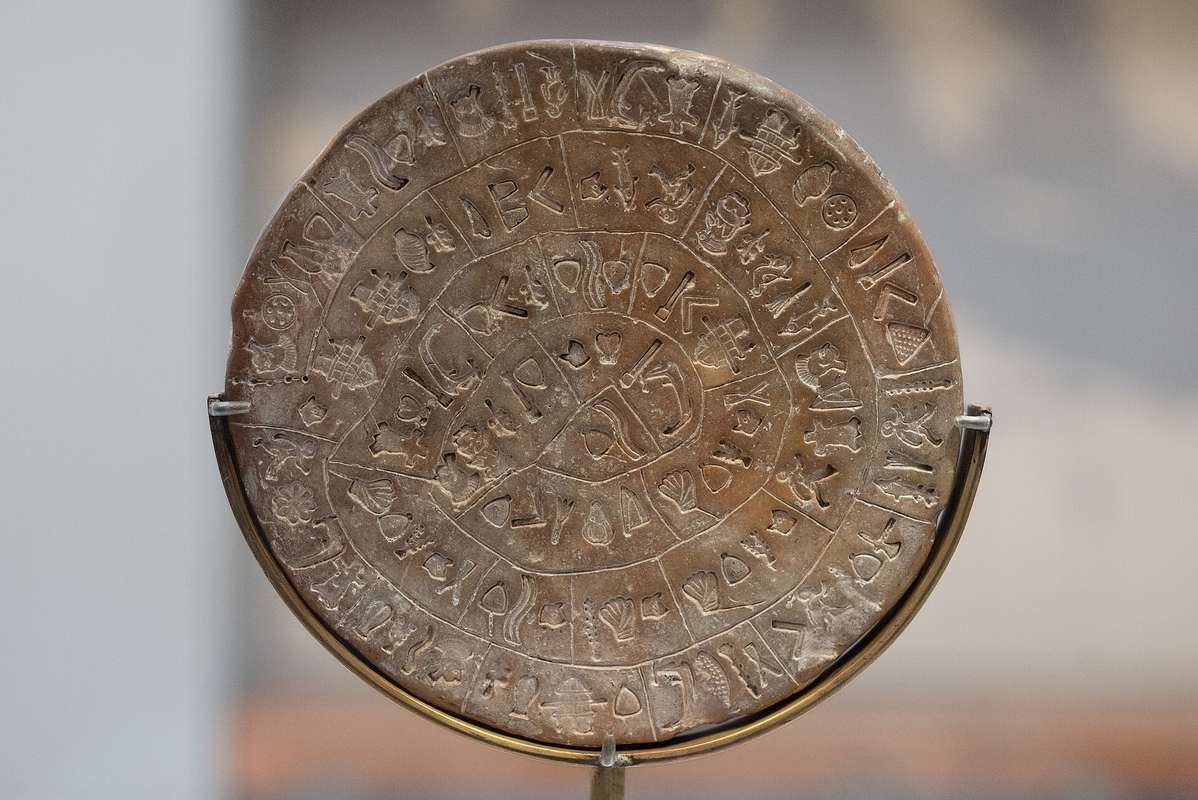
The Phaistos Disc is a fired-clay disc about sixteen centimetres in diameter, stamped on both faces with a spiral of pictographic signs that were impressed using pre-formed punches, an early and isolated experiment resembling movable type. It was found at the Minoan palace of Phaistos in southern Crete and remains one of archaeology’s most famous undeciphered objects. Plan tickets and tours through My Greece Tours.
The disc belongs to the wider Minoan world centred on the great palaces, and its story sits naturally alongside our guide to the Palace of Knossos. The sections below cover what the disc actually is, where and when it was found, what is stamped on its surface, how it was made and dated, whether anyone has truly deciphered it, how it compares with the other Minoan scripts, and where you can see it today.
What is the Phaistos Disc?
The Phaistos Disc is a circular fired-clay tablet, roughly sixteen centimetres across, stamped on both sides with a continuous spiral of small pictographic signs. Pre-formed punches pressed each sign into the soft clay before firing, making it a remarkable and unusual Minoan artefact.
The Phaistos Disc stands apart from almost every other object surviving from the Minoan period because of how it was made. Rather than being scratched or incised by hand, each individual sign was punched into the wet clay using a set of pre-formed stamps, one stamp for each distinct symbol. The same physical punch produced identical impressions wherever a given sign recurs across the surface. Scholars often describe the technique as an early, isolated experiment in what would much later be called movable type, even though nothing comparable appears again for many centuries afterwards in the Aegean region.
Physically the disc is modest in scale, roughly sixteen centimetres in diameter and about two centimetres thick, yet it carries an extraordinary density of information across both of its faces. The signs spiral inward from the rim toward the centre, grouped into small clusters separated by short vertical strokes. Because the object is unique, with no clear parallel found elsewhere, it resists the usual archaeological methods of comparison. Our guide to the Palace of Phaistos covers the site that gave the disc its name, and the next section covers where and when the disc was found.
Where and when was the Phaistos Disc found?
The Phaistos Disc was discovered at the Minoan palace of Phaistos in southern Crete by the Italian archaeologist Luigi Pernier during early-twentieth-century excavations. It came to light within the palace complex, the second great Minoan centre on the island after Knossos.
Phaistos sits on a low ridge in the fertile Messara plain of southern Crete, commanding wide views toward the surrounding mountains and the sea. The palace was one of the principal Minoan centres, second in importance only to Knossos, and Italian archaeologists worked the site intensively in the early twentieth century. During this campaign Luigi Pernier recovered the clay disc that now bears the palace’s name. The find immediately attracted attention because nothing quite like it had ever been recorded on the island or anywhere else.
The disc emerged from the palace complex rather than from an isolated tomb or shrine, which places it firmly within the daily and administrative life of a Minoan centre. Its precise findspot and the deposit around it have been much discussed, because dating the object depends heavily on understanding that context. The Bronze Age palaces of Crete have yielded many inscribed objects, and the disc joined a growing body of Minoan writing that scholars were only beginning to classify. Our guide to the comparison of Knossos and Phaistos covers how the two palaces relate, and the next section covers what is actually stamped on the disc’s surface.
What is written on the Phaistos Disc?
Both faces of the disc carry pictographic signs arranged in a spiral and divided into small groups by short strokes. Around two hundred forty-one sign-impressions appear in total, drawn from about forty-five distinct symbols depicting figures, objects, plants and other recognisable shapes.
The surface of each face is covered by a single spiralling band of signs that winds from the outer edge inward toward the centre. Within this band the signs are organised into small clusters, each cluster set off from its neighbours by a short vertical stroke. Many scholars read these clusters as the equivalent of words or grouped units, though without an agreed reading this remains an interpretation rather than a certainty. The individual symbols are pictorial and often quite charming, showing what look like human heads, walking figures, animals, plants, tools and everyday objects.
Counting carefully, researchers find around two hundred forty-one individual sign-impressions across both faces, produced from a repertoire of about forty-five distinct symbols. The repetition of the same stamped shapes is what allows this tally to be made with confidence. Beyond the count, however, almost everything is debated, including whether the text should be read from the rim toward the centre or the other way around. Our guide to Minoan Linear A covers a related undeciphered script from the same world, and the next section covers how the disc was actually made.
How was the Phaistos Disc made?
The Phaistos Disc was made from a round of clay, into which each sign was pressed with a pre-formed punch while the clay was still soft. One dedicated stamp produced every occurrence of a given symbol, then the disc was fired hard.
The craftsman began with a disc of moist clay about sixteen centimetres wide and shaped it into two smooth faces. Working from a set of about forty-five carved punches, one for each distinct sign, the maker pressed the symbols into the surface in a spiralling sequence that runs from the rim inward. Because a single punch created every instance of its sign, the impressions of any one symbol are effectively identical across both faces. This repeatable, mould-based method is why the disc is so often described as a distant forerunner of movable type, standing centuries ahead of anything comparable in the region.
Once the stamping was complete, short vertical strokes were drawn by hand to separate the signs into clusters, and the disc was fired to harden the clay and fix the impressions permanently. The material is therefore baked terracotta rather than the sun-dried clay used for many everyday Minoan tablets, which helps explain why it has survived so well. The two faces together carry around two hundred forty-one impressions, a dense record packed onto a palm-sized object. Nothing else from the Minoan world was produced by quite this stamping process, which reinforces how singular the artefact is.
How old is the Phaistos Disc?
The Phaistos Disc dates to the Bronze Age Minoan period, most likely the second millennium before the common era. Its exact age is debated because dating depends on the deposit around it, and that findspot context has been questioned.
The disc belongs firmly to the Bronze Age civilisation that built the great Cretan palaces during the second millennium before the common era. Phaistos flourished across the era of the first and second palaces, and the disc is generally placed within that long palatial phase. Precise dating rests on the layer in which the object was found and on the pottery and other material recorded alongside it, since a clay artefact carries no inherent date of its own. Scholars therefore reason from the surrounding deposit rather than from the disc itself.
The difficulty is that early excavation records are less detailed than modern standards demand, so the reliability of the original findspot has been reassessed over time. Different specialists have argued for slightly earlier or later positions within the Bronze Age, and the debate continues without a single agreed answer. What is not in doubt is the broad framework, a Minoan palatial object of the second millennium before the common era, contemporary with the wider world of Cretan writing. Our guide to Linear B at Knossos covers the later script from that same Bronze Age setting.
Has the Phaistos Disc been deciphered?
No, the Phaistos Disc has not been deciphered, and the language it may record is unknown. Many decipherment claims have appeared, proposing readings as hymns, prayers, lists or narratives, but none has won acceptance, partly because the text is so short and unique.
Decipherment normally relies on a substantial body of text, ideally with related inscriptions or a bilingual key that links the unknown script to a known one. The Phaistos Disc offers none of these advantages. It is a single short object with no confirmed parallels, so there is simply not enough material to test any proposed reading against. This scarcity is the central obstacle, and it explains why the disc has resisted generations of linguists, mathematicians and enthusiasts who have each been convinced they held the answer.
A long succession of proposed solutions has appeared, interpreting the signs as everything from a religious hymn to a calendar, a board game, a list of place names or a narrative of events. Some proposals are careful and scholarly while others are highly speculative, yet they share a common fate, because no single reading has been demonstrated in a way that other specialists can independently verify and accept. The honest position remains that we do not know what it says. The next section covers the theories that scholars and amateurs have put forward over the decades.
What theories explain the Phaistos Disc?
Theories about the Phaistos Disc range from a hymn or prayer to a goddess, to a calendar, a board game, a list of place names, or a narrative. Every reading remains unverified, because the short, unique text cannot be independently tested.
Religious readings are among the most popular, casting the spiral of signs as a hymn or prayer addressed to a Minoan deity, with the two faces treated as verses or invocations. Other proposals treat the disc as a practical document, such as a calendar that tracks days or seasons, or an administrative list recording place names, offerings or personnel. A further group of ideas sees the object as a game board, where the spiral track and clustered signs guide the movement of pieces. Each interpretation fits some features of the disc while leaving others unexplained.
The reason none of these theories can be confirmed is structural rather than a matter of effort. With only around two hundred forty-one impressions and no comparable text to check a reading against, any proposed translation rests on assumptions that cannot be falsified. A hymn, a calendar and a game board can all be argued for the same signs, and nothing in the surviving evidence decides between them. That is why specialists treat every published solution, however ingenious, as an unproven hypothesis rather than a genuine reading of the Phaistos Disc.
How does the Phaistos Disc compare to Linear A and Linear B?
The Phaistos Disc does not match either Linear A or Linear B. Linear B was deciphered and records early Greek, while Linear A stays undeciphered. The disc’s stamped pictographs differ from both handwritten scripts and form no demonstrated part of that family.
Linear B is the success story of Aegean writing, a script that scholars cracked and showed to record an early form of Greek used in the palace administrations. Linear A, the earlier Minoan system, remains undeciphered and encodes an unknown language, much like the disc itself. Both of these scripts were written by hand, incised or drawn into clay with a stylus, which sets them apart at once from the punched, stamped signs of the Phaistos Disc. The technique alone marks the disc as a different kind of object.
Beyond the method, the sign shapes on the disc do not line up neatly with the repertoires of either Linear A or Linear B, so scholars cannot slot it into that known sequence of Cretan scripts. Occasional comparisons are drawn with Cretan hieroglyphic signs and with inscribed seals, yet no convincing direct link has been established. The disc therefore stands as an intriguing outlier, related in spirit to the wider story of Minoan writing but not in any demonstrated descent from it. This isolation is a large part of why it remains so stubbornly resistant to reading.
Where can you see the Phaistos Disc?
The Phaistos Disc is displayed in the Heraklion Archaeological Museum in Heraklion on Crete, which holds the island’s foremost collection of Minoan artefacts. The disc is one of the museum’s signature exhibits, shown alongside other treasures of the Bronze Age palaces.
The Heraklion Archaeological Museum gathers the most important finds from across Minoan Crete, and the Phaistos Disc is among the objects visitors most want to see. Displayed under glass so that both faces and the spiral arrangement of signs can be appreciated, it sits within galleries that trace the rise and achievements of the palace civilisation. Seeing it in person conveys something the photographs cannot, namely how small and intimate the object is in relation to the enormous scholarly attention it has attracted for more than a century.
A visit to the museum pairs naturally with a trip to the palace sites themselves, and many travellers combine Heraklion with an excursion to nearby Phaistos in the south. The museum also holds a wealth of related material, from frescoes and pottery to inscribed seals and tablets, that places the disc in its broader cultural setting. Our guide to the Heraklion Archaeological Museum covers planning a visit and the other highlights on display. Plan your visit and tours through our Palace of Knossos guide.
Frequently Asked Questions
Is the Phaistos Disc genuine or a forgery?
The Phaistos Disc is generally accepted by mainstream scholarship as a genuine ancient artefact recovered during controlled excavations at the Minoan palace of Phaistos in southern Crete. A small number of researchers have raised questions about its authenticity, precisely because it is so unusual and has no clear parallels anywhere in the archaeological record. These doubts remain a minority view and have not displaced the consensus that the object is authentic.
The disc was found within the palace complex during professional fieldwork rather than appearing on the antiquities market, which is one of the factors that supports its acceptance. Its uniqueness is genuinely striking, and that very uniqueness is what fuels both the fascination surrounding it and the occasional sceptical question. For the ordinary visitor, the museum presents it without reservation as a real and important piece of Minoan heritage worth seeing in person.
Why is the Phaistos Disc so hard to decipher?
The central difficulty is that the disc provides far too little text to work with and stands almost entirely alone. Successful decipherments of ancient scripts usually depend on a large corpus of inscriptions, ideally accompanied by a bilingual document that pairs the unknown writing with a language scholars already understand. The Phaistos Disc offers neither. It is a single short object carrying only around two hundred forty-one sign-impressions, with no confirmed companion texts to compare it against and no bilingual key to unlock it.
The underlying language is unknown, so even if every sign could be assigned a sound, there would be no certainty about what words those sounds formed. The direction of reading and the function of the dividing strokes are also debated. These compounding uncertainties mean that, despite enormous effort, any proposed reading remains untestable, which is why no decipherment has been independently verified and accepted by the wider scholarly community.
How does the Phaistos Disc relate to other Minoan writing?
The Phaistos Disc belongs to the same broad Bronze Age world that produced the other early scripts of Crete, yet it does not clearly match any of them. The Minoans used a writing system known as Linear A, which is itself undeciphered and records an unknown language, and the later Linear B, which was deciphered and shown to record an early form of Greek. The disc’s pictographic signs do not correspond neatly to either of these systems, and its stamping technique sets it apart from the handwritten tablets.
This isolation is a large part of what makes it so puzzling, because scholars cannot slot it into a known family of related inscriptions. Comparisons are sometimes drawn with Cretan hieroglyphic signs and with inscribed seals, but no convincing direct link has been established. The disc therefore sits as an intriguing outlier within the story of Aegean writing, related in spirit but not in any demonstrated descent.
How big is the Phaistos Disc?
The Phaistos Disc is a small, palm-sized object, roughly sixteen centimetres in diameter and about two centimetres thick, made of fired clay. Despite these modest dimensions it carries a dense record of around two hundred forty-one sign-impressions spread across both of its faces. The contrast between its compact physical size and the scale of scholarly attention it has drawn is one of the things visitors find most striking when they see it in person.
Stamping rather than writing left the signs sitting crisply on the surface, and the spiral arrangement packs a great many symbols into a limited area. Photographs tend to exaggerate its presence, so people are often surprised by how genuinely small the disc is when they first encounter it in the Heraklion Archaeological Museum, where it is displayed under glass for close inspection.
Who found the Phaistos Disc?
The Phaistos Disc was found by the Italian archaeologist Luigi Pernier, who was working at the Minoan palace of Phaistos in southern Crete during the early-twentieth-century Italian excavations. Pernier recovered the object from within the palace complex, and it quickly became one of the most talked-about finds of the campaign because nothing comparable had been recorded before.
The controlled, documented nature of the excavation is an important part of why the disc is accepted as authentic today, since it came from professional fieldwork rather than from an unprovenanced sale. Pernier’s discovery placed the disc within the daily setting of a major Minoan centre, second only to Knossos in importance. More than a century later the object he lifted from the Messara plain remains a defining puzzle of Aegean archaeology and a highlight of the museum that now houses it.