
Gournia is the best-preserved Minoan town on Crete, a complete Bronze Age settlement of paved lanes, small houses, workshops, a public square and a modest governor’s residence overlooking the Gulf of Mirabello in the island’s east. Unlike the great ceremonial centres, it preserves the texture of ordinary Minoan daily life rather than royal grandeur. Plan tickets and tours through My Greece Tours.
Where the Palace of Knossos shows the Minoan court at its grandest, Gournia shows the people who supplied it, a working town of potters, smiths and weavers laid out across a low hill. The sections below cover what Gournia is, where it sits and how to reach it, what survives to see on site, why archaeologists value it so highly, when it rose and fell, the crafts and trade that sustained it, and how to plan a visit today.
What is Gournia?
Gournia is a Minoan town, the most completely preserved settlement of the Bronze Age Aegean. It is a working community, not a palace: a hillside grid of paved lanes, packed houses, craft workshops, a public square and a small governor’s residence.
The word that best describes Gournia is completeness. Most Minoan sites survive as fragments of one grand building, but here an entire town plan endures: you can trace where the main streets run, how side lanes branch off them, and how clusters of small flat-roofed houses pack together around a public square. The settlement covers a low coastal hill, and its layout reads almost like a map drawn in stone. Walking it, you sense a real community rather than a monument, with thresholds, drains and party walls still in place.
Its character is domestic and industrial rather than ceremonial. The houses are small, built of rubble and mudbrick on stone footings, and the lower town was a place of work, where potters, metalsmiths and weavers practised their crafts. A modest residence near the central square served whoever governed the town, yet it is dwarfed by the palaces elsewhere on the island. Our guide to Minoan architecture covers how these houses were built and roofed, and the next section covers where Gournia sits and how to reach it.
Where is Gournia and how do you get there?
Gournia lies in eastern Crete on the Gulf of Mirabello, near the isthmus of Ierapetra, on the coastal road between Agios Nikolaos and Sitia. It sits on a low hill inland from the sea, an easy stop on any eastern-shore drive.
Gournia is one of the most accessible Minoan sites on Crete because it stands right beside the main eastern coastal road, roughly nineteen kilometres east of Agios Nikolaos and close to the village of Pachia Ammos. Driving from Agios Nikolaos, the regional hub at the head of the Gulf of Mirabello, the site appears on its hill after a short journey eastward; continuing on, the road carries on towards Sitia in the far east. The setting matters as much as the access: the town looks out over the gulf, and the narrowest neck of Crete, the isthmus of Ierapetra, lies close by, linking the north and south coasts of the island.
A hire car gives the most freedom, since the eastern coast rewards a slow drive with bays, fishing harbours and other archaeological stops along the way. Buses running between Agios Nikolaos and Sitia pass close to the turning, so the site can also be reached without driving, though services are limited and worth checking in advance.
The site entrance sits right by the road, with a small parking area and a ticket booth, so the approach is quick once you arrive. Pachia Ammos and the resort of Istron lie a short distance away for a meal or a swim, and Agios Nikolaos itself makes a convenient base with its harbour, hotels and hire-car offices. Ierapetra on the south coast is a straightforward drive over the isthmus, which places Gournia within easy reach of both shores. Our guide to the palace of Zakros covers the harbour town further east along this same coast, and the next section covers what you can actually see once you arrive at Gournia.
What can you see at Gournia?
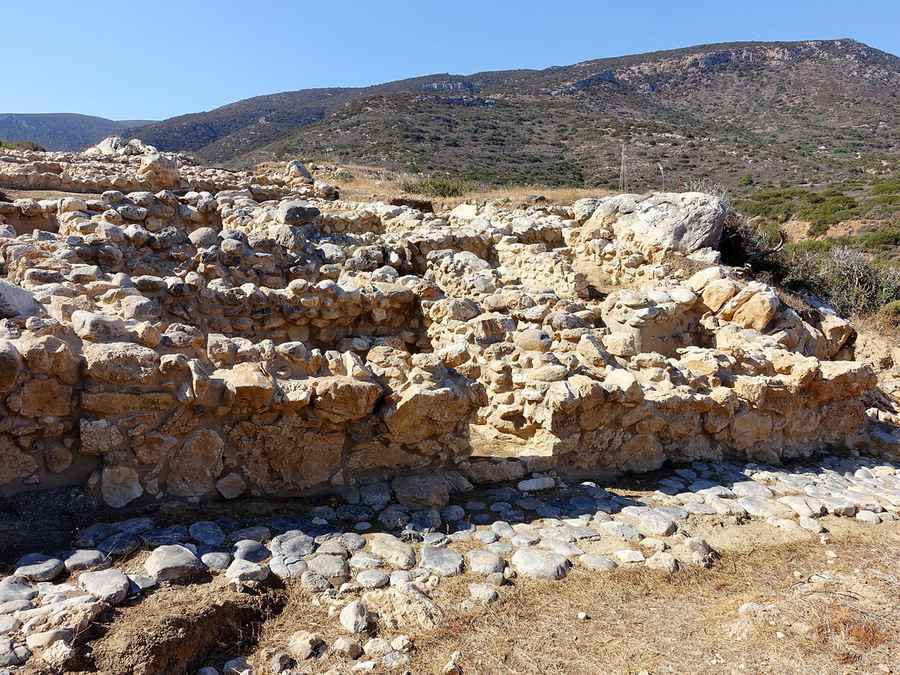
At Gournia you walk a complete Minoan town: paved streets and stepped lanes, the footings of small houses, craft workshops, a cobbled public square, and the compact governor’s residence at its centre. The remains stand low, yet the whole plan is legible underfoot.
The first thing visitors notice is the street system. A paved main road curves through the town, and from it narrow, sometimes stepped lanes lead up and down the slope to the house doors. The walls survive to roughly knee or waist height across much of the site, so you can follow these streets continuously, turning corners exactly where the Minoans did. The houses themselves are small and densely packed, their ground-floor rooms still defined by stone footings, with thresholds and the occasional fixed feature hinting at storerooms, kitchens and workshops.
Near the centre lies an open public square and, beside it, the so-called palace, a small residence that echoes the planning of the great palaces in miniature rather than rivalling their scale. A stepped area beside the square may have served as a place of public gathering, sometimes described as a primitive theatre. The lower quarters preserve the evidence of a working town, with spaces given over to crafts. Even without its lost upper storeys and roofs, the site conveys how a Minoan community actually lived and worked.
Two features reward a close look. A shrine on the higher ground yielded ritual objects, including terracotta figures linked to a snake goddess, hinting at the town’s religious life. Drains and channels run beneath and beside the paved streets, evidence of a practical water and waste system built into the town from the start. Small courtyards, storerooms and light wells break up the house blocks, so the plan reads as living quarters rather than an undifferentiated ruin. Our guide to the Heraklion Archaeological Museum covers where the finest Minoan finds are displayed, and the next section covers why Gournia matters so much to archaeologists.
Why is Gournia important?
Gournia is important because it preserves an entire Minoan town, not a single palace, giving rare insight into ordinary Bronze Age life and craft. Its completeness earned the nickname the Pompeii of Crete, and its excavation was a landmark in archaeology.
Almost everything famous about Minoan Crete comes from the palaces, with their frescoes, store magazines and ceremonial spaces. Gournia balances that picture by showing the other side of the civilisation, the townspeople who made the pottery, worked the metal and wove the cloth on which palace life depended. The settlement survives whole, so scholars can study how houses related to streets, how workshops sat among homes, and how a small provincial centre organised itself, questions that fragments of a single great building cannot answer.
The excavation itself is part of the story. Gournia was uncovered in the opening years of the twentieth century by the American archaeologist Harriet Boyd Hawes, and it ranks among the first major excavations in the Aegean to be directed by a woman, a notable moment in the history of the discipline. Her careful clearing of the town set a standard for studying Minoan settlement as a whole, treating streets and houses together rather than chasing a single showpiece building. Our guide to Minoan women covers women in both the ancient society and its modern study, and the next section covers when Gournia rose and fell.
When did Gournia rise and fall?
Gournia rose to its height in the New Palace period, in the centuries before roughly fourteen fifty before the common era, when the visible town was built. A destruction around that date, tied to the wider Minoan collapse, ended its main life.
The town that visitors walk today belongs mostly to the Neopalatial, or New Palace, phase of the Minoan Bronze Age, the same era that produced the grand rebuilt palaces of central Crete. In that period Gournia grew into a densely built settlement with its small palace, its square and its packed houses, serving as the local centre for the Mirabello region. Traces of earlier occupation show that people had lived on the hill before this peak, but the standing plan reflects the town at its most developed.
A destruction struck Gournia around the middle of the fifteenth century before the common era, part of the broad wave of destructions that ended the New Palace world across Crete. Fire and abandonment left the streets and houses much as excavation later found them, which is one reason the plan survives so completely. Reoccupation followed on a reduced scale in the Postpalatial period, before the site was finally left.
This sequence gives Gournia real value for dating the wider Minoan world. The town rose with the palaces, fell in the same horizon of destructions, and was not heavily overbuilt afterwards, so its remains capture a clear moment in time. Scholars can therefore compare Gournia’s pottery and layout directly with Knossos, Phaistos and the other centres of the same phase. The abandonment that ended the town is what preserved it, freezing an ordinary Minoan settlement at the height of the New Palace age. Our guide to the Minoan collapse covers the wider destructions, and the next section covers the crafts and trade that sustained the town.
What crafts and trade sustained Gournia?
Gournia lived by craft and trade. Its workshops produced bronze tools, pottery, stone vases and woven cloth, and the town served as a coastal trading centre for the Mirabello region, exchanging goods along the Cretan coast and the wider Aegean.
Excavation recovered the equipment of a working community rather than the trappings of a court. Bronze chisels, hooks, saws, awls and nails point to metalworking, and the finds include the tools of carpenters and smiths as well as the pots and stone vessels of daily use. Clay loom weights show that weaving took place in the houses, and presses and vats indicate the processing of oil and wine. Together these objects let archaeologists reconstruct the ordinary economy of a Minoan town in unusual detail, trade by trade and street by street.
The pottery from Gournia charts the town’s life through the Minoan sequence, from earlier wares to the later marine and floral styles of the New Palace age. Stone vases, sealstones and bronze fittings add to the picture, and a bronze-founder’s hoard points to a smith working scrap metal on the spot. These are the everyday things a palace inventory rarely records, which is why a town like Gournia fills a real gap. It shows the production side of the economy that supplied the ceremonial centres inland.
Position gave Gournia its commercial role. The town sat beside the sheltered Gulf of Mirabello and close to the isthmus of Ierapetra, the narrow land bridge between the north and south coasts, so goods could move by sea and overland alike. Gournia therefore worked as a regional production and trading centre, sending out craft goods and drawing in materials, part of the exchange networks that linked Minoan Crete to the wider eastern Mediterranean. Our guide to Minoan trade covers these networks, and the next section covers how to plan a visit to Gournia today.
How do you visit Gournia today?
You visit Gournia as an open-air archaeological site on the eastern Cretan coast, walking the streets and houses on foot. Wear sturdy shoes and a hat, bring water and visit in cooler hours. Pair it with other Minoan sites along the coast.
A visit to Gournia is straightforward and rewarding. The site is open to the air with marked paths through the ruins, so plan to spend time on foot, climbing the lanes and following the streets between the houses. Comfortable walking shoes matter on the uneven, sometimes stepped surfaces, and the exposed hill catches the full eastern-Crete sun, so a hat, sunscreen and water are sensible, with early morning or late afternoon the most comfortable times to walk. Allow enough time to slow down and read the town plan rather than rushing through, since an hour to ninety minutes lets you trace the streets properly.
Gournia works beautifully as part of a wider Minoan itinerary, since it sits among other important sites and museums on the same coast and within reach of the great palaces of central Crete. Seeing a town alongside a palace deepens the picture of the whole civilisation, from the rulers to the workshops that sustained them. Our guide to the Minoan palaces of Crete covers the grander sites you can combine with Gournia. Plan your visit and tours through our Palace of Knossos guide.
Frequently Asked Questions
Is Gournia a palace or a town?
Gournia is a town, and this is exactly what makes it special among Minoan sites. Places such as Knossos, Phaistos and Zakros are palatial centres built around grand courtyards, store magazines and ceremonial halls. Gournia, by contrast, is a complete settlement of ordinary people. It preserves a hillside grid of paved streets and stepped lanes, small flat-roofed houses, craft workshops and a public square, with only a compact governor’s residence, often called a small palace, near its centre. That residence echoes the layout of the great palaces in miniature yet never approaches their scale.
The point of visiting Gournia is therefore quite different from visiting a palace. Instead of royal grandeur, you encounter the texture of daily Minoan life, the homes and workplaces of potters, smiths and weavers. The small palace, the public court, the stepped gathering area and the shrine give the town a civic and religious focus, but the streets and houses dominate the plan. It is the best-preserved Minoan town anywhere, and that completeness is its chief value for both visitors and scholars.
Who excavated Gournia?
Gournia was excavated in the opening years of the twentieth century by Harriet Boyd Hawes, an American archaeologist who became one of the first women to direct a major excavation in the Aegean world. Working in eastern Crete, she uncovered the town as a whole rather than focusing on a single building. She cleared its streets, houses and workshops so that the complete settlement plan could be studied. This approach was significant in its own right, because much early Aegean archaeology chased spectacular palaces and their finds. Hawes instead revealed how an entire Minoan community was organised.
Her work at Gournia is remembered both for what it found, an unusually intact Bronze Age town, and for who carried it out, a pioneering woman in a field then dominated by men. As a result Gournia holds a double importance. It is a key source for understanding ordinary Minoan life, and a landmark in the history of archaeology as a discipline.
Why is Gournia called the Pompeii of Crete?
Gournia is nicknamed the Pompeii of Crete because, like the Roman town buried by Vesuvius, it preserves an entire ordinary settlement rather than a single monument. At most Minoan sites only one great palace survives. At Gournia the whole urban fabric endures: paved main streets, stepped side lanes, small houses with their thresholds and storerooms, craft workshops and a central square. Walking it, you can follow the layout of a real community, tracing where people lived, worked and gathered.
The comparison with Pompeii captures this sense of a frozen town, caught mid-life and left for archaeologists to read street by street. The two sites differ greatly in date and culture, and Gournia was ended by destruction and abandonment rather than a single eruption. Gournia is also far smaller and stands in ruin rather than under ash, so the parallel is one of preservation rather than of scale or event. Even so, the nickname conveys why the place matters. It is completeness, the survival of a whole Bronze Age town plan, that sets Gournia apart among the sites of Minoan Crete.
How long do you need to visit Gournia?
Most visitors find that an hour to ninety minutes is enough to explore Gournia properly, though the experience is richer if you take your time. The site is a complete town rather than a single building, so the pleasure lies in wandering the paved streets, climbing the stepped lanes between the houses, and tracing how the settlement was laid out around its public square and central residence. Walking the whole plan slowly, pausing to read the layout, rewards more than a quick circuit.
The hill is exposed and offers little shade, so in warmer months it is wise to visit in the cooler early morning or late afternoon and to carry water. Gournia also pairs naturally with other Minoan sites and museums along the eastern coast and in central Crete. Travellers often fold it into a longer day or a multi-site itinerary rather than treating it as a standalone stop, which lets the town and the palaces illuminate one another.