
Minoan seals are small engraved gemstones and signet rings used at Knossos to stamp clay, serving administration while ranking among the finest Minoan miniature art. Plan tickets and tours through My Greece Tours.
Minoan seals are among the most exquisite small finds linked to the Palace of Knossos. The sections below cover what they are and how they were made. They also cover their uses, their images, their materials, the sealings that ran the palace administration, the Pylos Combat Agate and where to see them.
What are Minoan seals?
Minoan seals are small engraved stamp seals and signet rings of Bronze Age Crete. Each carries a design cut in reverse, so pressing the face into soft clay leaves a raised, readable impression that marks ownership.
Minoan seals, also called sealstones, are among the most exquisite artworks of the Minoan civilisation. They belong to a craft that scholars call glyptic, the art of carving small stones. Most are gemstones with a design cut into one face. Most are pierced with a fine bore, so the owner could thread them on a cord and wear them at the wrist or neck. The grandest examples are gold signet rings with an engraved oval bezel. Each object condenses a whole scene into a field a fingertip wide, and the raised impression in clay reads clearly once the seal is pressed and lifted away.
These objects unite two roles that seem opposite. A Minoan seal is a working tool of the palace economy, a device for stamping clay and securing property. At the same time it is a miniature masterpiece carved with animals, figures and ritual scenes. The best pieces measure only a centimetre or two across, yet they capture a leaping bull or a robed goddess with observation and energy that reward a magnifying lens. That double character, practical and artistic at once, explains much of the fascination. Archaeologists prize the seals highly and study them closely across the whole span of Minoan Crete.
A crucial technical point separates Minoan seals from their Near Eastern cousins. In Mesopotamia and Syria the standard sealing device was the cylinder seal, a small barrel of stone that the owner rolled across wet clay to unfurl a continuous frieze. The Minoans took a different path and used stamp seals, pressed straight down like a modern rubber stamp, leaving a single self-contained image rather than a rolled band. This choice shaped the whole tradition, because a stamp face invites a compact, centred composition. Cretan engravers turned that constraint into a strength, filling the round or almond field with tightly balanced scenes.
Seals appear in Crete from the pre-palatial era at the start of the Bronze Age, and they continue in unbroken use through the great palace periods that followed. Thousands survive, drawn from Knossos, Phaistos, Zakros, Malia and countless smaller sites, and they range from crude early stamps to the polished gems of the mature palaces. Our guide to Minoan art and pottery covers the wider craft world these seals belonged to. The next section explains how Cretan engravers actually cut such fine designs into hard stone.
How were Minoan seals made and engraved?
Minoan engravers cut seals with abrasives and rotary tools. In the Middle Minoan period they adopted the horizontal bow lathe and rotary drill from the Near East, which let them carve hard imported gemstones with fine detail.
The making of a seal began with the choice and shaping of a small blank. An engraver first ground the stone to the desired form, a three-sided prism or an almond. He then bored the string-hole with a fine drill and polished the faces smooth before cutting any design. The actual carving used no hardened steel, which did not exist in the Bronze Age. Engravers relied on copper and bronze tools, cutting points, and above all abrasive powders such as emery. This hard mineral came from the nearby Aegean islands. Emery grit did the real cutting, dragged across the stone by the tool.
The decisive technical leap came in the Middle Minoan period. Cretan workshops adopted two rotary devices that had spread from the Near East, the horizontal bow lathe and the rotary drill. A bow drawn back and forth turned each one, so the string spun the tool. A fast-spinning point charged with emery could bite into stone far harder than a hand tool could manage. It left the tell-tale round pits and curved grooves that specialists still recognise on Minoan gems. This mechanisation of the cut is what opened the door to hard-stone glyptic and to the sudden flowering of detail on seals from the palace period onward.
Rotary tools also imposed a recognisable style. A drill naturally produces round holes and crescent gouges. Early hard-stone seals tend to build their animals and figures out of drilled dots and curved cuts, giving a slightly beaded, jointed look. As engravers gained control, they blended these mechanical marks into flowing outlines and modelled bodies, until the finest gems dissolve the drill-work entirely into muscle, drapery and movement. Tracing that progression, from blunt drilled forms to fluid modelling, lets scholars place a seal in its period. It even lets them attribute groups of gems to individual master hands in one workshop tradition.
The colour of the finished stone mattered as much as the cutting. Minoan engravers went out of their way to carve translucent and vividly banded gems: carnelian, amethyst, agate and rock crystal. Light passed through the miniature and lit the design from within. This taste for colourful semi-precious stone is a distinctly Minoan trait with no real Near Eastern parallel, where seal stones were chosen more for durability than for beauty. The Cretan love of the luminous gem turned an administrative tool into a jewel. It links the seals directly to the wider Minoan delight in colour that runs through the frescoes and the pottery.
What were Minoan seals used for?
Minoan seals served administration and security. Pressed into clay sealings, they closed containers, doors, storeroom pegs and documents, marked ownership, office and taxation in the palace economy, and doubled as personal amulets and jewellery.
The primary use of a Minoan seal was practical, and it lay at the heart of how the palaces controlled property. An official pressed the engraved face into a lump of soft clay. That clay wrapped around a cord, a jar mouth, a peg or a wooden fastening. It then dried hard into a sealing. That hardened clay tag both locked the object and recorded who had authorised it, because the impression carried a design unique to its owner. Breaking into the container meant breaking the sealing. A broken sealing announced the tampering at a glance. The seal thus worked as lock and signature fused into one small device.
Ownership and identity were the other half of the seal’s job. Because each engraved design differed, a seal stood for a named person, a household or an administrative office, exactly as a signature or a company stamp does today. In the record-keeping of a complex palace economy, where goods flowed in as taxes and dues and flowed out again as rations and offerings, that guarantee of identity was indispensable. A storeroom clerk at Knossos could tell at a glance which official had sealed a batch of oil or grain. The seal thus bound each transaction to a responsible person within the bureaucracy.
Taxation and the movement of commodities depended on this same system. The palaces gathered agricultural produce, textiles, oil, wine and craft goods from the surrounding countryside, and every stage of collection, storage and redistribution left a trail of sealed clay. A sealing on a storeroom door showed the room had been closed under a named authority. A sealing on a jar showed its contents had been checked. A sealing on a bundle of hides or a chest of tools tied that consignment to the account that owed or received it. The seal, in short, was the enforcing instrument of a redistributive economy run through the palace warehouses.
Beyond the storeroom, seals carried personal and symbolic weight. A fine sealstone or a gold signet ring was a mark of status and wealth. It was worn openly as jewellery at the wrist or on a necklace. Its ownership signalled the rank of the person who bore it. Many seals also served as amulets, and their images, a protective animal, a deity, a sacred symbol, plausibly held religious meaning for the wearer, guarding against harm. The seal was therefore an object of layered value. It was at once an administrative tool, a badge of office, a jewel and a charm, all compressed into a gem no larger than a fingernail.
Our guide to Minoan trade and economy covers the wider redistributive system these sealings enforced. The next section turns from the seals’ function to the vivid world of images cut into their faces.
What do Minoan seals depict?
Minoan seals depict animals, cult scenes and hybrids. Bulls, lions, agrimi goats, octopus and birds fill many; griffins, deities, epiphany and bull-leaping fill others; ships, plants and talismanic geometric patterns complete the range.
The images on Minoan seals form a treasury of Minoan art and belief, packed with skill into a tiny round or almond field. Animals dominate the repertoire, rendered with the keen observation that marks Cretan art at its best. Bulls charge and stand, lions crouch and spring, and the agrimi, the wild goat of the Cretan mountains, appears again and again with its great curving horns. Marine life brings the octopus, whose tentacles curl naturally into the round seal face, alongside fish and dolphins, while the sky brings a range of birds. This crowded natural world links the seals directly to the animal designs of Minoan pottery and fresco.
Scenes of human action animate a second large group. Bull-leaping was the daring ritual sport in which acrobats vaulted over the horns and back of a charging bull. It appears on seals with the same energy that fills the famous frescoes. The sport caught the Minoan imagination as a test of nerve and skill. Hunting scenes show men pursuing agrimi and deer, sometimes with dogs, and combat scenes show warriors locked in single fight. These narrative images, compressed into a field the width of a coin, demonstrate how far the engravers could push movement and drama within the tight compass of a stamp seal.
Hybrid and fantastic creatures give the seals a mythic dimension. The griffin, an eagle-headed lion, guards thrones and accompanies deities, and it became a badge of power that spread across the whole Aegean world. Even stranger is the Minoan genius, a daemon with the body of an upright lion or hippopotamus. This figure carries a jug and pours libations in cult scenes. Cretan religion borrowed it from Egypt and reworked it into an attendant of the divine. These invented beings, standing beside the closely observed real animals, show that the seal repertoire mixed the natural and the supernatural without any sense of contradiction.
The finest gold signet rings carry religious and ritual scenes that count among the most important evidence for Minoan religion. Rings show the epiphany, the moment a deity appears to worshippers. They also show goddesses seated beneath sacred trees, priestesses with raised arms and dances before shrines. Men and women pull at boughs or embrace baetyls, the sacred standing stones. Sacred symbols recur throughout, above all the double axe and the horns of consecration. These encoded scenes are read as a compact scripture of a religion whose written texts cannot yet be understood.
A further class of seals abandons pictures for pattern. So-called talismanic seals bear abstract and geometric motifs: spirals, arcs, rosettes, branch-like sprays and cross-hatched fields. These are cut in a quick shorthand. The design seems more concerned with protective power than with any readable subject. Ships appear too, single-masted vessels that testify to the seafaring reach of Crete. They connect the glyptic art to the wider theme of Minoan trade across the Aegean. Our guide to the Minoan religion covers the cult scenes in depth. The next section turns to the materials from which all these images were carved.
What were Minoan seals made of?
Minoan seals used soft steatite and ivory in the earlier periods, then harder imported gems as skill grew: carnelian, amethyst, agate, jasper, rock crystal, chalcedony and haematite. The grandest are solid gold signet rings.
The materials of Minoan seals changed as the craft advanced, and that change tracks the arrival of better tools. In the pre-palatial and early palatial periods, engravers worked mostly in soft materials that a hand tool could cut. Chief among them was steatite, the soft soapstone that carves as easily as chalk, together with ivory and bone. These early seals often take the form of stamps and small prisms, and their designs, cut without a fast drill, tend to be simpler and more linear. The softness of the stone made carving quick, but it also meant the finished seal wore down more readily in daily use.
Engravers who had mastered the rotary drill and the bow lathe turned to a group of far harder and more beautiful semi-precious stones. Carnelian glows a warm translucent red, amethyst a clear violet. Agate shows banded ribbons of colour, and rock crystal is transparent as glass. Jasper, chalcedony and dark haematite round out the palette. Cutting these demanded emery abrasive and a spinning point. The reward was engraving of far finer detail and far greater durability. The colour and translucency of the gems turned each seal into a small jewel. Many of these stones were imported, which ties the seals to Crete’s long-distance connections.
The choice of colourful hard stone is itself a Minoan signature. Near Eastern workshops selected seal stones chiefly for their toughness. Cretan engravers instead prized the play of light through a translucent gem. They favoured carnelian, amethyst, agate and crystal because a design cut into them seemed to float in coloured light. This preference has no close parallel outside Crete, and it marks the Minoan glyptic tradition as an aesthetic tradition as much as a technical one. The gem was meant to be admired on the wrist as well as pressed into clay, and its beauty was part of its worth.
At the top of the range stood the gold signet ring. These were not carved stones at all but solid gold rings with a flat, elongated oval bezel. Elaborate scenes of ritual and epiphany covered them, and they belonged to the highest elite. The bezel gave the engraver a broad field, and the finest rings pack processions, dances and divine apparitions into that small gold oval with astonishing density. Gold rings served as the seals of the greatest officials and as supreme markers of rank. Their combination of precious metal and sacred imagery made them the most prestigious objects the whole tradition produced.
| Material | Type | Period of main use | Character |
|---|---|---|---|
| Steatite (soapstone) | Soft stone | Pre-palatial, early palatial | Easy to carve, wears quickly |
| Ivory and bone | Organic | Pre-palatial | Fine early carving, prisms and stamps |
| Carnelian | Hard gemstone | Palatial | Translucent warm red |
| Amethyst | Hard gemstone | Palatial | Clear violet, often imported |
| Agate and chalcedony | Hard gemstone | Palatial | Banded, translucent |
| Rock crystal | Hard gemstone | Palatial | Transparent, glass-like |
| Jasper and haematite | Hard stone | Palatial | Opaque, durable, dark |
| Gold | Precious metal | Palatial, elite | Signet rings, engraved bezel |
The reliance on imported gems and gold underlines the value placed on seals. It also underlines the reach of Minoan Knossos, whose engravers could command stones brought across the sea. Our guide to the Minoan trade networks covers those imported materials and the routes that carried them. The next section turns from the seals themselves to the clay sealings they left behind.
What shapes did Minoan seals take?
Minoan seals took many forms: three-sided and four-sided prisms, lentoid and amygdaloid gems, the Minoan cushion seal, discoid and stamp-cylinder types, and gold signet rings. Early hieroglyphic and Archanes-script seals carry sign groups.
Shape in Minoan glyptic is not decoration but chronology, because different forms belong to different periods and workshops. The prism seal is a bar of stone with three or four engraved faces, one of the earliest hard-stone types. It let a single owner carry three or four different designs at once, one per side. These prisms, often cut in green and other coloured stones, carry the hieroglyphic signs of the earliest Cretan script alongside animals and abstract motifs. They mark the moment when seal, script and administration first came together in the early palaces.
The mature palace periods favoured smooth single-faced gems in two dominant shapes. The lentoid is a round, lens-shaped gem, biconvex like a lentil, offering a circular field that suited coiled octopus and compact animal scenes. The amygdaloid, from the Greek word for almond, is an elongated oval. Its longer axis suited running animals, ships and processions stretched across the face. Both types were pierced along their length for suspension. Together the lentoid and the amygdaloid account for a large share of the finest palatial sealstones, their broad faces giving the engravers room for ambitious miniature compositions.
Crete also produced a form of its own that has no exact parallel elsewhere, the cushion seal. This is a rectangular gem with gently convex faces, biconvex in section like a small pillow. It gave engravers a flat, roughly square field that framed a scene almost like a tiny panel painting. The discoid is a flat disc. The stamp cylinder is a hybrid that borrows the barrel form of the Near East while keeping a stamping face. These round out the range of gem shapes. Each form set its own compositional problem, and the engravers answered each with designs tailored to the field the shape provided.
Two special classes carry script rather than pure imagery. The earliest inscribed seals bear Cretan hieroglyphic signs, a pictographic writing used in the early palaces for short administrative notes. Among the very earliest is a small group associated with the Archanes script, named from the cemetery at Archanes near Knossos. That group preserves some of the first sign groups written in Crete. These inscribed seals sit at the junction of art, writing and bureaucracy, and they show that the seal was bound up with the birth of literacy on the island. Our guide to the Palace of Knossos covers the administrative world these inscribed seals served. The next section explains how the sealings they produced actually ran that administration.
How did Minoan sealings run the palace administration?
Clay sealings were the administrative counterpart of the seals. Nodules, noduli and roundels, impressed by seals and often inscribed, secured goods and recorded transactions at Knossos, Phaistos, Zakros and Ayia Triada, forming an early bureaucratic archive.
A seal is only half the system, because its real product is the clay sealing. The sealings, not the gems, survive in the greatest numbers. A sealing is a lump of clay pressed by a seal, and archaeologists sort them into named types by shape and function. The flat-based nodule was moulded over a knot or the folded edge of a parchment-like document and then stamped. It both secured a written record and identified the officer who closed it. Direct object sealings were pressed onto jars, pegs and boxes to lock them. Together these tags formed the physical filing system of the palace.
Two further clay types show how far the bureaucracy had developed beyond simple locking. The nodulus is a small clay lump that was never attached to anything. Stamped with a seal, it was apparently issued as a token or receipt, a kind of clay voucher passed between officials. The roundel is a flat clay disc stamped around its edge with one or more seal impressions. It was often inscribed in the Linear A script with a commodity sign and a number. It functioned as a record of a completed transaction, perhaps the receipt for goods disbursed. These types reveal a working accountancy in which clay carried both a seal and a written entry.
The great deposits of sealings come from the major palace sites, and each has yielded its own archive. Knossos produced enormous quantities across its long life, and Phaistos in the south gave one of the richest early groups. Zakros in the far east yielded a famous hoard of nodules stamped with fantastic composite creatures, the so-called Zakro monsters. Ayia Triada, the elegant villa near Phaistos, preserved a large Linear A sealing archive that documents its estate economy in detail. The distribution of these deposits maps the administrative heart of Minoan Crete and shows the same sealing practice repeated from one centre to the next.
What makes the sealings so valuable to scholars is that they preserve seals now lost. A single fine seal might be pressed hundreds of times. The gem itself may have vanished, yet its impression survives on the clay. The sealings thus record designs whose original stones are gone. Matching impressions across different sites even shows that one seal’s owner dealt with several palaces, tracing the movement of officials and goods across the island. The clay tags thus turn a scatter of engraved gems into a readable record of who did business with whom. They let archaeologists reconstruct the administrative network that bound the palaces together.
The clay evidence also fixes the seals firmly in the redistributive economy described elsewhere. A sealing found in a destruction layer, baked hard by the fire that ended a palace, freezes a single moment of accounting, the last consignment sealed before the building fell. Read together with the Linear A tablets, the sealings show a literate bureaucracy tracking oil, grain, wool and livestock through the storerooms, with the seal as its instrument of authority. Our guide to Minoan trade and economy covers that redistributive system, and the next section turns to the single most celebrated seal of all, the Pylos Combat Agate.
Why is the Pylos Combat Agate the finest Minoan seal?
The Pylos Combat Agate is a Late Minoan sealstone from the Griffin Warrior Tomb at Pylos. Its miniature combat scene, cut with detail barely visible to the naked eye, is regarded as the finest work of Aegean glyptic art.
The Pylos Combat Agate is a small banded agate sealstone recovered from an undisturbed shaft grave on the Greek mainland. It comes from the tomb of a warrior buried with rich Cretan goods. An ivory plaque of a griffin marked the grave, and the tomb takes its name from it. The grave lies at Pylos in the Peloponnese, yet the seal is a Minoan product. It is a Late Minoan gem carried from Crete to the mainland along with the other treasures that filled the tomb. Its discovery in a sealed, unlooted context gives it a secure date and an unbroken pedigree, which is rare for so fine an object.
What sets the agate apart is the sheer refinement of its engraving. The face shows a duel between two warriors. One drives a sword down into the neck of his opponent while a third figure lies fallen beneath them. The whole violent scene occupies a gem only a few centimetres long. The bodies are modelled with anatomical precision, muscle, sinew and the folds of a kilt. Details such as the hilt of the sword and the pattern of the fallen man’s shield measure a fraction of a millimetre. Some of these features are so fine that the naked eye cannot resolve them at all. They demand magnification to be seen.
That last fact has provoked one of the liveliest debates in Aegean archaeology. The finest lines on the Combat Agate lie below the threshold of unaided human vision. The Bronze Age had no lenses that survive. Scholars debate how an engraver could have cut what he could not clearly see. Some argue for the use of a drop of water or a polished crystal as a simple magnifier, others for the extraordinary trained hand of a master working largely by feel. The question remains open, but it sharpens the sense that the piece stands at the very limit of what pre-industrial craft could achieve.
The agate matters beyond its own beauty because it forces a revaluation of Minoan art as a whole. Before its discovery, the naturalism and dynamism of the combat scene would have been dated far later. Its presence in a Late Minoan context proves that Cretan engravers had already mastered a fully modelled, muscular human figure in motion. The seal thus links the world of Minoan Crete to the warrior culture of the early mainland. It stands as the supreme demonstration of what the whole glyptic tradition, born in the storerooms of Knossos, could reach at its height. The next section turns to where the visitor can see this artistry in person.
Where can you see Minoan seals?
The Heraklion Archaeological Museum holds the finest collection of Minoan seals and gold signet rings, gathered from Knossos and across Crete. It sits a short distance from the Palace of Knossos, and a combined ticket covers both.
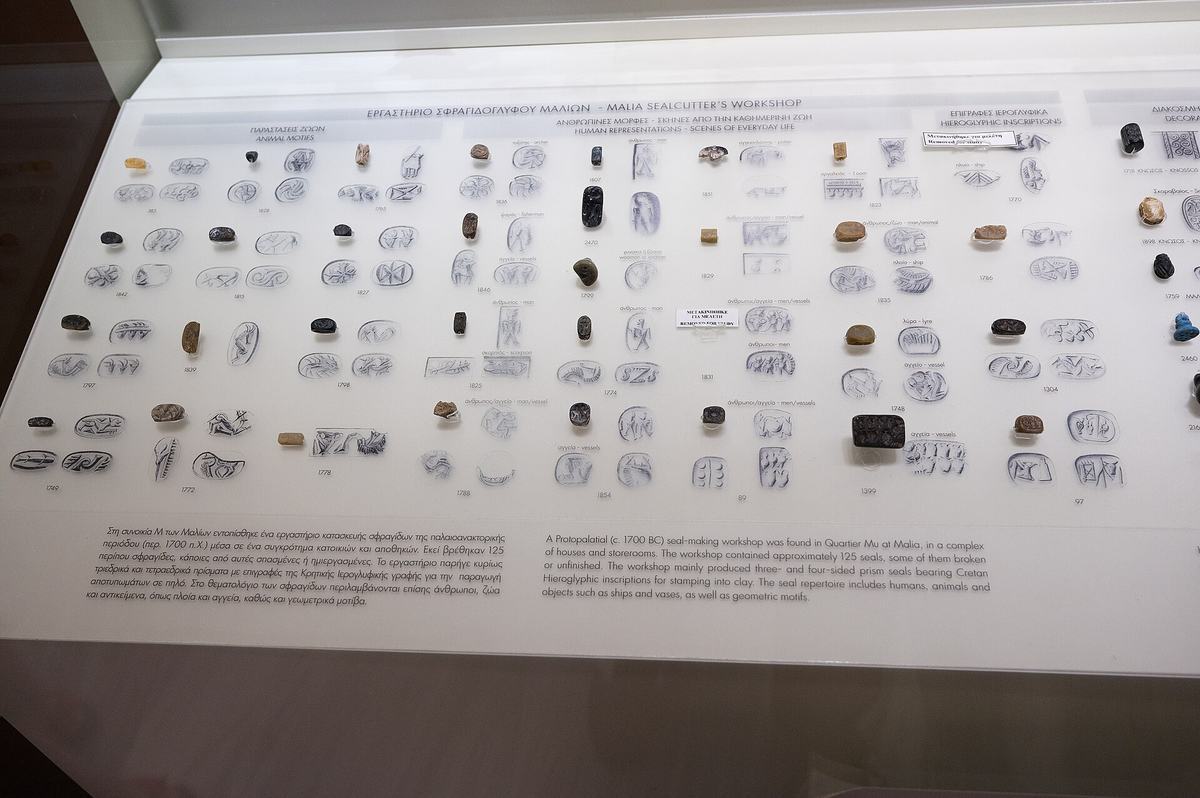
The best place to meet Minoan seals is the Heraklion Archaeological Museum, in the centre of Heraklion and a short distance from Knossos. It holds an outstanding collection of sealstones and gold signet rings drawn from the palace and from sites across the island. The museum gathers the celebrated gems, the rings engraved with epiphany scenes, and the animal and bull-leaping seals. It displays many of them beside the clay impressions they produced. The visitor can read the design as both a carved gem and a stamped image. This pairing of seal and sealing makes the whole administrative purpose of the objects clear at a glance.
Seeing seals well takes a moment of adjustment, because the objects are tiny, often just a centimetre or two across, and their detail is easy to miss. The museum meets this by showing enlarged photographs and line drawings of the engraved faces beside the originals. The eye can then grasp a coiled octopus or a leaping acrobat that would otherwise vanish at arm’s length. Standing before a lentoid the size of a coin, then looking up at its magnified image, gives a sudden shock of scale. That shock is the essence of glyptic art, an entire scene folded into a jewel meant to be worn and pressed rather than displayed.
A visit to the seals pairs naturally with the palace itself. The Palace of Knossos lies just outside Heraklion. A short trip links the ruins where the seals were used to the museum where they are kept. A single day can take in both the storerooms that the sealings once secured and the gems that secured them. A combined ticket covers the palace and the museum together. Seeing the two in sequence turns an abstract account of palace administration into something concrete, the actual rooms and the actual objects that ran them.
For all the grandeur of the palace walls, it is often the smallest things that bring the Minoans closest. A sealstone no larger than a fingertip, carved with a leaping bull or a robed goddess, was once worn at the wrist of an official. It was pressed into the clay that sealed a Knossos storeroom. Holding that scale in mind in the Heraklion museum, you meet not a faceless civilisation but the individuals who owned and used these gems. Our guide to the Heraklion Archaeological Museum covers the wider collection. You can plan tickets and tours through our Palace of Knossos guide and through My Greece Tours.
How are Minoan seals studied and catalogued today?
Scholars study Minoan seals through the Corpus der minoischen und mykenischen Siegel, or CMS, which catalogues thousands of seals and sealings. The study dates the palatial administration, traces workshops and connects sites across the Aegean.
Modern study of the seals rests on one great reference work, the Corpus der minoischen und mykenischen Siegel, usually shortened to CMS. This scholarly catalogue records thousands of Minoan and Mycenaean seals and sealings in a single systematic series. The corpus assembles photographs, casts, impressions and drawings of gems scattered across museums and collections worldwide. It gives every seal a standard reference, so scholars anywhere can cite the same object unambiguously. This gathering of a dispersed material into one ordered archive is what turned the study of glyptic from antiquarian collecting into a rigorous discipline.
The catalogue makes several kinds of research possible that no single collection could support. By comparing engraving styles across the corpus, specialists group seals into workshops and even attribute gems to individual master hands. They trace how a distinctive way of cutting a bull or a griffin spread from one engraver to his pupils. By plotting where impressions of the same seal turn up, they map the movement of officials and goods between palaces. The corpus thus converts a mass of small objects into evidence for the organisation of Minoan society, its bureaucracy, its trade and its art.
Seals also serve as a dating tool of unusual precision. Shapes, materials and motifs changed in a fairly regular sequence, from soft-stone prisms to hard-stone lentoids to gold rings. A seal found in a deposit can help date the layer around it. A sealing baked in a destruction can fix the last moment of an administrative building. Read against the Linear A and hieroglyphic records and against the pottery sequence, the seals give archaeologists a fine chronological grid for the palatial centuries. They anchor the story of how the palace administration rose, matured and fell.
The wider value of this study is that it reconnects the seals to the living society that made them. A catalogued gem is no longer just a beautiful object. It is a witness to a named workshop, a dated administration and a web of contacts across the Aegean. The sealings that share its design become the records of real transactions between real officials. Our guide to Minoan trade and economy covers the networks the seals help reconstruct. The frequently asked questions below gather the key points for the visitor and the curious reader.
Frequently Asked Questions
What are Minoan seals?
Minoan seals, or sealstones, are small engraved objects of Bronze Age Crete, among the most exquisite Minoan artworks. Most are carved gemstones, pierced so they could be worn or carried, while the grandest are gold signet rings with an engraved oval bezel. Each seal carries a design cut in reverse into its surface. Pressing the face into soft clay leaves a raised, readable impression, exactly like a stamp. Seals were used across Crete from the pre-palatial era onward, and large numbers come from Knossos and the other palace sites. Despite their tiny size, the finest are masterpieces of miniature carving that depict animals, figures and ritual scenes.
How are Minoan seals different from Near Eastern cylinder seals?
Minoan seals are stamp seals, pressed straight down into clay to leave a single self-contained image. The standard sealing device of Mesopotamia and Syria was the cylinder seal, a small barrel of stone rolled across wet clay to unfurl a continuous frieze. This distinction is fundamental. A stamp face invites a compact, centred composition, while a cylinder invites a running band. The Minoans adopted rotary drilling from the Near East, the bow lathe and the drill, but kept the stamp form throughout. They also favoured translucent, coloured gems such as carnelian, amethyst and agate, a taste with no real Near Eastern parallel.
What were Minoan seals used for?
Minoan seals were used mainly for administration and security in the palace economy. A seal pressed into a lump of soft clay, a sealing, could close and secure containers, boxes, storeroom doors and the cords binding documents. Once the clay hardened, the impression showed the item was authorised and revealed any tampering, an early form of lock and signature fused into one. Each seal carried a distinctive design, so it also marked identity, standing for a person, official or office. The system underpinned taxation and the redistribution of oil, grain and wool. Fine seals and gold rings also served as jewellery, badges of rank and protective amulets.
What is the Pylos Combat Agate?
The Pylos Combat Agate is a Late Minoan sealstone found in the undisturbed Griffin Warrior Tomb at Pylos on the Greek mainland. It is widely regarded as the finest work of Aegean glyptic art. Carved on a small banded agate only a few centimetres long, it shows a duel between two warriors over a fallen third figure. The figures are modelled down to muscle, drapery and the details of weapons and shields. Some of its finest lines lie below the threshold of unaided human vision. That has prompted a lasting debate over how a Bronze Age engraver could cut what he could not clearly see. The seal proves that Minoan engravers had mastered the fully modelled human figure in motion.
What are Minoan sealings, and why do they matter?
Sealings are the clay impressions left by seals, the administrative counterpart of the gems, and they survive in far greater numbers than the seals themselves. Archaeologists sort them into types: flat-based nodules moulded over documents, direct sealings on jars and pegs, noduli issued as clay tokens, and roundels stamped and inscribed in Linear A with a commodity and a number. Great deposits come from Knossos, Phaistos, Zakros and Ayia Triada. These map the administrative heart of Minoan Crete. Sealings preserve the designs of seals now lost. Matching impressions across sites trace the movement of officials and goods.
Where can you see Minoan seals and signet rings?
The best place to see Minoan seals is the Heraklion Archaeological Museum, a short distance from Knossos in the centre of Heraklion. It holds an outstanding collection of sealstones and gold signet rings from Knossos and across Minoan Crete. The collection includes some of the most famous examples of Minoan glyptic art, with animal, bull-leaping and religious scenes, displayed alongside the clay impressions they produced. The seals are small, often just a centimetre or two. The museum therefore shows enlarged photographs and drawings of the engraved designs beside the originals. A combined ticket covers both the palace and the museum.