
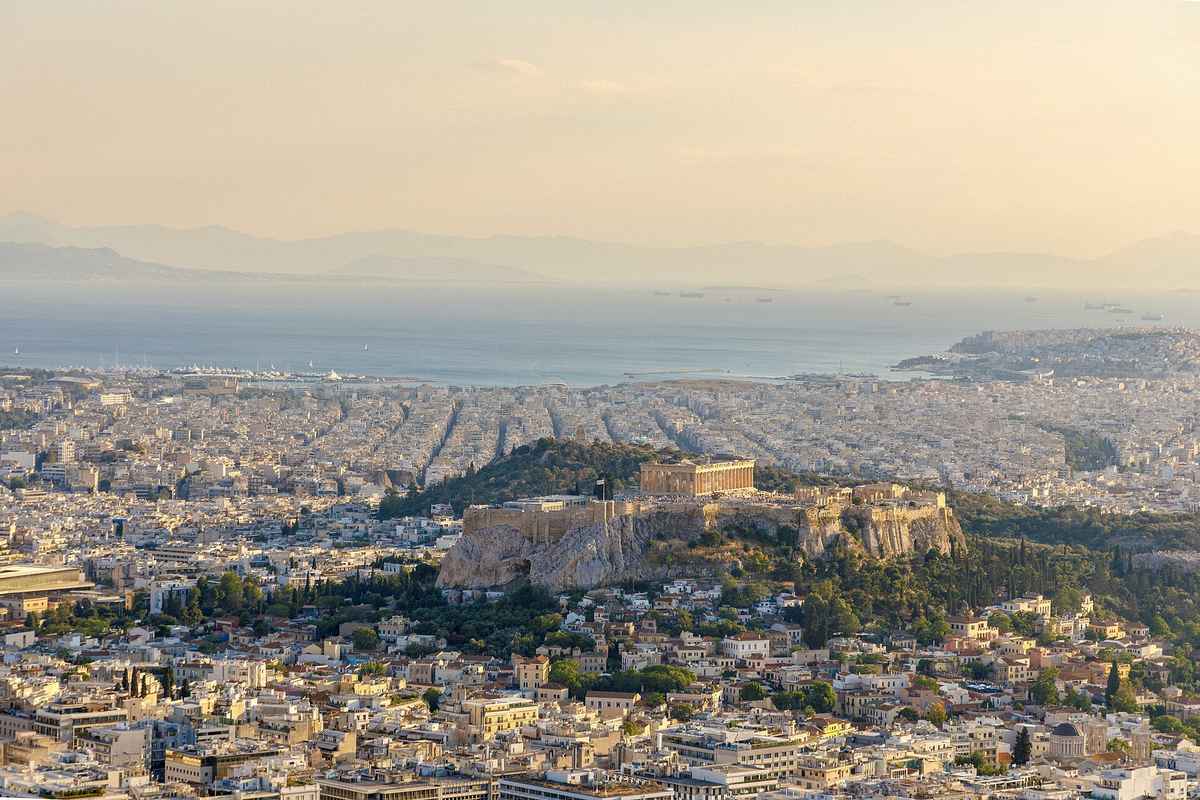
The best sunset spots in Athens are its hills and rooftops — Lycabettus, Filopappou, Strefi Hill and the Riviera coast — where the city and the Acropolis glow gold. Plan golden hour alongside skip-the-line sightseeing tickets and tours from My Greece Tours.
Sunset is one of the simple pleasures of the Athens travel guide. The sections below cover the best hilltop viewpoints, the quieter local spots, the Acropolis and rooftop options, the coastal sunset at Cape Sounion, and tips for timing it well.
Where is the best place to watch the sunset in Athens?
The finest spot for sunset in Athens is Mount Lycabettus, the highest point in the city, which offers sweeping 360-degree views over the Acropolis, the Attica basin and the Saronic Gulf. Reach the summit on foot or by funicular, and arrive 30 to 45 minutes early as it is popular. A chapel and a café sit at the top. For an unobstructed panorama of the whole city turning gold as the sun sinks toward the sea, Lycabettus is unbeatable.
Athens is a city of hills, and the very best of them for sunset is Mount Lycabettus, which rises steeply above the smart district of Kolonaki as the highest point in the centre. From its summit the view is total: the Acropolis below, the endless sprawl of the Attica basin, the surrounding mountains and, on a clear evening, the glinting Saronic Gulf beyond.
You can climb to the top through the streets of Kolonaki and up the pine-clad slopes, or save your legs by taking the funicular railway that runs up inside the hill. At the summit a little white chapel of Saint George and a café give you somewhere to settle. Because it is the city’s favourite sunset perch, it fills up, so arrive thirty to forty-five minutes before the sun goes down to claim a spot on the terrace and watch the light turn the marble of the Acropolis to honey.
What are the best hilltop viewpoints?
Besides Lycabettus, the best sunset hills are Filopappou and Strefi. Filopappou Hill, the Hill of the Muses, is a local favourite with a knockout view of the Acropolis framed by the setting sun, easier and less crowded than Lycabettus. Strefi Hill in Exarcheia is a hidden gem with panoramic views and few tourists, the Acropolis on one side and the sun setting behind the mountains on the other. Both are free, reached on foot, and offer pine-scented, uncrowded alternatives to the famous summit.
Lycabettus is the headline act, but two other hills give it serious competition and far fewer crowds. The first is Filopappou Hill, also called the Hill of the Muses, the pine-covered rise across from the Acropolis crowned by an ancient monument. It is the local favourite for good reason: the climb is gentle, the paths are shaded, and the view of the Acropolis framed against the sunset is simply stunning, with none of the crush of the more famous spots.
The second is Strefi Hill, tucked above the bohemian Exarcheia neighbourhood, a scruffy green knoll that most visitors never find. From its top you get a genuine panorama, the floodlit Acropolis on one side and the sun dropping behind the western mountains on the other, usually with only a handful of locals for company. Both hills are free to climb and reached entirely on foot, making them perfect for travellers who want a peaceful, scenic sunset away from the queues and the entry fees.
Can you watch the sunset from the Acropolis or a rooftop?
You can enjoy the sunset around the Acropolis, though the site itself closes at 8pm in summer and 6pm in winter, so you cannot stay for a late sunset inside. Better options are the Areopagus rock beside it, free and open, where crowds gather on the marble at dusk, and the many rooftop bars in Plaka, Monastiraki and Koukaki, which serve drinks with Acropolis views. A rooftop combines a glass of wine, a comfortable seat and the monument glowing against the evening sky.
Many visitors hope to watch the sun set from the Acropolis itself, but the archaeological site keeps fixed hours, closing at eight in the evening in summer and six in winter, so you usually cannot linger for the final glow. The classic free alternative is the Areopagus, the slippery marble outcrop just below the entrance, where every evening crowds climb up to sit on the rock and watch the sky change over the city.
The most comfortable way to enjoy an Athens sunset, though, is from a rooftop bar. The neighbourhoods around the Acropolis, Plaka, Monastiraki, Thissio and Koukaki, are full of rooftop terraces and bars that look straight at the floodlit monument, where you can settle into a seat with a cocktail or a glass of Greek wine as the sun goes down. Booking ahead for the best Acropolis-facing rooftops in summer is wise, as the prime tables are snapped up by travellers chasing exactly this view.
What about a sunset by the sea?
For a sunset by the sea, head to the Athens Riviera south of the city. The finest spot is Cape Sounion, where the ancient Temple of Poseidon stands on a clifftop above the Aegean, its columns silhouetted against the colourful sky in a magical scene about 70 km from Athens. Closer in, the beaches and marinas of Glyfada, Vouliagmeni and Faliro offer easy seaside sunsets. A Sounion sunset, often combined with a guided trip, is one of the most memorable evenings near Athens.
Athens sits by the sea, so a coastal sunset is always an option, and the most spectacular of all lies at the southern tip of Attica. Cape Sounion, about seventy kilometres down the Riviera coast, is crowned by the ruined Temple of Poseidon, whose white marble columns stand on a high cliff above the open Aegean.
As the sun sinks into the sea, the temple is silhouetted against a sky of orange and pink, a scene that has drawn travellers and poets for centuries and ranks among the great sunsets of Greece. Reaching it takes a drive or an organised afternoon tour along the scenic coast road, often timed precisely to arrive for the sunset. If you prefer to stay closer to the city, the beaches, marinas and seafront promenades of the nearer Riviera suburbs such as Glyfada, Vouliagmeni and Palaio Faliro offer relaxed seaside sunsets within easy reach by tram or car, drink in hand and feet near the water.
Sunset also pairs beautifully with the rhythm of an Athens day. The light show comes just as the worst of the heat fades and the city shifts into its relaxed evening mood, when Athenians emerge to stroll, eat and socialise, so timing your sightseeing to finish at a viewpoint or rooftop for dusk is a natural way to structure an afternoon and slide straight into the night.
Each season frames the sunset differently. In high summer the sun sets late and warm, ideal for a long evening that begins with a drink at golden hour and runs into dinner; in spring and autumn the clearer, cooler air often produces the most vivid colours; and even in winter, when the sun dips early, the low light over the Acropolis and the hills can be especially dramatic. Whatever the time of year, an Athens sunset is one of the simplest and most memorable pleasures the city offers, and it costs nothing but a little timing.
How do you make the most of an Athens sunset?
To make the most of an Athens sunset, check the day’s sunset time and arrive 30 to 45 minutes early to claim a spot, especially on Lycabettus or a popular rooftop. Wear sturdy shoes for the slippery marble of the Acropolis-area hills, bring water, and stay for the afterglow when the city lights come on and the Acropolis is floodlit. Spring and autumn bring the clearest skies, while summer offers the latest sunsets, around 8.30pm. Combine sunset with dinner or a drink nearby.
A little planning turns a good sunset into a great one. Start by checking the exact time the sun sets on the day, which shifts from around half past five in midwinter to nearly half past eight at the height of summer, and aim to be in place thirty to forty-five minutes beforehand, both to claim a good spot and to enjoy the slow build of colour.
Practical care helps: the marble of the Areopagus and the paths of Filopappou are notoriously slippery, so wear shoes with grip, and carry water, as the hills have little shade. Do not leave the moment the sun disappears, because the best light often comes in the afterglow, when the sky deepens, the streetlights flicker on and the Acropolis is lit up against the dusk. Spring and autumn give the clearest, most colourful skies, while summer offers the latest and warmest evenings. Best of all, fold the sunset into your evening by following it with dinner in Plaka or a drink at a nearby rooftop, so golden hour flows straight into the night. The questions below cover what visitors ask most.
However you choose to watch it, the Athens sunset is best enjoyed unhurried, with time to linger for the afterglow and the moment the city lights and the floodlit Acropolis take over from the fading sun, the close of a perfect Athenian day.
Frequently Asked Questions
Where can you watch the sunset for free in Athens?
You can watch the sunset for free from several Athens hills: Filopappou Hill opposite the Acropolis, Strefi Hill above Exarcheia, the Areopagus rock beside the Acropolis entrance, and the Pnyx. All are open, free to climb and offer superb views of the city and the monument at dusk. Mount Lycabettus is also free if you walk up rather than taking the paid funicular. Wear shoes with grip, as the marble hills can be slippery.
What time is sunset in Athens?
Sunset in Athens varies through the year, from around 5.15pm in December to nearly 8.45pm in June. In spring and autumn it falls roughly between 6.30pm and 8pm. Always check the exact time for your date and arrive 30 to 45 minutes early at popular spots like Lycabettus or an Acropolis-facing rooftop to secure a good place before the light show begins.
Is Cape Sounion worth it for sunset?
Yes, Cape Sounion is one of the most spectacular sunset spots near Athens. The ancient Temple of Poseidon stands on a clifftop above the Aegean, and at sunset its marble columns are silhouetted against a vivid sky in an unforgettable scene. It lies about 70 km south along the Riviera coast, reached by car or an organised afternoon tour, many of which are timed to arrive in time for the sunset.