
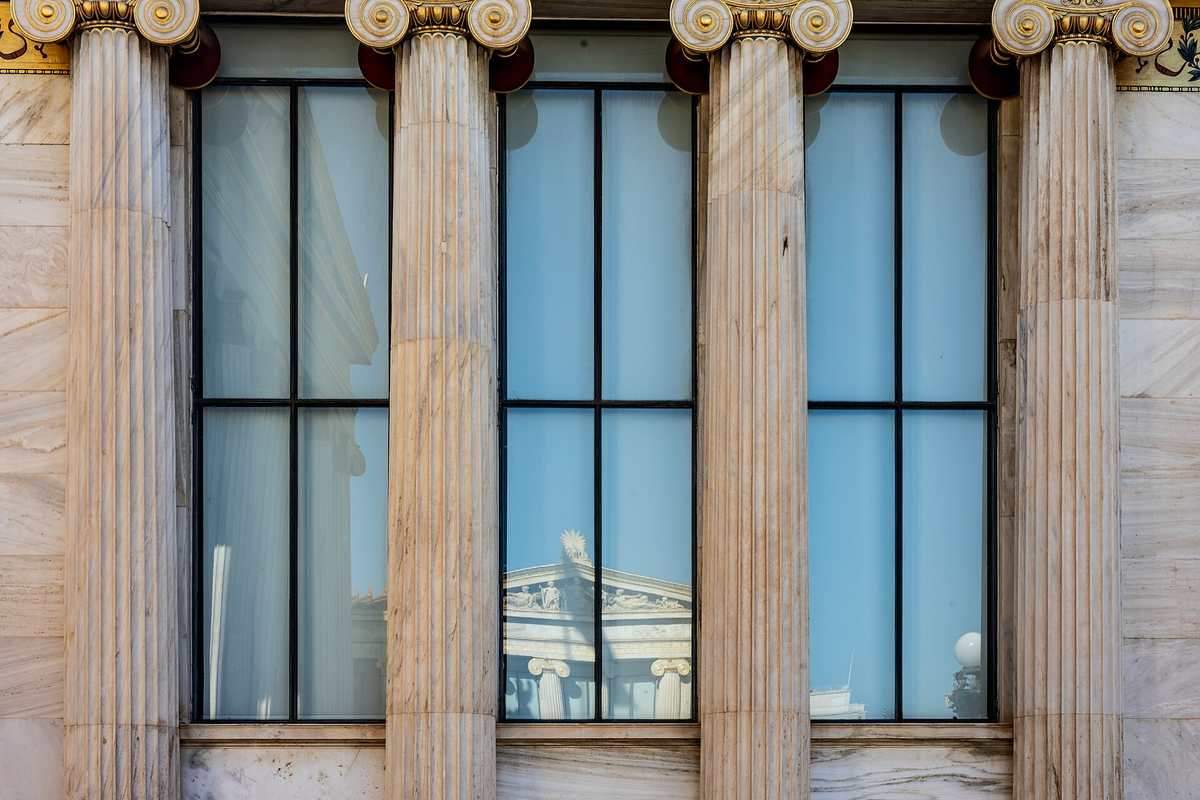
The Athens Trilogy is a magnificent group of three neoclassical buildings, the Academy, the University and the National Library, lined up on Panepistimiou Street and designed by the Danish Hansen brothers. Discover this architectural jewel on a city walk with skip-the-line sightseeing tickets and tours from My Greece Tours.
This neoclassical masterpiece is an architectural highlight of the Athens travel guide. The sections below cover what it is, the Academy of Athens, the University, the National Library, the Hansen architects, the history and significance, and how to visit.
What is the Athens Trilogy?
The Athens Trilogy, also called the Neoclassical or Athenian Trilogy, is a celebrated group of three grand neoclassical buildings standing side by side on Panepistimiou Street in central Athens: the Academy of Athens, the University of Athens and the Greek National Library. Built in the 19th century and designed largely by the Danish Hansen brothers, they form one of the finest neoclassical ensembles in Europe, symbolising the new Greek state’s link to its ancient heritage.
One of the architectural glories of modern Athens, and a must-see for anyone interested in the city beyond its ancient ruins, is the Athens Trilogy, a stunning trio of monumental neoclassical buildings ranged elegantly along one stretch of Panepistimiou Street, also known as Eleftheriou Venizelou Avenue, in the heart of the city. The three buildings, the Academy of Athens, the University of Athens and the Greek National Library, stand in a row, harmonising with one another while each displays its own character, and together they constitute one of the most important and beautiful ensembles of neoclassical architecture not only in Greece but in all of Europe.
Erected during the nineteenth century in the decades after Greece won its independence and Athens became the capital, they were conceived as a deliberate expression of the young nation’s identity, consciously echoing the forms and ideals of ancient Greece to forge a link between the new state and its glorious classical past. Built largely from gleaming Pentelic marble, the same stone as the Parthenon, and richly adorned with columns, statues and painted decoration, the Trilogy is a feast for the eyes. It is the showpiece of nineteenth-century Athens. The grandest of the three is the central Academy.
What is the Academy of Athens?
The Academy is the most splendid building of the Trilogy, a dazzling neoclassical temple-like structure designed by Theophil Hansen and completed in 1885. Its facade features an Ionic colonnade and a pediment with sculpted scenes, flanked by two tall columns topped by statues of the goddess Athena and the god Apollo, with seated marble figures of Socrates and Plato before it. It is Greece’s national academy of sciences and arts.
The architectural centrepiece and most lavishly decorated of the three buildings is the Academy of Athens, widely regarded as one of the finest neoclassical structures in the world and the dazzling jewel of the Trilogy. Designed by the Danish architect Theophil Hansen and completed in the 1880s after some decades of construction, the Academy takes the form of a gleaming marble temple, its facade graced by an elegant Ionic colonnade and a pediment filled with sculpted reliefs depicting the birth of the goddess Athena, painted and gilded in the manner of ancient temples. Most striking are the two tall, slender columns rising before the building, each crowned by a statue, one bearing the goddess Athena and the other the god Apollo, while at ground level two grand seated marble figures of the philosophers Socrates and Plato preside over the entrance, embodying the building’s dedication to learning.
Today the Academy serves as Greece’s national academy, the country’s senior body for the sciences, humanities and arts, and although the interior is not generally open to the public, the magnificent exterior is a free spectacle that draws photographers and admirers. It is the showstopper of the Trilogy. Beside it stands the older University.
What is the University of Athens building?
The University of Athens, the central and oldest building of the Trilogy, was designed by Christian Hansen and built between 1839 and 1864. Its handsome neoclassical facade features a colonnaded portico decorated with a colourful painted fresco depicting King Otto surrounded by personifications of the arts and sciences. Built of Pentelic marble, it housed the first university of the modern Greek state and remains a ceremonial seat of the university.
The central building of the Trilogy, and the first of the three to be built, is the historic main building of the University of Athens, a dignified and elegant neoclassical edifice that anchors the ensemble. It was designed by the Danish architect Christian Hansen, the elder of the two Hansen brothers, and constructed over the middle decades of the nineteenth century, making it the oldest part of the Trilogy and a foundational monument of the new Greek capital, built from the same prized Pentelic marble that supplied the ancient Parthenon. The building’s facade is centred on a graceful colonnaded portico, or propylon, whose most distinctive feature is a large and colourful painted fresco running along the wall beneath the colonnade, depicting the first king of modern Greece, Otto, surrounded by allegorical figures personifying the various arts and sciences being reborn, a vivid celebration of the revival of Greek learning.
As the home of the first university of the modern Greek state, the building has deep historical and national importance, and it still serves as the ceremonial and administrative seat of the venerable institution. Its painted portico is a delight to study. Completing the row is the National Library.
What is the National Library of Greece?
The National Library of Greece is the third building of the Trilogy, designed by Theophil Hansen and built in the late 19th century. Its severe, dignified facade uses the older, plainer Doric order, contrasting with the richer Academy, and is approached by a striking curved double staircase. It long housed the nation’s great collection of books and manuscripts, since moved to a new home, and its grand neoclassical building completes the ensemble.
The third and final building of the Trilogy, standing on the other side of the University, is the old main building of the National Library of Greece, a noble neoclassical structure that completes the harmonious row. It too was designed by Theophil Hansen, the architect of the neighbouring Academy, and was the last of the three to be built, raised in the closing decades of the nineteenth century. In a deliberate architectural contrast to the rich and ornate Ionic Academy, the Library was given a more austere and solemn character using the older and plainest of the classical orders, the Doric, lending it a grave dignity befitting a temple of knowledge.
Its most memorable feature is the dramatic curved double staircase that sweeps up to the entrance, a graceful and much-photographed flourish. For well over a century the building housed the nation’s priceless collection of books, manuscripts and historic documents, though this great library has in recent years been transferred to a magnificent modern home at the Stavros Niarchos Foundation Cultural Centre by the coast. The handsome neoclassical building remains a key part of the Trilogy. The three were the work of a remarkable family. The Hansen brothers gave Athens its neoclassical face.
Who were the Hansen brothers and why does the Trilogy matter?
The Trilogy was designed by two Danish brothers, the architects Christian Hansen, who designed the University, and Theophil Hansen, who designed the grander Academy and the National Library. Leading figures of 19th-century neoclassicism, they shaped the look of modern Athens. The Trilogy matters as a symbol of the new Greek nation reconnecting with its ancient classical heritage through architecture, and as a supreme example of the neoclassical style.
The creative force behind the Trilogy was a pair of talented Danish brothers who left an indelible mark on the architecture of the modern Greek capital. The elder, Christian Hansen, designed the University, the first of the three buildings, during his years working in newly independent Athens, while his younger and even more celebrated brother, Theophil Hansen, returned to design both the magnificent Academy and the National Library, becoming one of the foremost neoclassical architects of nineteenth-century Europe, renowned for major works in both Athens and Vienna. Together the Hansens, alongside other architects of the era, gave the young city of Athens its distinctive neoclassical character.
The deeper significance of the Trilogy lies in what it represents: built in the decades after Greece threw off Ottoman rule and chose Athens as the capital of a new nation, these buildings were a conscious and powerful statement, using the architectural language of ancient Greece, columns, pediments, marble and classical proportion, to express the reborn nation’s pride in its glorious classical heritage and its aspiration to revive the ideals of antiquity in education, science and the arts. As both art and symbol, the Trilogy is a cornerstone of modern Greek identity. It links the new Greece to the old. Visiting it is simple and free.
How do you visit the Athens Trilogy?
The Athens Trilogy stands on Panepistimiou Street in central Athens, easily reached on foot from Syntagma Square or by metro to Panepistimio station on line 2, right beside it. The buildings are best admired from outside, free of charge, as a stop on a city walk; the interiors are mostly not open to general visitors. Allow time to study the architecture and statues, ideally combining it with nearby Syntagma and the city centre.
Visiting the Athens Trilogy is wonderfully easy and costs nothing, as the three buildings are admired from the street and lie right in the heart of the modern city centre. They stand in a row along Panepistimiou Street, one of the main avenues of central Athens, just a short and pleasant walk from Syntagma Square and the Parliament, and the metro could hardly be more convenient, with the Panepistimio station on line 2, the red line, located directly beside the buildings, so you step out of the station almost at their feet. The Trilogy is best experienced as a stop on a walking tour of the neoclassical city centre, where you pause to take in the grand facades, the colonnades, the painted decoration and the statues of Athena, Apollo, Socrates and Plato, all of which can be enjoyed for free from the pavement and the forecourts.
The interiors of the buildings are generally not open to the public, being working institutions, so the visit is essentially an architectural appreciation from outside, rewarding photographers and lovers of fine buildings. Allow a little time to study the details and the sculptures, and combine the Trilogy with the surrounding sights of central Athens. It is a free and uplifting highlight. The neighbouring institution is detailed in the Academy of Athens guide. The questions below cover the points visitors ask most.
Frequently Asked Questions
What is the Athens Trilogy?
The Athens Trilogy is a celebrated group of three grand neoclassical buildings standing side by side on Panepistimiou Street in central Athens: the Academy of Athens, the University of Athens and the Greek National Library. Built in the 19th century and designed largely by the Danish Hansen brothers, they form one of the finest neoclassical ensembles in Europe.
Can you go inside the Athens Trilogy buildings?
The Athens Trilogy buildings are mostly admired from outside, free of charge, as their interiors are generally not open to general visitors, being working institutions such as the Academy and the University. The magnificent facades, colonnades, painted decoration and statues of Athena, Apollo, Socrates and Plato can all be enjoyed from the street and forecourts.
Where is the Athens Trilogy located?
The Athens Trilogy stands on Panepistimiou Street in central Athens, a short walk from Syntagma Square. It is extremely easy to reach by metro, as the Panepistimio station on line 2, the red line, lies directly beside the buildings. The three neoclassical structures can be admired for free as a stop on a walk through the city centre.