
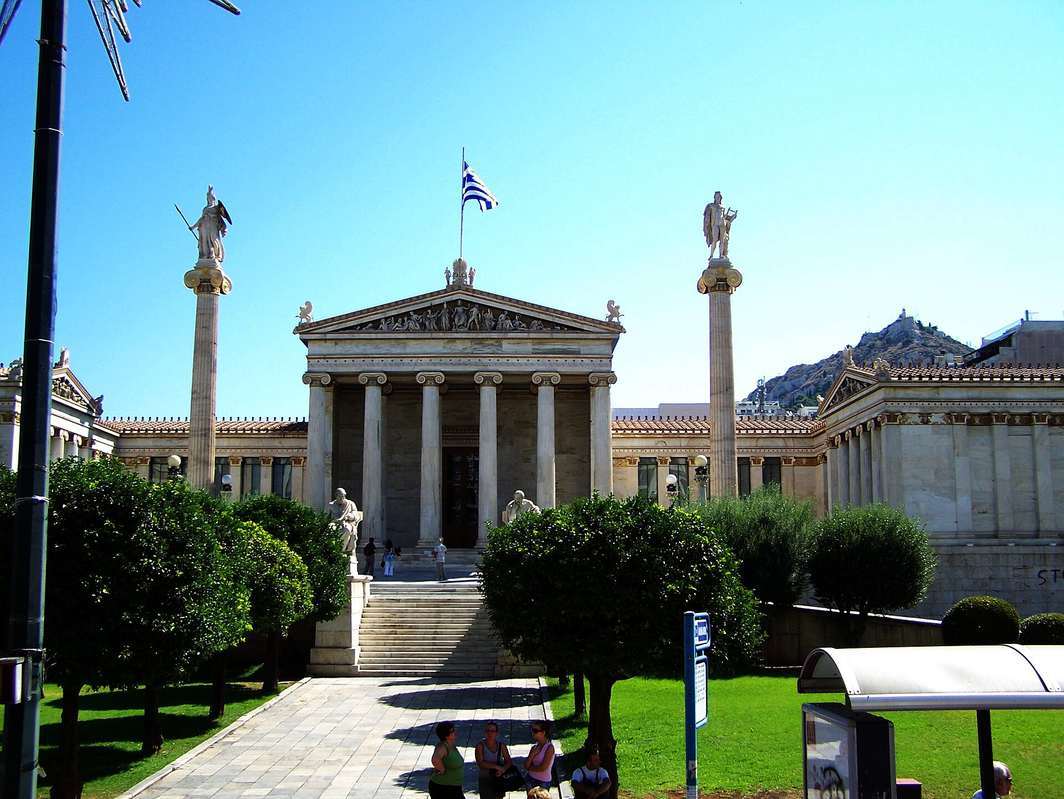
Athens’s Academy is the most beautiful of the city’s neoclassical “Athenian Trilogy” on Panepistimiou Street, its marble columns crowned by statues of Athena and Apollo. Admire it on a central walking route with skip-the-line sightseeing tickets and tours from My Greece Tours for the best of neoclassical and ancient Athens.
This architectural masterpiece is a highlight in the Athens travel guide. The sections below cover what it is, the Athenian Trilogy, the architecture and statues, the University and National Library, what it does today, practical details and how to get there.
What is the Academy of Athens?
Greece’s national academy and its highest research institution, the Academy of Athens is housed in a magnificent neoclassical building on Panepistimiou Street in central Athens. Built in the 19th century and designed by Theophil Hansen, it is the most splendid of the three “Athenian Trilogy” buildings, considered by some experts the finest neoclassical building anywhere in the world.
One of the architectural glories of modern Athens, the Academy of Athens is both the country’s pre-eminent learned institution and a breathtaking work of nineteenth-century architecture. Standing proudly on the grand boulevard of Panepistimiou Street in the heart of the city, the Academy is Greece’s national academy, the highest research establishment in the country, dedicated to the sciences, letters and arts in the tradition of the ancient philosophical academies. The building that houses it is its great glory: an exquisite neoclassical edifice of gleaming marble, designed by the celebrated Danish architect Theophil Hansen and completed in the later nineteenth century, which forms the most magnificent of the three adjacent buildings known as the “Athenian Trilogy”.
With its perfect proportions, harmonious lines, soaring Ionic columns and richly coloured decoration inspired by ancient Greek temples, it is admired the world over, and some experts have gone so far as to call it the most beautiful neoclassical building in existence. Though primarily an academic institution not generally open inside to the public, its dazzling exterior is one of the must-see sights of central Athens. It is part of a magnificent architectural ensemble. The trilogy is best appreciated on the walk in the Athens walking tour guide. It forms part of a celebrated trio.
What is the Athenian Trilogy?
The Athenian Trilogy is a group of three magnificent neoclassical buildings standing side by side on Panepistimiou Street: the Academy of Athens, the University of Athens and the National Library of Greece. Built in the 19th century by the Hansen brothers and funded partly by King Otto and benefactors, they represent the apex of Greek neoclassical architecture and the ideals of the new state.
To understand the Academy fully, it helps to know that it is one of three related masterpieces that together form one of the finest architectural ensembles in Athens, known as the Athenian Trilogy. This celebrated trio of grand neoclassical buildings stands in a row along Panepistimiou Street, in the centre of the modern city, and comprises the Academy of Athens, the University of Athens and the National Library of Greece. The buildings were conceived in the nineteenth century as monuments to learning and to the cultural rebirth of the newly independent Greek state, which consciously looked back to the glories of ancient Greece for inspiration.
The project was funded in part by King Otto and by wealthy national benefactors, and it was largely the work of the Danish Hansen brothers, the architects Theophil and Christian Hansen, with construction spanning roughly from the 1840s to 1890. Representing the very apex of Greek neoclassical architecture, the Trilogy embodies the ideals of knowledge, science and the arts that the young nation aspired to. Seen together, the three buildings make a stunning architectural statement and a highlight of any walk through central Athens. The ensemble rewards an unhurried look. The Academy’s own details are exquisite.
What is the architecture and statues of the Academy?
The Academy of Athens is a marble neoclassical building inspired by ancient Greek temples, with a colonnaded entrance and richly painted decoration. Flanking the entrance, two tall Ionic columns are topped by statues of the goddess Athena and the god Apollo, while seated statues of the philosophers Plato and Socrates sit below. The pediment depicts the birth of Athena.
The Academy of Athens rewards close attention, for its architecture and sculpture are among the finest in the city. Designed by Theophil Hansen in a pure neoclassical style directly inspired by the ancient temples of classical Greece, the building is constructed of gleaming Pentelic marble and crowned with a colonnaded portico, its proportions so balanced and harmonious that it appears almost serene. A special feature is its richly coloured decoration, with the pediments and entablature painted in the deep blues, reds and golds that ancient Greek temples are now known to have borne, lending it a vivid, authentic splendour. The most striking elements are the sculptures: flanking the grand entrance, two tall Ionic columns rise to support standing statues of Athena, goddess of wisdom, and Apollo, god of the arts and music, gazing out over the avenue, while at their feet sit dignified marble figures of the great philosophers Plato and Socrates, fitting guardians of a temple of learning.
The central pediment depicts the mythological birth of Athena. Together these details make the façade a masterpiece of detail and meaning. Pausing to take them in is a pleasure. The neighbouring buildings complete the picture. The University and Library frame the Academy.
What are the University and National Library?
The University of Athens, the central building of the Trilogy, was designed by Christian Hansen in a simpler style and features a vast painted mural on its portico. The National Library of Greece, modelled on an ancient temple, holds around two million books and rare manuscripts, including the first printed book in Greek from 1476. Together with the Academy they form the Trilogy.
Flanking the Academy of Athens stand its two companion buildings, each magnificent in its own right and completing the celebrated Trilogy. To one side rises the University of Athens, the central and oldest of the three, designed by Christian Hansen in a deliberately simpler and more restrained neoclassical style than its flamboyant neighbours; its great covered portico is adorned with a colossal painted mural, some forty-five metres long, designed by the artists Carl Rahl and Eduard Lebiedzki, depicting King Otto surrounded by personifications of the arts and sciences. On the other side stands the National Library of Greece, modelled on the form of an ancient Doric temple and approached by a grand sweeping double staircase, which long served as the country’s principal library, holding around two million volumes of books and periodicals and over four thousand precious manuscripts, among them the first ever printed book in the Greek language, dating from 1476.
Though the historic library’s main collections have largely moved to the modern Stavros Niarchos building, the temple-like edifice remains a landmark. Seen as a trio, the Academy, University and Library form a sublime hymn to learning in stone. The modern library is covered in the Stavros Niarchos Foundation guide. The Academy still serves its scholarly purpose.
What does the Academy of Athens do today?
The Academy of Athens remains Greece’s highest research and scholarly institution, established, comprising distinguished academicians across the sciences, humanities and arts. It conducts and funds research, awards prizes and oversees several research centres, continuing the tradition of the ancient philosophical academies. Its building is a working academic institution, so the interior is generally not open to the public, but the exterior is freely admired.
Beyond its architectural splendour, the Academy of Athens is a living, working institution at the summit of Greek intellectual life. The modern Academy was formally established as the national academy of Greece, consciously reviving the spirit of the ancient academies of philosophy, and it brings together the country’s most distinguished scholars, scientists, writers and artists as its academicians, organised into divisions covering the natural sciences, the humanities and letters, and the moral and political sciences. In this role it conducts and funds important research across many fields, operates a number of specialised research centres and institutes, publishes scholarly work, awards prestigious prizes and honours, and acts as an authoritative voice on matters of science, language and culture in Greece.
Because it is an active academic and research institution rather than a museum, the magnificent interior of the building, with its richly decorated halls, is generally not open to the public except on special occasions. Visitors are, however, entirely free to admire and photograph the stunning exterior and its sculptures from the street at any time, which is the main attraction for travellers. Its enduring purpose adds depth to its beauty. The institution honours Greece’s intellectual heritage. Visiting is simple and free.
How do you visit the Academy of Athens?
The Academy stands on Panepistimiou Street in central Athens, between Syntagma and Omonia squares, easily reached on foot or from Panepistimio metro station on line 2, right beside it. As a working institution, the interior is generally closed to the public, but the exterior and statues can be admired and photographed free at any time, ideally combined with the University and National Library.
Seeing the Academy of Athens is easy, free and a highlight of any walk through the modern centre of the city. The building stands on the grand avenue of Panepistimiou Street (officially Eleftheriou Venizelou), midway between the central squares of Syntagma and Omonia, and it could hardly be more accessible: the Panepistimio metro station on line 2, the red line, sits directly beside the Trilogy, and the buildings are an easy stroll from Syntagma. Because the Academy is an active academic institution, its lavishly decorated interior is generally not open to the public, save for occasional special events, so the experience for visitors is admiring the spectacular exterior, the marble façade, the painted decoration, the columns and the statues of Athena, Apollo, Plato and Socrates, which can be enjoyed and photographed free of charge at any time of day.
For the best experience, view it together with its two neighbours, the University of Athens and the National Library, taking a few minutes to appreciate the whole Trilogy as an ensemble. It combines naturally with a walk to Syntagma, the shops of the centre and the nearby museums. Comfortable shoes make the stroll pleasant. The wider network is explained in the getting around Athens guide. The questions below cover the points visitors ask most.
Frequently Asked Questions
What is the Academy of Athens famous for?
The Academy of Athens is famous as Greece’s highest research institution and as the most beautiful of the three neoclassical “Athenian Trilogy” buildings on Panepistimiou Street. Designed by Theophil Hansen, its marble façade features Ionic columns topped by statues of Athena and Apollo, with Plato and Socrates seated below, and richly painted temple-style decoration.
Can you go inside the Academy of Athens?
As a working research institution, the Academy of Athens keeps its richly decorated interior generally closed to the public except on special occasions. Visitors can, however, freely admire and photograph the magnificent exterior, columns and statues from the street at any time, ideally alongside the University and National Library.
What is the Athenian Trilogy?
The Athenian Trilogy is a group of three magnificent 19th-century neoclassical buildings side by side on Panepistimiou Street in central Athens: the Academy of Athens, the University of Athens and the National Library of Greece. Built largely by the Hansen brothers, they represent the apex of Greek neoclassical architecture.