
The Santorini to Naxos ferry takes 1.5 to 2.5 hours depending on the boat, with frequent summer sailings from around 35 to 70 euros, linking volcanic Santorini with the largest, greenest Cyclades island. This guide covers the journey time, the prices, the operators, the ports and tips for booking the ferry.
This route connects two contrasting Cyclades islands, a useful link in the wider Santorini travel guide. Naxos lies north of Santorini. The sections below cover the ferry.
How long is the Santorini to Naxos ferry?
The Santorini to Naxos ferry takes from about 1 hour 10 minutes to 2 hours 35 minutes, depending on the vessel. High-speed catamarans cross in around 1.5 hours, while conventional ferries take about 2.5 hours.
The crossing to Naxos is reasonably quick. The journey time depends on the type of boat. Fast catamarans and high-speed ferries reach Naxos in around an hour and a half, sometimes as little as one hour ten minutes. The larger conventional car ferries, such as Blue Star, take about two and a half hours but ride steadier in rough seas and cost less.
The route runs north through the heart of the Cyclades. It connects volcanic, dramatic Santorini with green, mountainous Naxos, the largest island in the group. Many sailings call at Ios and Paros on the way, so timings vary between direct and multi-stop services. It is a popular island-hopping link, set within the wider how to get to Santorini.
The vessel type shapes the whole trip, not just the clock. A fast catamaran gets you there sooner but bounces more in a swell and keeps passengers in the seating decks. A conventional ferry is slower yet roomier, with open decks, cafés and space to walk, which suits travellers who prefer comfort over speed on the crossing.
How much does the ferry cost?
The Santorini to Naxos ferry costs roughly 35 to 70 euros one way for a foot passenger. Economy seats start near 35 euros, rising to 110 or beyond for business class on the fast boats. Cars cost from about 60 euros.
Fares offer a range of choices. A one-way foot-passenger ticket typically costs between about 35 and 70 euros. It starts from around 35 euros for an economy seat on a slower conventional ferry and climbs to 110 euros or beyond for premium and business-class seating on the fast boats, with mid-range seating in between.
Vehicles and season change the price. Travellers taking a car pay from roughly 60 euros, and a motorbike from about 25. As ever in the Cyclades, prices climb in the peak July and August season and as boats fill. Booking early secures both a place and a better fare, set out alongside the guide to a Santorini itinerary.
Class of seat is worth weighing on the fast boats. The cheapest tickets place you in a numbered air-conditioned lounge, fine for the short hop, while business and VIP classes add wider seats, a quieter cabin and priority boarding. On the conventional ferries the price gap is smaller, so most foot passengers travel on the standard deck ticket.
What are the operators and ports?
The ferry is run by Blue Star Ferries, SeaJets and Golden Star Ferries, with around 49 weekly sailings in summer. It departs from Athinios, Santorini’s main port on the west coast, and arrives in Naxos Town. Most ferries carry cars.
Several operators serve this busy route. Three companies, Blue Star Ferries, SeaJets and Golden Star Ferries, run around 49 sailings a week in summer, giving good flexibility. The fleet mixes fast catamarans with the larger Blue Star car ferries, so travellers can pick speed or comfort to suit the day.
The ports sit at the heart of each island’s transport. The ferry leaves from Athinios, Santorini’s main port at the foot of the caldera cliffs on the west coast, reached by bus, taxi or transfer from Fira. It arrives at the port in Naxos Town, right by the island’s atmospheric old town and Venetian castle.
Most vessels carry vehicles. Both the conventional ferries and many of the high-speed boats take cars, which is handy for exploring Naxos’s superb beaches and mountain villages by road. Travellers planning to drive should book the vehicle space early in summer, as car capacity fills before foot-passenger seats, set out alongside the guide to Santorini car rental.
Where do you catch the ferry in Santorini?
You catch the Naxos ferry at Athinios, Santorini’s main passenger port on the west coast below the caldera cliffs. It is reached by KTEL bus, taxi or transfer from Fira, about 8 kilometres away. Arrive early, as the port is busy.
Athinios is the island’s working ferry port. It sits on the caldera-facing west coast, at the foot of a steep, winding road below the villages. Public KTEL buses run to Athinios timed loosely around the main sailings, and taxis and pre-booked transfers cover the trip from Fira, Oia and the airport. Traffic and queues build here in summer.
The port itself is compact and hectic at sailing time. Cars, buses and foot passengers converge on the quay as boats load and unload in quick succession, so signage and staff direct each ferry’s line. Reaching Athinios at least an hour before departure gives time to find the right queue without stress, set out alongside the guide to getting around Santorini.
What tips help for the ferry?
Book two to three months ahead for peak summer, and arrive at Athinios port at least an hour before departure. Allow flexibility for the meltemi wind, which can disrupt high-speed ferries in midsummer. Naxos makes a great longer stop or a contrasting second island.
Planning ahead makes the crossing easy. To reserve particular seats on the busy summer sailings, book your tickets two to three months in advance, as the route fills up. On the day, reach the busy Athinios port at least an hour before departure, allowing for the traffic and queues that build there in summer.
The weather deserves a plan B. The high-speed boats can be affected by the strong meltemi wind that blows through the Cyclades in July and August, leading to delays or cancellations. Build in some flexibility, avoid booking a tight onward connection on a windy day, and keep the conventional ferry in mind, as it copes better with a swell.
Naxos rewards more than a flying visit. With its long sandy beaches, lively port town and green mountainous interior, it makes a rewarding longer stop or a relaxed, contrasting second island after Santorini’s drama. Many island-hoppers pair the two, using the frequent ferry to swap volcanic cliffs for beaches, set out alongside the guide to the best time to visit Santorini.
Is Naxos a good day trip from Santorini?
Naxos works better as a longer stop than a day trip, as the crossing and multi-stop sailings eat into the day. A fast morning boat and a late return leaves a few hours, but Naxos rewards at least a night ashore.
A day trip is possible but tight. On a fast catamaran the crossing is around an hour and a half, so an early boat over and a late-afternoon return can give a half-day on the island. The catch is that timetables do not always line up neatly, and slower or multi-stop sailings shorten the time ashore further.
Naxos is large, which argues for staying over. The old town and castle sit by the port, but the best beaches spread down the west coast and the mountain villages lie inland, more than a quick stroll from the harbour. A single night frees you to see the Portara gateway, a beach and a village without racing the clock.
Booking a night on Naxos also solves the ferry timing. Rather than gambling on a same-day return that may leave early or run late, an overnight stay lets you take a relaxed morning boat back to Santorini. This turns a rushed dash into a proper mini-break, and the frequent summer service makes the return easy to arrange.
Should you take the fast or conventional ferry?
Take the fast catamaran to save time and the conventional Blue Star ferry to save money. The fast boat crosses in about 1.5 hours but costs more and rides rougher in wind. The conventional ferry is slower, cheaper, steadier and better for cars.
The fast catamaran suits travellers short on time. It reaches Naxos in around an hour and a half, keeping the crossing brief and leaving more of the day on either island. The trade-off is a higher fare, enclosed seating decks and a bumpier ride when the meltemi is up, since light high-speed hulls feel the swell more.
The conventional Blue Star ferry is the value choice. It takes about an hour longer but costs noticeably less, with open decks, cafés, room to move and a smoother ride in rough seas. Families, car travellers and anyone prone to seasickness usually prefer it, trading speed for space and stability, set out alongside the guide to a Santorini itinerary.
What is Naxos like compared to Santorini?
Naxos is greener, larger and more relaxed than Santorini, with long sandy beaches, fertile farmland and high mountains. Santorini is smaller, dramatic and volcanic, built around the caldera. Naxos offers space, beaches and local life, making the two islands a strong contrast on one trip.
Naxos is the giant of the Cyclades. It is the largest island in the group, with fertile valleys, olive groves and the range topped by Mount Zas, the highest peak in the Cyclades. Where Santorini rises in sheer volcanic cliffs, Naxos spreads out in beaches and farmland, feeding itself with potatoes, cheese and citrus rather than living on tourism alone.
The two islands answer different moods. Santorini delivers the caldera view, the sunset and the polish of a world-famous destination, at a price and with the crowds to match. Naxos offers long sandy beaches such as Plaka and Agios Prokopios, a lived-in port town and quiet mountain villages, at a gentler pace and cost. Pairing them gives a trip with real variety, set out alongside the guide to the best time to visit Santorini.
The order of the two islands is worth a thought. Many travellers end on Santorini, saving the caldera sunset as the finale after Naxos’s beaches, while others start on Santorini and unwind on Naxos afterwards. Either way, the short ferry link means the swap costs little time, and booking the crossing early keeps the whole itinerary flexible and secure through the busy summer.
What can you see and do on Naxos?
On Naxos you can see the Portara marble gateway by the port, wander the Venetian old town, relax on beaches such as Agios Prokopios and Plaka, and explore mountain villages like Halki and Apiranthos. The island suits beaches, hiking and local food.
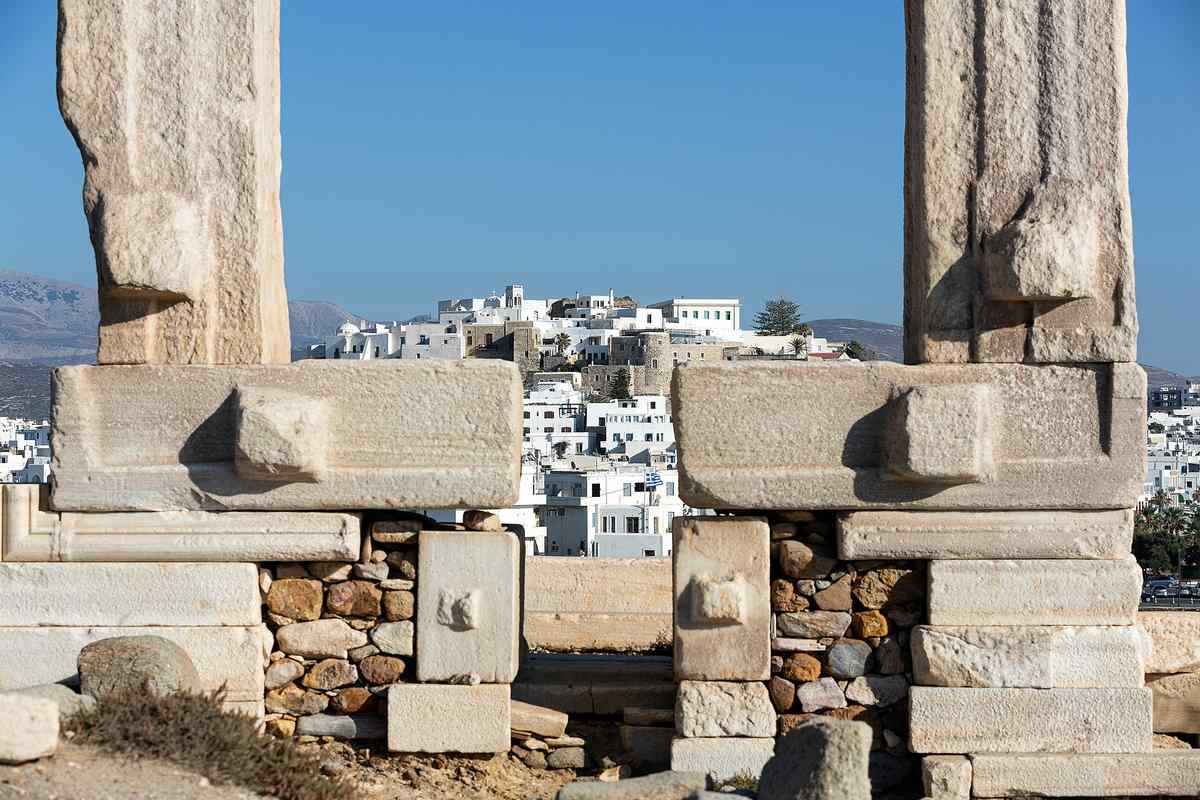
The port itself holds the island’s icon. The Portara, a huge marble doorway from an unfinished ancient temple, stands on an islet by the harbour and frames the sunset, an easy walk from where the ferry docks. Behind it, the Venetian old town climbs in a maze of lanes to a hilltop castle, packed with shops, tavernas and small museums.
Beyond the town, Naxos opens up. The west coast strings together long sandy beaches, from busy Agios Prokopios to quieter Plaka and Mikri Vigla, each with shallow, clear water. Inland, the mountain villages of Halki, Filoti and Apiranthos offer marble streets, old churches and local cheese and citron liqueur, rewarding travellers who hire a car and explore, set out alongside the guide to Santorini car rental.
How frequent is the Santorini to Naxos ferry, and in which season?
The Santorini to Naxos ferry runs most frequently from June to September, with four to six departures a day in each direction. May and October drop to one or two sailings a day, and winter to a few sailings a week.
Summer sailings spread from early morning to late afternoon, so a traveller can take a morning boat and still find an evening one back.
Blue Star Ferries, SeaJets and Golden Star Ferries share the route. When one line cancels a sailing, another boat leaves within a few hours.
Wind cancels more sailings in spring and autumn, and a posted departure can change at short notice. Reconfirm the sailing on the operator’s site the day before.
Where does the ferry leave from on Naxos for the trip back to Santorini?
Ferries to Santorini leave from Naxos harbour, beside Naxos Town, a five-minute walk from the Portara gateway. They arrive at Athinios, the Santorini port below the caldera cliffs, about 8 kilometres from Fira.
Check-in kiosks at Naxos harbour open about an hour before departure. Some operators still ask for a printed ticket at the gate.
Parking near the Naxos port is limited in summer, so foot passengers walk from their hotels or take a transfer.
At Athinios, buses meet most arrivals and run to Fira, where travellers change for Oia or the beaches. Book a transfer or hotel shuttle ahead in high summer.
Can you take a car on the Santorini to Naxos ferry?
Yes. Both the fast catamarans and the conventional ferries on the Santorini to Naxos route load cars, but vehicle space sells out before passenger seats in July and August. Reserve the car place as soon as the dates are fixed.
Some operators set the car fare by vehicle length, so note the length of the hire car when booking.
Arrive at the port at least 45 minutes early for vehicle check-in, and follow the marshals’ loading order.
Travellers who skip the car and rent a new one on each island avoid the vehicle fare and the loading queue. Our Naxos car rental page covers hiring on arrival.
How do you avoid seasickness on the Santorini to Naxos ferry?
To avoid seasickness on the Santorini to Naxos ferry, take a morning sailing before the afternoon meltemi builds, sit low and near the middle of the boat, and choose the conventional ferry on windy days, because its heavier hull rides the swell more steadily.
The meltemi is the dry north wind of the Cyclades in July and August, and it grows stronger through the afternoon.
Enclosed catamaran cabins make the pitching worse. On a conventional ferry, fresh air on the open deck helps.
Keep your eyes on the horizon, drink water, and take a motion-sickness tablet 30 to 60 minutes before boarding.
Frequently Asked Questions
How long does the Santorini to Naxos ferry take?
The Santorini to Naxos ferry takes from about 1 hour 10 minutes to 2 hours 35 minutes, depending on the boat. High-speed catamarans make the crossing in around 1.5 hours, while conventional Blue Star ferries take about 2.5 hours but are steadier and cheaper.
How much is the Santorini to Naxos ferry?
The ferry costs roughly 35 to 70 euros one way for a foot passenger, from roughly 35 euros for an economy seat on a slower ferry up to 110 or beyond for premium classes on the fast boats. Cars cost from about 60 euros, with prices higher in peak summer.
Where does the Santorini to Naxos ferry leave from?
The ferry leaves from Athinios, Santorini’s main port on the west coast at the foot of the caldera cliffs, and arrives in Naxos Town by the old town and castle. Most ferries carry cars, useful for exploring Naxos’s beaches and mountain villages.
Do you need to book the Santorini to Naxos ferry in advance?
You should book the Santorini to Naxos ferry two to three months ahead for peak July and August, as the popular sailings sell out. Booking early secures a place, a seat class and a better fare, and vehicle space in particular fills before foot-passenger tickets.