
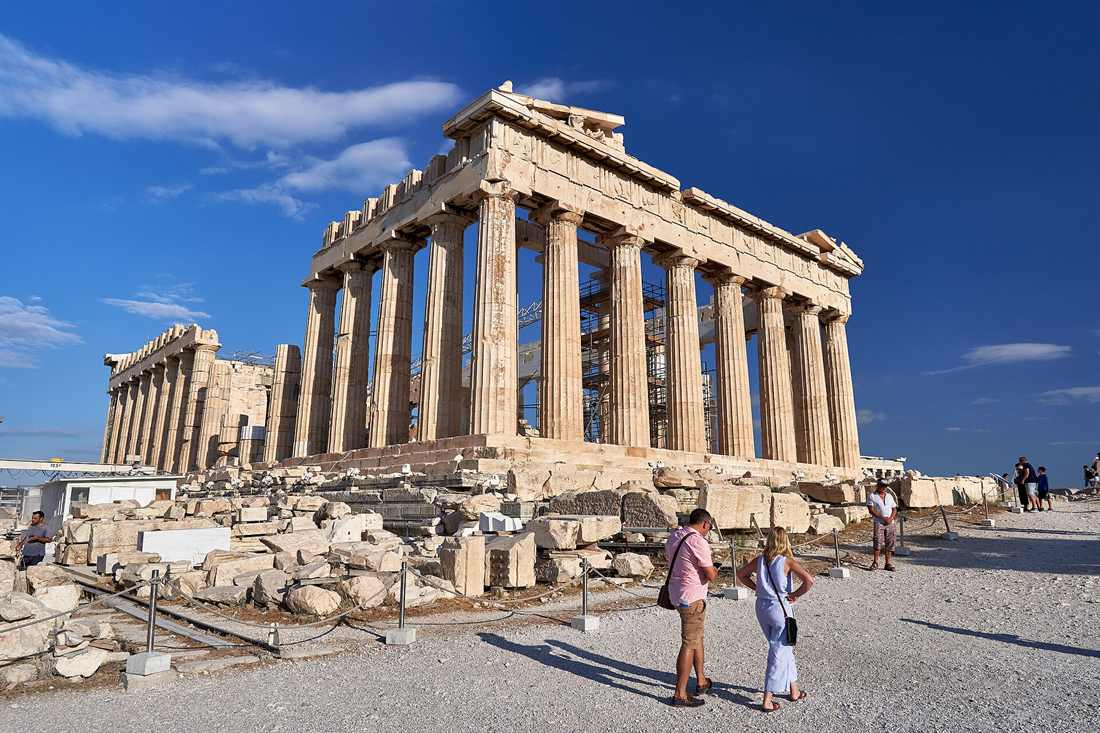
An acropolis tour in Japanese leads visitors across the rock above Athens with a guide who speaks Japanese. Further trips across the mainland and the islands are listed on Greece Tours.
Two Japanese-only tours run on GetYourGuide, and Veltra lists a bus tour with a Japanese assistant. The sections below cover licensed Japanese-speaking guides, the way Japanese texts write the monument names, the visa rule for a Japanese passport, payment, tour lengths and how to reserve and cancel.
What do Japanese speakers find when they book an acropolis tour in Japanese?
Japanese speakers find three kinds of product for an acropolis tour in Japanese. GetYourGuide sells two Japanese-only listings. Veltra sells a shared bus tour with a Japanese assistant. Four more Acropolis products list Japanese among other languages.
The first Japanese-only listing is a guided visit with the entrance ticket. The second is a private tour of the rock and its museum. The next two sections describe each listing. Both count as a true acropolis tour in Japanese, because the language line names Japanese and no other language.
Veltra is a Japanese-language booking site. Its half-day tour by H.I.S. is a shared bus tour with an English-language guide. A Japanese assistant, or 日本語アシスタント (nihongo ashisutanto), interprets for the group. The listing states that the tour is not private.
A check of 47 Athens listings on GetYourGuide found Japanese in nine language lists. Four of those products visit the Acropolis. One is the family tour, which names Japanese among eight languages and offers a private option. None of the four is an exclusive acropolis tour in Japanese, since each lists other languages too.
Readers who plan more than the rock can browse our Athens tours page for the rest of the city.
How does the Hill of the Muses scenic walk run in Japanese?
The listing sells a two-hour acropolis tour in Japanese with no other guide language. A licensed Japanese-speaking guide leads the visit. The booking carries fast-track entry plus the ticket for the site. The summary names the Parthenon and key monuments.
The web address of this GetYourGuide listing reads acropolis-hill-of-the-muses-scenic-walk-in-japanese. The title on the page reads “Athens: Acropolis Japanese Guided Tour & Fast-Track Ticket”. The summary names the Acropolis, the Parthenon and key monuments. It does not name the hill. Only the operator can confirm whether the route of this acropolis tour in Japanese includes it.
The listing marks the visit as skip the line, with free cancellation. Travellers must book at least 10 hours ahead. The booking form takes up to 25 participants. The listing holds 3.3 stars from 3 reviews, so the sample for this acropolis tour in Japanese is small.
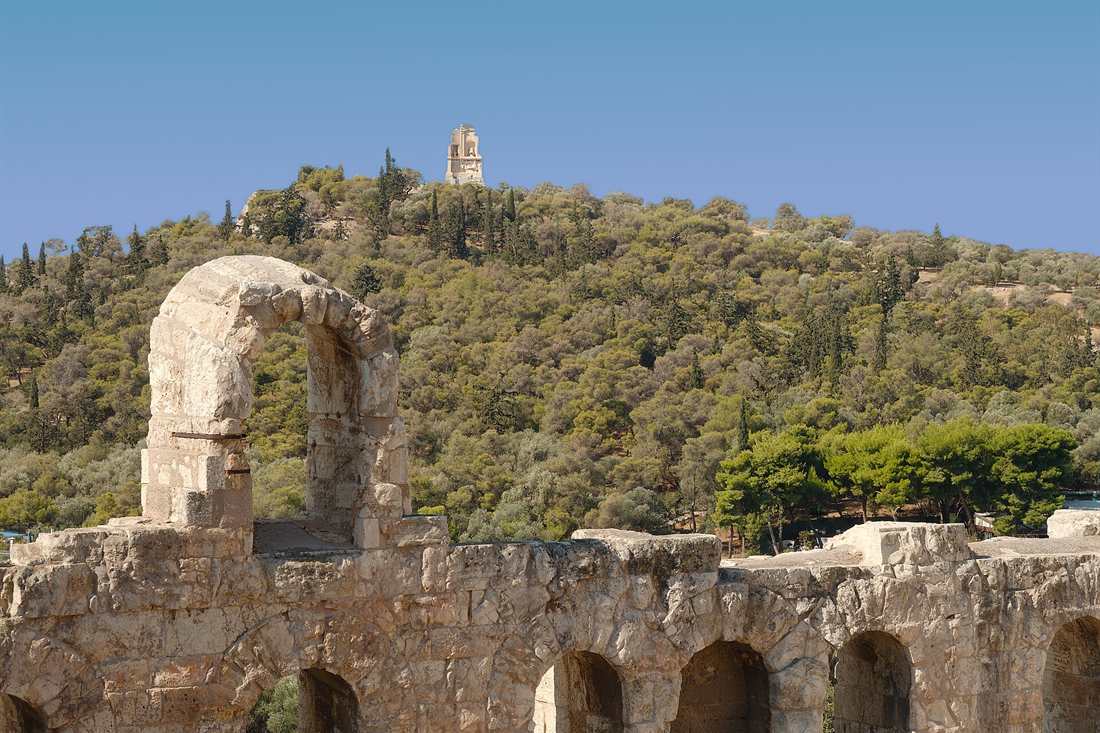
The Hill of the Muses is also called Mouseion Hill. It lies southwest of the Acropolis, and the Philopappos Monument stands on it. The monument is a Roman tomb built for Philopappos, a prince of Commagene who died in AD 116. An acropolis tour in Japanese that includes the hill adds this history.
The tomb stands opposite the Acropolis. Tradition held that the poet Musaeus lay buried on the same spot. White Pentelic marble forms the monument, which measures 9.80 by 9.30 metres.
What does the private Acropolis Museum tour in Japanese include?
This private acropolis tour in Japanese lasts five and a half hours. A Japanese-speaking guide leads the group through the Acropolis, the Parthenon and the Acropolis Museum. A stroll through Plaka and Anafiotika follows. The listing adds skip-the-line access.
The listing is titled “Athens: Acropolis & Museum Private Tour in Japanese”. Its language line shows Japanese and no other language. GetYourGuide tags it as a private group and a small group. The booking form accepts 2 to 6 participants. At five and a half hours, it is the longer acropolis tour in Japanese on GetYourGuide.
Cancellation is free for this acropolis tour in Japanese. The booking window closes 10 hours before the start. A single review gives the listing a 5.0 rating.
The stroll through Plaka and Anafiotika follows the museum on this private acropolis tour in Japanese. Anafiotika is a tiny neighbourhood inside Plaka, on the northeast side of the Acropolis hill. Workers from the island of Anafi built the first houses while they worked on King Otto’s palace. Workers from other Cycladic islands followed them.
Cycladic architecture shapes the quarter, with white walls and small cubic houses. Only 45 houses remain today, and the little streets up to the rock have no names. Houses carry labels such as “Anafiotika 1” and “Anafiotika 2”.
Veltra marks private tours with the word 貸切 (kashikiri), as in the title tag <貸切/3.5時間/アテネ発> (kashikiri, 3.5 hours, from Athens). The listing explains the word. Because the tour is kashikiri, the group sets its own pace and asks questions at any time.
Which Japanese-language booking sites list an acropolis tour in Japanese?
Veltra, a Japanese-language site, sells Japanese support on its Acropolis bus tour. GetYourGuide lists the two Japanese-only tours on its English pages. Headout and byFood have Japanese pages for Acropolis tours, yet each page names other guide languages.
Veltra, written ベルトラ (Berutora) in Japanese, shows 21 tours in its Athens sightseeing category and 15 in its Acropolis category. The H.I.S. title puts the language first inside angle brackets: <日本語または英語/午前/アテネ発> (nihongo mataha eigo, gozen, Atene hatsu). That reads Japanese or English, morning, from Athens.
The H.I.S. listing carries 13 traveller reviews and two plans. One plan comes with a Japanese assistant. The other plan comes with an English guide, and the page states that no Japanese guide or assistant joins it. Other Veltra Acropolis titles read <英語/午前/アテネ発> (eigo, gozen, Atene hatsu), which means English, morning, from Athens.
A Japanese page therefore does not promise an acropolis tour in Japanese. Headout’s Japanese page for its private Acropolis tour shows Japanese labels, but the text names a licensed English-speaking guide. The byFood page for a private Acropolis walk lists English, French, Italian and German as guide languages.
WAUG’s Japanese page for an Acropolis entry ticket offers an audio guide or a live guide. The page does not name a guide language, so it does not prove an acropolis tour in Japanese. It also says an AI translated the description. A mixed party of Japanese and Chinese speakers can read our Acropolis tour in Chinese page too.
Which guides in Athens work in Japanese?
The Association of Licensed Tourist Guides lists two guides under the language filter Japanese. Both give Attica as their place of residence. The Association’s note says licensed guides work everywhere in Greece, whatever their place of residence.
The directory sorts guides by language, and Japanese has its own entry in the drop-down list. Each row shows the languages, the place of residence, the telephone number and the e-mail address. A traveller who wants a licensed guide for an acropolis tour in Japanese contacts the guides from that list.
Read the job title before you book an acropolis tour in Japanese. A 日本語アシスタント (nihongo ashisutanto) interprets for an English-language guide on Veltra’s shared bus tour. The two GetYourGuide listings say a Japanese-speaking guide leads the group.
Veltra’s Athens ranking list also shows a listing titled アテネ観光日本語公認ガイド手配 (Atene kanko nihongo kounin gaido tehai). The title reads as the arrangement of a Japanese licensed guide. It adds a six-hour custom plan, a possible hotel transfer and a booking for one group.
The title does not name the Acropolis, so ask which sites the guide covers on an acropolis tour in Japanese.
How are the Acropolis monuments written in Japanese?
Japanese writes the rock as アクロポリス (Akuroporisu) and its main temple as パルテノン神殿 (Parutenon shinden). The sounds use katakana, and the word for temple uses two kanji. Learn these written forms before you join an acropolis tour in Japanese.
Japanese Wikipedia files the hill under アテナイのアクロポリス (Atenai no Akuroporisu). Its museum article writes アテネのアクロポリス (Atene no Akuroporisu) instead. Both spellings of Athens appear in print, so learn both for your acropolis tour in Japanese.
The Acropolis article names four masterpieces: パルテノン神殿, プロピュライア (Puropyuraia), エレクテイオン (Erekuteion) and アテナ・ニケ神殿 (Atena Nike shinden). The Nike temple has a second spelling, アテーナー・ニーケー神殿 (Atēnā Nīkē shinden), as its own page title. The bar ー lengthens the vowel before it.
The same pages explain two of these names. プロピュライア joins pro, “before”, and pylaion, “gate”, so it means “in front of the gate” (門の前, mon no mae). ニーケー means 勝利 (shōri), “victory”. The statue of Nike had no wings, so Athenians called it 翼のない勝利 (tsubasa no nai shōri), “wingless victory”.
The name パルテノン comes from the Greek παρθενών, 処女の部屋 (shojo no heya), the “virgin’s room”. The article adds that sources differ on which room carried the name and why. Hear it as Parutenon on an acropolis tour in Japanese.
Three more names come up around the rock. ディオニューソス劇場 (Dionyūsosu gekijō) is the Theatre of Dionysus. ヘロディス・アッティコス音楽堂 (Herodisu Attikosu ongakudō) is the Odeon of Herodes Atticus, a Roman music hall at the southwest foot. アクロポリス博物館 (Akuroporisu hakubutsukan) is the museum, also called 新アクロポリス博物館 (Shin Akuroporisu hakubutsukan).
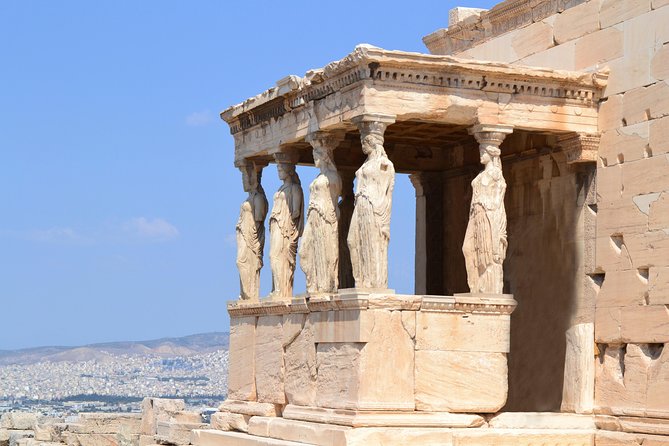
The statues of the Porch of the Maidens are カリアティード (Kariatīdo), also written 女像柱 (jozōchū). The term means a standing female figure that works as a column.
Our Acropolis monuments guide sets out the layout of the buildings. Use it to place each Japanese name during an acropolis tour in Japanese.
Which Japanese terms describe the Doric, Ionic and Corinthian orders?
Japanese calls an order オーダー (ōdā). It names the three styles ドーリア式 (Dōria shiki), イオニア式 (Ionia shiki) and コリント式 (Korinto shiki). Pages also write 様式 (yōshiki), “style”, in place of 式. Listen for these words at the columns on an acropolis tour in Japanese.
The Doric order is also ドリス式 (Dorisu shiki). Japanese Wikipedia calls it the oldest of the three styles. The column is thick, with strong エンタシス (entashisu), the slight swelling of the shaft, and a plain square capital. The column has no base. The page likens the capital to a 鏡餅 (kagami-mochi), the rice-cake offering of a Japanese New Year.
The same page says the triglyph, トリグリフ (torigurifu), is the beam end of the older wooden building, kept in stone. It lists the Parthenon among its Greek examples.
The Ionic capital carries a pair of scrolls, 渦巻 (uzumaki), also spelled ヴォリュート (voryūto). The shaft stands on a base, 礎盤 (sohan), and a relief frieze, フリーズ (furīzu), runs above. The Ionic page names the Erechtheion as its Greek example. It adds that the Parthenon, though mainly Doric, carries Ionic parts. Spot the scrolls on an acropolis tour in Japanese.
Vitruvius, a Roman architect, compared Doric to a sturdy male body and Ionic to a delicate female one. Japanese Wikipedia repeats the comparison. Look for that contrast between the Parthenon and the Erechtheion.
The Propylaia shows two orders in one gate. Its façade has Doric columns, and Ionic columns line the passage. Japanese Wikipedia calls it the first known building to show both together. Look up at both orders as you enter on an acropolis tour in Japanese.
The Corinthian order, コリント式, has a capital shaped like acanthus leaves, アカンサス (akansasu). Vitruvius tells that the sculptor Kallimachos, カリマコス (Karimakosu), designed it after seeing a basket left on a girl’s grave. Japanese Wikipedia adds that Greek builders rarely used this order.
Japanese Wikipedia also lists buildings in Japan for each order. The National Museum of Nature and Science, 国立科学博物館 (Kokuritsu kagaku hakubutsukan), stands under Doric. Hyōkeikan, 表慶館, at the Tokyo National Museum stands under Ionic. The Bank of Japan head office, 日本銀行本店 (Nippon Ginkō honten), stands under Corinthian.
What does Japanese Wikipedia say about the rock before an acropolis tour in Japanese?
Japanese Wikipedia describes a flat rock 150 m above sea level with an area of 3 hectares. Cliffs close three sides, and the only path up runs on the west. Read this overview before an acropolis tour in Japanese begins.
The Japanese embassy essay in search results for this topic is a participant’s report on a study tour of Japan. It never mentions the Acropolis, so Japanese Wikipedia serves as the Japanese-language source here.
The article adds that the hill is about 70 m high and that Greece has other acropolises. The plain word アクロポリス (Akuroporisu) still points to the Athenian one. Tradition says the wooden buildings burned to ash in the Persian wars. The stone rebuilding that followed reached its brightest age under Pericles.
The restoration section says every repair uses titanium nails, set so that a later team can undo the work. It counts 2,675 tons of building parts restored. Of the stones, 686 are original, 905 carry new marble patches, and 186 are wholly new. Check these figures against what the guide tells you on an acropolis tour in Japanese.
A Japanese TV show also appears in the Parthenon article. 日立 世界・ふしぎ発見 (Hitachi Sekai Fushigi Hakken) used projection mapping to paint colour onto the temple. The article notes that the carved decoration was first painted. Ask the guide how the temple looked when it was painted.
Which audio and digital guides offer the Acropolis in Japanese?
Of the audio and digital guides checked, one lists Japanese: the GetYourGuide VR audio tour of the Acropolis. The Hellenic Heritage app, the Acropolis Museum audio guides and the Headout combo ticket list no Japanese. Check each language list before you plan an acropolis tour in Japanese.
Japanese closes the list of eleven languages on that GetYourGuide tour. The product pairs a virtual reality app with an audio guide and pre-reserved entry tickets.
The bestselling GetYourGuide audio-guide ticket lists seven languages. Japanese is not one of them, so the ticket does not cover an acropolis tour in Japanese.
The Hellenic Heritage app carries the Acropolis of Athens among its sites. Its audio tours run in eight languages, and Japanese is not among the eight. The app cannot replace an acropolis tour in Japanese.
The Acropolis Museum offers its own free digital guide. Its audio runs in Greek and English. An artificial intelligence tool translates the text and the voice into 29 languages, and the page lists none by name.
The museum website menu offers Greek, English, German, Italian, French and Spanish. Ask the museum whether Japanese is among the 29 before you pair its guide with an acropolis tour in Japanese.
The Headout combo ticket for the Acropolis and its museum comes with audio in six languages. Japanese is not one of the six. That leaves the VR tour as the one audio product here with Japanese. The other route to an acropolis tour in Japanese is a live guide.
Does a Japanese passport need a visa for Greece?
No. The Hellenic Ministry of Foreign Affairs lists Japan as visa-free for ordinary passports. A Japanese traveller stays up to 90 days in each 180-day window. Settle the passport first, then book an acropolis tour in Japanese.
The ministry’s table has three columns: ordinary, diplomatic and service passports. Japan reads “visa-free” in all three.
The EU Delegation to Japan sets out the conditions on its travel page. The trip serves tourism, business, a family visit, a cultural or sporting event, or a similar purpose. An acropolis tour in Japanese counts as tourism.
A traveller joining an acropolis tour in Japanese meets two passport tests, according to the same page. The passport stays valid for at least three months after you leave the Schengen country you visit. It was also issued within the previous ten years.
Each Schengen country runs its own immigration control, the delegation adds. Questions about entry go to the embassy of the country you enter. For Greece, that is the Embassy of Greece in Minato ward, Tokyo.
The embassy runs a Japanese-language site titled 日本の中のギリシャ (Nihon no naka no Girisha), “Greece in Japan”. Its news list carries a notice that the Schengen Entry/Exit System began on 12 October. Read it before you fly for an acropolis tour in Japanese.
The ETIAS pre-travel form for visa-free visitors has seen its start date move more than once. Check the EU’s own ETIAS page before you fly.
How do visitors from Japan pay for tours and tickets in Athens?
Acropolis Museum e-tickets are paid in euro by Visa, Mastercard, Maestro or UnionPay card. The museum’s pages do not name JCB. Check the card brand in your wallet first, then pay for an acropolis tour in Japanese.
The museum’s FAQ and its e-ticket terms agree on the card types. JCB, a card brand issued in Japan, is not among them. A Visa or Mastercard is on the museum’s list.
A press release from JCB and Viva Wallet names around 80,000 merchants in Greece for JCB cards. The release describes the partnership’s plan, not a live shop map. Ask the seller before you rely on JCB for an acropolis tour in Japanese.
GetYourGuide works with the payments firm Checkout.com. The firm’s release says customers book and pay in their own language and in the currency of their choice. A GetYourGuide director names Japan among the company’s key strategic markets.
The museum’s e-ticket site issues a receipt, not an invoice. A business that needs an invoice buys through the museum’s Group Bookings Service.
Our Acropolis tickets guide explains the timed-entry slots for the rock that an acropolis tour in Japanese climbs.
Which Japanese-language travel sites and guidebooks cover Athens?
Chikyū no Arukikata (地球の歩き方), a Japanese guidebook series, covers Athens in its Greece volume. The Nippon Travel Agency runs a Greece page in Japanese. Use both to plan your stops, then book an acropolis tour in Japanese.
Volume A24 of the series covers Greece. Its older edition is titled ギリシアとエーゲ海の島々&キプロス (Girishia to Ēgekai no shimajima to Kipurosu), “Greece, the Aegean Islands and Cyprus”. Its Athens section lists the Acropolis ruins, the Parthenon, the Ancient Agora and the National Archaeological Museum. Read it before an acropolis tour in Japanese.
The publisher says diagrams (zukai, 図解) explain the Acropolis ruins, the Ancient Agora and the National Archaeological Museum. It also posts a correction notice for that edition. The notice lists changed phone numbers for sites, hotels and restaurants.
A later edition carries the shorter title ギリシャ (Girisha), “Greece”. A bookshop listing for it shows an area chapter called アテネとアッティカ地方 (Atene to Attika chihō), “Athens and the Attica region”.
The Nippon Travel Agency (日本旅行, Nihon Ryokō) says Athens took its name from Athena, deity of wisdom and war. The page recommends visiting the Acropolis together with the National Archaeological Museum.
Greece’s national tourism organisation keeps an illustrated leaflet in Japanese, ギリシャ 総合案内 GREECE (Girisha sōgō annai), in its online archive. The record’s topic list includes Athens, museums, archaeological sites and a Greek-Japanese dictionary.
Which links between Greece and Japan can a visitor trace before an acropolis tour in Japanese?
Four links join the two countries: Hōryū-ji’s columns, temple guardians, a Greek-born writer and an Athens garden. The first two are theories, so read them as stories around an acropolis tour in Japanese.
In the Meiji era, Itō Chūta (伊東忠太) was a graduate student at the Imperial University. He argued that the swollen columns of Hōryū-ji (法隆寺) came from Greek entasis. In Japanese, that swelling is called dōbari (胴張り).
He walked from China through India and Turkey to Greece over three years. He found entasis columns nowhere but in Japan and Greece, and he never proved the idea. Japanese Wikipedia now calls it a folk theory (zokusetsu, 俗説).
Its article on Japan–Greece relations says ancient Greek culture reached Japan indirectly along the Silk Road. The grapevine arabesque (葡萄唐草文, budō karakusamon) on treasures of the Shōsōin (正倉院) is said to come from Greece. Meiji scholars also floated a theory tying the tale of Yuriwaka Daijin (百合若大臣) to the Odyssey.
The English Wikipedia article on Greco-Buddhism traces the Niō (仁王) temple guardians to Vajrapani. This Buddhist figure took the look of the Greek hero Heracles.
The article also cites a Chūō University professor who links the wind god Fūjin (風神) to the Greek god Boreas. The scholars it cites do not assume a noticeable Greek influence on Gandharan Buddhism beyond art.
Lafcadio Hearn was born on the Greek island of Lefkada and later became a Japanese citizen. In Japan he is known as Koizumi Yakumo (小泉八雲). Lefkada’s Cultural Center houses a Lafcadio Hearn Historical Center, and Lefkada and Shinjuku are sister cities.
Athens has a Japanese garden of its own, in Nereidon Park on Michalakopoulou Street near the National Gallery. Greek City Times calls it the city’s first thematic park. JT International Hellas supported it under the auspices of the Japanese Embassy. Pair a visit with an acropolis tour in Japanese for a day built around these ties.
How long, in hours, does an acropolis tour in Japanese run?
The shortest acropolis tour in Japanese runs 2 hours on GetYourGuide. The private museum tour there runs 5.5 hours. The H.I.S. half-day on Veltra takes 4.5 to 6 hours with hotel transfers and puts its sightseeing at about four hours.
The 2-hour length matches one travel blog, which says to allow at least 2 hours for the whole site. Pick a date on the GetYourGuide booking page to see start times for this acropolis tour in Japanese.
The Veltra page counts 4.5 to 6 hours from hotel pickup to drop-off. A note on the page gives the sightseeing share as about four hours. The same blog spent 4 hours on the Acropolis and the museum.
Civitatis lists its English guided Acropolis tour at 2 hours, the same length as the Japanese walk. The private acropolis tour in Japanese with the museum needs 5.5 hours. Treat it as a day of its own.
When and where does an acropolis tour in Japanese begin?
The 2-hour acropolis tour in Japanese gathers near Acropolis Metro Station and lists dates on Saturdays and Sundays only. The page shows start times after you choose a date. The H.I.S. half-day on Veltra collects guests at their hotel between 07:00 and 08:30.
The calendar for the acropolis tour in Japanese runs for about seven months from late October and holds 64 dates. Every date falls on a weekend. The private museum tour sells Monday to Saturday for the year ahead and lists no Sunday.
One reviewer of the walk waited at the meeting point the operator had sent and found no guide. The operator replied that the point moved a day earlier because of high temperatures. It sent the new spot through GetYourGuide and WhatsApp. Check your messages the day before.
The H.I.S. coach starts the sightseeing at 09:00 after pickup from a hotel named on your voucher. Wait in front of the hotel, not in the lobby. The page warns that traffic can make the bus slightly late, and it returns guests at 13:00.
The private plan from Nianiakos Travel starts on the hour from 08:00 to 13:00. The guide picks you up at your Athens hotel or meets you on site. The exact spot arrives after booking.


What does a Japanese-speaking guide show on the south slope?
The 2-hour GetYourGuide walk climbs the southern slope and names the Theatre of Dionysus as its stop there. The listing names no other slope monument. Ask the guide about two sites beside the theatre: the Odeon of Pericles and the Choragic Monument of Thrasyllos.
Japanese Wikipedia says the Athenian assembly met in the Theatre of Dionysus after the Pnyx was judged unsuitable. It adds that records show Nero had the theatre repaired in AD 61. That makes the theatre a political stop on an acropolis tour in Japanese, as well as a stage.
The Odeon of Pericles stood at the south-eastern foot of the rock, next to the theatre entrance. Builders first raised it in 435 BC for music contests of the Panathenaea. Its foundations measure 62.40 by 68.60 metres, and 90 pillars in nine rows of ten held the roof.
The roof used timber from captured Persian ships and took the shape of a tent. Fire destroyed the hall during Sulla’s siege of Athens in 87 to 86 BC. Ariobarzanes II of Cappadocia then had it rebuilt.
The Choragic Monument of Thrasyllos dates to 320 and 319 BC. It fills a natural cave in the south face of the rock and takes the form of a small temple. A church of Panaghia Spiliotissa, Our Lady of the Cave, used the cave until the late twentieth century.
The listing names neither site, so check whether your acropolis tour in Japanese passes them.
What does a Japanese-speaking guide say at the Parthenon?
Japanese Wikipedia dates the Parthenon to 447 to 438 BC, with carved decoration running to 431 BC. The marble came from Mount Pentelikon, 16 kilometres from Athens. These are the facts an acropolis tour in Japanese can build its talk on at the temple.
The article gives the base as 69.5 metres in length and 30.9 metres in width. Each outer Doric column is 1.9 metres across and 10.4 metres tall. The temple has 46 outer columns and 19 inner ones.
The platform is not flat. It curves upward by 60 millimetres at the east and west ends. On the north and south sides the rise is 110 millimetres. The article treats the idea that these curves correct an optical illusion as a theory.
The blocks are heavy. Column drums weigh 5 to 10 tons, and the beams about 15 tons. The joints fit to within 1/100 of a millimetre, and the builders used no mortar to adjust them.
The same article calls the golden-ratio claim for the front a later urban legend, because the ratios are not exact.
The article adds that the US Supreme Court building and La Madeleine in Paris copy the Parthenon’s design. Its form is also the motif of the UNESCO logo. Know both points before your acropolis tour in Japanese reaches the front of the temple.
What does a private acropolis tour in Japanese involve?
A private acropolis tour in Japanese gives your group its own Japanese-speaking guide. Two routes exist. One is the GetYourGuide private museum tour. The other is the tailor-made Veltra plan from Nianiakos Travel, which asks for bookings in units of 4 or fewer.
The Veltra operator asks for your wishes by email first. It then builds the private acropolis tour in Japanese around them. Its example day starts at the Acropolis and the Acropolis Museum. It adds lunch in Plaka, the Ancient Agora, the Roman Agora and Hadrian’s Library. The plan includes the licensed Japanese guide only.
The page promises restaurant suggestions and bookings with the plan. It also lets you choose the start and end times. Guests who add a private car can reach Cape Sounion for sunset and dinner. The car also lets one day cover all the main Athens spots.
The GetYourGuide private museum tour suits a family that wants one Japanese-speaking guide for the whole group. Its text calls the day a private, relaxed tour.
For a private route that goes beyond the rock, see our Athens private tour page.


In which months and at which hours does an acropolis tour in Japanese work well?
An acropolis tour in Japanese follows the site hours. The site opens at 8 am and closes at 8 pm until the end of August. Closing slips to 6 pm by late October and to 5 pm from November. Each Japanese holiday period meets a different closing time.
Japan’s Ministry of Foreign Affairs (外務省, Gaimushō) publishes a Greek safety page in Japanese. For early spring, it flags allergy symptoms from the pollen (花粉, kafun) of pine and cedar trees.
Golden Week (ゴールデンウィーク, gōruden wīku) runs from Shōwa Day on 29 April to Children’s Day, according to Wikipedia. An acropolis tour in Japanese in that run meets the season that closes at 8 pm. The Athens Tourism Guide lists the first of the fifth month (5月1日, gogatsu tsuitachi) as a closed day. That date falls inside Golden Week.
Wikipedia names 15 August, Hachigatsu Bon, as the commonly celebrated date of Obon (お盆, o-bon). Mountain Day (山の日, Yama no Hi) on 11 August was set to coincide with the Bon vacation. Both dates sit in the months that the Athens Tourism Guide advises avoiding for heat and peak cruise crowds.
The same guide names the 8 am opening as its first choice of the day. It warns against 11 am to 4 pm in summer, when the exposed rock is hot and busy.
The ministry page also warns of summer heatstroke (熱中症, netchūshō) at ruins without shade. It adds: in recent years, large wildfires have broken out in different parts of Greece from about June to September.
Wikipedia gives Autumnal Equinox Day (秋分の日, Shūbun no Hi) as around 23 September. The Acropolis closes at 7 pm from 16 to 30 September. An acropolis tour in Japanese on that holiday meets the 7 pm closing time.
Wikipedia notes that companies in Japan voluntarily close from 29 December to 3 January. A winter acropolis tour in Japanese meets the 8 am to 5 pm hours. The Acropolis is shut on 25 December, 26 December and 1 January.
The private museum tour’s calendar, when read, showed no dates on 25 or 26 December. It also showed none from 28 December to 1 January.
How does an acropolis tour in Japanese pair with the Acropolis Museum?
Pair an acropolis tour in Japanese with a separate museum ticket and a walk down the hill. The museum states that its ticket is independent of the Acropolis ticket and valid only on the date issued. The Dionysiou Areopagitou pedestrian walkway links the two sites.
On Saturdays and Sundays the museum opens at 9 am and closes at 8 pm in summer and winter alike. Last entry is 7:30 pm.
Friday is the late day. The museum stays open until 10 pm, and the second-floor restaurant stays open until midnight on Fridays and Saturdays. Monday is the short day and closes at 5 pm in both seasons.
The Athens Tourism Guide sketches a half-day plan. It starts with 90 minutes on the rock at 8 am, then a walk down to the museum. The museum visit begins at 10 am and lasts 90 minutes.
At the museum entrance, an X-ray scanner checks bags, and large bags go to the cloakroom. Amateur photography is permitted throughout, apart from the Archaic Acropolis Gallery. Flash and tripods are not allowed inside.
Guests can add a guided museum visit after an acropolis tour in Japanese. Our Acropolis Museum guided tour page lists those formats.
Which rules govern reserving and cancelling an acropolis tour in Japanese?
GetYourGuide’s terms refund a cancellation made more than 24 hours before the start, unless the listing sets other conditions. A cancellation inside 24 hours, or a no-show, gets no refund. The supplier’s time zone decides how deadlines are counted.
Each acropolis tour in Japanese also sets its own age bands. The walk lists adults from 18 and children aged 17 and younger. It adds an 18 to 24 band for EU citizens who show ID. The private tour lists adults from 18, children aged 6 to 17 and infants aged 5 and younger.
Greece runs on UTC+2, and on UTC+3 from the last Sunday in March to the last Sunday in October. Japan stays on UTC+9 all year, so the gap is 6 hours in summer and 7 hours in winter.
Take a 9 am start for an acropolis tour in Japanese and the 10-hour cut-off on both listings. If the supplier works on Athens time, bookings close at 11 pm the evening before. That is 5 am in Japan in summer and 6 am in winter.
Japan lies outside the EU, so a Japanese passport falls under the non-EU rules. The Athens Tourism Guide says non-EU children enter the Acropolis free up to age 18 with a passport.
The museum gives non-EU children up to age 5 free entry and non-EU visitors under 25 reduced admission. It sells reduced and free tickets only at its ticket desk, against a passport.
Which last questions do visitors raise about an acropolis tour in Japanese?
Does a guest in a wheelchair reach the rock on an acropolis tour in Japanese?
The Acropolis has a wheelchair lift on the north slope. Visitors reach it by the secondary north entrance off the Theorias Street path. Wheelchair-accessible toilets stand at the main south entrance. The platform above is mostly paved or smooth marble, with uneven sections.
Until what time can guests enter the Acropolis?
Last admission is 20 minutes before closing. That means 7:40 pm in the 8 pm season and 4:40 pm in winter, according to the Athens Tourism Guide.
Does rain stop an acropolis tour in Japanese?
Heavy rain or lightning does: the site can close for safety, the Athens Tourism Guide says. Wet marble also becomes treacherous, so grip matters.
Which photo and drone rules apply on the rock?
Hand-held photography on an acropolis tour in Japanese is permitted for personal use. Commercial photography or filming needs permission from the Hellenic Ministry of Culture. Drones are forbidden, and the whole area is a drone exclusion zone.
Does the Acropolis Museum offer free Wi-Fi?
Yes. Free access to the museum’s wireless network is available in all public areas of the building.
Can families borrow strollers and wheelchairs at the museum?
Yes. Strollers are lent at the ground-floor cloakroom, and wheelchairs at the Visitor Services Desk. Ramps serve all entrances, and a parents’ room for babies sits on the first floor.