
A Larnaca tour walks the old town, the Church of Saint Lazarus, then the Salt Lake and Hala Sultan Tekke. Day trips reach Lefkara, the Troodos Mountains, Nicosia and Famagusta. Find more trip ideas on Greece Tours.
Below we compare the walks, the sights, the inland villages and the day trips from the city, with the booking rules.
What is a Larnaca tour?
A Larnaca tour is a guided visit to the sights of Larnaca, a city on the south-east coast of Cyprus. It goes on foot, by bike or by vehicle. Lengths run from a 2-hour old-town walk to a 9-hour day trip with hotel pickup.
The name comes from larnax, the Greek word for a coffer or sarcophagus. An informal etymology links it to the sarcophagi found in the area. A consul of the late 19th century claimed to have explored more than 3,000 tombs around the town.
Larnaca is the capital of the Larnaca District. Locals call the old harbour district Skala, the Greek word for ladder. Each Larnaca tour type gets its own section below. The page starts with the old town, then covers the sights on the edge of the city. It ends with day trips across the island.
Which Larnaca tour formats can you book?
GetYourGuide lists a 2-hour private walking tour, a 3-hour old-town tour and a 2.5-hour bike tour. A jeep safari takes 8 hours. Longer Larnaca tour routes run 4 to 9 hours and add hotel pickup.
The private walking tour covers Larnaca’s ancient roots and Byzantine sites, the Finikoudes seafront and the Old Turkish Quarter. It runs for a private group and carries free cancellation. A booking must be made at least 24 hours ahead.
The 3-hour private tour combines the old town, the Salt Lake and a glass-bottom boat trip to the Zenobia shipwreck. It takes a small group and offers pickup. A booking must be made 10 hours ahead. Our Larnaca boat trip page covers the sea side.
The rest of the list holds food classes, Troodos Mountains days and long routes to Nicosia, Famagusta and Paphos. TUI Musement lists its Larnaca-area tours in English, German and Polish. One GetYourGuide food day runs only in French. The sections below sort every Larnaca tour by place.
How does the municipal Larnaca walking tour work?
The Larnaka Tourist Information Office runs a guided walk called “Larnaka – Past and Present” every Wednesday at 10am. The walk is free and lasts 2.5 to 3 hours. A licensed guide leads the group on foot.
The group meets at the Tourist Information Office building. Visit Cyprus says this Larnaca tour needs no reservation. The walk’s own page asks guests to arrive 15 minutes early. The walk does not run on public holidays.
Entrance fees and drinks are not included, so guests pay for them. The office advises comfortable walking shoes, light clothes and a hat in summer. The guide leads it in English. Private groups that want another language apply to the same office.
The Larnaka Tourism Board also arranges a sensory Larnaca tour for visually impaired visitors. It offers the tour to organised groups. A pilot of it won gold at the Cyprus Tourism Awards. The pilot offered specially designed activities for visually impaired guests.
Which old-town stops does a Larnaca tour pass on foot?
A Larnaca tour on foot passes five stops. They are the statues, the Kebir Mosque, the art studios, the Kyriazis Medical Museum and the Municipal Market. The municipal walk links them.
The Larnaka Storytelling Statues give a self-guided Larnaca tour a voice. Guests scan a QR code on a monument and receive a call-back on their phone. The call carries no charge. Each monument tells its story in English or Greek.
The Kebir Mosque stands at the end of Athens Avenue, opposite the medieval castle. It began as a Catholic church dedicated to Santa Katerina in the 13th or 14th century. A public fountain outside still survives. The municipal walk lists it among its stops.
The Art Workshops Neighbourhood holds two streets of studios parallel to the Piale Pasha coastal street. On a Larnaca tour of the studios, sculptors, ceramists and painters welcome visitors to watch them work. Pottery lessons are on offer. The Municipal Market has 20 shops on its ground floor and a Saturday farmer’s market in the yard.
The Kyriazis Medical Museum sits in a traditional mansion. Its exhibits run from Ancient Roman times to the late 20th century. They include an X-ray machine and a filled pharmacy unit. Its listed opening days are Wednesday and Saturday mornings.
What does a Larnaca tour show at the Church of Saint Lazarus?
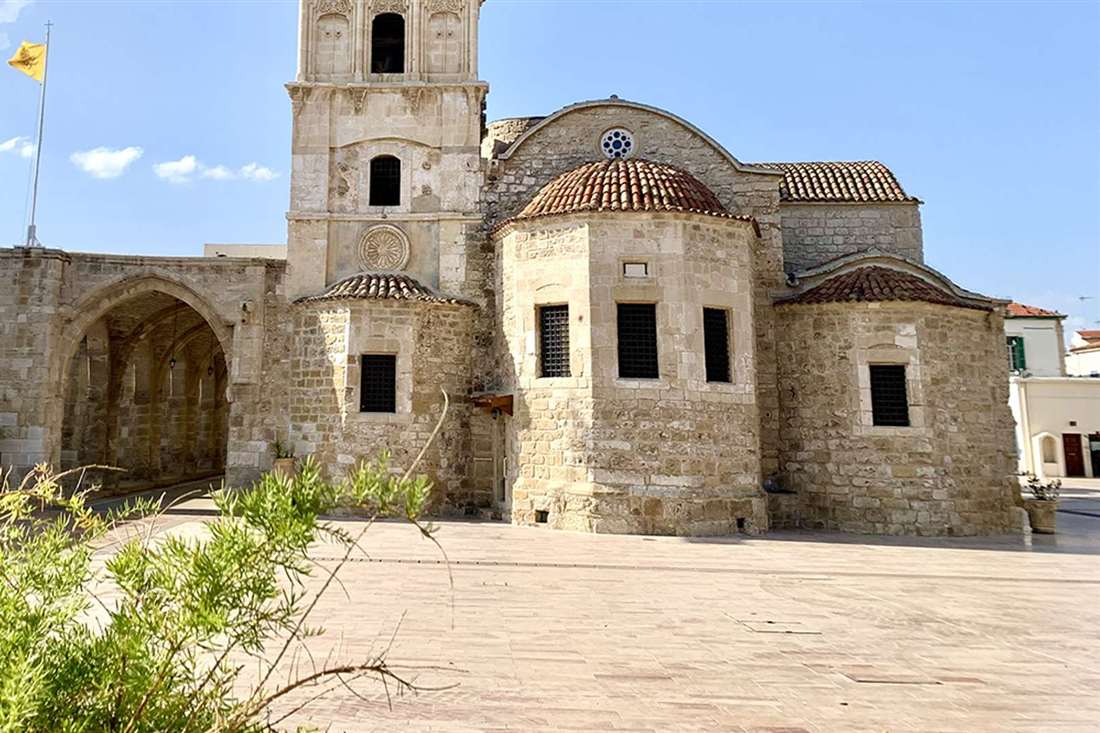
The Church of Saint Lazarus shows a gold-covered baroque iconostasis, a rebuilt bell tower and the saint’s tomb. The tomb lies under the sanctuary. Emperor Leo VI built the church, and a restoration followed in the 17th century.
The building measures 31.5 by 14.5 metres and has three aisles. Square limestone blocks about 1 metre thick form the stonework. The three original domes and the first bell tower fell in the early years of Ottoman rule.
The Ottoman authorities later allowed bell towers again, and the present tower went up in a Latin style. A carver named Chatzisavvas Taliadorou made the iconostasis in the late 18th century. Painters added the icons, and gilders covered the screen in gold.
A fire damaged the interior in the 1970s, and restorers re-plated the screen in gold. Next to the church, the Byzantine Museum shows icons, artefacts and relics. The church has an entrance ramp, chair lifts and accessible toilets. It also joins the Storytelling Statues project, where Leo the Wise recounts why he had it built.
Which museums can a Larnaca tour add?
A Larnaca tour can add the Pierides Museum, the Larnaca District Museum and the Byzantine Museum. The Pierides Museum is the oldest private museum in Cyprus. The District Museum sits 100 metres from the Kition-Bamboula excavation.
The Pierides Museum fills a family home. Its prized items are red polished ware from the Early Bronze Age, Roman glassware and medieval ceramic dishes. A cartography hall holds old maps and charts of Cyprus. Five generations of the family built the collection.
A tactile station lets visitors with a sensory disability explore the museum’s history by touch. A cross-shaped idol about 6,000 years old stands among the exhibits. The municipal Larnaca tour lists this museum as an optional interior visit.
The Larnaca District Museum belongs to the Department of Antiquities. A replica of the stele of King Sargon II greets visitors in the entrance hall. Room I shows a Neolithic burial from Choirokoitia, with a millstone on the body. The Kition-Kathari site lies 500 metres further north.
What does a Larnaca tour show at Hala Sultan Tekke?
Hala Sultan Tekke shows an Ottoman shrine around the tomb of Umm Haram and a domed mosque of yellow stone. Radar surveys put a Late Bronze Age city beside it at up to 50 hectares.
The tomb of Umm Haram lies behind the mosque wall that faces Mecca. The dervish Sheikh Hasan found the tomb in the 18th century and built the first structure. The domed mosque is square, with a balcony.
An octagonal fountain opposite the mosque dates from the late 18th century. The Tekke garden is called the Pasha garden. In Ottoman times, ships flying the Ottoman flag lowered it to half mast off Larnaca. They also saluted the shrine with cannon shots.
The Cyprus Tourism Organization publishes audio guides for the site in MP3 and PDF form. The guided bike tour on GetYourGuide passes Hala Sultan Tekke. A Larnaca tour by bike therefore reaches the shrine and the lake in one ride.
What does a Larnaca tour show at the Salt Lake?
The Salt Lake is a Ramsar wetland of four lakes: Aliki, Orphani, Soros and Spiro. Aliki is the largest. Flamingos feed on brine shrimp there, and recent evidence indicates that the greater flamingo also breeds on the wetland.
The Larnaca Salt Lake is the second largest salt lake in Cyprus, after the Limassol Salt Lake. It is also a protected EU Natura site and an Important Bird Area. Halophytic scrubland surrounds the water.
A legend explains the salt. Saint Lazarus asked an old woman for food and drink. She refused and said her vines had dried up. He answered with a curse: her vines stay dry and the place becomes a salt lake forever.
Salt from the lake was once one of the major exports of the island. Workers collected it with donkeys and piled it into huge pyramid-shaped heaps. Harvesting stopped in the 1980s. The bike tour and the 3-hour private Larnaca tour both include the lake. The Paphos day trips list it too.
What is the Kamares Aqueduct on a Larnaca tour?
The Kamares Aqueduct is a stone water channel built by Ebubekir Pasha, the Ottoman governor of Cyprus. Of its three arched spans, 75 arches survive. The guided bike tour from Larnaca passes the aqueduct.
The governor saw the poor of Larnaca carry water on their backs from springs two hours’ walk away. He paid for the aqueduct from his own fortune. The first span had 50 arches, the second 12 and the third 31.
Between the spans, the water ran through a long tunnel with about 250 air wells. The wells sit at falling heights, so the water flowed by gravity alone from the source to the town. Lights illuminate the arches at night.
Foreign travellers counted the aqueduct as the leading Ottoman monument of Cyprus. Locals call the arches “The Kamares”, which means “The Arches”. A Larnaca tour on two wheels gives time to stop beside them.
What does a Larnaca tour see at the fort and on the seafront?
Larnaca Fort stands at the end of the Finikoudes promenade and guarded the harbour in the Middle Ages. A Blue Flag beach runs beside the promenade. A bust of Cimon there reads “Even in death he was victorious.”
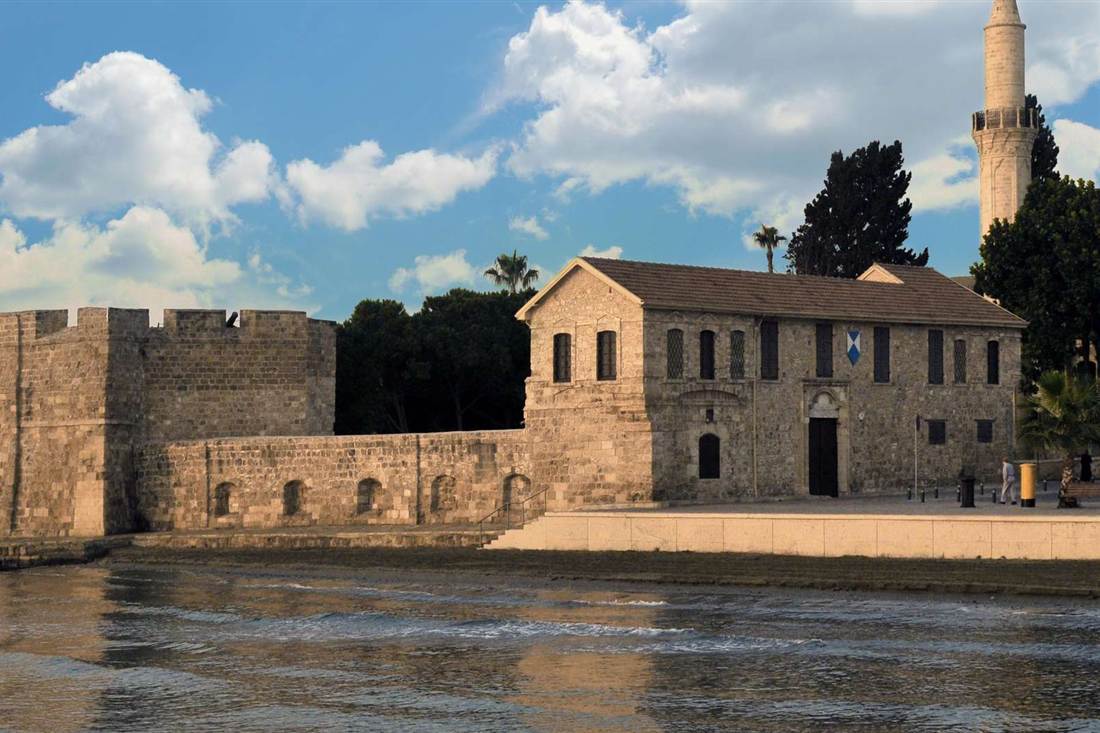
The fort took its present form under Ottoman rule. A chronicler links it to King James I of the Lusignan dynasty, who built it to protect the harbour. The British later turned the fort into a prison. The gallows stayed in use until the late 1940s.
The beach beside the promenade has fine brown-beige sand and calm, shallow water. Lifeguards watch the sea, and a floating wheelchair is free to use. Free Wi-Fi covers the whole strip. Boat trips leave from the adjacent pier.
Europe Square marks the start of the promenade and holds a museum and a gallery. The Seafront Stage hosts cultural events. The guided bike tour cycles the promenade and visits the medieval castle, so one Larnaca tour covers both.
Which Larnaca tour reaches the Neolithic village of Choirokoitia?
A 5-hour Larnaca tour on GetYourGuide combines Choirokoitia with Lefkara, Kato Drys, a wine tasting and two small museums. A 4.5-hour option pairs a self-guided Choirokoitia visit with a donkey farm and the White Rocks cliffs.
The village stands on a hill slope in the Maroni river valley, about 6 km from the sea. A stone wall 2.5 metres thick closed it off. At its highest preserved point the wall rises 3 metres.
On the 5-hour Larnaca tour, round houses called tholoi huddle inside the wall, each 2 to 9 metres wide. Groups of them circle an open courtyard. Scholars put the population at 300 to 600 at any one time. The villagers grew wheat, barley and lentils.
They herded sheep, goats and pigs and hunted deer. The dead lay in crouched positions under the house floors. One suggested meaning of the name is “pig cradle”. Porphyrios Dikaios of the Department of Antiquities discovered the settlement.
Which Larnaca tour visits Lefkara, Kato Drys and Fikardou?
The “Meet the Locals of Lefkara” Larnaca tour lasts 8 hours. It covers halloumi making, wine tasting, the villages of Lefkara and Fikardou and a meze lunch. Pano Lefkara itself has cobbled limestone streets and a lace school.
The name Lefkara joins the Greek words for white and mountains. Pano means upper, and Kato Lefkara, the lower village, lies 1.2 km away. Silversmiths make filigree work, and a folklore museum in a restored house shows local costumes and lacework.
The surviving old houses date from Ottoman times. They have bare stone fronts, few openings and flat roofs of rammed earth. Tourism arrived in the 1970s and saved the village from economic ruin, because the old architecture was still intact.
Kato Drys sits at 520 metres on hilly ground beside the Agios Minas river. Saint Neophytos was born there, and his birth house still stands. Fikardou keeps the look of a medieval village and belongs to the Department of Antiquities.
A private Larnaca tour of 6 to 8 hours covers Pano Lefkara and the man-made Lefkara lake on foot. A 7-hour option adds a donkey farm and a camel park with optional rides.
Which monasteries and village churches sit within reach of a Larnaca tour?
Stavrovouni Monastery crowns a hill in Larnaca District. The Panagia Angeloktisti church stands at Kiti, 11 km south-west of Larnaca. Tradition dates the founding of Stavrovouni to the years 327 to 329 AD.
Stavrovouni means “mountain of the cross”. Tradition says Saint Helena left a piece of the True Cross there. The monastery is the earliest documented one on the island. A silver cross-shaped reliquary holds a minute fragment of the relic.
Monks from Mount Athos brought the monastery back to life at the end of the 19th century. It later sent monks to revive the Trooditissa monastery in the Troodos Mountains.
Kiti is the setting of a local legend. Residents of ancient Kition moved there to escape the Arab invasions. They began to build a church, and its foundations moved overnight. Tradition says angels built the church, so it is called Panagia Angeloktisti, “Panagia built by angels”.
Which Larnaca tour climbs into the Troodos Mountains?
A Larnaca tour to the Troodos Mountains runs 8 to 8.5 hours. GetYourGuide lists a UNESCO churches tour, a Kykkos Monastery tour and a 4×4 jeep safari. All three start from Larnaca.
The UNESCO churches tour visits the Church of Cyprian and Justina and the Church of the Virgin Mary Assinou. The UNESCO list names ten painted churches and monasteries in the Troodos region. Steep-pitched wooden roofs with tiles are unique to Cyprus.
The church of Agios Nikolaos tis Stegis in Kakopetria dates from the 11th century. No older katholikon survives on the island. The Panagia Phorviotissa, also called Asinou, is a 12th-century church in Nikitari.
The Kykkos tour adds the village of Kakopetria and the tomb of Archbishop Makarios III at Throni. Emperor Alexios I Komnenos founded Kykkos Monastery around the end of the 11th century. It lies at 1,318 metres, and Makarios III began his career there as a monk.
The jeep safari covers traditional villages and forest landscapes on a 4×4. Our Troodos Mountains tour page compares the routes from every coast.
Which Larnaca tour visits Nicosia and the Kyrenia castles?
A 6-hour Larnaca tour to Nicosia visits the Cyprus Handicraft Center and drives round the centre. Free time in the Walled Old Town follows, and guests can cross the border. A longer tour adds the Troodos Mountains and Omodos.
An 8-hour Larnaca tour joins Nicosia, the Troodos Mountains and Omodos. Its listing calls Nicosia the last divided city in the world. Guests stroll through traditional villages after the capital. Our Nicosia tour page covers the Green Line, the museums and the border rules.
A 6-hour small-group Larnaca tour with a private guide goes north to Saint Hilarion Castle and Bellapais. Saint Hilarion stands in the Kyrenia Mountains and commands the pass road from Kyrenia to Nicosia. It is the least damaged ruin of the three Kyrenia strongholds.
The upper ward holds the royal apartments, and a carved window there is called the Queen’s Window. Bellapais Abbey is a ruined 13th-century monastery about 5 km from Kyrenia. Its refectory hosts concerts.
Which Larnaca tour heads east to Cape Greco, Ayia Napa and Famagusta?
The Cape Greko tour from Larnaca lasts 4 hours and caps the group at 5 guests. A private tour runs 5 hours. A 7-hour tour adds the Blue Lagoon and Nissi Beach. Famagusta days run 8 to 9 hours.
The 4-hour small-group Larnaca tour includes round-trip transfers. It visits Cape Greko, then the caves and the Bridge of Love. The private 5-hour version adds the Monastery of Ayia Napa and Nissi Beach.
The 7-hour tour lists Nissi Beach, the Blue Lagoon, Cape Greco and Ayia Napa. It adds the caves and the Bridge of Love. It leaves time for swimming and for lunch, which costs extra. Our Ayia Napa tours page explains the cape and the caves.
The 8-hour Famagusta day trip has a licensed guide. It covers the Varosha ghost town, the Saint Barnabas Monastery and the Salamis site. One listing offers a walk into the once-sealed Varosha quarter that has just reopened. A 9-hour version covers the same three sights.
Which Larnaca tour starts in Paphos or Limassol?
Paphos and Limassol operators run Larnaca days of 7 to 9.5 hours. The Paphos Larnaca highlights tour lasts 9 hours with hotel transfer. It adds the Salt Lake, Lefkara and Nicosia.
One Paphos Larnaca tour invites guests to touch holy relics and wash their faces with holy water. A 9.5-hour version in English visits Lefkara, Nicosia, Larnaca and the Salt Lake. Another Paphos tour of 8 to 9 hours pairs Larnaca with divided Nicosia.
From Limassol, a 9-hour grand tour combines Nicosia and Larnaca. A private 7-hour Limassol tour covers the same two cities.
The reverse direction also runs as a Larnaca tour to Paphos. A 10-hour day trip from Larnaca, Ayia Napa and Protaras visits Paphos and Kourion, with Aphrodite’s Rock and traditional sweets. Kourion was an ancient city-state on the south-west coast, and its acropolis crowns a limestone promontory nearly 100 metres high.


Which food, drink and active Larnaca tour options run?
GetYourGuide sells a 2-hour cocktail class, a 1.5-hour craft beer tasting and a 2-hour quad bike ride in Larnaca. A 4-hour botanical workshop leaves from the city too. The cocktail class and the beer tasting take small groups.
The cocktail class takes place in a former travellers’ inn beside the Church of Saint Lazarus. On this Larnaca tour, guests pick a spirit or Cypriot classics and make three cocktails. Each guest takes home a recipe booklet.
The craft beer tasting serves five 20 cl samples in a 19th-century khan. The founder of the Cyprus Craft Beer Festival guides it, and local cold cuts and cheese go with the beers.
The quad Larnaca tour crosses the countryside to the villages of Oroklini, Kellia and Troulloi. It also visits the bi-communal village of Pyla. The botanical workshop in a park builds an aromatherapy blend and ends with a sensory walk through aromatic gardens.
A French-language food day covers halloumi making, a creative workshop, a wine tasting and an organic olive grove. This Larnaca tour lasts 8.5 to 10 hours.
Local dishes include fasolaki, French beans cooked in red wine with lamb, and louvi me lahana, black-eyed peas with chard. The next course can include Cyprus village sausage, sheftalia, dolmades and keftedes.
Which months and festivals suit a Larnaca tour?
Larnaca has a hot semi-arid climate with humid winters and dry summers. The Kataklysmos festival fills the seafront in early summer, and Lazarus Saturday brings a procession eight days before Easter.
Kataklysmos is the Festival of the Flood. It once lasted about a week and now runs for about three weeks. The authorities close the seafront to traffic in the evenings during the festival.
On Lazarus Saturday, bearers carry the icon of Saint Lazarus through the streets of Larnaca. In summer the church opens at 6:30 on Sunday mornings. It closes at 12:30 and reopens at 3:30.
Opening days shift through the week. The Pierides Museum closes on Sundays. Listings advise visitors to check times before a visit, because times and entry rules change without notice. A Larnaca tour on a Sunday needs that check first.
How do you book and plan a Larnaca tour?
Reserve a Larnaca tour through GetYourGuide or Viator: choose a date and a group type. Listings carry free cancellation, and cut-off times run from 30 minutes before the start to 2 days ahead.
The guided bike tour closes bookings 30 minutes before the start. The private walking tours need 24 hours or 2 days. The jeep safari and the Troodos food day need a booking 10 hours ahead. The UNESCO churches tour needs 1 hour.
Public transport in Larnaca is served only by buses. Pickup is available on the jeep safari, the Cape Greko tour and the Troodos food day. Compare Larnaca with the other bases on our Cyprus tours page. Then fit the Larnaca tour into a longer island trip.
What do travellers ask about a Larnaca tour?
Which statues does a Larnaca tour pass in the centre?
The phoenix monument on Athenon Avenue remembers the first Armenian refugees who landed in Larnaka. A marble bust of Zeno of Citium stands at the crossroads near the American Academy. Zeno was born in Kition and founded Stoicism after he studied in Athens.
Who founded ancient Kition?
Phoenicians established the city-kingdom of Kition at the start of the 10th century BC. Swedish archaeologists found a sanctuary of Heracles-Melqart on Bamboula hill, which was the acropolis. The ruins lie inside modern Larnaca.
Can wheelchair users join a Larnaca tour?
Yes. The 3.5-hour private walking tour lists wheelchair access, and so does the botanical workshop. The Municipal Market has full disabled access, and the Pierides Museum has a wheelchair-accessible entrance.
When does the Larnaca farmers’ market run?
The open-air farmers’ market runs on Saturdays from 6am to 1.30pm in the yard of the Municipal Market. The market’s shops open Monday to Saturday from 7am.
Can you tour Larnaca without a guide?
Yes. The Art Workshops Neighbourhood offers a self-guided tour with a map and signs. The Storytelling Statues have a printable trail map. The Deputy Ministry of Tourism publishes an audio guide on Saint Lazarus and the Byzantine Museum.