
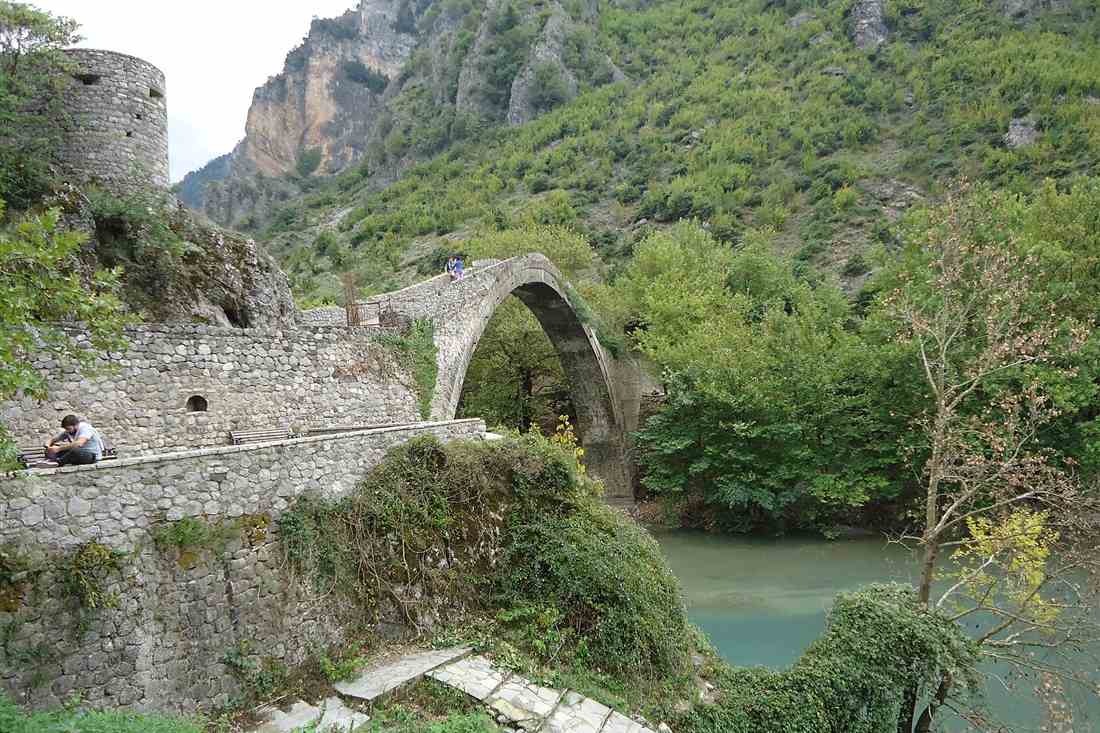
The Konitsa via ferrata climbs the rock of the Aoos valley on a fixed steel cable, iron rungs and bridges, above the town where the Aoos meets the Voidomatis and the single-arch stone bridge crosses the river. Plan the rest of the trip with Greece Tours.
This page covers the route: how a via ferrata works, the kit and the briefing on a guided trip, who can join, what to wear, the town and its bridge, the national park around it and the other adventure sports nearby.
What is the Konitsa via ferrata?
The Konitsa via ferrata climbs the rock of the Aoos valley. You move along a fixed route above the river with a guide. The line runs close to the water and the town, so the valley stays in view as you rise.
The rock face starts near the valley floor. You reach for the first metal hold and feel the river wind on your arms.
Red and grey stone surfaces stand above the green riverbed. Your feet find small edges as the route leaves the ground, and your breathing slows into a steady pull.
Looking back, you see the water shrink below you. The high sides of the valley close around you in the morning light, and the noise of the current fades into the climb.
How does the Konitsa via ferrata work?
A via ferrata is a climbing route with a steel cable fixed along the rock, iron rungs and steps, and bridges over gaps. You follow these fixed holds through the exposed parts of the wall. The hard moves already have a secure line.
A steel cable runs along the rock face and marks the line to follow. It passes through fixed anchor points set into the stone.
Iron rungs and steps give your hands and feet a place to grip on steep sections. The metal holds stand out clearly from the wall.
Bridges carry the route over gaps in the rock where no natural ledge exists. You cross one gap at a time on a narrow metal path.
Where does the Konitsa via ferrata climb?
The route climbs low above the river where Konitsa overlooks the valley of the Aoos and the Voidomatis. You look straight down at the water and across to the green slopes that frame the two rivers.
The town sits on the slope above the meeting point of the Aoos river and the Voidomatis river. From the rock you see how the two watercourses join below.
The route follows a wall on the side of that valley. You feel the river air rise from below the holds, cool and sharp in the morning.
Water glints in the joint channel below the town. The far bank stays close throughout the climb, a green strip under the high ridges.
What is the Aoos valley setting of the Konitsa via ferrata?
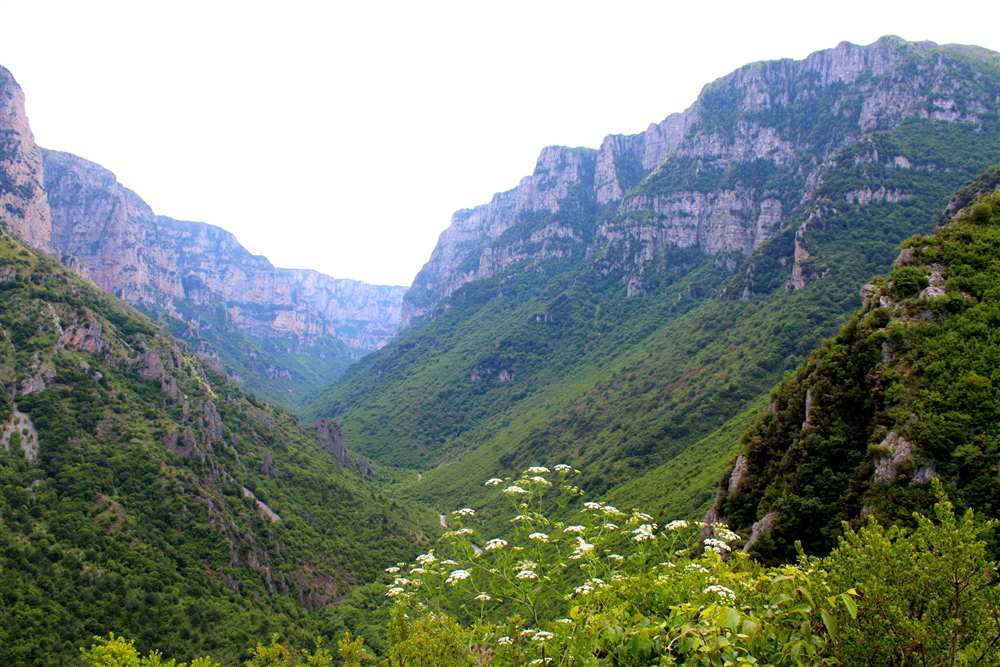
Konitsa is a town in Epirus, in the Ioannina regional unit of north-western Greece, at about 600 metres on the slopes of the Pindus. The valley cuts between mountain walls below the town.
The Pindus slopes rise behind the town and fall away toward the riverbed. The drop gives the valley its deep V-shape.
The valley floor carries the Aoos through a channel lined with trees and rock. You hear the river far below when the wind drops.
From the walls, you see the town above one side and open mountain country on the other. The two sides meet in a narrow band of water.
What kit does a guided Konitsa via ferrata trip supply?
A guided trip supplies the harness, helmet and lanyard. The team checks each piece before you start. You wear this kit for the entire route, from the first step to the final ledge.
The harness sits snug around your waist and legs. The guide adjusts it before the route begins, and you feel it hold you firmly at the edge.
The helmet protects your head from loose stone and from bumps on the rock. It sits light on your head and leaves your vision clear.
The lanyard hangs from the harness and stays in reach while you move. Its two arms fall to your sides as you step up.
How do the lanyard and carabiners keep you attached on the Konitsa via ferrata?
A lanyard of two carabiners and an energy absorber connects you to the steel cable. You move one carabiner at a time so you stay attached. The two points keep you secured when one is moved.
The lanyard splits into two arms, and each arm ends in a carabiner. Both arms join at the energy absorber near your body.
One carabiner stays on the cable while the other moves past the next anchor point. You repeat this action on every section of the line.
The energy absorber sits between your body and the cable to reduce force if you fall. It is the middle part of the safety system.
What happens in the briefing and practice for the Konitsa via ferrata?
The guide gives a briefing and practice at the foot of the route. You learn how to move the clip-in gear along the cable before the climb starts. The guide watches and corrects your rhythm.
The group gathers at the start of the rock face. The guide shows the clipping sequence on the cable and names each part of the action.
You practise on a low section of the route. Your feet stay close to the ground while you move the attachments, and the guide gives a quiet correction.
The guide checks each person before the real ascent begins. Your hands learn the order before the wall steepens, and the movement becomes automatic.
Who can join the Konitsa via ferrata?
No climbing experience is needed on a guided trip. You join with a guide who sets the pacing and helps you through each section of the route. A normal level of walking fitness is enough.
People join this route for a first taste of a high rock face. The fixed holds give you a clear path without a climber’s technical skills.
The guide leads from the front and explains each exposed step. You only need to follow the line and keep a steady pace behind the group.
If you can walk a mountain path, you have enough base fitness for the route. The wall feels steep, but the holds keep the effort manageable.
What do you wear and carry on the Konitsa via ferrata?
Wear light mountain clothes that let you move your arms and legs freely. Carry a small backpack with water only. Use closed shoes with a firm sole so your feet feel the rungs.
Soft trousers give your legs room to lift onto the metal steps. A top with short or long sleeves works in dry weather and lets air move around your arms.
Your shoes grip the metal holds and the rock ledges. Avoid open sandals because the edge contact is poor and the toes stay unprotected.
A small pack sits close to your back and holds water for the climb. Leave loose items behind in the vehicle so nothing drops from the wall.
What does the stone bridge over the Aoos add to a Konitsa via ferrata day?
An Ottoman-era single-arch stone bridge crosses the Aoos at Konitsa. You see its curved shape from the route and from the riverbank. It gives the day a clear landmark below the rock.
The bridge arches over the river near the start of the valley route. Its stone curve stands out against the water and the darker trees.
Before the climb, you can walk near the bridge and hear the river moving under the arch. The old stone feels cool next to the current.
After you descend from the rock, the bridge is a natural place to stop and look back up the valley. The route is visible as a pale scar on the wall.
What can you see in the town of Konitsa near the via ferrata?
The mansion of Hamko, mother of Ali Pasha, stands in the town. Konitsa is also the regional centre for the small Pindus villages around it. Both make the town worth a short walk before or after.
The mansion has a strong stone presence in the town. It connects the town to a wider Ottoman past and to the story of Ali Pasha.
Konitsa serves the small mountain villages that sit deeper in the Pindus. You see locals coming in for supplies and stopping to talk in the square.
A walk through the streets after the climb shows the town on its slope above the two rivers. The sound of water stays close even among the houses.
Why does the Vikos–Aoos National Park matter to the Konitsa via ferrata?
The Vikos–Aoos National Park lies around Konitsa. It includes the Vikos Gorge, the Aoos Gorge and the Tymfi mountains. The route sits within this protected landscape and shares its rock forms.
The park wraps the town with deep gorges and high mountain walls. The via ferrata is one way to feel that vertical scale up close.
You look across the Aoos Gorge and see the same rock shapes that run into the Vikos Gorge. The walls rise in broken tiers above the water.
After the climb, a Vikos Gorge hike goes deeper into the park on foot. The trail shows the park from its floor level.
What are the Dragon Lakes and the Kavasila baths near the Konitsa via ferrata?
The Dragon Lakes sit high on Tymfi and on Smolikas. The sulphur baths of Kavasila lie near the town. They offer a different mountain day before or after the route.
The Dragon Lakes fill high basins under the peaks of Tymfi and Smolikas. Their water reflects the bare summit slopes in cold blue plates.
The Kavasila baths carry warm sulphur water close to Konitsa. The air around them has a sharp mineral smell that sticks to the skin.
You can rest in the baths after the climb and let the valley cool you down. The mountains stay visible above the steam, and the light changes on the ridges.
What other adventure sports pair with the Konitsa via ferrata around Konitsa?
Visitors come to Konitsa for hiking in the Pindus, rafting on the Aoos and paragliding. You can mix the via ferrata with a second sport on the same trip.
Hiking trails leave the town toward the high villages and the national park. The paths climb quickly into open mountain ground.
The Konitsa via ferrata experience is listed as “Via Ferrata Live” on GetYourGuide, along with rafting trips on the Voidomatis and the Aoos.
After the climb, book Voidomatis river rafting for a water route through the same area. The river gives a slower view of the valley walls.
How does the Konitsa via ferrata fit a trip through Zagori and Epirus?
The route sits inside the wider Zagori and Epirus mountain circuit. You can use Konitsa as a base and join the via ferrata between days of hiking, river trips and village stops.
You arrive in Konitsa before the climb and leave the same day or the next morning. The road out follows the valley to other mountain villages.
The rock route gives a short, active contrast to the long walks and rivers of the region. It presses the day into a single strong memory of exposure.
You end the day with a clear view back to the route and the bridge, then plan the next leg through Epirus. Konitsa sits at the centre of that next choice.
Which season and hour suit the Konitsa via ferrata?
Spring and autumn, rather than summer afternoons, suit the Konitsa via ferrata because Konitsa sits at about 600 metres and cooler air and clear light in the mountains of Epirus keep the rock from heating in direct sun while the valley stays warm.
Konitsa sits at about 600 metres, so summer afternoons are warm in the valley and the rock heats up in direct sun.
Spring and autumn bring cooler air and clear light in the mountains of Epirus. Cooler air and clear light make the rock feel less hot for the climb.
The Konitsa via ferrata offers cooler rock in spring and autumn, while summer afternoons bring direct heat to the valley.
How does a Konitsa via ferrata group meet and reach the rock?
Guided groups on the Konitsa via ferrata meet in the town and walk or drive to the foot of the route together, so no one approaches the rock alone and everyone starts from the same point as a unit.
Guided groups meet in the town and walk or drive to the foot of the route together.
The route is on rock above the Aoos, so the river and the stone bridge are in view from the cable. The Aoos stays below while the group moves along the cable.
The Konitsa via ferrata therefore begins with the whole group moving from the town to the rock as one body.
Frequently Asked Questions
Do you need climbing experience for the Konitsa via ferrata?
No. Guided trips supply the kit and teach the clipping routine at the foot of the route.
What kit is used?
A harness, a helmet and a lanyard with two carabiners and an energy absorber.
Where is Konitsa?
In Epirus, above the valley where the Aoos meets the Voidomatis.