
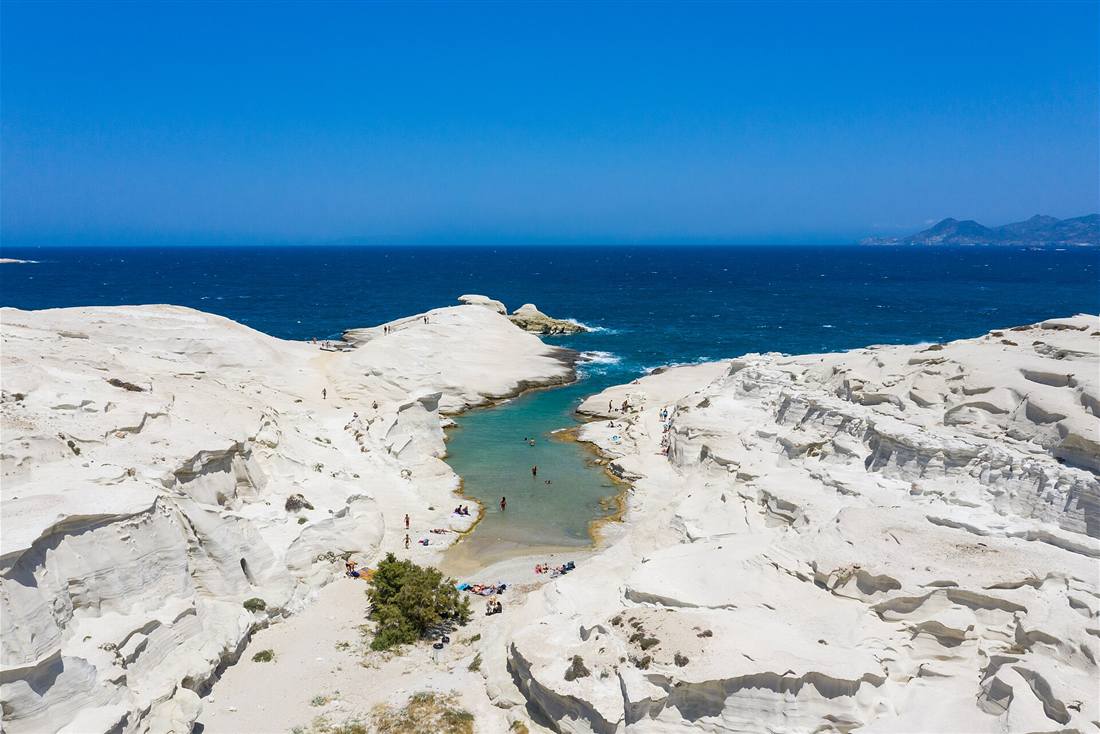
A Milos photoshoot works the white volcanic rock of Sarakiniko at sunrise, the painted boathouse doors at Klima in the evening, the lanes and castle hill of Plaka, and the sea caves of Kleftiko from a boat. Plan the rest of the trip with Greece Tours.
This page covers the sessions: where they go, what each location gives the camera, the hour that suits it, the season, the villages, the boat trips, what to wear and how to book.
How many photos does a Milos photoshoot deliver?
45 or more edited photographs from a solo session, 60 or more from a maternity session, 70 or more from a couples session, 100 or more from a proposal session, 120 or more from a group session and 160 or more from the ATV photo day.
One studio delivers every edited frame by WeTransfer 3 to 7 days after the shoot.
Packages include bottled water during the session.
Sessions stop at two locations: one headline beach, village or church, and one hidden spot.
Where does a Milos photoshoot go?
At Sarakiniko, in Plaka and its Kastro, along the painted boathouses of Klima, at Kleftiko by boat, in the fishing harbours of Mandrakia and Firopotamos, above Papafragas, in the cove of Tsigrado, on the Pollonia waterfront and at the Ancient Theatre.
Sarakiniko is the most photographed place on the island.
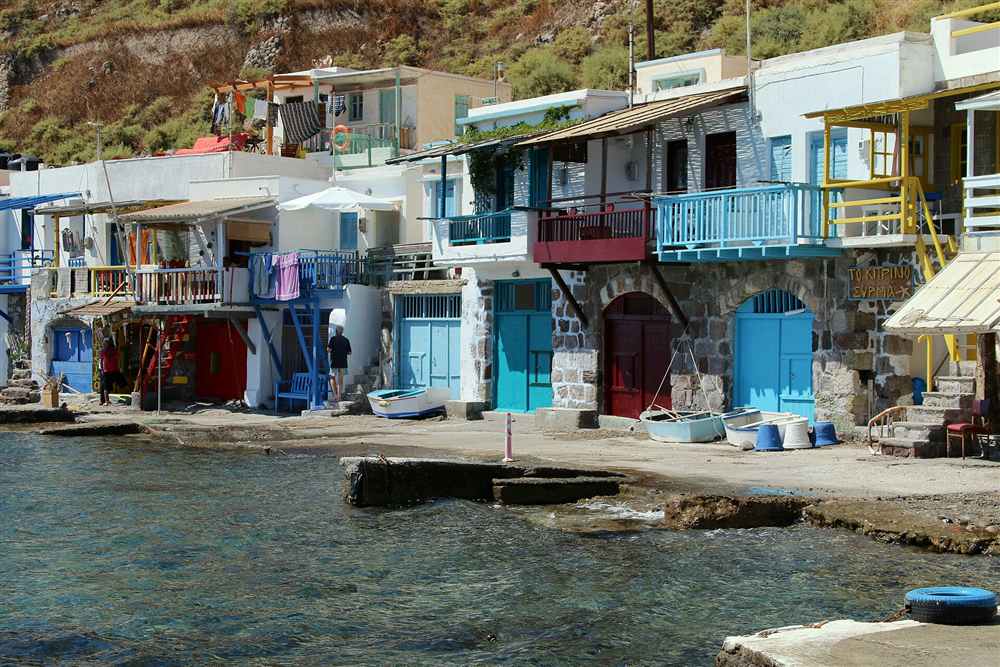
Klima and Mandrakia both keep rows of syrmata, the two-storey boathouses with painted doors built into the rock.
The kayaking side sits at Milos kayak tour.
What is the Sarakiniko sunrise Milos photoshoot?
A session on the chalk-white volcanic rock before the crowds arrive: park above the bay between 5:30 and 5:45 in the morning, walk onto the western lobe facing the sunrise, and shoot the first 45 minutes of low golden light.
One island photographer states the rock glows almost pink for the first 20 minutes after the sun clears the horizon, around 6:30 in summer.
Tour buses from Adamantas arrive by 9 in the morning and the bay fills by noon.
What is the Plaka and Kastro sunset Milos photoshoot?
A climb from the main square of Plaka to the Venetian castle and the church of Panagia Thalassitra, started about 40 minutes before sunset, for a 270-degree frame over the bay of Milos, the open Aegean and the islands of Kimolos and Antimilos.
The start time is around 7:15 in the evening in summer and 5:45 in winter.
The whitewashed lanes climbing to the castle are a subject in themselves, and vehicles are kept out of Plaka in the afternoon.
Entry to the castle church area is free, and the walk down takes 15 minutes through the blue hour.
What is a Klima boathouse Milos photoshoot?
A session along the single curving row of syrmata below Plaka, whose painted doors face west and take direct warm light from about 6:30 in the evening in summer until the sun drops behind the headland.
One bright door, red, cobalt or sea-foam green, becomes the backdrop for the portrait.
The water at the foot of the houses is shallow enough to stand in for low-angle frames.
Weekday evenings are quieter than July and August weekends, and the drive down from Plaka takes 8 minutes.
Can a Milos photoshoot reach Kleftiko?
A morning departure between 9:30 and 10:00 reaches the cliffs by 11:00, when the sun lights their eastern faces head-on.
Small boats enter the coves themselves while large catamarans anchor together in one zone.
The cruising side sits at Milos catamaran cruise.
Which quiet villages suit a Milos photoshoot?
Mandrakia and Firopotamos on the north coast and Pollonia on the north-eastern tip, where the crowds thin out and the white chapels, painted boathouses and fishing skiffs sit in one frame.
At Mandrakia the western headland frames the chapel of Agios Nikolaos, the painted doors, the boats and the open sea together, lit head-on between 7:00 and 7:40 in the evening in summer.
At Firopotamos a 5-minute footpath up the eastern headland looks down on the church, the boathouses and the clear water, best from 7:30 to 9:00 in the morning.
Pollonia has a tamarisk-lined promenade that gives dappled light for family frames from 6:30 to 7:15 in the evening.
What is a Papafragas Milos photoshoot?
A top-down frame from the cliff edge into the enclosed emerald pool that the sea has carved through a slot in the north-coast rock, taken between 9:30 and 10:30 in the morning when the sun reaches the back wall of the inlet.
The lookout is a 2-minute walk from a small parking area, 15 minutes by road from Plaka.
The edge is unfenced, so a seated pose is the safe one for portraits.
The open Aegean shows through the cave mouth behind the pool.
What is a Tsigrado cove Milos photoshoot?
A session in a sand-bottomed cove on the south coast reached by a ladder and rope descent through a rock chute, where the sheer cliffs make any figure in the frame read as tiny.
Arriving at the clifftop parking by 8:45 in the morning beats the boat tours that unload around 10:30.
From knee-deep water the frame looks back at the western wall, lit straight on by the morning sun.
Grippy shoes matter: the ladder is metal and the rope assist heats up by midday.
What is an Ancient Theatre Milos photoshoot?
The Venus de Milo was unearthed beside this theatre in 1820.
The third or fourth tier from the bottom puts the curve of the seating and the bay in one frame, with cypress trees closing the lower edge.
Catacombs groups arrive by 9:30, which leaves a quiet 90-minute window.
What is the Milos Instagram tour?
Both are booked online with the date and the meeting point fixed in advance.
When is the light best for a Milos photoshoot?
The 50 minutes after sunrise and the hour before sunset: the volcanic white rock throws back so much midday glare that shoots between 11 in the morning and 4 in the afternoon lose every other tone from May to September.
Sunrise runs from about 6:25 in mid-December to 6:05 in late June, and sunset moves from 5:10 in December to 8:45 in June.
Blue hour follows sunset for 25 to 30 minutes.
Sarakiniko, Tsigrado and the north-facing bays belong to the morning; Plaka, Klima, Mandrakia and Pollonia belong to the evening.
Which season suits a Milos photoshoot?
Late April to mid-June and mid-September to mid-October: the light is soft, wildflowers cover the volcanic slopes in spring, the crowds at Sarakiniko and Tsigrado are a fraction of August levels, and the meltemi stays gentle enough for the boat run to Kleftiko.
July and August give the deepest blue water with the hardest midday light, which cuts shooting to 6 to 9 in the morning and 7 to 9 in the evening.
Autumn keeps a warm sea, gentle light and quiet villages.
Greek Easter week brings villagers home and fresh whitewash on the walls, with accommodation booked out early.
What is a proposal Milos photoshoot?
Honeymoon, engagement and maternity sessions run on the same two-stop structure.
The romantic side sits at Milos sunset cruise.
How do you reach the Milos photoshoot locations?
Parking at Firopotamos fits about 8 cars and fills early.
The lot at Pollonia fills by 11 in the morning in peak summer.
The island page sits at Milos.
What do you wear to a Milos photoshoot?
Light, moving fabrics that read against white rock and blue water, flat or grippy shoes for the ladder at Tsigrado and the lanes of Plaka, and a second outfit when the session covers two stops.
Long dresses catch the wind on the Sarakiniko ridge and at the Kastro terrace.
Swimwear works at Firopotamos, where the bay is shallow and protected.
Photographers agree the plan, the route and the timing before the day.
How do you book a Milos photoshoot?
Shoulder-season dates open first and hold the clearest air over the Aegean.
The wider island list sits at Milos boat rental.
Where does a Milos photoshoot start?
In Adamantas, the harbour town where the ferries dock, or at the guests’ hotel. The photographer names the meeting point when the booking is made.
Adamantas sits at the head of the bay in the middle of the island.
Plaka lies a short drive above it, and Pollonia is on the far north-eastern corner.
Boat sessions to Kleftiko also leave from Adamantas.
What is Pollonia like for a Milos photoshoot?
A seaside village on the north-eastern tip and the island’s second harbour, named after a temple of Apollo that stood east of the settlement, with a tamarisk-lined waterfront facing Kimolos.
A small boat crosses from the village to Kimolos through the day.
The main beach runs beside the village, so the water is in the frame from the promenade.
A Milos photoshoot here suits families who want a relaxed setting rather than a monument.
What are syrmata, and where does a Milos photoshoot find them?
Fishermen’s houses with a boat garage cut into the soft rock below and living rooms above, their doors painted in strong colours. Klima has the longest row, and Schinopi, Areti and Fourkovouni keep more.
The basement was dug out as a winter mooring for the boat.
The painted doors are the reason the row at Klima appears in most pictures of the island.
The quieter rows at Areti and Fourkovouni give the same colour without the visitors.
Can a Milos photoshoot use the catacombs?
The catacombs at Trypiti are among the largest in Greece, cut into the volcanic rock in early Christian times. Photography rules inside are set at the entrance, so the frames are taken above ground.
The site sits on the hillside below Plaka, beside the Roman theatre.
The approach path and the terrace above the bay both work as settings.
Groups arrive from mid-morning, so an early start keeps the path clear.
Where was the Venus de Milo found?
On the hillside at Trypiti beside the ancient theatre. The statue of Aphrodite now stands in the Louvre, and the spot is marked on the path between the theatre and the catacombs.
The theatre below it looks straight out over the bay of Milos.
The marble tiers hold a soft white tone in the morning.
A Milos photoshoot that starts here carries on down to Klima in ten minutes by road.
What is Fylakopi?
The ruins of an ancient city on the road to Pollonia, an important settlement of the Cycladic period, now an excavated site on the shore.
The stonework sits low, so the sea fills the background of a wide frame.
The site is open ground with no shade.
It pairs with Pollonia, five minutes further along the same road.
What is Paliochori beach?
A long southern beach of sand and fine pebbles under cliffs streaked red, orange and white by volcanic minerals, with tavernas along the shore and warm patches in the sea where heat rises through the seabed.
The colour in the cliffs is the reason a Milos photoshoot goes to this coast.
The beach faces south and takes the sun all afternoon.
Sand and pebble mix underfoot, so flat shoes help on the walk in.
What is a Firiplaka Milos photoshoot?
The beach next along the south coast from Paliochori, under the same banded volcanic cliffs, reached by a track down from the road.
The cliff face behind the sand carries the strongest colour on the island.
Frames are taken from the water’s edge looking back at the wall of rock.
Tsigrado lies a few minutes further west along the same shore.
What are Plathiena and Fourkovouni?
A sheltered bay north of Plaka and the syrmata hamlet on the headland beside it, both a short drive from the village and quieter than Klima.
Plathiena is sandy and shallow, which suits family frames in the water.
Fourkovouni holds a handful of painted boathouses on the rock.
A Milos photoshoot that wants the Klima look without the crowd comes here instead.
Can a Milos photoshoot cover the mining side of the island?
Yes. The mining museum at Adamantas covers an eleven-thousand-year history with ore samples, maps and tools, and the bay of Paliorema at Theiafes keeps the ruins of a sulphur quarry on the shore.
The quarry buildings stand rusted above a beach on the east coast.
The site is remote and reached by boat or a rough track.
Mineral colour runs through the rock on that coast, yellow at the sulphur workings and red further south.
Which locations need a boat?
Kleftiko, Sykia and the islet of Polyaigos. None of them has a road, so the frames are taken from the water or from a landing on the rock.
Boats leave Adamantas in the morning and reach the caves before midday.
A Milos photoshoot on the water depends on the sea state, so the date is kept flexible.
How does a Milos photoshoot move between locations?
Plaka and Klima sit ten minutes above Adamantas, Pollonia about twenty minutes away.
The south coast beaches take longer on narrow roads that end in tracks.
What is the difference between a photoshoot and a photo tour?
A photoshoot is a fixed session at one or two settings.
The Instagram tour holds a 4.9 rating from 57 reviews.
A Milos photoshoot booked as a session is the cheaper way to get portraits at one location.
Who runs a Milos photoshoot?
One local studio is run by a photographer with Greek and South African roots whose family comes from the island.
Another delivers every edited photograph by file transfer three to seven days after the shoot.
Both agree the spots with the guests before the day.
How do you plan a two-location session?
Pair one headline place with one quiet one: Sarakiniko with Firopotamos in the morning, or Klima with Plathiena in the evening, keeping the drive between them under fifteen minutes.
Island studios build their packages on exactly that structure, one main attraction and one hidden spot.
Two settings need a change of clothes and a few minutes in the car.
A Milos photoshoot that tries three locations in an hour loses time on the road.
Where does a family Milos photoshoot go?
At Pollonia on the tamarisk waterfront, at Plathiena and Firopotamos where the water is shallow, and in the lanes of Plaka in the late afternoon.
Flat ground at Pollonia and Adamantas suits small children better than the Sarakiniko rock.
What do you bring for a boat Milos photoshoot?
A dry bag, a change of clothes, flat shoes for the deck and a hat. Boats to Kleftiko leave in the morning and return in the afternoon.
Spray reaches the deck on the open crossing to the south-west coast.
Which spots stay quiet in August?
Firopotamos, Mandrakia, Fourkovouni, Areti and Schinopi. They hold the same painted boathouses and clear water as Klima with a fraction of the visitors.
Sarakiniko and Tsigrado fill from mid-morning through the summer.
A Milos photoshoot in August runs from six to nine in the morning or from seven in the evening.
Weekday evenings are quieter than weekends on every coast.
What does a Milos photoshoot look like through the year?
Wildflowers on the volcanic slopes in spring, deep blue water and hard light in summer, warm sea and empty villages in autumn, and dramatic skies with a closed-down island in winter.
The air over the Aegean is clearest in April, May and October, when distant islands sharpen in the frame.
Greek Easter brings fresh whitewash on the walls and villagers back to the houses.
Winter wind stops the boat trips to Kleftiko for days at a time.
How long does a Milos photoshoot last?
One to one and a half hours for a solo session, one and a half to two hours for couples, maternity and family sessions, two to two and a half hours for a proposal, and six hours for the ATV route.
The clock starts at the first location, not at the pick-up.
Two-stop packages spend about half the time at each.
The six-hour route covers four main attractions and one hidden spot.
How far ahead do you book a Milos photoshoot?
Weeks ahead for July and August, when one photographer holds a single slot per evening. Shoulder-season dates open closer to the day.
Sunrise slots at Sarakiniko fill first because the window is short.
Boat-based sessions are booked against the weather forecast.
Which Milos photoshoot suits a honeymoon?
Honeymoon sessions are timed for the end of the day at Klima or Plaka.
What is the ATV photo route?
The route reaches coasts that a hire car cannot approach comfortably.
It covers the most ground of any package sold on the island.
Water is carried for the group through the day.
Where do solo travellers shoot?
The marble tiers of the ancient theatre suit a single figure in the frame.
The Sarakiniko ridge works the same way at sunrise.
What happens if the weather turns?
Land sessions move to the sheltered villages, and boat sessions move to another day. The meltemi wind stops the crossing to Kleftiko rather than the shoot itself.
Plaka, Klima and Mandrakia stay usable in wind because the lanes and the rock face break it.
Winter brings dramatic skies over empty beaches.
A Milos photoshoot in shoulder season carries the lowest risk of a lost slot.
Do you need permits for a Milos photoshoot?
Not for the beaches and villages. The archaeological sites — the theatre, the catacombs and Fylakopi — allow handheld cameras on the marked paths and ask for a permit for staged shoots.
Tripods and lighting are what turns a session into a staged shoot.
Photographers work with natural light for that reason.
What colours work in the frame on Milos?
White and pale tones against the volcanic rock at Sarakiniko, strong colour against the painted doors at Klima, and plain fabrics against the banded cliffs at Paliochori.
The white rock reflects light back into a face, which lifts a portrait at sunrise.
The painted syrmata doors carry the colour, so the outfit stays simple.
A Milos photoshoot that covers two settings brings a change of clothes for the second.
How does Milos compare with Santorini for photographs?
Milos trades caldera views for white volcanic rock, painted boathouses and empty coves, and its locations are quieter at every hour of the day.
Sarakiniko has no equivalent anywhere in the Cyclades.
The island keeps its fishing villages working rather than converted.
What does a Milos photoshoot at Mandrakia look like?
A small northern harbour with a chapel on the headland, painted boathouse doors and fishing skiffs in the water, all four elements framed together from the western bluff.
The chapel of Agios Nikolaos stands on the point above the moorings.
Light lands on its facade between seven and twenty to eight in the evening in summer.
The drive from Plaka takes twelve minutes on the inland road, with parking on a dirt track above the village.
What does a Milos photoshoot at Firopotamos cover?
A horseshoe bay on the north coast with a domed church on the eastern headland, a row of weathered boathouses below it and clear shallow water in front.
A five-minute footpath climbs the eastern headland to a flat rock platform above the church.
From there the church, the doors, the curved beach and the water sit in one frame.
The bay is sheltered, which makes it the calmest place on the island for water portraits.
Which Milos photoshoot spots work at midday?
The lanes of Plaka, the covered path at the catacombs and the shaded tables at Pollonia. The open rock at Sarakiniko and the southern cliffs are unusable in the middle of the day.
Whitewashed walls in Plaka bounce light into shaded corners.
Tamarisk trees along the Pollonia front break the sun into patches.
Midday is also the hour when the boat trips are out at Kleftiko and the villages are empty.
How does a Milos photoshoot handle the sunrise slot?
The party meets at the parking above Sarakiniko between half past five and a quarter to six in summer, walks down to the western lobe of rock and shoots the first forty-five minutes of light.
The rock turns pink for about twenty minutes after the sun clears the horizon.
Tour buses from Adamantas arrive around nine, which ends the quiet window.
The drive up from Adamantas or Plaka takes ten minutes at that hour.
What is the evening route for a Milos photoshoot?
Klima from about half past six, when the western front takes direct light, then the climb to the Kastro at Plaka forty minutes before sunset for the panorama over the bay.
The walk up from the main square of Plaka takes about fifteen minutes.
The terrace beside the church of Panagia Thalassitra gives a 270-degree view.
The descent runs through the blue hour, when the lanes light up.
Which Milos photoshoot format fits a cruise or day visit?
The solo or couples session at one location near Adamantas, because the ferry and cruise arrivals dock there and the session runs about an hour.
Sarakiniko is ten minutes away by road, Klima and Plaka about the same.
Kleftiko needs a half-day boat trip and does not fit a short stop.
The mining museum and the harbour front are within walking distance of the quay.
What does a Milos photoshoot at Paliochori add?
Colour. The cliffs behind the beach are streaked red, orange and white by volcanic minerals, and the sand runs long enough to keep other bathers out of the frame.
Tavernas sit at the back of the beach, so a session there ends at a table.
Warm patches rise through the seabed close to the shore.
The drive from Adamantas crosses the island in about twenty minutes.
Which Milos photoshoot locations work for a group of ten?
Pollonia’s waterfront, Plathiena beach and the open ground at the ancient theatre.
Narrow spots like Klima and Papafragas do not hold a large group safely.
Group sessions carry 120 or more edited photographs.
How do you choose between Sarakiniko and Klima?
Sarakiniko for white rock, blue water and a lunar look at sunrise. Klima for colour, boats and village texture in the evening. A two-stop Milos photoshoot takes one of each.
Sarakiniko works only in the first hour of the day in summer.
Klima works only in the last ninety minutes, before the headland blocks the sun.
The two sit fifteen minutes apart by road, so they rarely fit in the same session.
Which Milos photoshoot locations are free to enter?
Sarakiniko, Klima, Mandrakia, Firopotamos, Plathiena, Papafragas, Pollonia and the Kastro church terrace at Plaka. Only the theatre, the catacombs and Fylakopi charge at the gate.
Parking is free at the northern bays, with room for about eight cars at Firopotamos.
The clifftop lookout at Papafragas is two minutes from its small car park.
What happens on the day of a Milos photoshoot?
The photographer meets the party at the agreed point, drives or walks to the first location, shoots there for about half the session, then moves to the second and finishes as the light goes.
Nothing is set up on site. The camera is handheld and the light is whatever the hour gives.
Guests walk, sit and move rather than hold poses.
Edited files arrive by transfer link a few days later.
How does the photographer plan a Milos photoshoot route?
Around the light, the wind and the crowds: Sarakiniko and the north bays in the morning, Klima, Plaka and Mandrakia in the evening, and the sheltered villages when the meltemi blows.
The island is small, so two locations sit within a fifteen-minute drive of each other.
Sunrise and sunset move by three hours between winter and summer, which resets the meeting time each month.
Boat locations are fixed by the sea, not by the clock.
What is Adamantas like as a starting point?
The harbour town where the ferries dock, set at the head of the long bay, with the waterfront, the mining museum and the boat quays in walking distance of each other.
Most sessions begin here because the arrivals and the hotels are close.
Plaka and Klima lie ten minutes above the town by road.
The boats for Kleftiko leave from the same quay.
Which Milos photoshoot locations have shade?
The lanes of Plaka, the tamarisks on the Pollonia waterfront and the path below the catacombs. Sarakiniko, Papafragas, Fylakopi and the southern cliffs have none at all.
Shade matters between eleven and four from May to September.
The white walls in Plaka bounce light into the shaded corners, which keeps faces lit.
Open sites are left to the two ends of the day.
How do you get from the port to Sarakiniko?
Ten minutes by road from Adamantas, north-east across the island, with a small car park above the bay and a short walk down onto the rock.
The lot fills from mid-morning in summer.
The western lobe of rock faces the sunrise and holds the cleanest frames.
The walk down is on bare rock, so grip matters more than style in the shoes.
What makes the rock at Sarakiniko unusual?
It is smooth white volcanic stone, sculpted by wind and sea into wave-like shapes with no vegetation on it, which is why the bay is compared to a lunar landscape.
A narrow inlet of turquoise water cuts into the middle of it.
The white surface throws light upward, which fills shadows under the eyes at sunrise.
By the middle of the day the same surface turns into glare.
What does a Milos photoshoot at Plaka cover?
The lanes of the hilltop capital, the steps up to the Kastro, and the terrace beside the church of Panagia Thalassitra, which looks over the bay of Milos, the open Aegean, Kimolos and Antimilos.
Plaka sits above Adamantas on the western ridge and is known for its views.
Cars are kept out of the village in the afternoon, so the lanes stay clear.
The climb from the main square takes about fifteen minutes at a walking pace.
What does a Milos photoshoot at Pollonia cover?
The village waterfront under the tamarisks, the fishing boats on the quay and the strait towards Kimolos, with the ruins of Fylakopi on the road back to Adamantas.
Pollonia is the island’s second harbour and takes its name from a temple of Apollo that stood east of the settlement.
A small boat crosses to Kimolos from the same quay through the day.
The beach runs beside the village, so water and village sit in one frame.
Which Milos photoshoot spots face the sunset?
Klima, Plathiena, Fourkovouni and the Kastro terrace above Plaka. All of them look west across the water and hold the last forty minutes of light.
The syrmata at Klima take direct light until the headland cuts it off.
Plathiena is sandy and sheltered, which suits a family at the same hour.
The Kastro terrace sits high enough to keep the light a few minutes longer than the shore.
Which Milos photoshoot spots face the sunrise?
Sarakiniko, Papafragas, Mandrakia and Firopotamos on the north coast, and the marble tiers of the ancient theatre above Klima.
The north coast faces the open sea towards Kimolos and Polyaigos.
Light comes in low and warm for the first forty-five minutes.
The theatre holds a soft white tone on the marble in the same window.
How busy do the locations get?
Sarakiniko fills from mid-morning, Tsigrado from about half past ten when the boat trips unload, and Klima on summer weekends. The northern hamlets stay quiet all day.
Weekday evenings are the calmest hours at Klima.
Firopotamos rarely holds more than a handful of walkers on the cliff path.
Kleftiko is busiest in the middle of the day, when the catamarans anchor together.
What is the volcanic ground like?
The rock is soft, pale and sharp at the edges. It marks light clothing, holds heat through the afternoon and turns slippery where the sea has polished it.
The syrmata at Klima are cut straight into that rock, which is why the boat garages sit below the houses.
The same stone gives the catacombs their smooth walls.
Flat grippy shoes are the practical choice at every coastal location.
Which Milos photoshoot locations suit older visitors?
Pollonia, Adamantas, Plathiena and the ancient theatre, where the ground is level or stepped and the walk from the car is short.
Sarakiniko, Papafragas and Tsigrado all need surefootedness on bare rock or a ladder.
Plaka has steps, but the lanes are short and the terrace is reachable at a slow pace.
Boat sessions involve a step down from the deck.
Frequently Asked Questions
How much is a photoshoot in Milos?
Where is the best place to shoot in Milos?
Sarakiniko at sunrise, the Kastro of Plaka at sunset, and Klima for the painted boathouse doors.
What time of day is best?
The 50 minutes after sunrise and the hour before sunset; midday glare off the white rock flattens every frame.