
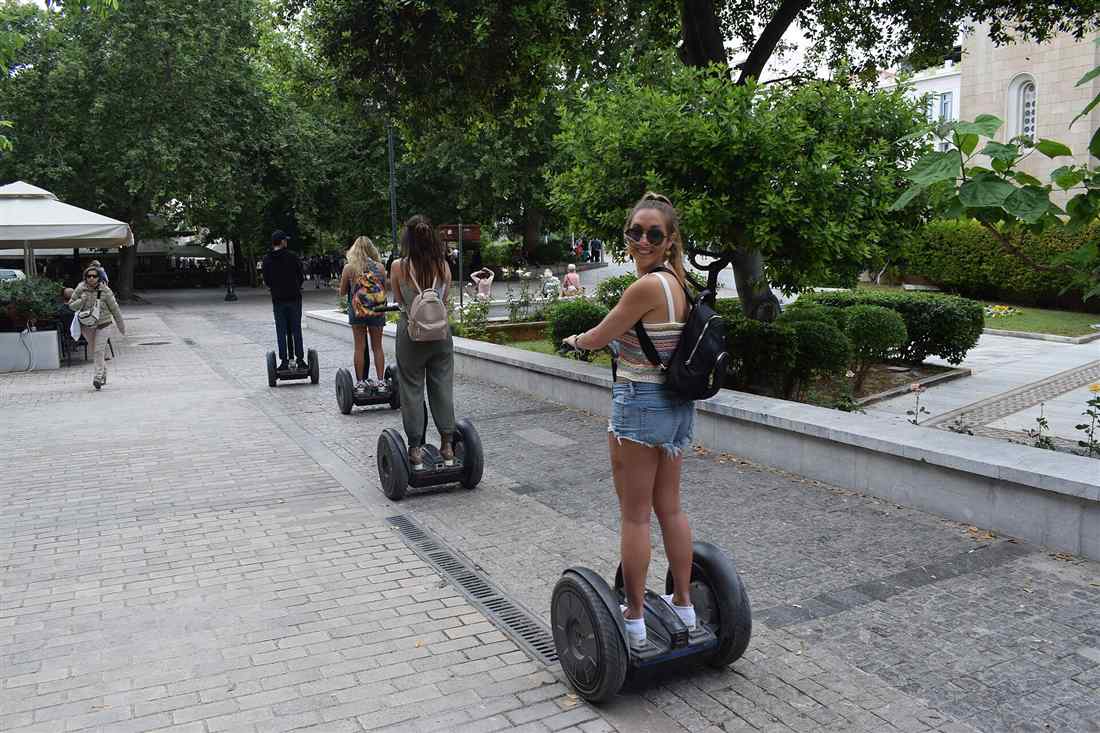
An Athens segway tour runs one to three hours on a self-balancing two-wheeler around the pedestrian belt below the Acropolis, in groups of four to twelve, with training, a helmet and a radio headset before the first metre. Plan the rest of the trip with Greece Tours.
This page covers the ride: where the routes go, what they cost, the age, weight and health rules, how hard the machine is to handle, the night and food versions, the machines and the law, what to wear, who the format suits, how it compares with an e-bike or a walk, the meeting points and how to book.
What is an athens segway tour?
A guided ride of one to three hours on a self-balancing two-wheeler through the pedestrian belt around the Acropolis, in groups of four to twelve with a training session first, a helmet and a radio headset.
The machine does the work the legs otherwise do. Athens is built on seven hills and the historic centre climbs and drops constantly, and a segway turns three kilometres of that into an hour without anyone arriving at the Parthenon out of breath. The athens segway tour operators state this at booking and print it on the voucher.
Every tour opens with 15 to 20 minutes of training on a flat closed area before it moves. The instructor covers mounting, stopping, turning and the lean that steers, and nobody joins the road section until they can ride a slalom. The athens segway tour timetable is built on it rather than on distance.
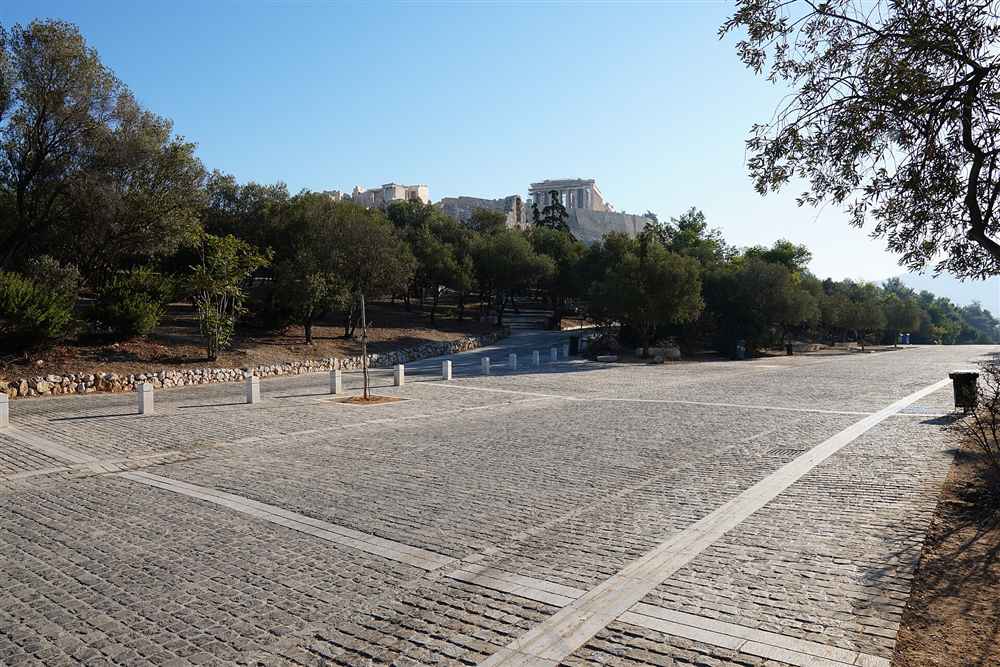
The route uses the Dionysiou Areopagitou and Apostolou Pavlou promenades, a 2.5 km pedestrian arc laid in 2004 that runs from the Temple of Olympian Zeus round the south and west flanks of the Acropolis to Thissio. It is marble-paved, closed to traffic and almost flat. Riders on an athens segway tour meet it within the first ten minutes.
Guides talk through a headset rather than shouting, so the group rides in a line with the commentary in each rider’s ear. That format is what makes a moving tour work at all.
Where does an athens segway tour go?
The Acropolis promenade, Thissio, the Ancient Agora fence, Monastiraki, Hadrian’s Library, the Temple of Olympian Zeus, Zappeion and the National Garden, with the longer rides adding Plaka, the Panathenaic Stadium and Filopappou.
The two-hour ride is the standard product. It starts near Syntagma or Thissio, takes the promenade under the south slope, stops below the Odeon of Herodes Atticus, then loops through Monastiraki and the Roman Forum. Every athens segway tour is planned around it before the machines leave the base.
The three-hour grand tour adds the Panathenaic Stadium, the Zappeion gardens and the Presidential Mansion, and finishes at Filopappou hill for the view back to the rock. Guides brief it through the headset before an athens segway tour rolls out.
The National Garden version is the gentlest: two hours entirely inside the 15.5 hectares of the royal garden laid out by Queen Amalia in 1838, on packed gravel paths under palms and cypress with no traffic at all. That is the athens segway tour difference against a walking circuit.
What no tour does is ride onto the Acropolis itself. The archaeological site is closed to any wheeled vehicle, so a segway tour circles the rock and the ticket is taken separately on foot.
What does an athens segway tour cost?
From 45 to 65 euros for a one to two-hour ride, 70 to 95 euros for the three-hour grand tour, and 180 to 320 euros for a private departure for two to four, with helmet, training and the headset included.
The rate is per rider, not per vehicle, because each person needs a machine. Group discounts appear above six riders and most operators cap the tour at twelve for control on the narrow stretches. An athens segway tour is sold on that, and the listing says so plainly.
Night rides carry a small premium, at 55 to 75 euros for two hours, and that buys lit monuments and an empty promenade rather than extra distance. An athens segway tour is priced on the hours, not the kilometres. It decides which athens segway tour format fits the party.
Nothing else is bundled. Site tickets, food and drink are paid separately, and the tours stop outside the gates rather than inside them. An athens segway tour carries the helmets and the water for it.
What are the age, weight and health rules?
Riders are 12 or over on most operators and 16 on a few, weigh between 45 and 118 kilos, and sign a declaration covering pregnancy, heart conditions, balance disorders and recent surgery.
The weight floor exists because the machine reads body movement to balance, and a rider under 45 kilos does not shift enough mass for the sensors to work reliably. The ceiling is the motor and battery rating. This is what an athens segway tour delivers across the pedestrian belt.
The age rule follows insurance rather than skill. Under-18s ride with a parent or guardian present and signing, and some operators run a family session with a slower speed limiter set on the machines. The athens segway tour price reflects it, hour by hour.
The health declaration is short and specific. Balance is the whole basis of the vehicle, so anything affecting the inner ear, vision or reaction time rules a rider out, and the guides ask before the deposit rather than at the kerb. The athens segway tour season turns on this more than on the calendar.
Alcohol is refused outright. Riders arriving from a long lunch are turned away without refund on every operator that publishes terms. The athens segway tour timetable is built on it.
How hard is it to ride and how long does the training take?
Fifteen to twenty minutes on a closed area, and almost everyone rides comfortably by the end of it. Lean forward to move, stand upright to stop, turn with the handlebar. There are no pedals and no throttle.
The disconcerting part is the first two minutes, when the machine corrects under the feet and feels alive. After that the body stops fighting it and the balance becomes automatic. The athens segway tour fleet is prepared for it from March to November.
Top speed on a guided tour is limited to 12 to 15 km/h, which is a brisk jog. The machines carry a training mode that caps them lower for the first stretch and the guide unlocks it when the group is steady. An athens segway tour fills first on that count between May and October.
The surfaces decide the difficulty, not the vehicle. Marble paving when wet, the cobbles in Plaka and the tram rails at Syntagma are the three places guides slow the group and call it out on the headset. The athens segway tour operators state this at booking and print it on the voucher.
Riders who cannot manage the training are refunded on the spot by the reputable operators. It happens on roughly one tour in twenty and the terms state it plainly.
What is the night segway tour like?
A two to three hour ride from about 19:00 to 21:30 in summer and 17:30 in winter, taking the lit Acropolis from the promenade, the Zappeion, the Kallimarmaro and Monastiraki with the crowds gone.
The floodlights on the rock come on at dusk and the promenade empties at the same hour, which makes the night ride faster and quieter than the same route at noon. An athens segway tour starts with this settled at the training area.
The machines carry front and rear lights and the guides add reflective vests. The route avoids traffic entirely, so the darkness changes the view rather than the risk. The athens segway tour route is set by it more than by the map.
The photographs are the point. The stops are chosen for the angles on the lit Parthenon from Thissio and the Areopagus approach, and the guides allow time at each rather than rolling straight through. Every athens segway tour is planned around it before the machines leave the base.
It also solves July and August. At 21:00 the temperature has dropped from 36 degrees to 28, and an athens segway tour after sunset is the version that is actually comfortable.
What is the food segway tour?
A two and a half to three hour ride with four to six tasting stops: souvlaki, koulouri, bougatsa, loukoumades and a coffee or an ouzo, threaded between the monuments of the central route.
The souvlaki version is the common one. It rides the promenade and Monastiraki, stops at a counter on Mitropoleos, and finishes in Psyrri with a sweet. The athens segway tour timetable is built on it rather than on distance.
The stops are short by design, five to ten minutes each, because the machines have to be parked and watched. Nobody sits down, and that is what keeps the tour inside three hours. Riders on an athens segway tour meet it within the first ten minutes.
Dietary requirements are handled with notice. Vegetarian is standard, vegan needs a day, and the guides swap the meat stop for a tomato-and-feta plate rather than skipping it. An athens segway tour is sold on that, and the listing says so plainly.
What do you wear on an athens segway tour?
Closed flat shoes, trousers or shorts that allow a wide stance, a hat under the helmet in summer, sun cream and water. Skirts, heels and flip-flops are refused at the training area.
Footwear is the rule that catches people out. The feet stand square on the platform and the rider shifts weight through the soles, which sandals do not transmit and heels make dangerous. Guides brief it through the headset before an athens segway tour rolls out.
Helmets are supplied and compulsory, and they sit better over a cap than a wide-brimmed hat. Sunglasses matter more than most riders expect on the white marble in July. That is the athens segway tour difference against a walking circuit.
Bags go in the front basket or the guide’s pannier. Nothing is carried on the back, because a shifting rucksack moves the rider’s centre of gravity and the machine reads it as a command. This is what an athens segway tour delivers across the pedestrian belt.
Water is carried by the guide on the longer rides. Athens runs 33 to 38 degrees in high summer, and an athens segway tour carries the gear for it.
Who does an athens segway tour suit?
Travellers who want the historic centre covered in one morning, families with teenagers, riders with limited walking stamina, cruise passengers on a short call, and anyone repeating a city they have already walked.
The distance argument is the strongest. A three-hour ride covers 8 to 12 km of the centre against the 3 to 4 km a walking tour manages, and it does so without the climb. It decides which athens segway tour format fits the party.
Families with children over twelve treat it as the day’s activity rather than a sightseeing chore, and the teenagers who were dragged round two museums arrive at the third in a better mood. An athens segway tour carries the helmets and the water for it.
It is the wrong product for anyone who wants depth. The guide covers the outside of everything and the inside of nothing, because the machines cannot enter the sites. The athens segway tour fleet is prepared for it from March to November.
Cruise passengers use it as a survey. Two hours from Syntagma covers what a coach circuit shows in three, and leaves the Acropolis ticket for the afternoon on foot.
How does a segway compare with an e-bike or a walking tour?
A segway covers 8 to 12 km with no effort and no gear changes, an e-bike covers 15 to 20 km and handles hills and traffic, a walking tour covers 3 to 4 km and goes inside the sites.
The segway wins on the pedestrian belt and loses everywhere else. It is not allowed on most roads, it cannot climb Lycabettus, and it is slower point to point than a bicycle. The athens segway tour price reflects it, hour by hour.
The e-bike is the better buy for a party that wants the coast or the wider city. The city bike tours run to the Riviera and up the Ilissos corridor where no segway tour goes. The pedal version sits at Athens bike tour. The athens segway tour season turns on this more than on the calendar.
The walking tour is the only one of the three that takes you onto the Acropolis with a licensed guide. It covers less ground and explains far more. That version is at Athens private tour. An athens segway tour starts with this settled at the training area.
Parties book two: a segway ride on the first afternoon for the geography, a guided walk the next morning for the depth. The athens segway tour route is set by it.
When do the tours run and what stops them?
Year round, with departures at 09:30, 12:00, 15:00 and 19:00 in summer and a reduced timetable in winter. Rain stops them, because wet marble and a two-wheeled balance machine do not mix.
Cancellation for weather is the operator’s call and comes by message an hour or two before. Rides are moved to the next slot or refunded in full, and the policy is published. An athens segway tour fills first on that count between May and October.
High summer pushes the morning departure earlier and the evening later, leaving the 12:00 and 15:00 slots thin. The 09:30 ride is the one to take between June and September. The athens segway tour operators state this at booking and print it on the voucher.
Winter runs 08:30 to 16:30 with two or three departures a day and small groups. The light is better and the promenade is empty, and the machines handle 10 degrees without complaint. The athens segway tour season turns on this. The athens segway tour timetable is built on it rather than on distance.
Where do the tours meet and how do you get there?
Most meet near Syntagma, Thissio or Makrigianni, all on the metro. Syntagma is served by lines 2 and 3, Thissio and Akropoli by line 1 and line 2, and every meeting point is within 400 metres of a station.
The confirmation names a street address rather than a landmark, because the training areas are small squares and car parks rather than famous corners. Arriving at the Acropolis gate instead is the common mistake. The athens segway tour route is set by it more than by the map.
Arrive 15 minutes early. The waiver, the helmet fitting and the machine assignment take that long, and a late rider misses the training rather than joining it. Every athens segway tour is planned around it before the machines leave the base.
Parking is irrelevant: nobody drives to these. The metro ticket is 1.20 euros for 90 minutes and covers the trip in and the trip back. Riders on an athens segway tour meet it in the first ten minutes. Guides brief it through the headset before an athens segway tour rolls out.
How do you book an athens segway tour?
Two to five days ahead from May to October and a day ahead outside it, stating rider count, ages and weights. Free cancellation to 24 hours is standard, and the machine count caps the group at twelve.
Weights are asked because the fleet carries a fixed number of machines and each has a rated range. It is not an idle question and an operator who skips it is not checking its own limits. Riders on an athens segway tour meet it within the first ten minutes.
Private departures need more notice, three to seven days, because they take a guide and a full set of machines out of the public rota. An athens segway tour is sold on that, and the listing says so plainly.
Payment is normally a deposit online with the balance at the meeting point. The waiver is signed there on paper or a tablet, and every rider signs their own. An athens segway tour is booked on that basis. It decides which athens segway tour format fits the party.
What machines do the Athens operators run?
Segway PT i2 and x2 models and their successors, with a 20 to 38 km range, lithium batteries, two gyroscopes and five tilt sensors per wheel, and a turning circle tight enough for a two-metre lane.
The i2 is the city machine, on smooth narrow tyres for marble and asphalt. It is the model that handles the Dionysiou Areopagitou promenade and the Plaka lanes without scrubbing. That is the athens segway tour difference against a walking circuit.
The x2 carries fat off-road tyres and a wider stance for gravel and packed earth, and it is the machine the National Garden and Filopappou routes use where the surface turns loose. This is what an athens segway tour delivers across the pedestrian belt.
Redundancy is why the vehicle is trusted. Each machine carries two independent balance systems and dual motors, and a failure in one drops the rider gently to a stop rather than tipping the platform.
The fleets are maintained daily because the failure mode matters. Tyre pressure, battery charge and sensor calibration are checked before the first departure, and a machine outside tolerance stays in the garage.
What safety record do these tours have?
Incidents are rare and almost all are low-speed falls during training rather than on the route. The controls are a helmet, a 12 to 15 km/h limiter, a traffic-free route and a group cap of twelve riders per guide.
The pattern is consistent across cities: the accidents happen in the first ten minutes when riders overcorrect, which is exactly why the training area is closed, flat and separate from the route. An athens segway tour carries the helmets and the water for it.
Helmets are compulsory on every Athens operator and refusing one ends the booking. Knee and elbow pads are offered by some and taken by few. The athens segway tour fleet is prepared for it from March to November.
Insurance is carried by the operator for third-party liability, and personal accident cover sits with the rider’s own travel policy. The waiver states the split in plain terms before the deposit.
The guide rides at the front and a second staff member closes the group on the larger departures. Riders who fall behind get the pace dropped rather than being left to catch up.
What is the legal position of segways in Greece?
Personal light electric vehicles are regulated under law 4784 of 2021: permitted on pedestrian ways at walking pace, on cycle lanes and on roads with a limit of 50 km/h, with a 25 km/h ceiling and riders aged 15 and over.
The pedestrian-way clause is what makes the Acropolis promenade rides legal, and it is also why the guides hold the group to a pace that pedestrians can absorb. The athens segway tour season turns on this more than on the calendar.
Helmets are required by the same law for riders under 18 and carried as a condition of insurance by every commercial operator regardless of age. An athens segway tour starts with this settled at the training area.
Archaeological sites sit outside all of it. The Ephorate of Antiquities bans wheeled vehicles inside fenced sites, so no permit exists for riding onto the Acropolis or through the Ancient Agora.
Commercial operators hold a tourism licence from the Greek National Tourism Organisation, and the guides who interpret inside a site hold the separate state guide licence. The two are not the same qualification.
What do the guides actually tell you on the route?
The commentary runs through the headset at each stop rather than while moving: the Acropolis from four angles, the Agora’s role in Athenian democracy, Hadrian’s building programme, and the modern city from 1834 onwards.
The stops are the tour. Riders park in a line, the guide talks for four to eight minutes, and the group moves on, which gives a two-hour ride eight to twelve interpretive stops. The athens segway tour operators state this at booking and print it on the voucher.
The strongest material is the geography. From Filopappou and the Pnyx a guide points out the Acropolis, the Agora, the Kerameikos and the Long Walls to Piraeus in one sweep, and the shape of ancient Athens becomes visible. The athens segway tour timetable is built on it rather than on distance.
The modern layer gets covered too: the Zappeion of 1888, the Kallimarmaro rebuild of 1896, Syntagma and the 1843 constitution, and the neoclassical trilogy on Panepistimiou.
A guide licensed for the sites adds the interior material at the gate and hands the party their tickets. On the standard ride the guide is a tour leader and the sites stay outside the fence.
How does the segway tour work for cruise passengers?
A two to three hour ride from a meeting point in the centre, reachable from Piraeus by metro line 1 in 25 minutes, and sold as a shore excursion with transfers at 110 to 170 euros including the port pickup.
The independent version is cheaper and needs the passenger to manage the transfer. Metro from Piraeus to Monastiraki costs 1.20 euros and the walk to a Thissio meeting point is eight minutes. Every athens segway tour is planned around it before the machines leave the base.
The excursion version carries the return guarantee, which is the thing worth paying for on a tight call. The operator books the buffer and the ship holds if the transfer fails. Guides brief it through the headset before an athens segway tour rolls out.
The ride suits a port day because it is short and covers the maximum ground per hour, leaving the Acropolis ticket and the museum for the afternoon on foot.
Piraeus itself has no segway route. The port is industrial, the traffic is heavy and the operators run entirely in the historic centre. The port day is covered at Athens shore excursion.
What photographs come out of the ride?
The Parthenon from Thissio across the Agora, the Odeon of Herodes Atticus from the promenade, the Erechtheion’s north face from below, the Temple of Olympian Zeus with Hadrian’s Arch, and the Kallimarmaro horseshoe from the road.
The guide takes them. On most departures one staff member carries a phone or a camera and sends the set by message or link the same evening, at no charge on the reputable operators. An athens segway tour is sold on that, and the listing says so plainly.
Riders photograph at the stops rather than while moving. Riding one-handed with a phone is refused and the guides enforce it, because the machine reads a shifting torso as a steering command. It decides which athens segway tour format fits the party.
The light decides which stops work. Morning puts the sun behind the camera at Thissio and the Pnyx, and late afternoon does the same at the Zappeion and the stadium.
The night ride is the one that produces the photographs people keep, because the floodlit rock from the Areopagus approach is the image of Athens and the promenade is empty at that hour.
What are the private and group options?
A private departure for two to eight riders at 180 to 320 euros for two hours plus 45 to 70 euros a head beyond that, with a chosen start time, a route built on request and a guide who works to your pace.
The reason to pay for it is time of day. A private booking starts at 07:30 when the promenade is empty and the marble is cool, and no public departure runs that early. This is what an athens segway tour delivers across the pedestrian belt.
Corporate and team bookings take the whole fleet, which caps at 10 to 14 machines on most Athens operators, and add a treasure-hunt format or a food route at the same price band. The athens segway tour price reflects it, hour by hour.
Families with mixed ages use the private format to set a slower limiter on the children’s machines and a longer training block, which no public departure accommodates.
Two to eight riders is the workable range. Above eight the group splits over two guides and the private booking loses the flexibility that was the reason for it.
What happens to riders who cannot ride?
The operator refunds on the spot or transfers the booking, and the rider waits at the meeting point or joins on foot for the walking sections. This is settled during the training block, before the group leaves the closed area.
Balance rather than fitness is what separates the two groups. Riders with inner-ear trouble, poor proprioception or a recent knee or ankle injury are the ones the training exposes. The athens segway tour fleet is prepared for it from March to November.
Nerves account for the rest. A rider who tenses and grips the handlebar fights the machine, and the instructors spend the extra five minutes on that before calling it. An athens segway tour fills first on that count between May and October.
The refund policy is written on the listing by the operators worth booking, and the absence of that clause is the signal to book elsewhere.
A party with one non-rider has two options: switch the whole booking to a walking tour, or ride with one on foot at the stops, which works on the promenade because the pace is slow.
How does the segway tour fit a three-day Athens stay?
Day one afternoon for the segway ride, which maps the centre. Day two morning for the Acropolis and the museum on foot. Day three for the neighbourhoods, a food route or a day trip out of the city.
The order works because the ride is a survey. After two hours on the promenade the geography is fixed, and the walking day afterwards reads faster because every corner is already placed. An athens segway tour starts with this settled at the training area.
Reversing it wastes the ride. A party that has already walked the same 3 km spends the segway hours recognising rather than discovering, and the value drops. The athens segway tour route is set by it more than by the map.
The food version slots into the third afternoon rather than the first, because the tastings land better once the party has eaten in the city and has a reference point.
Evenings belong to the rooftops and the lit hill, and the night ride sits there rather than in the daytime plan. The after-dark options are at Athens night tour.
Frequently Asked Questions
What does an Athens segway tour cost?
From 45 to 65 euros for a one to two-hour ride, 70 to 95 euros for the three-hour grand tour, and 180 to 320 euros for a private departure carrying two to four riders. Helmet, training and headset are included.
How old do you have to be to ride?
Twelve on most Athens operators and sixteen on a few, with a parent or guardian signing for anyone under 18. The weight range runs from 45 to 118 kilos on every fleet in the city.
Can you ride a segway onto the Acropolis?
No. The Ephorate of Antiquities bans wheeled vehicles inside every fenced archaeological site, so the tours circle the rock on the promenade and the site ticket is taken separately on foot.