
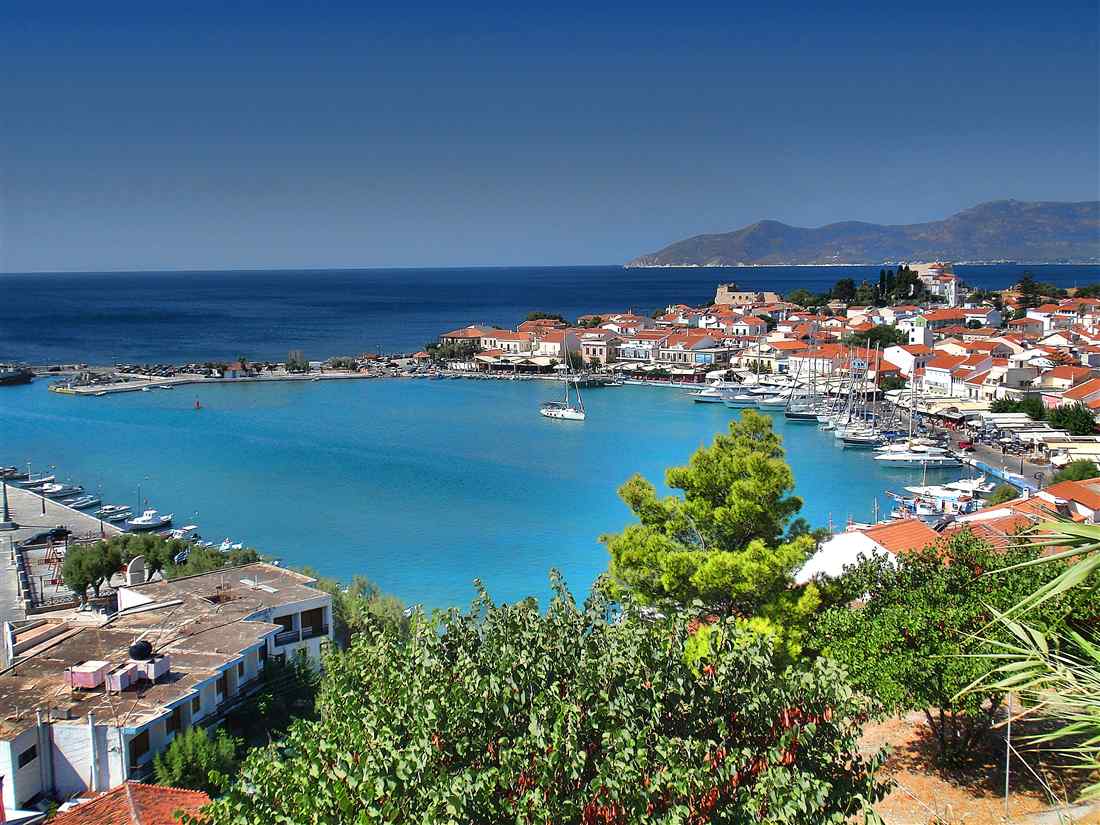
Ephesus from Samos is the day trip that carries you across the narrow strait from the Greek island of Samos to Ephesus in Turkey, pairing a short morning ferry with a guided tour of one of the best-preserved ancient cities in the Mediterranean. Plan the whole trip with Greece Tours.
This guide covers the Ephesus-from-Samos trip in full: how the ferry across the strait works, the passport and documents you need to cross, what an organised day tour includes, the monuments you see at Ephesus, the timing and length of the day, the cost, the best season to go, whether the trip is worth it, and what else you combine with it.
Is Ephesus reachable from Samos in a single day?
Yes. A daily passenger ferry crosses the narrow strait from Samos to Kusadasi in Turkey in 60 to 90 minutes, and a guided day tour links that ferry to the ancient city of Ephesus, putting the ruins within one round-trip day.
Samos sits at the eastern edge of the Aegean, closer to the Turkish coast than to any other Greek island. The strait between the island and Anatolia narrows to under two kilometres at its tightest point, and the sea lane the ferries follow runs from the Samian ports across to the mainland resort of Kusadasi. From that harbour the archaeological site stands 20 kilometres inland by road, a 25-minute coach transfer through orange groves and the Selçuk plain.
Travellers based on the island reach three connected destinations in the same crossing: the port town of Kusadasi, the ancient metropolis of Ephesus, and the Byzantine hill town of Selçuk beneath the castle of Ayasoluk. The full itinerary — ferry out, coach transfer, guided walk through the ruins, coach back, ferry home — fits inside the daylight hours of the sailing season.
The practical structure of the day rests on a few fixed points:
- A morning ferry departs from Samos Town (Vathy) or Pythagorio toward Kusadasi.
- A licensed guide and air-conditioned coach meet the boat at the Turkish port.
- The group tours Ephesus, the House of the Virgin Mary, and the Temple of Artemis site.
- An afternoon ferry returns passengers to Samos before nightfall.
This is one of the most rewarding excursions in the eastern Aegean, and it pairs naturally with the rest of an island holiday planned through Greece Tours. A visitor spending a week on Samos devotes a single day to Turkey and returns to the same hotel room that evening, with the finest classical ruins on the Anatolian coast already seen.
How does the Samos to Ephesus ferry work?
Two Samian ports run the crossing: Vathy (Samos Town) and Pythagorio. Boats leave in the morning, clear Turkish immigration on arrival at Kusadasi, and return in the late afternoon. The sailing lasts 60 to 90 minutes and a valid passport is mandatory.
The northern departure point is Vathy, the island capital, whose deep harbour faces the open Aegean. The southern departure point is Pythagorio, on the strait itself, the closest Greek harbour to the Turkish shore. Both operate the international line to Kusadasi during the season, and the tour operator assigns each booking to whichever port matches that day’s schedule.
Passengers check in at the port office 60 to 90 minutes before departure. Staff collect passports at check-in, process the exit and entry paperwork, and return the documents on board or at arrival. This centralised handling removes the queue that an individual traveller faces at a land border. The vessels are fast catamaran or conventional passenger ferries carrying foot passengers only — no private cars cross on this route.
The ticket structure separates the fare from the taxes. A crossing includes:
- The round-trip ferry fare charged by the operator.
- A Turkish port tax levied on arrival at Kusadasi.
- A Greek port fee folded into the departure ticket.
Kusadasi’s cruise harbour receives the ferries directly beside the town centre, so passengers step off the boat metres from the Scala Nuova promenade and the waiting tour coaches. The immigration hall sits inside the port terminal. Foot passengers clear it in minutes because the ferry company pre-submits the passenger manifest to Turkish authorities before the boat docks. On the return leg, the same office handles the exit stamp out of Turkey and the re-entry into Greece and the European Union.
The crossing distance and the vessel type set the sailing time. The Pythagorio route covers the shorter track across the strait and runs nearer to 60 minutes, while the Vathy route from the deeper northern harbour adds distance and sits closer to 90 minutes. Sea state in the channel between Samos and the Dilek Peninsula stays sheltered through the summer, and the Meltemi wind that stirs the central Aegean loses its force in the lee of the Anatolian coast, so the crossing holds steady through the peak season.
Booking runs a day ahead because the passenger manifest closes the evening before departure. Travellers reserve through the ferry agency in Vathy or Pythagorio, through their hotel, or through the tour operator that packages the whole excursion, and each booking records the full name and passport number that the manifest requires. A same-day walk-up ticket is refused, since the immigration submission is already lodged, so the seat is secured the afternoon before the crossing.
What documents does the crossing from Samos to Turkey require?
A passport valid for the full trip is compulsory for every traveller. Citizens of the European Union, the United States, the United Kingdom, Canada, and Australia enter Turkey for a day visit without a separate visa on this ferry route, and the ferry company processes passport control for the group.
Turkey and Greece are separate states with a hard external frontier, so this is a genuine international border crossing rather than a domestic island hop. A national identity card is insufficient; the document presented is a passport. The passport requires validity that extends beyond the date of travel, and worn or damaged documents are refused at the terminal.
The ferry operator submits each passenger’s details to Turkish immigration ahead of arrival, which is why the tickets are booked a day in advance with full name and passport number. This advance manifest clears the day-visitor category and removes the need for the individual e-Visa that longer stays require. Entry categories break down cleanly:
- EU, EEA, and Swiss nationals: passport, no visa for the day trip.
- United States, United Kingdom, Canada, Australia, New Zealand nationals: passport, no visa for the day trip on this ferry.
- Other nationalities: the ferry office confirms visa status at booking.
Non-EU residents of Greece carry their residence permit alongside the passport. Children travel on their own passports, and a minor crossing without both parents carries the documents the operator specifies at booking. The passport stays with the ferry office through the immigration process and returns before disembarkation, so travellers hand over the document at check-in on Samos and collect it once cleared into Turkey. The identical sequence runs in reverse in the evening, stamping the exit from Turkey and the re-entry into the Schengen Area.
The day-visitor route sidesteps the online formalities that independent overland travellers face. A tourist entering Turkey for a longer stay by air applies for an electronic visa in advance, but the ferry day trip from Samos runs on the operator’s bulk manifest and the passport check at the port, so no e-Visa application is filed for the single-day return. The distinction rests on the same-day nature of the trip: the traveller leaves Turkish territory on the evening boat, and the manifest records that outbound leg before the crossing begins.
Two practical points close the document question. A traveller whose passport nears expiry confirms the remaining validity with the ferry agency before booking, because a document short on validity is turned away at the terminal and the fare is forfeited. And the stamp count grows by two per trip — an exit and an entry on each leg — so a passport already dense with stamps benefits from a check that blank pages remain. The ferry office resolves both questions at the point of booking, a day ahead of the sailing.
What does a Samos-to-Ephesus day tour include?
A full guided package bundles the round-trip ferry, the coach transfer from Kusadasi port to the archaeological site, a licensed English-speaking guide, and entrance to Ephesus. Most itineraries add the House of the Virgin Mary and the Temple of Artemis, and a lunch stop features on the longer versions.
The organised tour exists to knit the ferry timetable to the site opening hours and to supply the ground transport and guiding that an independent foot passenger arranges alone. From the moment the boat docks, the day runs on the operator’s schedule. The standard inclusions are consistent across the Samian operators:
- Return ferry crossing Samos to Kusadasi and back.
- Air-conditioned coach transfer between the Turkish port and Ephesus.
- A licensed guide leading the walk through the ruins.
- Admission ticket to the Ephesus archaeological site.
- Visit to the House of the Virgin Mary on Mount Koressos.
- Stop at the Temple of Artemis, one of the Seven Wonders of the ancient world.
The guide is the core of the value. Ephesus is a vast ruin field with sparse on-site signage, and a licensed Turkish guide narrates the marble streets, dates the monuments, and explains the Roman and early Christian layers that a self-directed visitor walks past unremarked. The guiding is the difference between a walk among stones and a reading of an entire ancient city.
The Turkish port tax and the Ephesus entrance fee are itemised separately by certain operators and bundled by others, so the booking confirmation lists exactly what the headline price covers. The premium tours add a buffet lunch at a restaurant in Selçuk or Sirince and the entrance to the Terrace Houses, the covered mansion complex that carries its own surcharge inside the site.
What do you see at Ephesus on the day trip?
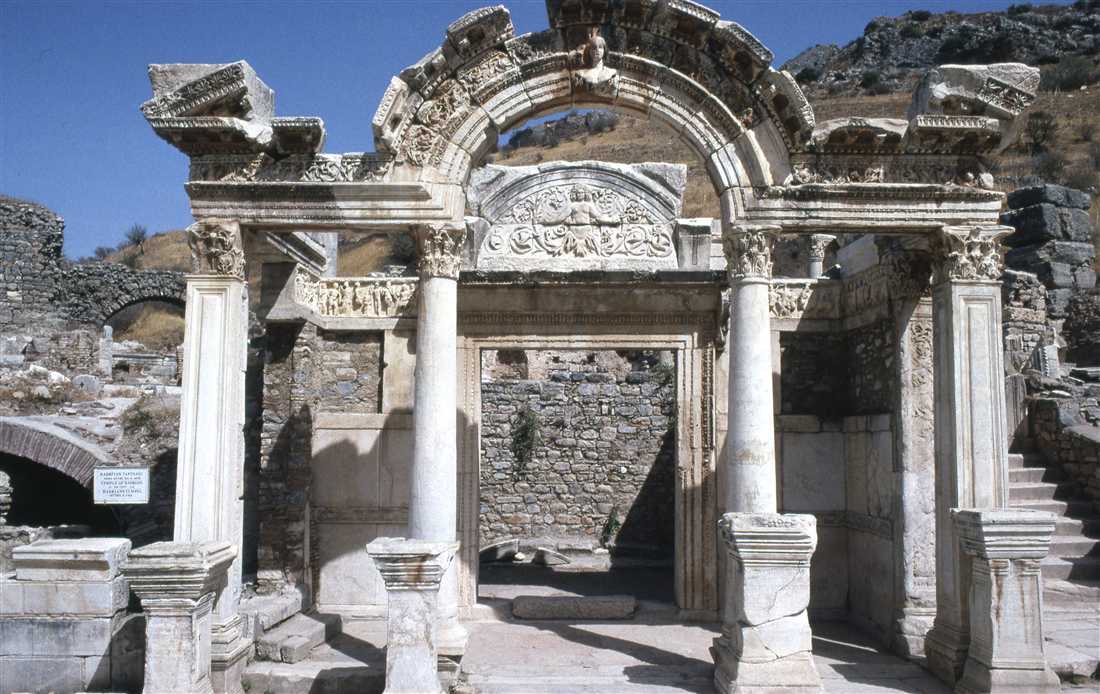
The walk descends the marble spine of the ancient city past the Library of Celsus, the Great Theatre, Curetes Street, the Temple of Hadrian, the Terrace Houses, and the Odeon — the best-preserved concentration of Roman urban architecture on the Mediterranean’s eastern shore.
Ephesus was the capital of Roman Asia and a port city of a quarter-million residents before its harbour silted up. The excavated core presents a continuous streetscape rather than isolated fragments, and the guided route runs downhill from the upper Magnesia Gate to the lower Harbour Gate, so the walk is gravity-assisted and the coach collects the group at the far end.
The landmarks along the route form a sequence:
- The Library of Celsus, its two-storey marble façade rebuilt from original blocks, the signature image of the site.
- The Great Theatre, a 25,000-seat auditorium cut into Mount Pion where the Apostle Paul preached to the Ephesians.
- Curetes Street, the colonnaded marble avenue lined with statue bases, fountains, and shopfronts.
- The Temple of Hadrian, its arched façade carved with Tyche and a frieze of the city’s mythical founding.
- The Terrace Houses, the roofed complex of patrician mansions with intact mosaic floors and frescoed walls.
- The Odeon, the roofed council chamber that seated the city senate.
The Library of Celsus anchors the visit. Tiberius Julius Aquila raised it as a tomb-monument to his father, the proconsul Celsus, whose sarcophagus lies beneath the reading room. The niches once held twelve thousand scrolls, and the four statues on the façade personify the virtues of Wisdom, Knowledge, Intelligence, and Valour. Beside it the Gate of Mazaeus and Mithridates opens onto the Commercial Agora.
The Terrace Houses reward the surcharge. Under a modern protective roof, six residential units climb the hillside on three terraces, their walls bright with painted panels and their floors laid with figured mosaics of Dionysus, tritons, and geometric fields — domestic Roman life preserved at a level matched at Pompeii and almost nowhere else.
The Great Theatre closes the downhill route at the foot of the Arcadian Way, the marble avenue that once ran to the vanished harbour. Its cavea rises in three tiers up the slope of Mount Pion, and the acoustic carries a spoken voice from the orchestra to the topmost row without amplification. The Acts of the Apostles set the riot of the silversmiths here, when the trade that sold shrines of Artemis rose against the preaching of Paul, so the theatre joins the Roman and the early Christian narratives of the city in one monument.
Smaller structures fill the route between the headline monuments and reward an attentive walk. The visitor passes the Fountain of Trajan, the Gate of Hercules with its relief of the hero in the Nemean lion skin, the public latrines of the Scholastica baths with their marble seating, and the Temple of Domitian on its terrace above the state agora. The carved foot and the female figure incised into the marble of Curetes Street point the way to the brothel, a detail the guides read aloud as the group descends toward the library.
How long is the day and what is the timing?
The day spans nine to ten hours. The ferry leaves Samos around 08:00, the group spends two to four hours at Ephesus and its satellite sites, and the return boat sails in the late afternoon, landing back on the island in the early evening.
The schedule is built backward from the two ferry sailings that frame the day. The morning departure sets the wake-up call, and the fixed afternoon return sets the hard deadline for leaving Turkish soil. Between them the operator sequences the ground programme to fit the site’s opening hours and the drive times around Selçuk.
A representative timeline runs as follows:
- 07:00 — check-in at the Samos port office, passports handed over.
- 08:00 — ferry departs Vathy or Pythagorio for Kusadasi.
- 09:00 — arrival at Kusadasi, immigration cleared, coach boarded.
- 09:30 — House of the Virgin Mary on Mount Koressos.
- 10:30 — guided tour of the Ephesus archaeological site.
- 13:00 — lunch stop and the Temple of Artemis.
- 16:30 — ferry departs Kusadasi for Samos.
- 17:30 — arrival back on Samos.
The two to four hours on the archaeological site itself deliver the substance of the day, and the downhill layout of Ephesus makes that window sufficient to walk the full length from the upper gate to the theatre without rushing. The transfer legs are short — 25 minutes each way between the port and the ruins — so the ratio of touring to travelling favours the visitor.
Punctuality governs the whole exercise. The return ferry sails on a fixed slot, and a passenger absent at the harbour is stranded across an international border overnight, so the guide keeps the group to the clock through the afternoon. Booking the excursion as an organised package removes that risk, because the operator owns both the coach and the ferry seat and holds the schedule together.
What does the Ephesus-from-Samos trip cost?
The full-day organised tour lands in a price band of roughly 55 to 90 euros per adult, covering the round-trip ferry, coach, guide, and Ephesus entrance. The Turkish port tax adds a fixed surcharge, and independent foot passengers pay less for the ferry alone but organise the ground programme themselves.
The cost divides into three components that travellers weigh against each other. The ferry fare is the baseline, the taxes are unavoidable, and the guided ground programme is the variable that separates a bare crossing from a full excursion. Breaking the spend down clarifies the choice:
- Round-trip ferry fare: the fixed cost of the sea crossing itself.
- Turkish port tax: a per-passenger levy collected on arrival at Kusadasi.
- Guided tour supplement: coach, licensed guide, and site entrance for the organised package.
The independent route suits a traveller who prizes autonomy over structure. That visitor buys the ferry ticket alone, disembarks at Kusadasi, and reaches Ephesus by public dolmus minibus to Selçuk followed by a taxi or a walk to the site gate, paying the Ephesus entrance directly at the turnstile. This trims the headline outlay but forfeits the guide, the door-to-door coach, and the schedule insurance that keeps the group ahead of the return sailing.
The organised package concentrates the value for a first visit. The premium is modest against the ferry-only fare once the coach transfer, the licensed guiding, and the pre-cleared immigration are counted, and the operator carries the risk of the timetable. The upper end of the price band buys the extras — a buffet lunch, the Terrace Houses surcharge, and a stop at Sirince — while the entry-level package holds to the core of Ephesus, the House of the Virgin Mary, and the Temple of Artemis. Whichever route a visitor picks, the passport handling and the port tax remain constant, so the real decision is guide-and-coach against go-it-alone.
Group size and season nudge the final figure. Families and pairs booking together secure the coach and guide at a lower per-head rate than a solo traveller pays, and the shoulder-season sailings undercut the July and August fares as demand thins. Children travel at a reduced rate on the ferry and the tour, and the operator quotes the child price against age at the point of booking, so the total for a family lands below the sum of four adult tickets.
When is the best time to make the Samos-Ephesus day trip?
The ferry runs from April to October, and spring and autumn deliver the finest conditions — mild temperatures on the exposed marble of Ephesus and thinner crowds than the July and August peak. A midweek date dodges the cruise-ship surge that floods the site on weekend port-call days.
Ephesus is an open, shadeless site of white marble and stone, and the Anatolian summer drives midday temperatures above 35 degrees Celsius with no relief along Curetes Street. The shoulder months trade that heat for comfortable walking weather. The seasonal pattern is clear:
- April to early June: warm days, green hillsides, moderate visitor numbers.
- July and August: peak heat and peak crowds, longer queues at the Library of Celsus.
- September and October: warm sea, settled weather, the harvest light of autumn.
The crowd calendar matters as much as the thermometer. Kusadasi is a major cruise port, and on days when large ships dock the archaeological site absorbs thousands of extra visitors funnelled through the same downhill route. The ferry day trip from Samos arrives on the same marble avenues, so a date chosen away from the heaviest cruise turnaround gives an emptier Library terrace and an unobstructed line of sight down Curetes Street. Midweek departures sit outside the busiest cruise rotations.
The sailing season itself bounds the decision. Outside the April-to-October window the international ferry pauses, so a winter visitor to Samos has no crossing to Turkey. Within the season the earliest and latest weeks carry the lightest passenger loads and the sharpest low-angle light on the ruins, and they align with the mildest walking conditions on the site. Spring adds wildflowers across the Selçuk plain and a full flow in the ancient fountains after the winter rains; autumn adds a warm Aegean for the ferry crossing and the amber tone that photographs the Celsus façade best.
Is the Ephesus day trip from Samos worth it?
Yes. Ephesus ranks among the best-preserved ancient cities in the Mediterranean, and reaching it as a single-day return from a Greek island is a rare geographic gift. The trip rewards anyone drawn to classical history, biblical sites, or standout architecture, and it fills one day of a Samos holiday with a Wonder of the ancient world.
The verdict rests on what the day delivers against what it costs. For under a hundred euros and inside ten hours, a visitor stands before the marble façade of the Library of Celsus, walks the avenue where the Apostle Paul addressed the Ephesians, and looks up at the Great Theatre carved into the mountain. That density of first-rank antiquity, packed into a return trip from a beach holiday, is unmatched by any other excursion in the eastern Aegean.
The trip suits distinct kinds of traveller:
- History enthusiasts, who read the Roman capital of Asia in its own streets.
- Pilgrims, who join the House of the Virgin Mary to the basilica of Saint John in Selçuk.
- Architecture admirers, who study the Terrace House mosaics and the Temple of Hadrian frieze.
- Repeat visitors to Samos, who add a second country to a familiar island week.
The trip demands an early start and a passport, and the fixed ferry timetable governs the pace, so a traveller set on a slow, unstructured day is served better by a beach on the island. For everyone else the arithmetic is decisive: the strait is narrow, the ferry is quick, the guiding is expert, and the destination is a Wonder of the ancient world. Standing among the ruins of the harbour city, a Samos holidaymaker crosses an international border, walks two thousand years of stone, and sleeps back on the island that night. The day earns its place in the itinerary.
What else combines with Ephesus from Samos?
The crossing opens more than the ruins alone. Kusadasi’s bazaar and waterfront, the House of the Virgin Mary, the Temple of Artemis, the hill village of Sirince, and the Ephesus Museum in Selçuk all sit within the day’s reach, and most organised tours fold two or three of them into the itinerary.
The Turkish side of the strait packs a cluster of destinations around the archaeological park, each a short drive from the next. A well-planned day threads the ruins together with the pilgrimage and market stops that share the Selçuk plain. The principal add-ons are:
- The House of the Virgin Mary, a stone chapel on Mount Koressos honoured as the final home of Mary, mother of Jesus.
- The Temple of Artemis, whose single re-erected column marks one of the Seven Wonders of the ancient world.
- Sirince, a hillside village of Ottoman-Greek houses known for its fruit wines and terraced vineyards.
- The Ephesus Museum in Selçuk, holding the multi-breasted Artemis statues and the finds lifted from the Terrace Houses.
- Kusadasi town, its Grand Bazaar, the Scala Nuova promenade, and the Byzantine-Genoese fortress on Pigeon Island.
The House of the Virgin Mary draws pilgrims of two faiths. The Vatican recognises the shrine, the site holds a Catholic Mass, and a spring below the chapel and a wall of tied prayer ribbons mark the devotion of Christian and Muslim visitors alike. It pairs on the standard itinerary with the Basilica of Saint John, the ruined church over the traditional tomb of the Evangelist beneath Ayasoluk castle.
Sirince rewards the tours that climb the eight kilometres above Selçuk into the hills. The village kept its Greek Orthodox church and stone houses after the population exchange, and its lanes sell peach, mulberry, and pomegranate wines pressed from the surrounding terraces. Kusadasi itself absorbs the time between the coach and the ferry — the bazaar for Turkish delight, spices, and leather, and the causeway to Pigeon Island for a last view back across the strait toward Samos before the evening boat.
The Ephesus Museum in Selçuk concentrates the finds that the excavators lifted from the site, and it completes the story the ruins leave open. Its centrepiece pair of Artemis statues, the Beautiful Artemis and the Great Artemis, show the goddess hung with rows of ovoid pendants, the cult image that drew pilgrims across the ancient world to her temple. The museum also displays the bronze athlete, the frieze of the Parthian monument, and the household objects and frescoes recovered from the Terrace Houses, so the domestic mosaics seen inside the site gain their portable furnishings in the gallery.
The choice of add-ons scales the day to the traveller. A pilgrim weights the itinerary toward the House of the Virgin Mary and the Basilica of Saint John; a shopper trades an hour of ruins for the Kusadasi bazaar; a wine and village enthusiast climbs to Sirince. Each combination fits inside the same ferry bracket, and the operator sets the balance at booking, so the party names its priorities and the guide sequences the stops between the morning arrival and the afternoon return.
Frequently Asked Questions
Can you do Ephesus as a day trip from Samos?
Yes. A passenger ferry crosses the narrow strait from Samos to Kusadasi in Turkey in about ninety minutes, and a guided day tour links the ferry to Ephesus, returning to Samos the same evening within a single day.
What do you need to cross from Samos to Ephesus?
A valid passport is required to cross from Samos to Turkey; the ferry operator collects passports for border control at check-in. Visitors from the EU, the United States, the United Kingdom and most Western countries enter for the day trip without a prior visa.
How long does the Ephesus day trip from Samos take?
The full day runs about nine to ten hours: an early ferry from Samos, a coach transfer to Ephesus, two to four hours at the ancient city with the House of the Virgin Mary and the Temple of Artemis, and a late-afternoon ferry back.