
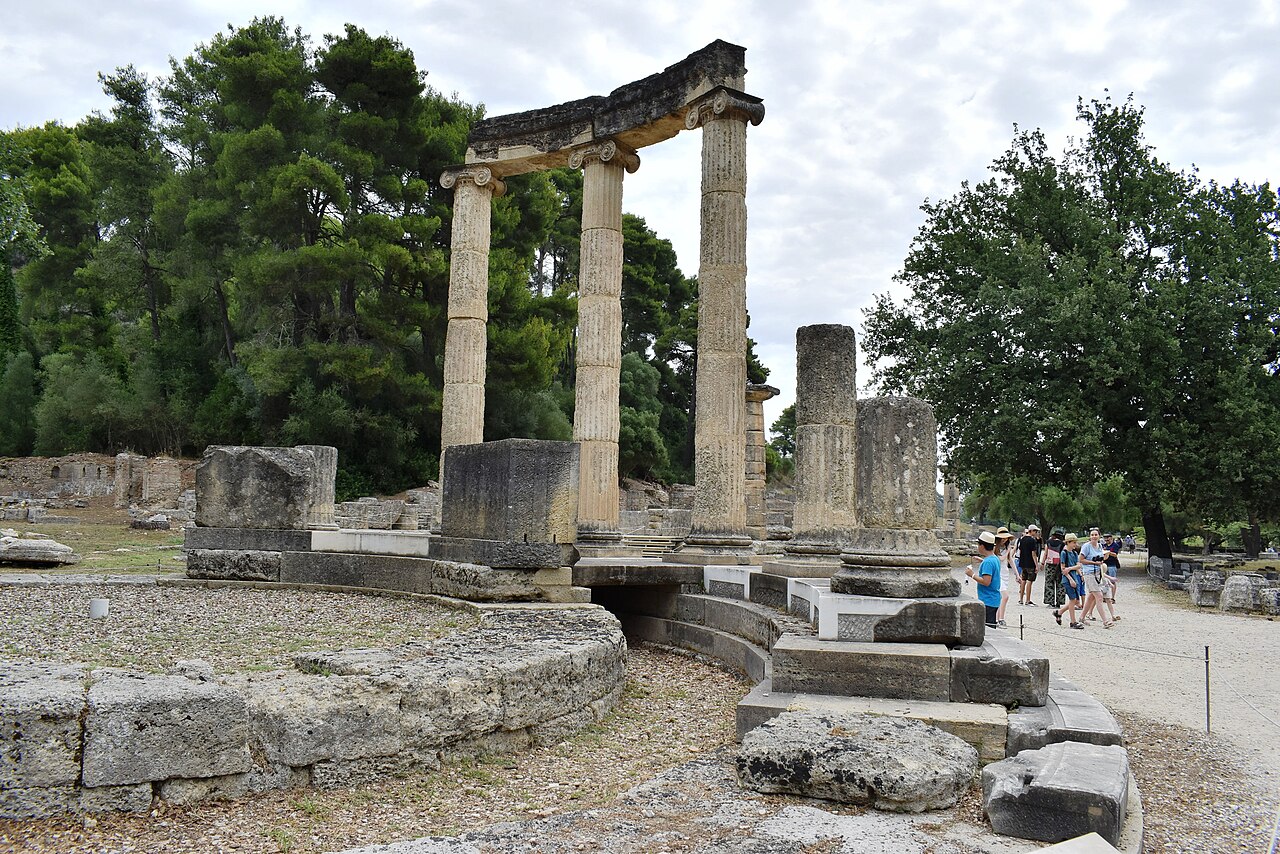
The Philippeion is one of the most elegant and unusual monuments at Ancient Olympia, a graceful circular building set in the sacred Altis beside the Temple of Hera. Begun by Philip II of Macedon after his victory that made him master of Greece, and completed by his son Alexander the Great, it held gold-and-ivory statues of the Macedonian royal family. Uniquely among the buildings of the Altis, it was dedicated not to a god but to human beings, marking the arrival of Macedonian power at the heart of the Greek world. This guide covers who built it, its architecture, the statues it held and what survives today.
This guide covers the Philippeion at Olympia in full: who built it, its Ionic architecture, the statues it held, its significance and what you see today. Read it beside the full Ancient Olympia guide and the guide to the Temple of Hera at Olympia, its neighbour in the sacred precinct.
What is the Philippeion at Olympia?
The Philippeion is a circular monument, or tholos, in the sacred Altis of Olympia, one of the few round buildings of the ancient Greek world. Begun by Philip II of Macedon and finished by Alexander the Great, it held statues of the Macedonian royal family. It was the only structure in the Altis dedicated to human beings rather than to the gods, a mark of Macedonian power.
It is a round monument. The Philippeion is a rare circular building, so it stands out among the rectangular temples of Olympia.
It honoured a royal family. It held statues of Philip, Alexander and their family, so it celebrated the Macedonian royal house.
It was unique in the Altis. Alone among the sacred buildings, it honoured humans rather than gods, so it marked a bold statement of power.
Who built the Philippeion?
The Philippeion was begun by Philip II of Macedon after his victory at the Battle of Chaeronea, which made him master of Greece, and it was completed after his death by his son Alexander the Great. By placing this monument in the most sacred precinct of Olympia, the Macedonian kings proclaimed their power and their place at the heart of the Greek world.
Philip began it. Philip II raised the monument after his victory made him master of Greece, so it announced Macedonian dominance.
Alexander finished it. His son Alexander the Great completed the building after Philip’s death, so it links the two greatest Macedonian kings.
It proclaimed their power. Set in the sacred Altis, the Philippeion declared Macedonian authority, so it was as much politics as devotion.
What did the Philippeion look like?
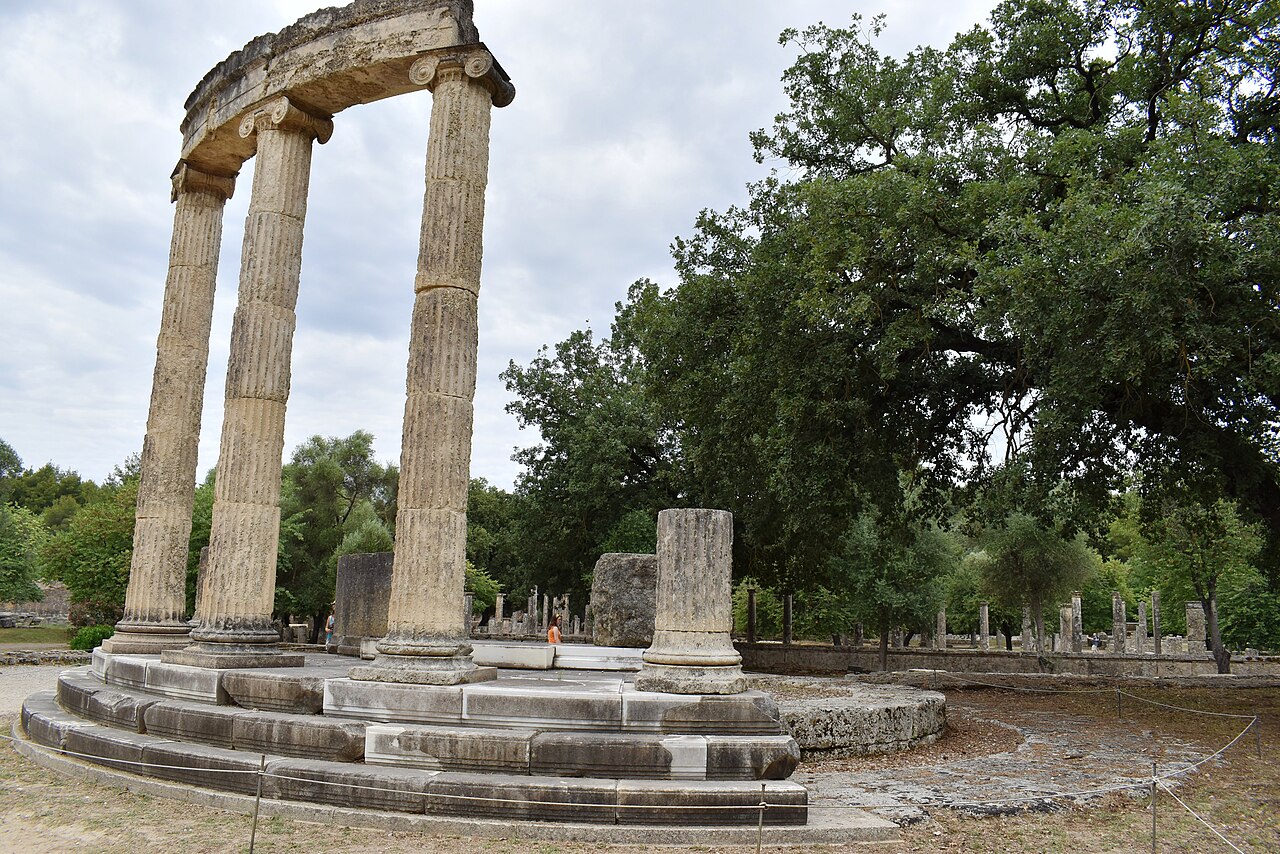
The Philippeion was a circular building about fifteen metres across, ringed by eighteen Ionic columns on a three-stepped marble base. Its outer parts were of fine Pentelic marble and its inner wall of limestone, and a cone-shaped roof crowned it. Inside stood a curved base holding the statues of the royal family, so the whole design framed the Macedonian kings in elegant Ionic architecture.
It was ringed with columns. Eighteen Ionic columns encircled the building, so it presented a graceful colonnade on every side.
It was built of marble. Fine Pentelic marble faced the exterior over a limestone core, so the monument gleamed in the Altis.
It framed the statues. A curved base inside held the royal statues, so the architecture was designed around the family it honoured.
What statues did the Philippeion hold?
The Philippeion held five gold-and-ivory statues of the Macedonian royal family: Philip II himself, his son Alexander the Great, his wife Olympias, his father Amyntas III, and his mother Eurydice I. Made in the same chryselephantine technique as the great statues of the gods, they placed the royal family among the divine at the very heart of Olympia.
It honoured five royals. The statues showed Philip, Alexander, Olympias, Amyntas and Eurydice, so three generations of the royal house stood together.
They were gold and ivory. The statues used the chryselephantine technique reserved for gods, so the family was raised to almost divine status.
They claimed the sacred centre. Placing the royal family in the Altis set them among the gods, so the statues were a powerful political statement.
Why is the Philippeion significant?
The Philippeion is significant as the only building in the sacred Altis of Olympia dedicated to human beings rather than gods, and as a monument of the rise of Macedon. By honouring the royal family in the most sacred Greek precinct, and in the divine technique of gold and ivory, Philip and Alexander proclaimed their power over Greece and their place beside the gods.
It broke with tradition. As the only monument in the Altis to humans, it marked a striking departure, so it stands apart from every temple.
It marked Macedon’s rise. The building announced Macedonian dominance over Greece, so it is a monument of a turning point in history.
It raised kings toward gods. Honouring the family in divine materials placed them among the gods, so it was a bold claim of royal power.
Where is the Philippeion at Olympia?
The Philippeion stands in the north-western part of the sacred Altis at Olympia, just west of the Temple of Hera and north of the great Temple of Zeus. Its position among the most important monuments of the sanctuary, close to the temples of the gods, underlined the bold claim of the Macedonian kings to a place at the sacred heart of Greece.
It sits by the Temple of Hera. The monument stands just west of the Heraion, so the two are seen together on the walk.
It lies near the Temple of Zeus. The great temple rises close by, so the Philippeion is at the heart of the sanctuary.
It commands a sacred spot. Its central position underlined the Macedonian claim, so its very location was part of its message.
What can you see of the Philippeion today?
Today you see the round base of the Philippeion with several of its Ionic columns re-erected, giving a clear sense of the graceful circular building. Set in the green Altis beside the Temple of Hera, the restored columns make the monument one of the most photogenic at Olympia, and its distinctive round plan stands out among the rectangular ruins of the sanctuary.
Its base survives. The circular foundation is clear, so visitors read the round plan of the building.
Columns stand again. Several Ionic columns have been re-erected, so the monument shows its graceful form.
It is photogenic. The restored round colonnade in the green Altis makes a fine sight, so it is a favourite for photographs, as the full Ancient Olympia guide describes.
Frequently Asked Questions About the Philippeion
Why was the Philippeion built?
The Philippeion was built to celebrate the power of Philip II of Macedon after his victory made him master of Greece, and to honour his royal family. By placing it in the sacred Altis of Olympia and filling it with gold-and-ivory statues of the family, Philip and his son Alexander proclaimed Macedonian dominance at the very heart of the Greek world.
The monument was as much a political statement as a work of art, so its purpose was to display Macedonian power in the most sacred Greek sanctuary.
What is a tholos?
A tholos is a circular building in ancient Greek architecture, a relatively rare form used for special monuments and shrines. The Philippeion is one of the best-known examples, a round colonnaded building unlike the rectangular temples that dominate Greek sanctuaries. Its circular shape made it stand out among the buildings of Olympia and gave it a special, memorable character.
Because round buildings were uncommon in Greek architecture, the tholos form of the Philippeion made it distinctive and gave it lasting fame.
Is the Philippeion worth seeing at Olympia?
Yes, the Philippeion is well worth seeing at Olympia. Its graceful re-erected columns, its rare round design and its remarkable story as the only monument in the Altis to humans make it a highlight of the sanctuary. Standing beside the Temple of Hera in the green precinct, it is both beautiful and historically important, so it rewards a stop on any visit.
Its beauty and its unique history together make the Philippeion one of the most rewarding monuments to seek out at Olympia.
What happened to the statues in the Philippeion?
The gold-and-ivory statues of the Macedonian royal family that once stood in the Philippeion have not survived. Like the great statue of Zeus, they were lost when the sanctuary was abandoned in late antiquity, their precious materials removed or destroyed. Only the round building and the curved base that held them remain, so the statues are known today from ancient descriptions rather than from the works themselves.
Because the precious statues were lost with the fall of the sanctuary, the Philippeion survives as an empty but eloquent monument to the Macedonian kings.
Who was Philip II of Macedon?
Philip II of Macedon was the king who transformed Macedon into the leading power of Greece, defeating the Greek city-states and uniting them under his leadership. He was the father of Alexander the Great, who went on to conquer the Persian Empire. Philip built the Philippeion at Olympia to celebrate his victory and to proclaim his family’s power at the sacred heart of Greece.
As the father of Alexander and the maker of Macedonian power, Philip II stands among the most important figures of ancient Greek history, and the Philippeion is his monument at Olympia.