
Saria is the small, uninhabited islet off the northern cape of Karpathos, separated from it by a narrow. Deep strait so slender that the two are thought to have been one island in antiquity before an earthquake split them. Rugged, empty and protected as a Natura site, Saria is a place of clear coves, sea caves, ancient and Byzantine ruins and rare birdlife, reached only by boat. Plan the whole trip with Greece Tours.
This guide covers Saria as a destination: how to visit, its famous beach of Palatia and its sea cave. The ruins of the lost city and the medieval village, the hiking trails, its long history and its protected wildlife. For the practical detail of the excursion itself, see the guide to Karpathos boat trips.
What is Saria island?
Saria is a small, uninhabited islet off the northern tip of Karpathos, separated by a narrow strait. Rugged and empty, it is a protected Natura area of clear coves, sea caves, ancient ruins and rare birdlife.
Saria lies just north of Karpathos, divided from it by a long. Very narrow strait. Slender that many believe the two islands were once joined and split by a strong earthquake in antiquity. The islet is uninhabited and rugged, a wild landscape of steep hills, small coves and sea caves, empty of any development and reached only from the sea.
Its emptiness and its clear, undisturbed waters are the great draw. Saria has been declared a Natura protected area, safeguarding its rare birdlife and its unspoiled character, so a visit feels like stepping onto a genuinely wild island. Alongside the natural beauty, the islet carries the ruins of an ancient city and a medieval village, giving it depth beyond its beaches.
For visitors to Karpathos, Saria is the ultimate escape: a short crossing from the north of the island to a place with no roads. No buildings and almost no one, where clear coves and ancient stones sit under towering crags. It is the wildest and most memorable of the excursions from Karpathos.
How do you visit Saria island?
Saria is reached only by boat, on excursions from the port of Diafani in about twenty minutes or on longer trips from Pigadia. Daily boats run in season, landing at Palatia beach with time to swim and explore.
It is reached only by boat. Excursion boats cross from the northern port of Diafani in about twenty minutes, while longer trips run up the coast from Pigadia, both landing at the sheltered bay of Palatia, the usual base for a visit.
The boats run daily through the summer season. A typical trip combines a swim stop, often at a sea cave. With time on Palatia beach and the chance to walk to the ruins, sometimes with lunch cooked on the island. Tickets are sold by the crews along the Diafani and Pigadia quays, and the crossing itself is a scenic part of the day.
Visiting Saria pairs naturally with the port of Diafani and the village of Olympos above it, so many combine the islet with a day or stay in the north. For the full detail of the routes, the boats and what a trip includes, see the guide to Karpathos boat trips, and the guide to Diafani for the launch port.
What is Palatia beach on Saria?
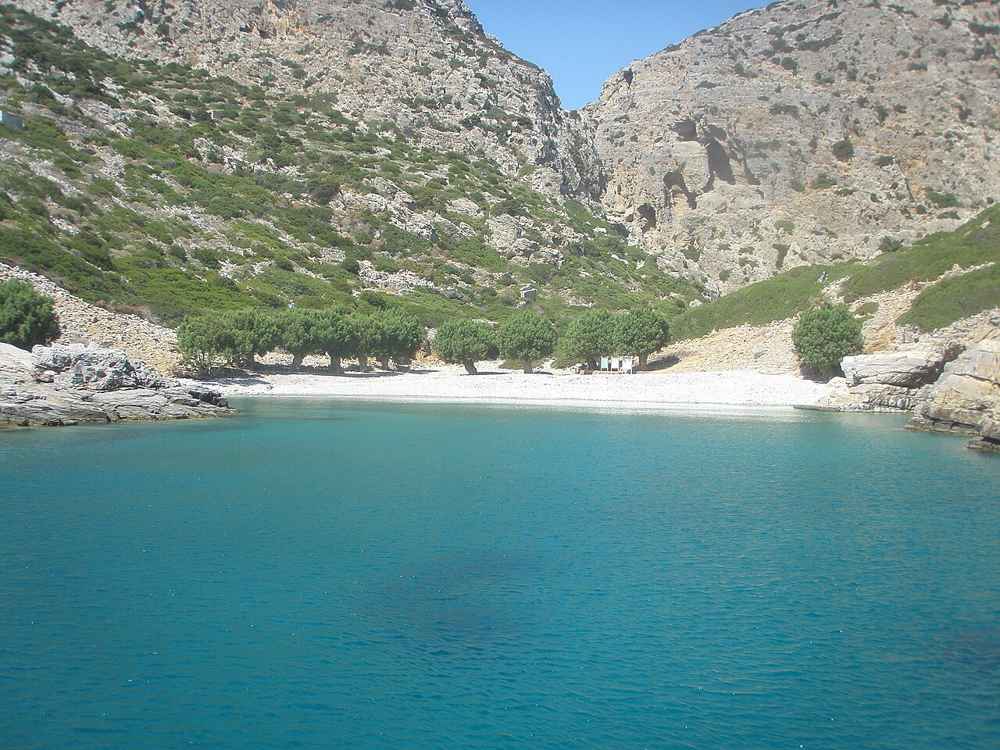
Palatia is the most famous beach on Saria, a sheltered pebble cove of emerald, crystal-clear water framed by steep cliffs, with a sea cave to explore on one side and the ruins of a medieval village behind it.
Palatia is the heart of a visit to Saria, a beautiful cove set in the north-east of the islet and well protected by steep cliffs on both sides. Its pebble shore drops into emerald and crystal-clear water that is superb for swimming and snorkelling. Its enclosed. Dramatic setting under the crags gives it a wild, secluded character quite unlike the organised beaches of Karpathos.
On the left side of the cove, as you face the sea, lies a sea cave worth exploring. With a hidden exit that adds a touch of adventure to a swim. The clear, calm water and the sheltered position make Palatia an idyllic place simply to spend time on the beach. For most day visitors it is the main focus of the trip.
Behind the beach rise the ruins of the medieval village of Palatia and the traces of the ancient city. The cove combines swimming with a walk into the islet’s past. Whether you come to swim, snorkel or explore, Palatia is the natural landing point and the most memorable spot on Saria.
What are the ruins of Saria island?
Saria holds the ruins of the ancient city of Nisyros, or Saros, one of the four ancient cities of Karpathos, and the medieval village of Palatia from the sixth to ninth centuries, along with early Christian chapels and a basilica.
The islet was inhabited from deep antiquity. A city-state called Saros, also linked with the name Nisyros, one of the four ancient cities of the Karpathos region, once stood here. Traces of this ancient settlement survive. Legend even holds that an old temple to Apollo lies on the seabed in the strait between Saria and Karpathos. A reminder of how closely the two islands were once bound.
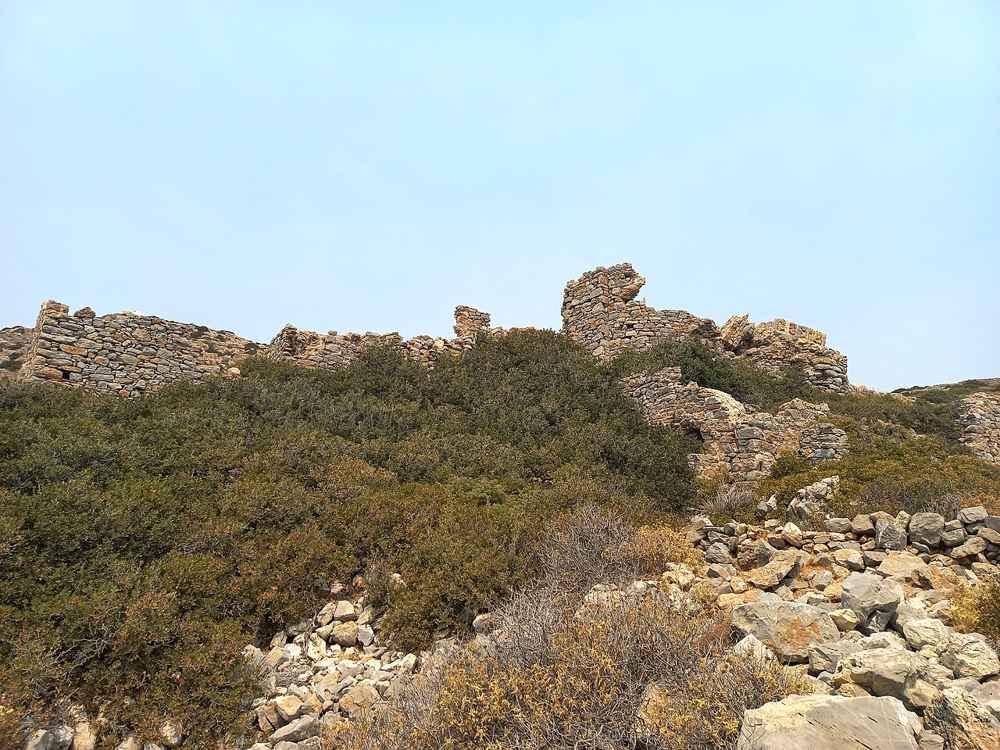
Above Palatia beach stand the more visible ruins of the medieval village, also called Palatia, dating from roughly the sixth to the ninth centuries. Its distinctive stone houses with domed roofs are thought to have been built and inhabited by Arab or Saracen pirates who used the sheltered. Hidden island as a base. They are among the most atmospheric ruins in the region.
Scattered across the islet are early Christian remains too, including a basilica and small chapels dating back as far as the fifth century. Such as Agios Zacharias near the Palatia trail and Agios Panteleimonas and Agios Spyridonas in the south. Together the ancient city, the pirate village and the chapels give Saria a rich layer of history beneath its wild surface.
Can you hike on Saria island?
Yes. Trails lead from Palatia beach across the islet, most notably to the abandoned settlement of Argos through the dramatic Endi river gorge. The full hike is about eight kilometres, though shorter walks and the beach alone reward a visit.
For those who want more than the beach, Saria offers rewarding walking on old mule trails through its wild interior. The best-known route leads from Palatia to the abandoned settlement of Argos, passing through an impressive gorge cut by the Endi river. Where huge crags tower overhead, one of the most dramatic short treks in the area.
Other paths from Palatia climb to the little chapel of Agios Zacharias near the trailhead and cross the abandoned fields and mule trails of the islet. The full network of walks totals around eight kilometres. Serious walkers can spend a good part of the day exploring. Taking in the ruins, the chapels and the empty landscape along the way.
That said, a hike is optional, and even a short stroll from the beach or simply staying at Palatia is enough to feel the islet’s distinctive character. Time on Saria is usually limited by the boat’s schedule. Most visitors combine a swim at Palatia with a short walk to the nearest ruins rather than the full trek to Argos.
What is the history of Saria island?
Saria has been inhabited since the Neolithic and Bronze Ages, was a member of the ancient Delian League, and held the city of Saros. Earthquakes and piracy later destroyed its settlements, leaving the islet uninhabited.
The history of Saria reaches far back: traces of habitation have been found from the Late Neolithic Age and the Early and Middle Bronze Age. In classical times the island was a member of the Delian League, the alliance led by Athens. The city-state of Saros stood here, alongside the settlements of Palatia and Argos, when the islet supported a real community.
Over the centuries, repeated earthquakes and the constant threat of piracy took their toll, destroying the settlements and driving away their inhabitants. The medieval village of Palatia, built and used by pirates, was the last significant settlement. After it too was abandoned the islet fell silent. Left to the wild as the uninhabited place it remains today.
This long arc, from a Neolithic and classical settlement through a Byzantine and pirate past to its present emptiness, is what gives Saria its haunting character. Walking among the ruins above Palatia, it is easy to feel the weight of the islet’s history beneath the silence. A striking contrast to the living traditions of Karpathos across the strait.
What wildlife is on Saria island?
Saria is a Natura protected area, home to some of the rarest birds in Europe, including Bonelli’s eagle, the long-legged buzzard and Eleonora’s falcon. Its clear, undisturbed waters also shelter marine life.
Saria’s protection as a Natura site reflects its importance for wildlife, particularly its birds. The rugged, undisturbed islet is a refuge for some of the rarest raptors in Europe, including Bonelli’s eagle, the long-legged buzzard and Eleonora’s falcon. Which nest on its cliffs and hunt over its empty landscape, a rare sight for visitors who look up as they explore.
The clear, sheltered waters around the islet are just as valuable. Undisturbed by development and rich in marine life, they make Saria one of the finest spots for snorkelling and diving in the area. The Mediterranean monk seal. One of the world’s most endangered marine mammals, is known to shelter along this stretch of remote coast.
This natural richness is a large part of what makes Saria special and worth protecting. Visitors are asked to tread lightly, taking nothing and leaving nothing, so that the islet keeps its wild character and its rare birds and marine life endure. Experiencing this protected wilderness, so close to Karpathos yet so untouched, is the essence of a visit to Saria.
Frequently Asked Questions
How do you get to Saria island?
Saria is reached only by boat, on excursions from the northern port of Diafani in about twenty minutes, or on longer trips up the coast from Pigadia. Daily boats run in the summer season, landing at the sheltered bay of Palatia with time to swim, snorkel and walk to the ruins before returning.
What is there to see on Saria island?
The highlights of Saria are Palatia beach, a sheltered cove of emerald water with a sea cave. The ruins above it: the medieval pirate village of Palatia and traces of the ancient city of Saros. Along with early Christian chapels and a basilica. Hiking trails lead to the abandoned settlement of Argos through the dramatic Endi gorge.
Why is Saria island uninhabited?
Saria was inhabited from the Neolithic and Bronze Ages and held the ancient city of Saros. Repeated earthquakes and centuries of piracy destroyed its settlements and drove away its people. The last significant settlement, the medieval village of Palatia, was used by pirates, and after it was abandoned the islet fell silent and has remained uninhabited.
Is Saria island protected?
Yes. Saria is a Natura protected area, safeguarding its rare birdlife, including Bonelli’s eagle, the long-legged buzzard and Eleonora’s falcon. Its clear. Undisturbed waters, which shelter marine life and occasionally the endangered Mediterranean monk seal. Visitors are asked to tread lightly and leave the wild islet as they find it.