
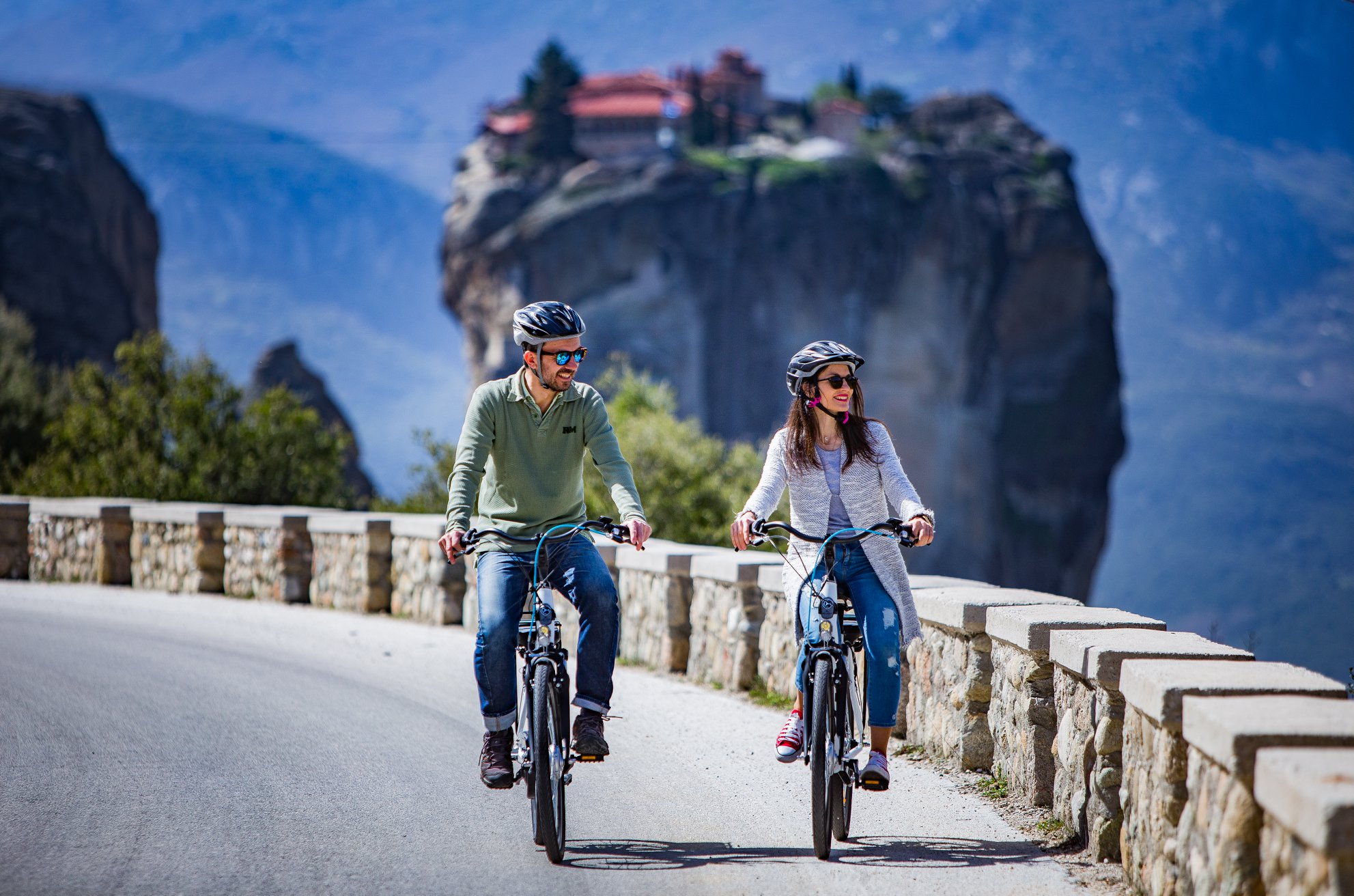
Cycling routes in Greece, by region and season: Peloponnese, Meteora, Crete, Cyclades winds, and gravel Pindus. Plan the whole trip with Greece Tours. Choose the right bike, timing, and safety tips.
If you’ve ever looked at a map of Greece and thought, “Surely this is made for cycling,” you’re not wrong. Between the mountain spines that run down the mainland, the endless island coastlines, and the backroads that slip past olive groves, Byzantine chapels, and ancient stones, Greece rewards riders who like their miles scenic and their coffee stops frequent.
We’ve spent years riding here the way locals actually do it: a long summer month island-hopping, a shoulder-season loop through the Peloponnese, a quick Athens escape when city life gets loud.
And because we’re Greek and on the ground (Yannis Divramis here, raised on Milos and Santorini, still in Athens every month), we’ll keep this practical: where to ride, when to ride, what kind of bike to bring, and how to handle the few Greece-specific curveballs like meltemi winds, fast descents, and the occasional free-range dog with strong opinions.
See more in My Greece Tours.
Below are our favorite cycling routes in Greece, organized by region, season, and skill level, so you can build a trip that feels like a vacation, not a survival test.
Key Takeaways
- Cycling routes in Greece deliver a huge variety in short distances, from coastal spins and island punch climbs to Alpine-feeling mountain switchbacks and quiet gravel backroads.
- Plan cycling routes in Greece by season: spring and fall are the sweet spot, while summer demands early starts, strict hydration, shade-friendly routing, and meltemi wind strategy in the Cyclades.
- Match your bike to the surfaces you’ll actually ride—endurance/all-road (30–35 mm) is the most flexible choice, gravel (38–45 mm) unlocks remote tracks, and road bikes work best when you’re comfortable on rough patches.
- Choose regions to fit your riding style: Peloponnese for classic road loops with culture stops, Epirus/Zagori for dramatic climbs and gorge views, Meteora/Thessaly for rolling mileage plus iconic viewpoints, and Crete for big sustained climbing days.
- Ride safer by staying highly visible with daytime lights, descending conservatively on surprise pavement changes and gravelly corners, and using calm, consistent tactics for occasional territorial dogs.
- Make logistics part of the plan by favoring loop routes on islands, using ferries as recovery time, relying on offline maps for inconsistent signage, and carrying essential spares for self-sufficient riding in remote areas.
What Makes Greece A Great Cycling Destination
Greece is one of those rare places where a “good ride” can mean three totally different things in the same week: a smooth coastal spin past turquoise coves, a high-mountain climb with switchbacks that feel Alpine, and a gravel day through pine forest with nobody around except goats.
The big reason Greece works so well is the variety packed into short distances. We can ride a quiet inland lane in the Peloponnese in the morning and be eating seafood by the sea in the afternoon. On the islands, the roads often link villages every few kilometers, which naturally creates perfect micro-stages with frequent reset points (water, shade, a bakery, our three essentials).
And then there’s the cultural layer. Greece isn’t just scenery: it’s scenery with context. You’re not “passing ruins”, you’re rolling by Mycenaean walls near Argos, the theater at Epidaurus, monasteries around Meteora, or a Venetian fort on Corfu. That mix of riding + history is what keeps us coming back.
Terrain And Road Conditions To Expect
Expect three main “surfaces,” often within the same region:
- Paved coastal and valley roads: Typically rolling, with short climbs. Many are in decent condition: the very small lanes can be patchy.
- Island roads: Frequently steep and punchy. The climbs aren’t always long, but they can be sharp, especially when a road cuts straight up from a harbor to the main town.
- Dirt/gravel: Greece has a huge network of farm roads, fire roads, and old trackways. On routes like the Bike Odyssey concept (often cited around 600 km with a high percentage of dirt), riders report that much of the unpaved riding is well-maintained dirt rather than pure rock-chunk chaos, though conditions vary after storms.
A note from real-life riding: Greek pavement can change abruptly. One minute it’s smooth, the next it’s weathered with cracks or gravel in corners. That doesn’t ruin a ride, but it does change how we descend and why we recommend wider tires than you might pack for, say, the Netherlands.
Weather, Wind, And Daylight By Season
Greece has a long riding season, but the “best” months depend on what you’re doing and where.
- Spring (March–May): Wildflowers, green hills, and comfortable temperatures. Great for big mainland rides and longer island days without the furnace effect.
- Summer (June–August): Bright, long days. Also, heat, sometimes serious, and in the Cyclades, the meltemi wind, which can turn “easy coastal” into “why are we doing this?”
- Fall (September–November): Our favorite for many trips. The sea stays warm, the roads calm down, and the sun is kinder.
- Winter (December–February): Surprisingly workable in the southern regions and islands on clear days, but the mountains can be cold, wet, and occasionally snowy.
Daylight is generous in summer, but we still plan around the heat: early starts, long midday breaks, and a second ride window late afternoon if we want extra miles.
Safety, Traffic, And Driver Awareness Basics
Most of the riding we love in Greece happens on quiet roads, especially once you’re away from city centers and the main national highways. But driver behavior varies:
- In rural areas, drivers are often used to tractors, scooters, and slow vehicles, so the pace feels calmer.
- In busy zones (Athens, parts of Thessaloniki, peak-season island ports), awareness can be lower and patience shorter.
We ride with a few consistent habits:
- Lights on, day or night. Visibility is everything.
- Assume drivers didn’t see us at junctions, even if we have the right of way.
- Descend conservatively, gravel in corners appears like a surprise quiz.
And yes, dogs come up enough that it’s worth mentioning early: most are harmless, some are territorial. We’ll cover how we handle them in the risk management section.
How To Choose The Right Route For Your Trip
Choosing cycling routes in Greece is less about finding “the best” and more about matching your ride to your reality: your bike, your fitness, your heat tolerance, and how much logistics you want to manage.
A common mistake we see: riders plan Greece like it’s one continuous bike path network. It’s not. Greece is a patchwork, in a good way. You can build an incredible week, but you’ll enjoy it more if you choose the right type of riding.
Road Bike Vs Gravel Vs MTB: Matching Surface To Bike
Here’s how we usually decide:
- Road bike (25–30 mm tires): Best for mainland “classics” and islands where you want speed and long paved climbs. If you’re confident handling rough patches, you’ll be fine.
- All-road / endurance road (30–35 mm): Our favorite “one-bike solution” for Greece. It smooths out broken asphalt and gives you optional gravel detours.
- Gravel bike (38–45 mm): Ideal for the Pindus, Zagori backroads, Crete plateaus, and anywhere you want to connect villages via dirt.
- MTB: Great if your trip is specifically trail-focused (or you’re staying near Athens and want short, technical escapes).
If you’re planning a mixed trip, say, 4 days on an island plus 3 days on the mainland, we lean toward all-road or gravel. You’ll lose a bit of road speed and gain a lot of comfort and flexibility.
Distance, Elevation, And Fitness Planning
Greece can trick you because distances look short on the map. But climbing adds “hidden cost.” A 65 km island loop with 1,200 m of elevation can feel harder than a 100 km flatter ride.
What works well for most riders:
- Beginner / casual: 25–60 km/day, keep elevation modest, plan plenty of swims and long café stops.
- Intermediate: 60–110 km/day with one “feature climb” or a rolling profile.
- Advanced: 100–160 km/day, big climbing days on the mainland, or back-to-back island loops.
We also plan around the Greek rhythm: it’s normal to stop for a proper coffee and snack, and it’s normal for lunch to become… a long lunch. That’s not “lost training time.” That’s the trip.
If you like concrete examples, rides often recommended online include an easy Athens Riviera out-and-back around ~45 km for a low-stress day, while some Meteora loops can pack serious climbing into a relatively compact route.
Loop Vs Point-To-Point: Logistics And Support
Loops are simply easier in Greece, especially on islands.
- Loop rides: Start and finish in the same town. Less fuss with ferries, buses, and hotel changes. Corfu, Kos, and many Cyclades islands are perfect for this.
- Point-to-point: Amazing if you want a “journey” feel, but you’ll juggle baggage, transfers, and sometimes limited transport options.
When we do point-to-point, we pick areas with straightforward connections:
- Mainland routes that track near larger towns.
- Island hops where ferries run frequently (in summer), and where we can keep the itinerary flexible.
If you’re traveling with a group, support becomes a big factor. A simple rental car doing leapfrog resupply can turn a tough route into a relaxed one, especially in summer.
Mainland Road Classics: Big Climbs And Scenic Valleys
The mainland is where Greece shows its “grand tour” side: long climbs, deep valleys, stone villages, and that feeling that the road is taking you somewhere meaningful.
If we had to pick one reason to ride the mainland: space. You can find long stretches where the only sounds are your chain, cicadas, and distant church bells.
Peloponnese Coastal And Mountain Loops
The Peloponnese is a dream for road cycling because it stacks environments close together: coast, farmland, mountain towns, and archeological sites.
Our favorite way to ride it is in loops based around a few hubs:
- Nafplio / Argolida: Great shoulder-season base with rolling roads, sea views, and easy access to historical stops like Mycenae and Epidaurus (perfect “culture breaks” on lighter days).
- Messinia (Kalamata area): Quiet inland lanes through olive groves, plus coastal stretches where you can tack on extra distance.
- Laconia / Mystras: More rugged, more climbing, and a strong “old Greece” atmosphere once you get into the hills.
A classic Peloponnese day for us looks like: early ride inland while it’s cool, mid-ride espresso in a village square, then a final hour rolling back toward the sea.
Climbing note: Peloponnese climbs are often steady rather than brutal. You can settle into a rhythm, which makes them great for riders building endurance.
Epirus And Zagori: Gorges, Switchbacks, And Quiet Roads
If you want drama, real, cinematic road cycling, Epirus delivers.
Zagori’s stone villages and the Vikos Gorge area are famous for hiking, but cyclists get something special: serious elevation with rewarding views and roads that feel far from mass tourism.
What we love here:
- Switchback climbs that gain altitude quickly.
- Cooler air compared to the islands in summer (though it can still get hot).
- Gravel options everywhere if you brought the right bike.
This is also where we pay extra attention to descents. Narrow roads, changing pavement, and the occasional animal in the road mean we descend with margin, always.
Thessaly And Meteora: Rolling Miles And Iconic Views
Meteora is one of those places that doesn’t need marketing. The rock pillars and monasteries look unreal in photos, and somehow even more unreal when you’re riding underneath them.
From a cycling perspective, Thessaly gives you two big assets:
- Rolling valley roads are great for steady mileage.
- Punchy climbs when you head toward Meteora’s viewpoints.
We like riding Meteora early in the day to avoid both heat and traffic. Later, tour buses arrive, and the vibe shifts.
If you’re fit and want a challenge, you can link multiple viewpoints and monastery loops into a longer ride with real elevation. If you want a calmer day, ride the valley, then do a short climb for a sunset view, simple, memorable, and not a sufferfest.
Island Riding: Best Greek Islands For Cycling
Island cycling is where Greece becomes addictive. Every island has its own “personality,” and on a bike you feel those differences immediately: the way the wind hits you, how the roads tilt, how often you see the sea.
Our rule of thumb: choose islands based on what you want your days to feel like.
- Want long climbs and big days? Crete.
- Want short, sharp rides with a wind strategy? Cyclades.
- Want gentler grades and greenery? Ionian.
- Want dry heat and open roads? Dodecanese.
Crete: Long Climbs, South Coast Roads, And Shoulder Seasons
Crete rides like a mini-country. Distances are real, climbs are real, and the landscape changes constantly.
Why we keep recommending Crete:
- Long, sustained climbs that suit road riders who like tempo.
- South coast roads with fewer crowds and a wilder feel.
- Shoulder seasons are excellent here; spring and fall bring comfortable temperatures and quieter roads.
Crete can also handle ambitious route planning: you can build multi-day tours, or base yourself in one area and create big loops. Some riders love the “Road of the Gods” style routes that blend iconic scenery with serious climbing; just be honest about your legs before you commit.
Cyclades: Short, Punchy Climbs And Wind Management
The Cyclades look like postcard perfection: white villages, blue domes, and bright sea. But cyclists remember them for something else: wind.
The meltemi can be steady and strong in summer. That doesn’t mean “don’t ride”, it means ride smart:
- Plan routes with wind direction in mind (tailwind home is a gift).
- Start early before gusts build.
- Expect climbs to feel harder when you’re also fighting the air.
The terrain tends to be short and steep, which makes the Cyclades great for riders who enjoy punchy efforts and frequent resets in villages. It’s less about long base miles and more about bite-sized challenges.
And yes, islands like Milos and Santorini are stunning from the saddle, but they can be busy in peak season. We aim for early morning roads and quieter inland detours.
Ionian Islands: Gentler Grades And Lush Inland Lanes
If you want island riding that feels a bit softer, greener, more shaded, and often with gentler gradients, the Ionian Islands are a strong choice.
- Corfu: A classic for loop rides. You can stitch together coastal views with inland olive groves and small villages.
- Lefkada: Great mix of seaside and interior climbs, and easy to combine with beach time.
The Ionian vibe is “ride, swim, eat, repeat.” Roads can still climb (it’s Greece, after all), but the islands often feel more forgiving than the Cyclades.
Dodecanese: Dry Heat, Open Roads, And Early Starts
The Dodecanese islands (like Kos and Rhodes) offer a different feel: drier landscapes, open roads, and summer conditions that demand respect.
We like them most when:
- We’re comfortable starting early.
- We’re disciplined about hydration.
- We plan midday downtime.
Kos, for example, is known for a manageable loop option (often cited around the ~60 km mark), which makes it approachable even if you’re not chasing huge elevation. Rhodes can scale up the challenge with longer rides and more varied terrain.
The key in this region is timing. If we start late in July or August, the day can feel like riding inside a hair dryer, no exaggeration.
Gravel And Off-Road Routes: Dirt Roads, Trails, And Backcountry
Greece isn’t only a road cycling destination. In fact, some of the most memorable “only in Greece” days happen on dirt: a mountain track that ends at a tiny chapel, a plateau road with views to the sea, a descent into a gorge where the air suddenly turns cool.
Gravel riding also solves a practical problem: it helps us avoid traffic entirely. If we can connect two villages via dirt, we usually will.
Pindus Mountains And Forest Tracks
The Pindus range is the backbone of wild Greece. It’s where gravel riders go when they want depth: long climbs, forest roads, and remote terrain.
What to expect:
- Sustained climbing on mixed surfaces.
- Cooler temperatures than the coast, especially mornings and evenings.
- Remote stretches where self-sufficiency matters.
Bike choice: a gravel bike with solid gearing is ideal. MTB works too, especially if you plan to explore rougher spurs.
This is also where trip planning becomes real planning. We download maps, carry extra food, and treat water sources as “nice when available,” not guaranteed.
Crete Gravel: Plateaus, Gorges, And Remote Coastal Dirt
Crete’s gravel is special because it blends mountain landscapes with coastal remoteness. You can ride a plateau in the morning, drop through a gorge-like valley mid-day, and end at a quiet beach road that feels like the edge of the map.
We love gravel in Crete during the shoulder seasons. In summer, these routes can be too exposed unless you’re very early and very prepared.
Practical notes from our own rides:
- Tire width matters. We prefer 40 mm+ for comfort and control.
- Sun exposure is relentless in open sections.
- Some coastal dirt roads look “short” but can be slow due to washboard or loose rock.
Attica And Near Athens: Gravel Escapes And Short MTB Options
Athens surprises riders. Yes, it’s a city. But within a short drive, or even a direct ride if you’re comfortable in traffic, you can reach hills and gravel tracks that feel completely separate from the urban noise.
Attica works well if:
- You have limited time (2–4 hour ride windows).
- You want a mixed-surface day without a full travel day.
- You’re pairing cycling with city sightseeing (Acropolis in the morning, gravel in the afternoon, why not?).
For shorter MTB options, the terrain around Athens offers quick climbs, punchy descents, and plenty of variation. It’s not “one famous trail system.” It’s a network of possibilities, best explored with offline maps and local advice.
Best Times To Ride And How To Handle Greece’s Conditions
If we could bottle the perfect Greek cycling day, it would look like this: crisp morning air, sun that warms without punishing, a light breeze, and a long café stop that somehow turns into a second breakfast.
That day exists, but timing matters.
Spring And Fall: The Sweet Spot For Most Regions
For most riders planning cycling routes in Greece, spring and fall are the safest bet.
Why we love them:
- Temperatures are comfortable for climbing.
- Roads are calmer outside the peak tourist season.
- The landscape is either green and blooming (spring) or golden and calm (fall).
Spring is especially beautiful on the mainland, in Peloponnese olive groves, Epirus hillsides, and those clear days when you can see far into the distance. Fall shines on the islands because the sea stays warm, and the crowds thin out.
Summer Heat Strategy: Timing, Hydration, And Shade Planning
Summer riding is absolutely doable, but we treat it like a different sport.
Our heat strategy is simple and strict:
- Start early. If wheels aren’t turning by 7:00–7:30 a.m., we’re already behind.
- Plan shade, not just distance. A 70 km ride with shade and cafés can be easier than a 40 km exposed coastal grind.
- Hydrate constantly. We don’t wait until we’re thirsty.
- Use the Greek schedule. Long break midday, then optional late ride.
We also respect the wind. In the Cyclades, fighting meltemi for hours can quietly drain you. Sometimes the smartest move is a shorter route with more shelter than a long swim and a longer lunch.
Winter Riding: Where It Works And What To Avoid
Winter in Greece depends heavily on location.
- Works well: Southern mainland and many islands on clear days, especially Crete and lower-elevation coastal regions.
- Be cautious/avoid: High mountains (Pindus, Zagori) where cold, rain, and occasional snow can turn a ride into a risk.
Winter also means shorter daylight. We keep routes conservative, bring lights, and avoid committing to remote gravel unless the forecast is stable.
If your goal is a “training camp” vibe, winter can actually be pleasant in the south, with quiet roads, cool air for climbing, and that satisfying off-season calm.
Planning And Practicalities For Cyclists In Greece
Great routes are only half the trip. The other half is logistics, especially if you’re mixing mainland and islands, or traveling with a bike bag.
The good news: Greece is used to tourism, ferries, and people moving around. The not-so-good news: you can’t always rely on perfect signage or “bike infrastructure” in the Northern European sense. We plan accordingly.
Getting There With A Bike: Airports, Ferries, And Transfers
Most international trips funnel through Athens. From there, you can:
- Fly onward to islands (Crete has major airports; others have seasonal flights).
- Use ferries from Piraeus/Rafina/Lavrio depending on destination.
Ferries are part of the Greek cycling experience. We treat them like moving rest days: snack, hydrate, confirm the next hotel, and double-check the route.
Transfers on islands vary. Some are easy with taxis and vans; others require a bit more patience. If you’re traveling with a hard bike case, plan extra time and confirm vehicle size in advance.
Rentals, Repairs, And What Spares To Carry
In cycling-heavy areas (Crete, parts of the Peloponnese, popular islands), rentals are increasingly solid, especially for endurance road and gravel setups. But inventory can be limited in peak season.
What we carry even on “easy” rides:
- 2 tubes (or plugs if tubeless)
- Mini pump + CO₂ (optional)
- Quick link
- Tire levers
- A small first-aid kit
- Electrolytes (summer)
Repairs: In bigger towns you’ll find shops, but in remote areas you may not. We plan self-sufficiently, because a simple sidewall cut can become an all-day story.
Navigation, Offline Maps, And Signage Reality
Signage in Greece is improving, but it’s inconsistent, especially once you’re off main roads.
Our rule: offline maps are non-negotiable.
We often build routes in tools like Ride with GPS and download them. On gravel, this matters even more because tracks can fork, fade, or change after storms.
Also, place names can have multiple spellings in English. If you’re searching routes or hotels, using Greek characters (or copying the Greek name from a map) can save time.
Food, Water, And Café Culture On Route
This is one of Greece’s great cycling perks: the café culture is built for riders.
A typical “fuel plan” here isn’t gels and bars (though bring them if you want). It’s:
- Freddo espresso or Greek coffee
- A koulouri or pie from a bakery
- Yogurt with honey
- Seasonal fruit
Water: in summer, we refill constantly. We’re careful with remote gravel days, carry more than you think you need, and don’t assume every village has an open shop at all hours.
And yes, we absolutely plan routes around good stops. It’s not cheating: it’s local wisdom.
Rules, Etiquette, And Risk Management
Riding well in Greece isn’t just about fitness. It’s about being adaptable, reading the road, respecting local life, and managing small risks before they become big problems.
Road Rules, Helmets, And Lights
Greece follows standard European-style road rules, but what matters most for cyclists is behavior, not theory.
What we do:
- Wear helmets. It’s the simplest risk reducer.
- Run daytime lights. Especially on mixed-traffic roads and in changing light.
- Ride predictably. Hold a line, signal clearly, and avoid sudden swerves around potholes (check behind first).
If you’re riding at dawn or dusk, lights are essential, not optional. And on islands, some roads have minimal shoulders and sharp edges. Visibility buys you space.
Dogs, Descents, And Common On-Road Hazards
Three Greece-specific hazards come up again and again:
- Dogs: Most are fine. Some chase. We avoid panic-sprinting (it can escalate things). We slow slightly, keep the bike between the dog and us, use a firm voice, and stay calm. In truly persistent cases, stopping can defuse the chase.
- Descents: The views tempt you to fly. We don’t. Gravel in corners, uneven pavement, and occasional animals make “controlled” the smart speed.
- Road surface surprises: Potholes, broken edges, or sudden construction. We keep space between riders and avoid overlapping wheels on rough sections.
In summer, heat is also a hazard. Heat stress sneaks up. If someone in the group gets quiet, stops sweating, or looks confused, we treat it seriously, shade, fluids, salts, and rest.
Respecting Local Communities And Sensitive Areas
Our favorite rides pass through places where people live and work, not just places designed for visitors.
A few simple habits keep cycling welcome:
- Slow down in villages, especially near cafés and schools.
- Don’t treat farm roads like racecourses.
- Close gates if you open them on rural tracks.
- Be mindful around monasteries, churches, and sensitive natural areas; quiet and respectful goes a long way.
We also remember that in smaller islands, your behavior travels faster than you do. If we’re friendly, patient, and supportive of local businesses, cyclists keep getting treated well. It’s a shared ecosystem.
Risk management isn’t about fear. It’s about making sure the story you bring home is “best ride of our lives,” not “we got unlucky because we rushed.”
Conclusion
Greece is the kind of place where cycling routes aren’t just lines on a map, they’re days you can still taste later: salt on your skin after a post-ride swim, strong coffee in a shaded square, thyme-scented air on a quiet climb.
If we’re planning a first trip, we keep it simple: pick one mainland region or one island group, ride in spring or fall if we can, and match the bike to the surfaces we’ll actually ride (not the fantasy version). Then we build routes that leave room for Greece to do what it does best, surprise us.
Whether we’re chasing big climbs in Epirus, rolling beneath Meteora’s rock towers, grinding gravel in the Pindus, or managing the Cyclades wind like it’s a chess match, the payoff is the same: Greece feels alive from the saddle. And once you’ve had a few days like that, it’s hard not to start planning the next one on the flight home.
Frequently Asked Questions About Cycling Routes in Greece
What are the best cycling routes in Greece for first-time visitors?
For a first trip, keep it simple: choose one mainland region (like Nafplio/Argolida in the Peloponnese) or one island (like Corfu or Kos) and ride loop routes. You’ll get scenic coastal roads, village café stops, and easy access to landmarks like Mycenae and Epidaurus.
When is the best time to ride cycling routes in Greece?
Spring (March–May) and fall (September–November) are the sweet spots for cycling routes in Greece: comfortable temperatures, calmer roads, and greener landscapes in spring or warm seas and fewer crowds in fall. Summer is doable with early starts and wind planning—especially in the Cyclades.
What bike should I bring for cycling routes in Greece: road or gravel?
It depends on surfaces. A road bike works well on mainland classics and paved island loops, but broken asphalt is common. Many riders prefer an endurance/all-road setup (30–35 mm tires) as a one-bike solution. For farm roads, Pindus tracks, or Crete dirt, bring a gravel bike (38–45 mm).
How hard are island cycling routes in Greece compared to the mainland?
Island routes often look short but feel harder because climbs are steep and punchy—especially when roads rise straight from harbors to hill towns. The mainland can deliver longer, steadier climbs and big mileage days. In summer, the Cyclades meltemi wind can make an “easy coastal” feel surprisingly demanding.
Is it safe to cycle in Greece with traffic and dogs?
Most great routes use quiet backroads, but awareness varies near busy areas like Athens or peak-season ports. Use daytime lights, assume drivers may not see you at junctions, and descend conservatively because gravel can appear in corners. For dogs, stay calm, slow slightly, use a firm voice, and avoid panic-sprinting.
Do I need offline maps for cycling routes in Greece, and how do I handle logistics?
Yes—offline maps are essential because signage can be inconsistent and place names have multiple spellings. Many cyclists build routes in Ride with GPS and download them. Logistics are easiest with loop rides; for island trips, plan around ferries from Athens ports and allow extra time if traveling with a hard bike case.
See more tips and blog posts in My Greece Tours:
- Are Acropolis Guided Tours Worth It? An Honest Look at the Acropolis Experience
- Acropolis Accessibility Guide: Information and Tips
- Best Time to Visit Acropolis Athens: Optimal Times & Sunset Visits
- Acropolis Multi-Site Pass & Combo Tickets: Acropolis Pass & Tickets Guide
- Acropolis Museum Tickets – Prices, Guide, & Tours | Skip The Line Tickets
- Explore the Acropolis: Acropolis Tickets & Tours Guide